OpenStatus vs Uptimepage
Learn how OpenStatus and Uptimepage differ in their key features, development activity, technology
stack and community adoption, so you can decide which of these uptime monitoring tools is best for you.
Learn how OpenStatus and Uptimepage differ in their key features, development activity, technology stack and community adoption, so you can decide which of these uptime monitoring tools is best for you.

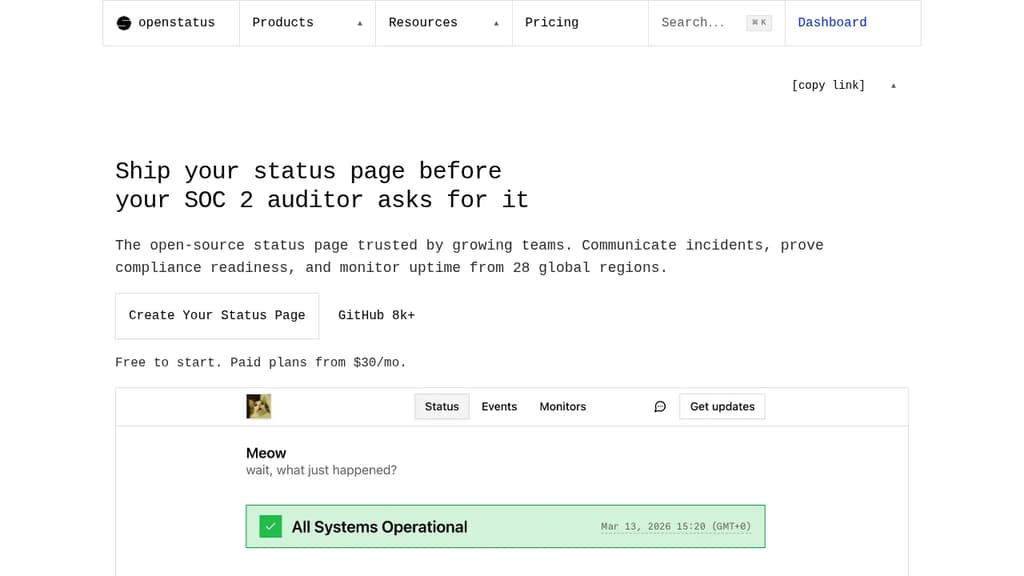
OpenStatus
Last 30 days
Last commit
5 hours agoRepository age
3 yearsLicense
AGPL-3.0Self-hosted
YesRepository
openstatus

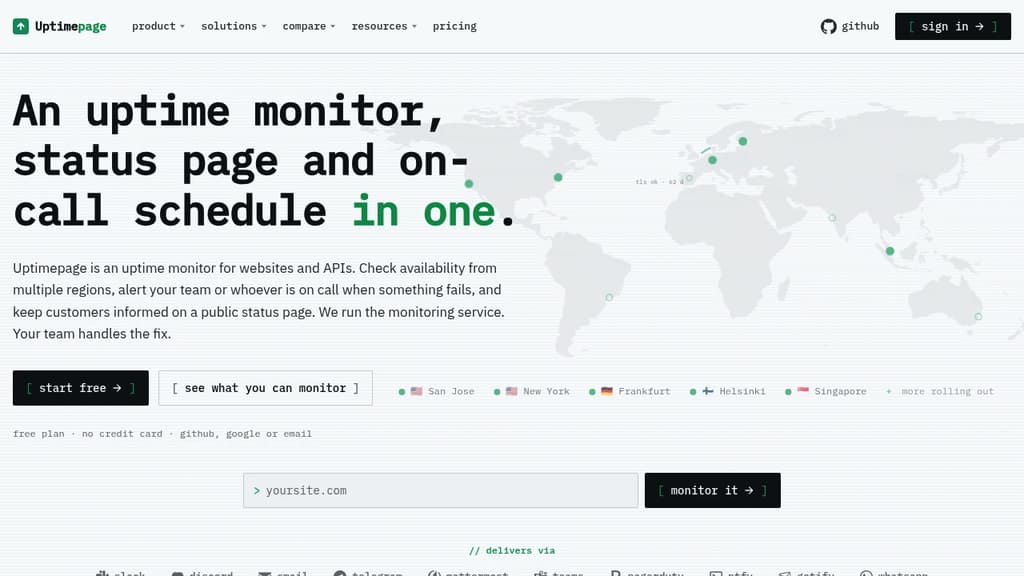
Uptimepage
Last 30 days
Last commit
6 hours agoRepository age
6 monthsLicense
AGPL-3.0Self-hosted
YesRepository
uptimepage
Detailed Comparison
OpenStatus appears to have several advantages over Uptimepage, particularly in popularity and maturity. Consider your specific needs regarding popularity, activity, technology, maturity, licensing and features when making your decision.
OpenStatus appears to have several advantages over Uptimepage, particularly in popularity and maturity. Consider your specific needs regarding popularity, activity, technology, maturity, licensing and features when making your decision.
Community & Popularity
OpenStatus significantly outpaces Uptimepage in community adoption with 9,232 stars compared to 49 stars on GitHub. This 188.4x difference suggests OpenStatus has a much larger and more active community. In terms of developer contributions, OpenStatus has 796 forks, indicating moderate developer engagement.
Development Activity
Both projects show recent activity, with OpenStatus last updated 5 hours ago and Uptimepage 6 hours ago.
Technology Stack
Both tools share common technology foundations, being built with JavaScript, Bash. However, they differ in their additional technology choices: OpenStatus uses CSS, Typescript, JSX, Next.js, Golang while Uptimepage leverages Python, Rust.
Project Maturity
OpenStatus has been in development longer, starting 3 years ago, compared to Uptimepage which began 6 months ago. This 2.9-year head start suggests OpenStatus may have more mature features and established processes.
Licensing
Both projects use the AGPL-3.0 license, providing identical terms for usage and distribution.
Use Cases & Features
Both tools serve similar use cases in Uptime Monitoring, Status Pages.
Hosting & Deployment
Both OpenStatus and Uptimepage offer self-hosting capabilities, giving you full control over your data and infrastructure.
Other tool comparisons to consider
OpenStatusvs
 Uptime KumaOpenStatus
vs
 CachetOpenStatus
vs
 CheckmateOpenStatus
vs
 GatusOpenStatus
vs
 HealthchecksOpenStatus
vs
 OneUptimeOpenStatus
vs
 KenerOpenStatus
vs
 TianjiOpenStatus
vs
 PeekapingOpenStatus
vs
 StatusnookOpenStatus
vs
 EasyMonitorOpenStatus
vs
 StatusScoutUptimepage
vs
Uptime KumaUptimepagevs
CachetUptimepagevs
CheckmateUptimepagevs
GatusUptimepagevs
HealthchecksUptimepagevs
OneUptimeUptimepagevs
KenerUptimepagevs
TianjiUptimepagevs
PeekapingUptimepagevs
StatusnookUptimepagevs
EasyMonitorUptimepagevs
StatusScout Openlane – Open-source, developer-first platform for automated compliance, risk management, and built-in Trust Center.