Open Source Spotify Alternatives
A curated collection of the 2 best open source alternatives to Spotify.
The best open source alternative to Spotify is Navidrome. If that doesn't suit you, we've compiled a ranked list of other open source Spotify alternatives to help you find a suitable replacement. Other interesting open source alternative to Spotify is Nuclear.
Spotify alternatives are mainly Media Servers but may also be Music Apps. Browse these if you want a narrower list of alternatives or looking for a specific functionality of Spotify.

Written by Piotr Kulpinski

Open source music server that streams your personal library via a web player or any Subsonic-compatible mobile app on iOS and Android.
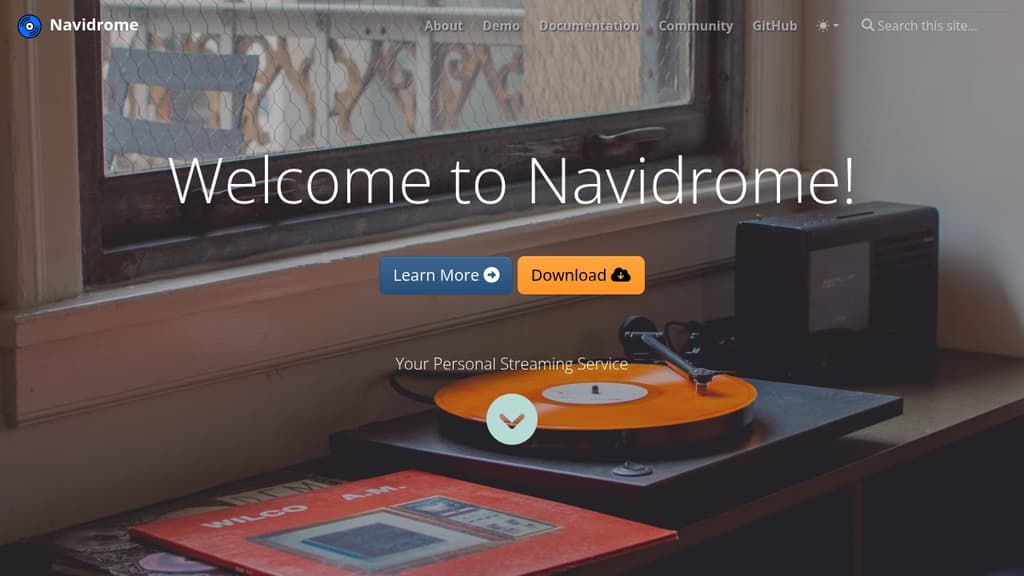
Navidrome is a self-hosted music streaming server that puts your personal music collection online, accessible from any browser or mobile device. You run it on your own hardware, and it handles everything from serving your files to transcoding audio on the fly so playback works across different network conditions without burning through mobile data.
The web interface is built in and requires no extra setup. For mobile, Navidrome works with any app that supports the OpenSubsonic API, which is the de facto standard for self-hosted music clients. That means a large ecosystem of iOS and Android apps already work with it out of the box, without any special integration work.
Scale is a genuine strength here. It has been tested with libraries approaching 900,000 songs, including a mix of FLAC and MP3 files, and remains fast. It's also lightweight enough to run on low-power hardware like a Raspberry Pi, which makes it a realistic option for home servers that aren't dedicated machines. If you're comparing options, Jellyfin covers similar ground but targets video and broader media libraries rather than music specifically.
Multi-library support lets you organize your collection into separate libraries with per-user access controls. This is useful for separating music from audiobooks, or keeping a family library distinct from a personal one.
Transcoding happens in real time during playback, converting files to a lower bitrate when needed. You don't have to pre-convert your collection or manage separate copies for mobile use. For a different approach entirely, Nuclear streams music from online sources rather than your own files.
Navidrome is free, open source, and actively maintained with regular releases. The project accepts contributions through GitHub and has a community forum for support and discussion.

Open-source desktop music player for Windows, macOS, and Linux. Search artists and tracks across multiple sources, build playlists, and listen without ads or tracking.
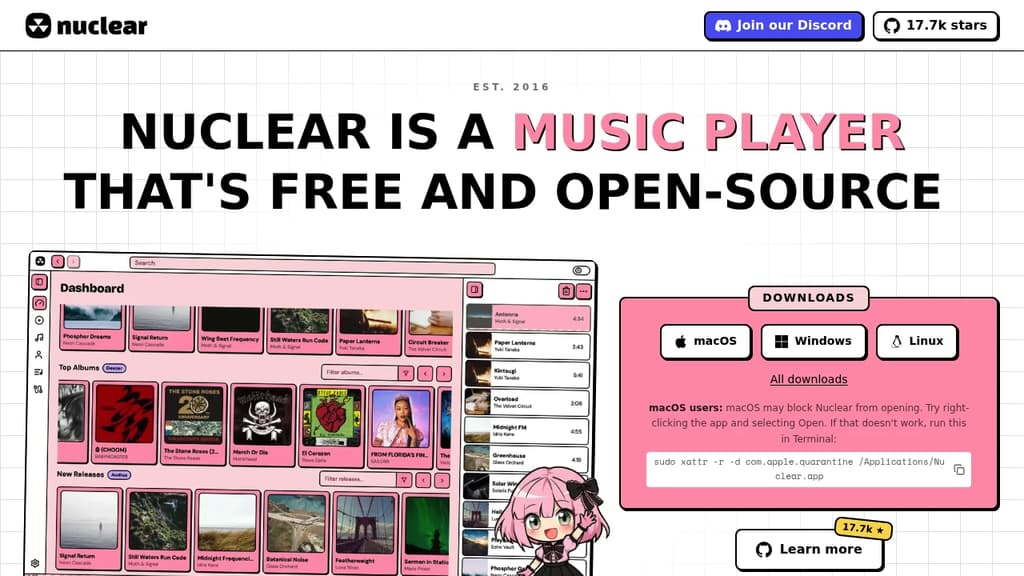
Nuclear is a desktop music player that pulls audio from multiple online sources, with no ads, no tracking, and no subscription required. It's been around since 2016, carries over 17,000 GitHub stars, and is released under the AGPL-3.0 license. The full source code is publicly auditable, and there's no telemetry or data collection of any kind.
The core experience is straightforward: search for an artist, album, or track, and Nuclear finds it across whatever sources are available. Playlists can be built from any source, reordered, renamed, and saved for later. You can also import playlists from other services or from JSON files, which makes migrating away from a streaming subscription fairly practical.
Extensibility is a real part of the design. A plugin API lets you add new audio sources or other functionality, and auto-update is built in. Built-in themes give some control over the interface, and a log viewer is included for debugging — useful if something stops resolving correctly.
A more unusual feature is the built-in Model Context Protocol server. This lets an AI agent (Claude, Codex, or similar tools) connect to Nuclear and control playback, search for music, and manage queues and playlists programmatically. Most music players don't offer anything like it.
Nuclear runs on Windows, macOS (both Intel and Apple Silicon), and Linux. Linux users have several install options including Flatpak, AUR, and AppImage. No mobile version exists. If you'd rather self-host your own music library instead, something like Navidrome takes a different approach entirely.
One tradeoff worth knowing: because Nuclear streams from external sources rather than licensed catalogs, its legal standing has been questioned, and source availability can vary.

People are looking for alternatives to...
View all alternatives
Spotify

Claude Code

Claude

CapCut

Notion

Lovable
 InfluxDB – The purpose-built time series platform for high-velocity ingestion and real-time queries at scale.
 Sent
Sent