
OpenStatus
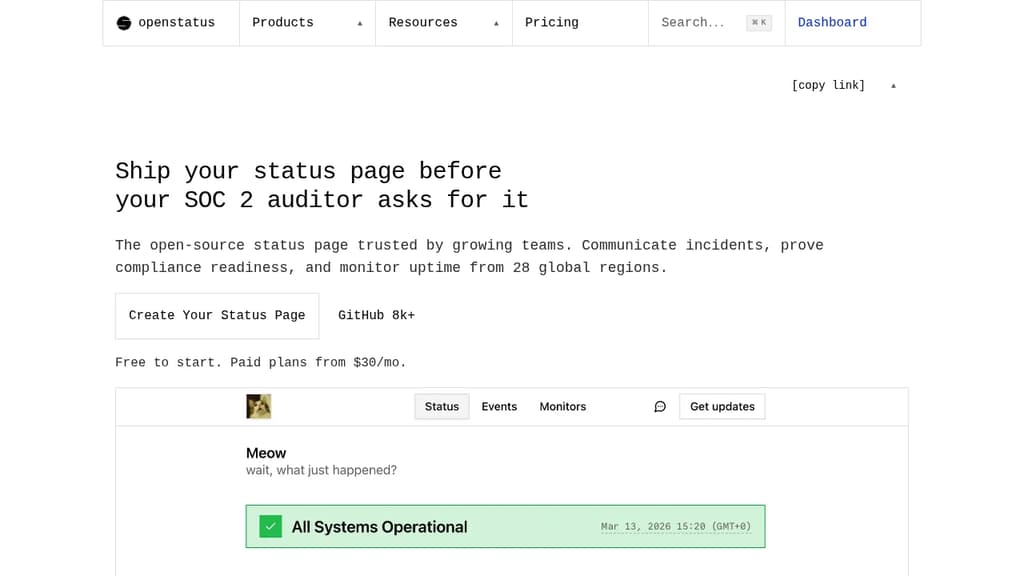
Open-source status page and uptime monitor that tracks endpoints from 28 global regions, communicates incidents, and helps satisfy SOC 2 audit requirements.
Open Source Alternative to:





Last 30 days
Last commit
8 hours agoRepository age
3 yearsLicense
AGPL-3.0Self-hosted
YesRepository
openstatus
OpenStatus combines a branded status page with uptime monitoring into one tool. It's aimed at teams that need to communicate incidents clearly to users and demonstrate that process to auditors. The free plan covers one monitor and one status page. Paid plans start at $30/month.
Monitoring runs from 28 regions across three cloud providers, covering Europe, North America, South America, Asia, Africa, and Oceania. HTTP endpoints (REST or GraphQL) are checked on a schedule, and alerts fire to Slack, Discord, PagerDuty, email, or webhooks the moment something fails. The status page updates automatically during incidents.
For SOC 2 compliance, every status report is timestamped and stored automatically. That gives auditors a documented trail of how incidents were communicated. Status pages support custom domains, public or password-protected access, maintenance windows, and subscriber notifications via email or RSS.
Every dashboard action is also available through the API. Teams can manage monitors via a CLI, a typed HTTP API, a Terraform provider, or an MCP server that connects to Claude, ChatGPT, or Cursor. Monitor configurations can be versioned in YAML and applied through CI/CD pipelines.
It's fully open source and self-hostable via a small Docker image. Private monitoring locations can be deployed behind a firewall to check internal services. If you're comparing options, Statusnook and Cachet are worth a look for self-hosted setups, while Atlassian Statuspage is the common hosted alternative.
Tags:











Last 30 days
Last commit
8 hours agoRepository age
3 yearsLicense
AGPL-3.0Self-hosted
YesRepository
openstatus
Every Sunday we deconstruct one proprietary app and pick the best open source alternatives worth switching to.
Similar open source projects

Stars
Last commit
License
Stars
Last commit
License
Stars
Last commit
License
 Capture – Capture screenshots, generate PDFs, scrape content, extract metadata, and automate browsers with one API.
 Sent
Sent CodeRabbit