Aptabase vs Databuddy
Learn how Aptabase and Databuddy differ in their key features, development activity, technology
stack and community adoption, so you can decide which of these product analytics is best for you.
Learn how Aptabase and Databuddy differ in their key features, development activity, technology stack and community adoption, so you can decide which of these product analytics is best for you.

Aptabase
Last 30 days
Last commit
4 days agoRepository age
4 yearsLicense
AGPL-3.0Self-hosted
YesRepository
aptabase/aptabase


Databuddy
Last 30 days
Last commit
1 day agoRepository age
2 yearsVersion
v0.0.1License
AGPL-3.0Self-hosted
YesRepository
databuddy-analytics/databuddy
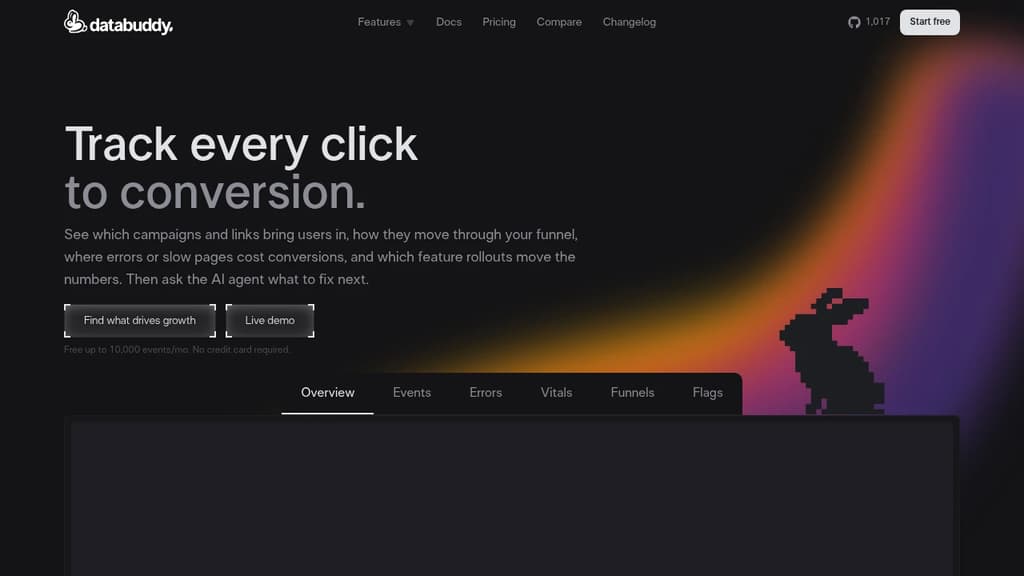
Detailed Comparison
Aptabase appears to have several advantages over Databuddy, particularly in popularity and maturity. Consider your specific needs regarding popularity, growth, activity, technology, maturity, licensing and features when making your decision.
Aptabase appears to have several advantages over Databuddy, particularly in popularity and maturity. Consider your specific needs regarding popularity, growth, activity, technology, maturity, licensing and features when making your decision.
Community & Popularity
Aptabase leads in popularity with 1,832 stars vs 1,171 stars for Databuddy. The 56% higher star count indicates stronger community adoption. In terms of developer contributions, Databuddy has 220 forks, indicating moderate developer engagement.
Growth Momentum
Aptabase and Databuddy are moving at much the same rate, adding 40 stars and adding 28 stars respectively over the last 30 days (+2.2% vs +2.4%). Neither is pulling away from the other on momentum alone.
Development Activity
Both projects show recent activity, with Aptabase last updated 4 days ago and Databuddy 1 day ago.
Technology Stack
Both tools share common technology foundations, being built with JavaScript, CSS, Bash, Typescript, JSX. However, they differ in their additional technology choices: Aptabase uses C# while Databuddy leverages Next.js, Rust.
Project Maturity
Aptabase has been in development longer, starting 4 years ago, compared to Databuddy which began 2 years ago. This 2.0-year head start suggests Aptabase may have more mature features and established processes.
Licensing
Both projects use the AGPL-3.0 license, providing identical terms for usage and distribution.
Use Cases & Features
Both tools serve similar use cases in Product Analytics. However, they also have distinct specializations: Databuddy extends into Web Analytics.
Hosting & Deployment
Both Aptabase and Databuddy offer self-hosting capabilities, giving you full control over your data and infrastructure.
Other tool comparisons to consider
Aptabasevs
 OpenPanelAptabase
vs
 PostHogAptabase
vs
 RybbitAptabase
vs
 OpenReplayAptabase
vs
 CountlyAptabase
vs
 LitlyxAptabase
vs
 TrenchAptabase
vs
 VemetricDatabuddy
vs
OpenPanelDatabuddyvs
 UmamiDatabuddy
vs
PostHogDatabuddyvs
 PlausibleDatabuddy
vs
 MatomoDatabuddy
vs
RybbitDatabuddyvs
 Fathom LiteDatabuddy
vs
CountlyDatabuddyvs
 OpenWebAnalyticsDatabuddy
vs
LitlyxDatabuddyvs
TrenchDatabuddyvs
 SwetrixDatabuddy
vs
VemetricDatabuddyvs
 BetterlyticsDatabuddy
vs
 HitKeepDatabuddy
vs
 Prisme Analytics
 CodeRabbit – The leading AI Code Review platform. Ship better quality code in 50% less time, with 90% fewer bugs.