Open Source Cursor Alternatives
A curated collection of the 12 best open source alternatives to Cursor.
The best open source alternative to Cursor is Zed. If that doesn't suit you, we've compiled a ranked list of other open source Cursor alternatives to help you find a suitable replacement. Other interesting open source alternatives to Cursor are: Neovim, Cline, Aider, and Kilo.
Cursor alternatives are mainly General Purpose Editors but may also be AI Coding Assistants or AI Coding Agent Orchestrators. Browse these if you want a narrower list of alternatives or looking for a specific functionality of Cursor.

Written by Piotr Kulpinski


A Rust-built code editor from the creators of Atom and Tree-sitter, combining native performance with multiplayer collaboration and deep AI integration.
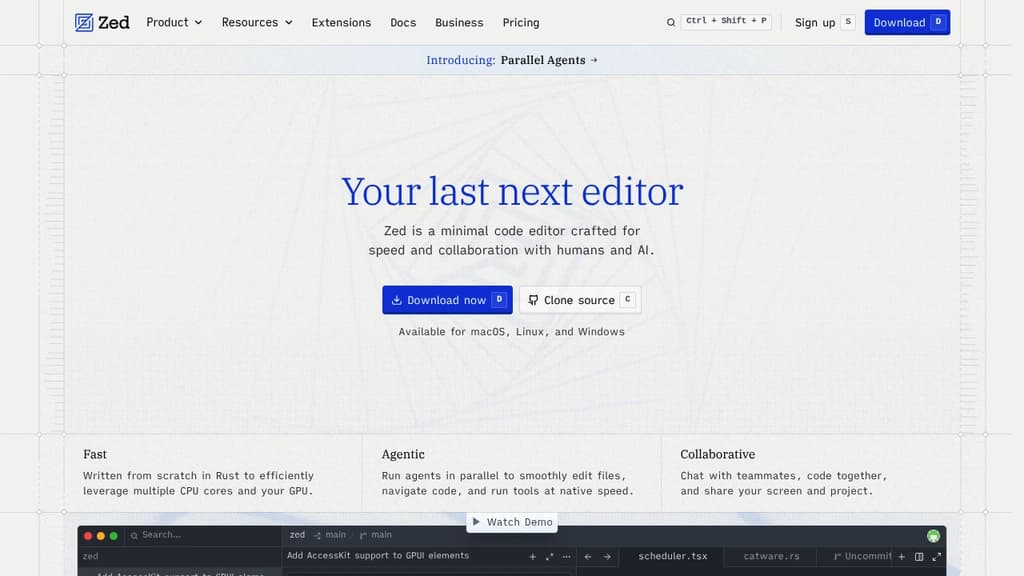
Zed is a code editor built from scratch in Rust, designed to make full use of multiple CPU cores and your GPU. The result is an editor that feels noticeably faster than most alternatives at startup, during file navigation, and while typing. It comes from the team behind Atom and Tree-sitter, and that experience shows in how carefully each feature is implemented.
The AI integration goes well beyond a chat sidebar. Zed lets you run multiple agents in parallel across different projects, delegate tasks and watch changes happen live, and bring in models from providers like Anthropic, OpenAI, or others via ACP. If you prefer a lighter touch, the inline assistant lets you send selected code directly to a model for transformation without breaking your flow. Edit prediction, powered by Zeta (an open-weight model), anticipates your next edit as you type. Tools like Aider take a similar agentic approach, but Zed does it natively inside the editor itself.
Collaboration is built in at a deep level. You can code with teammates in real time, share your screen and project, and chat without leaving the editor. Remote development is also supported: the UI runs locally while the actual codebase lives on a remote server.
Key capabilities include:
- Multibuffer editing: compose excerpts from across the codebase into one editable surface
- Native Git support: stage, commit, diff, pull, and push without plugins
- Debugger: built on the Debug Adapter Protocol with multi-language support
- LSP support: full language server integration for diagnostics, completions, and more
- Vim and Helix modes: first-class modal editing with text objects and marks
- Built-in REPL: run code interactively through Jupyter kernels
- Dev Containers: consistent environments across machines
- Extensions ecosystem: hundreds of extensions for language support, themes, and tooling
Zed targets developers who've felt the sluggishness of Electron-based editors and want something that keeps up with how fast they think. It's a strong alternative to editors like CodeEdit for macOS users who want a native feel, but with broader platform support (macOS, Linux, and Windows) and a more mature feature set. The combination of raw speed, real-time collaboration, and deep AI tooling in a single editor is what makes it stand apart.

A modernized Vim fork with built-in LSP, Lua scripting, Tree-sitter parsing, and an async plugin architecture that works the same across every platform.
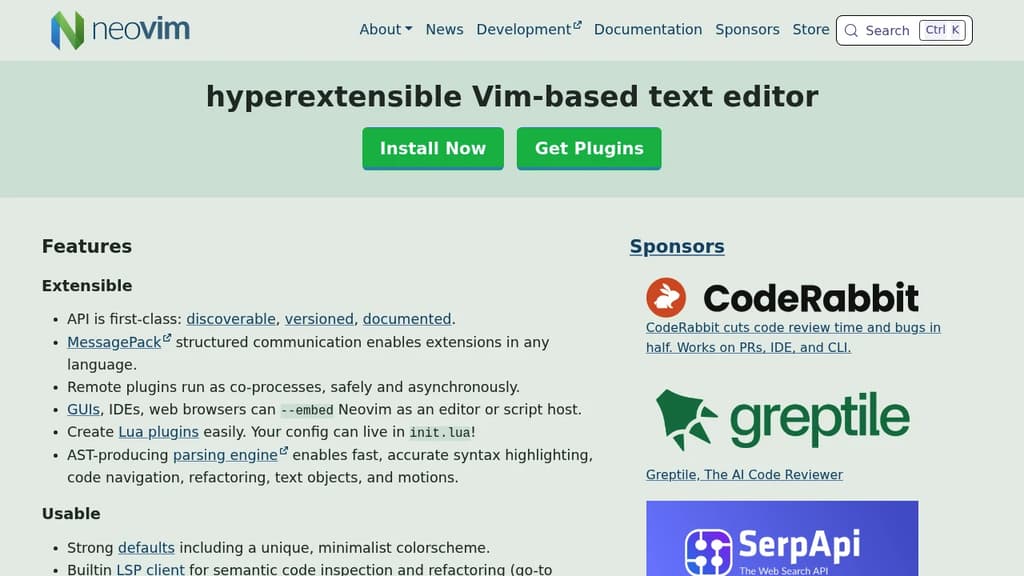
Neovim is a Vim fork built for people who want Vim's editing model without its limitations. It keeps full compatibility with Vimscript and Vim 8 plugins while adding a modern foundation underneath. If you already live in Vim, switching is low-friction. If you're new to modal editing, :Tutor gets you started.
The core philosophy is extensibility without bloat. Neovim's codebase is roughly 30% smaller than Vim's, yet it adds capabilities that Vim lacks entirely.
What makes it different from Vim:
- Lua configuration replaces the need for Vimscript. Your entire config can live in
init.lua, and plugins can be written in any language that speaks the remote API. - Built-in LSP client gives you go-to definition, find references, rename, and code formatting without installing a separate plugin manager or language server shim.
- Tree-sitter integration produces an AST for fast, accurate syntax highlighting and enables text objects and motions that understand code structure, not just patterns.
- Async plugin architecture runs remote plugins as co-processes, so slow plugins can't freeze the editor.
- Client-server model lets you attach multiple UIs to a single Neovim session, similar to tmux but built into the editor itself.
- Embeddable as a component: GUIs, IDEs, and web browsers can embed Neovim directly. There's even a UI that runs it inside VS Code or a browser.
Neovim targets terminal power users, developers who want a fast editor that pairs well with tools like Alacritty, and anyone building editor tooling or custom UIs on top of a capable core. It works identically across platforms with a single build type and a single command.

AI coding agent that runs inside VS Code and the terminal, supporting multi-file edits, bash execution, and any LLM provider via bring-your-own-key.

Cline is an open-source AI coding agent that works inside VS Code and the command line. It reads and edits files across a project, runs terminal commands, reacts to their output in real time, and handles long-running processes like dev servers or test suites.
The Plan/Act mode split lets you discuss a strategy with the agent before it touches any code, then switch to Act mode when you're ready to execute. Every step is approvable, or you can enable auto-approve for unattended runs.
Model choice is unrestricted. Claude, GPT, Gemini, local Ollama or LM Studio instances, and any OpenAI-compatible endpoint all work. You bring your own key or your own weights.
For teams, Cline supports multi-agent setups where a coordinator delegates to specialist agents with their own tools and context windows. It also connects to Slack, Discord, Telegram, and Linear, and runs headlessly inside GitHub Actions or GitLab pipelines. Tools like Roo Code and OpenHands take a similar multi-agent approach if you want to compare.
.clinerules files let you ship coding standards, architecture guidelines, and deployment conventions alongside your repo so the agent follows project-specific rules consistently.
Extensibility comes through the SDK and MCP server support, which lets you register custom tools and connect to databases, APIs, or infrastructure. The project is Apache 2.0 licensed with 250+ contributors.

Terminal-based AI coding tool that lets you edit existing codebases or start new projects using LLMs like Claude, GPT, and DeepSeek.
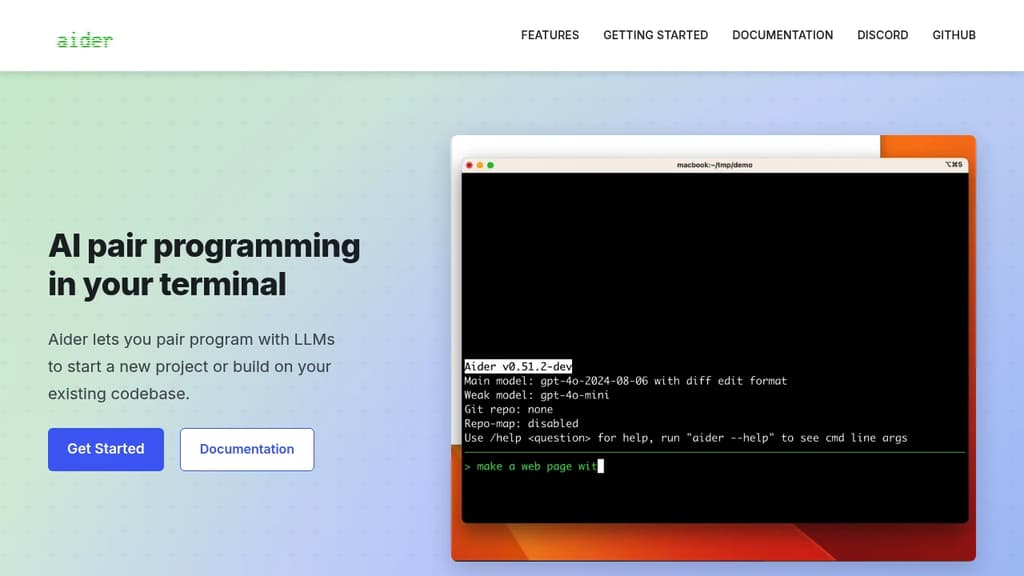
Aider brings AI pair programming directly into your terminal, letting you work with large language models on real codebases. It's built for developers who want to stay in their existing workflow rather than switching to a new editor or browser-based tool.
You point Aider at your project directory and start a conversation. It reads your files, understands the structure, and makes targeted edits across multiple files at once. Changes are applied directly to your code, not pasted into a chat window for you to copy manually.
Key capabilities:
- Multi-model support: works with Claude, GPT-4, o3-mini, DeepSeek, and other LLMs. You bring your own API key.
- Git-aware editing: automatically commits changes with meaningful messages, so every AI-assisted edit is tracked and reversible.
- Multi-file edits: handles changes that span several files in a single request, keeping diffs coherent.
- Existing codebase support: drop it into any project, not just greenfield work. It maps your repo to give the model context.
- Voice input: supports voice-to-code for hands-free coding sessions.
- Linting and test integration: can run your test suite or linter after edits and feed results back to the model for self-correction.
Compared to IDE plugins or browser-based AI coding agents, Aider is lightweight and editor-agnostic. It fits into any setup that has a terminal. The open source model means no subscription lock-in, and you control which LLM backend you use.
It's a practical choice for developers who want AI assistance without giving up their existing tools or paying for a bundled editor.

Open source AI coding agent with 500+ models, bring-your-own-key support, and specialized modes for writing, debugging, and planning code across IDEs and CLI.
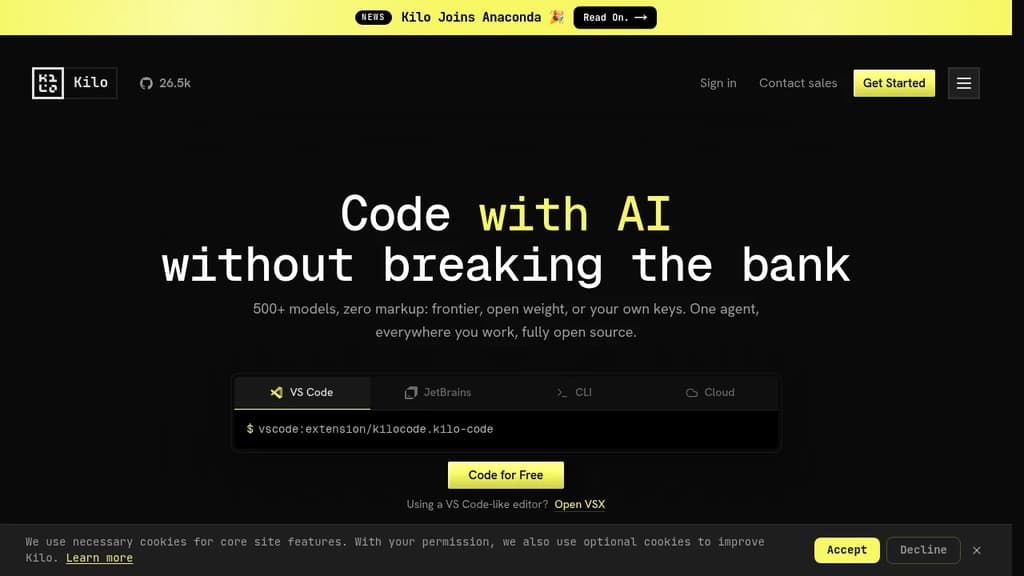
Kilo is an AI coding agent that works inside VS Code, JetBrains, the command line, and a hosted cloud environment. It's built for developers who want full control over their AI setup: bring your own API keys at zero markup, use local models to keep code private, or route through Kilo's model gateway to access 500+ models.
The agent ships with five specialized modes, each suited to a different part of the development workflow:
- Code Mode writes, refactors, and ships production-ready code with full codebase context
- Architect Mode helps plan complex features and structure work before any code is written
- Debug Mode reads errors, traces issues, and suggests targeted fixes
- Ask Mode answers questions about your codebase without making changes
- Custom Mode lets you define your own agent behavior for specific workflows
Switching between modes doesn't mean switching tools. Everything runs in the same agent, in the editor or terminal you're already using.
Kilo also includes KiloClaw, a managed version of the OpenHands open agent platform. It deploys in under 60 seconds with no Docker, SSH, or config files required. Once running, KiloClaw connects to Telegram, Discord, or Slack, handles scheduled tasks and cron jobs, and acts on your behalf autonomously. It's the part of Kilo designed for background work: running tasks while you're away, automating repetitive operations, or handling code review in the cloud.
For teams comparing options, Kilo positions itself against tools like Cline and Roo Code as a more fully integrated alternative with broader model support and cloud agent capabilities built in. The codebase is Apache-2.0 licensed and fully open source.

Self-hosted AI coding assistant that enhances productivity with context-aware suggestions and privacy-focused implementation.
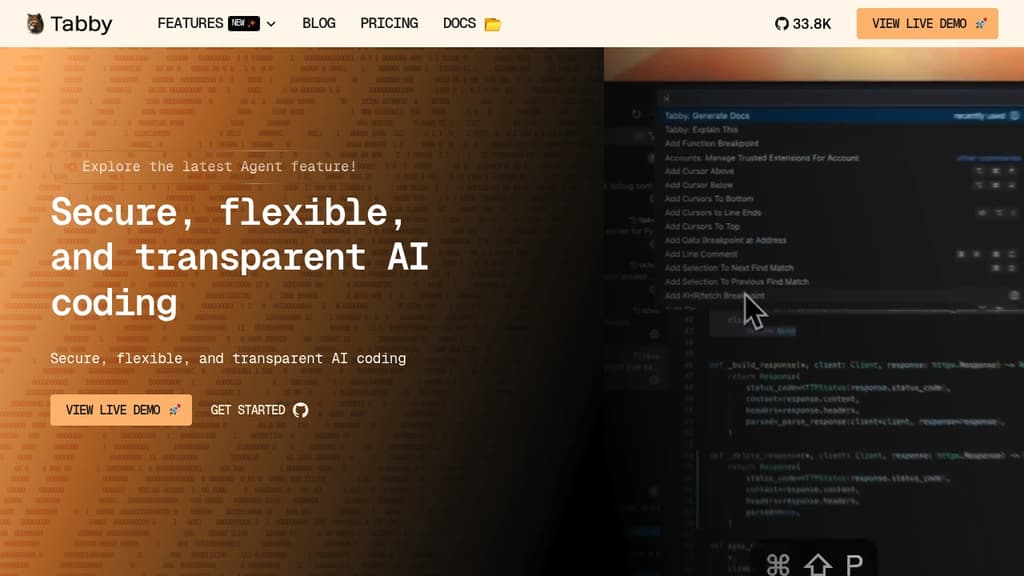
Tabby is a revolutionary self-hosted AI coding assistant that transforms the way developers write code. By leveraging advanced machine learning techniques, Tabby provides intelligent, context-aware code suggestions that seamlessly integrate into your existing workflow.
Key benefits of Tabby include:
- Enhanced Productivity: Tabby accelerates your coding process by offering relevant code completions and snippets, reducing the time spent on repetitive tasks.
- Privacy-Focused: As a self-hosted solution, Tabby ensures that your code and data remain secure within your own infrastructure, addressing privacy concerns associated with cloud-based alternatives.
- Customizable and Adaptable: Tabby learns from your codebase and coding style, providing increasingly accurate and personalized suggestions over time.
- Language Agnostic: Supporting a wide range of programming languages, Tabby seamlessly integrates into diverse development environments.
- Resource Efficient: Designed to run efficiently on consumer-grade hardware, Tabby delivers powerful AI assistance without the need for extensive computational resources.
- Open Source: Benefit from a transparent, community-driven development process and the ability to customize Tabby to your specific needs.
By combining the power of AI with the control and security of self-hosting, Tabby empowers developers to write better code faster while maintaining full ownership of their development process.

Self-hosted orchestrator for coding agents like Claude Code, Codex, and Cursor, controlled from phone, desktop, web, or CLI.
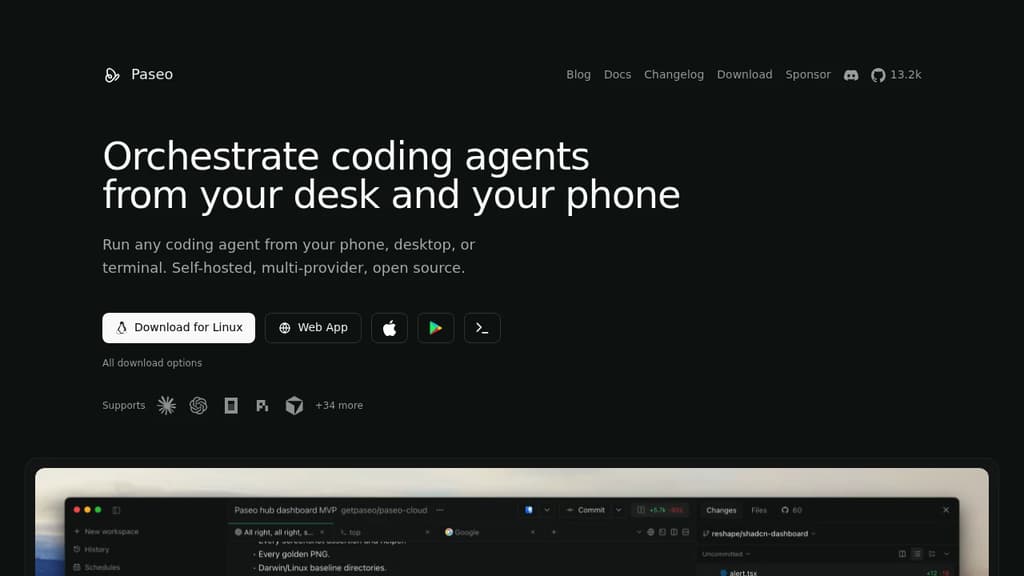
Paseo runs coding agents on your own machines and lets you drive them from your phone, desktop, web, or terminal. It’s for developers who use CLI agents like Claude Code or Codex and want to start, monitor, and steer them without sitting at their laptop. Kick off a task at your desk. Check on it from your phone later.
It sits on top of the agents you already have rather than replacing them. Each provider runs as its own process using its native harness, so your subscriptions, skills, config, and MCP servers keep working, and Paseo doesn’t wrap or modify their behavior.
- Multi-provider: works with Claude Code, Codex, Cursor, OpenCode, Pi, and dozens more.
- Full mobile parity: the native mobile app does everything the desktop app does.
- Runs where you work: start agents on a laptop, VM, or dev server, then reach them over a direct connection or an end-to-end encrypted relay.
- Code stays local: agents run on your machines and talk to their own APIs. Paseo doesn’t send your code anywhere.
- Review and ship inline: create branches, preview the app in a browser, review diffs, commit, open a PR, and merge without leaving the app.
- Scriptable: anything in the app also works from the terminal, including loops and schedules.
An optional self-hosted Hub adds GitHub, Slack, and Discord triggers, so mentioning a bot can start an agent on your own daemon with your own keys. It’s free.

A lightweight, natively built editor. Open source and free forever. Develop any project using any language at speeds like never before.
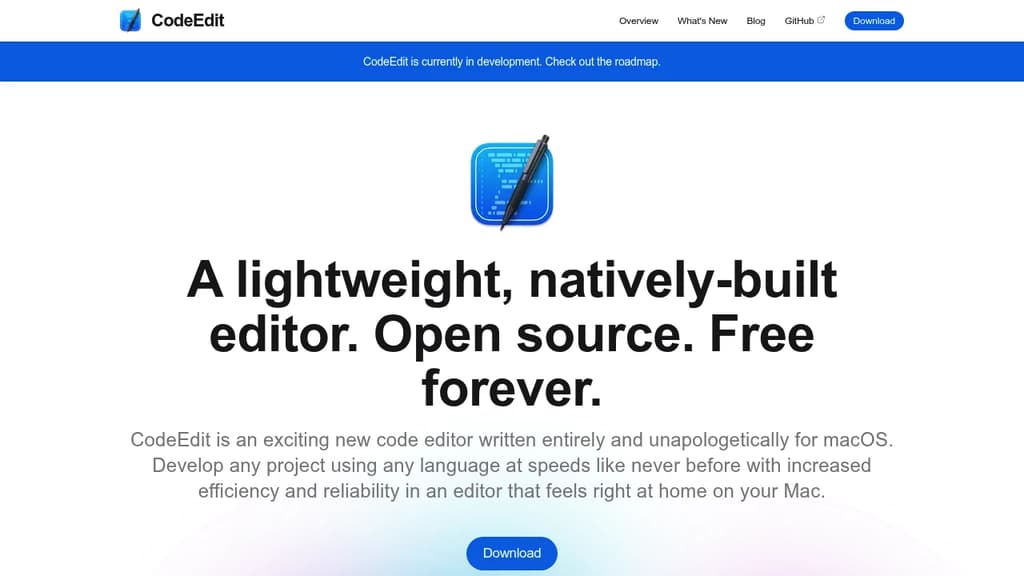
CodeEdit is an exciting new code editor written entirely and unapologetically for macOS. Develop any project using any language at speeds like never before with increased efficiency and reliability in an editor that feels right at home on your Mac.
It is not meant to replace Xcode but rather supplement it for projects not intended for Apple platforms. We believe every type of developer deserves a great experience and excellent performance.
Key features:
- macOS Native: Harness the full power of your Mac, something only possible with our completely native architecture developed in Swift.
- Lightweight Yet Powerful: Designed to be lean with limitless potential.
- Completely Open Source: CodeEdit is developed for you by developers like you. Don't like something? Want a new feature? Just create an issue or submit a PR.
- Extensible & customizable: Make CodeEdit your own, tailored to your needs.
- Familiar & Intuitive User Interface: Our user interface is designed to be familiar for ease-of-use and productivity.
- Better tools to get the job done: Feel connected to the code you are writing with tools to keep you on track.

AI coding harness that runs inside your terminal, mixes LLMs per task, and uses multi-agent architecture to handle large codebases without bloating context.
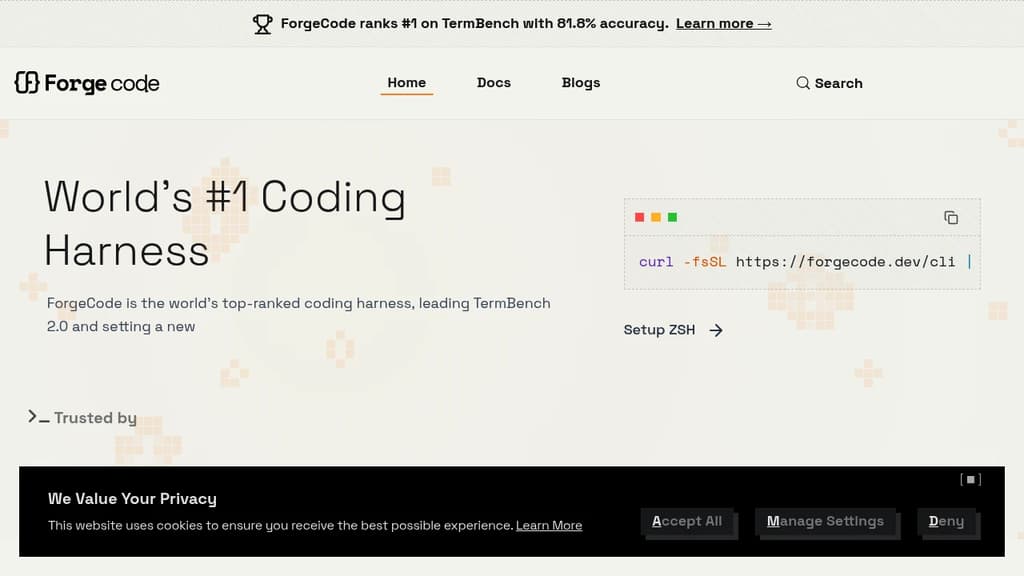
ForgeCode is a terminal-native AI coding agent that sits directly inside your ZSH shell. It's built for developers who want AI assistance without leaving the command line or abandoning their existing setup. Your custom aliases, Oh My Zsh plugins, and shell workflows stay intact. Type : and you're talking to ForgeCode.
What sets it apart from other AI coding tools is how it handles context. Rather than dumping your entire codebase into one prompt, ForgeCode uses a multi-agent architecture with specialized sub-agents for research, planning, and execution. Each agent works on minimal, relevant context, which keeps local models on track and results reliable.
Key capabilities:
- Model mixing per task. Use a thinking model to plan, a fast model to write code, and a large-context model for big files, all within a single session without restarting.
- Codebase understanding at scale. A context engine built for large repos, with fast tool corrections that prevent local models from drifting off course.
- Skills at scale. Handles thousands of skills without bloating the context window.
- Broad LLM support. Connects to hundreds of providers and models natively from the shell.
- Rigorous evaluation. Every change runs through thousands of evaluations across coding tasks and models before shipping.
ForgeCode ranks #1 on TermBench 2.0 with 81.8% accuracy, a benchmark designed specifically for terminal-based coding agents. It processes over 38 billion tokens and 24 million lines of code per day across its user base.
It's fully open source, with over 7,300 GitHub stars and 354 releases, backed by an active community. For teams already living in the terminal, it's a practical alternative to browser-based or IDE-embedded AI coding environments.

Open-source code editor for macOS, Windows, and Linux that puts coding agents, terminal, Git, and GitHub in a single window.
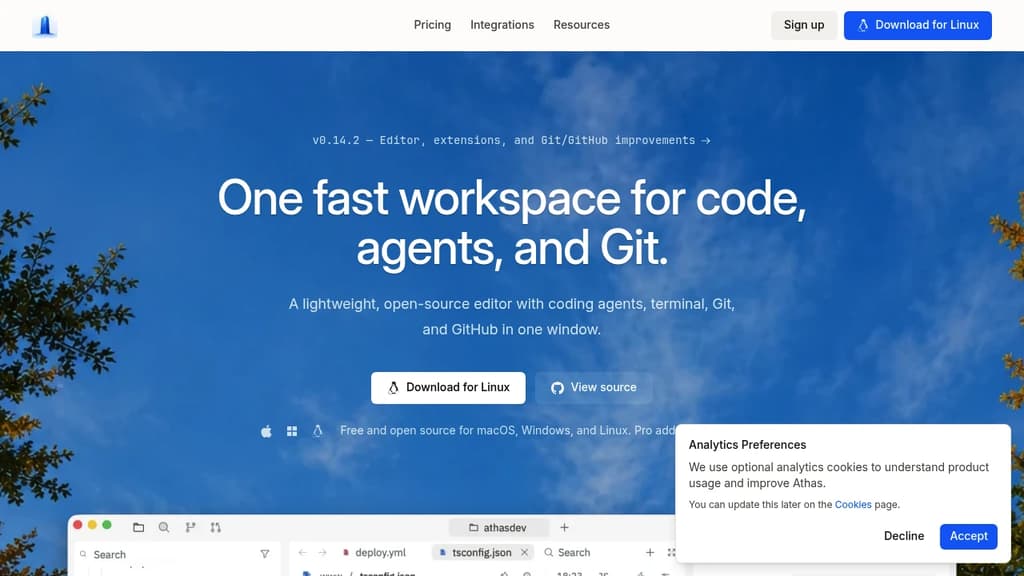
Athas is a lightweight, open-source code editor built around the idea that your editor, your AI coding agents, and your Git workflow belong in one place. It runs on macOS, Windows, and Linux, and keeps the interface fast and focused rather than loading it with features you won't use.
The core pitch is simplicity without sacrifice. You get a code editor, an integrated terminal, Git controls, and GitHub access, all in a single window. Agents sit beside the code they're changing, so you can review diffs in context rather than switching between tools.
What's included:
- Built-in Athas Agent for chat-driven coding, with support for any OpenAI-compatible model provider and per-task model switching
- Third-party agent support for Claude, Gemini CLI, GitHub Copilot, Antigravity, Kimi CLI, OpenCode, Qwen Code, and others
- Git and GitHub integration built directly into the editor window, no separate client needed
- Integrated terminal so you stay in one window from editing through running
- 102 integrations to shape the editor around your specific stack
Compared to heavier AI-powered editors like Cursor, Athas leans into minimalism. It's not trying to be an IDE with every feature bolted on; it's a focused workspace that stays out of your way. The AGPL-3.0 license means the code is fully open, and development happens in public.
If you already have a preferred CLI agent, Athas is designed to run it natively rather than replace it.

Run multiple AI coding agents in isolated Git worktrees, with cross-repo context, GitHub/Linear integrations, and support for Claude, Codex, Cursor, and more.
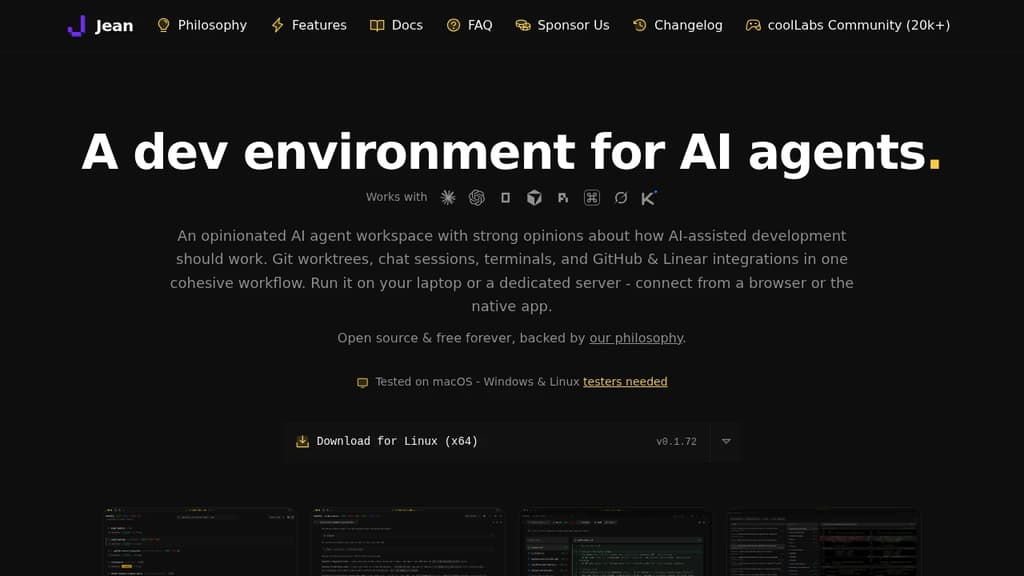
Jean is a dev environment built specifically for AI-assisted coding. Instead of running one agent in one terminal, it lets you spin up multiple agents in parallel, each in its own isolated Git worktree, so they can work on separate branches simultaneously without stepping on each other.
It's opinionated by design. Jean makes decisions about how AI-assisted development should work, so you don't spend time configuring workflows from scratch. Git worktrees, chat sessions, terminals, GitHub and Linear integrations all live in one interface.
Key capabilities:
- Isolated workspaces – every agent task gets its own worktree. Launch multiple agents at once, review each workspace independently, and merge only what you approve.
- Linked Projects – connect related repos (app, API, docs, SDK) so agents share context across all of them without manual copy-pasting.
- Magic Git Commands – load GitHub or Linear issues into a session, run AI code reviews, generate commit messages and PR descriptions, write release notes, and resolve merge conflicts from a command palette.
- Magic Prompts – every built-in workflow has an editable prompt template. You can swap models and reasoning levels per workflow, using faster models for routine tasks and stronger ones for reviews.
- Mr. Robot – polls open GitHub issues, creates a worktree per issue, and drafts a focused plan. Can execute approved plans automatically on a schedule.
- Token-reduction plugins – RTK compresses CLI tool output by 60-90%; Caveman trims Claude's replies by 65-75%. Both install with one click.
- Remote access – run Jean on a Linux server and connect from any browser or the native app. Works well over Tailscale for private network access.
Jean supports OpenCode, Claude CLI, Codex CLI, Cursor, Grok, Kimi Code, and others. You bring your own subscription for each provider. It's a solid alternative to tools like Claude Code or Jules when you need multi-agent coordination and cross-repo context in one place.
Licensed under Apache 2.0, free forever, with no paid tiers or feature gates.

A Mac app that brings multiple AI coding agents into a single window, running on your existing subscriptions with parallel agent sessions, PR management, and a built-in browser.
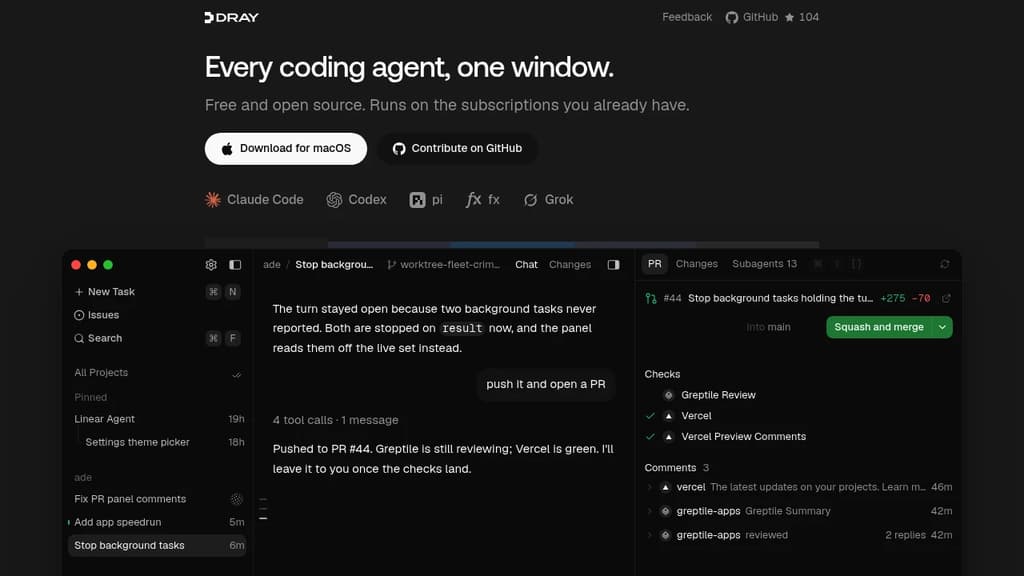
Dray is a Mac app for developers who run AI coding agents constantly and want them all in one place. Instead of juggling separate terminals or browser tabs for each agent, Dray puts Claude Code, Codex, Grok, pi, and fx into a single window, using the subscriptions you already pay for.
The core idea is that one agent shouldn't be your ceiling. Dray lets you run a swarm in parallel: ask one agent to split a task, and it spins up a separate session per subtask, each in its own Git worktree. All of them report back to the parent session when they're done. For a team shipping fast, this means sign-in screen, onboarding copy, and analytics events can all run at the same time.
Key capabilities:
- Split-pane chat, drag any session into a split view and watch multiple agents stream live, side by side
- Built-in PR panel, checks, review threads, and merge readiness update live; merge directly from the panel once everything's green, no browser tab required
- Issue integration, type
#to pull up an issue; description, comments, and attachments sit right beside the transcript - Built-in Chromium browser, the agent can open your running app, check its own UI work, and you can browse alongside it
- Local dictation, press ⌘D and speak; transcription runs on-device via a local model, nothing sent off your Mac
- Worktree-per-session, parallel agents each get an isolated Git worktree, so they don't step on each other
Dray works alongside tools like Greptile for code review and integrates naturally with Cline-style workflows. It's self-contained on macOS, free, and built in the open.

People are looking for alternatives to...
View all alternatives
Claude Code

Spotify

CapCut

Claude

Notion

Lovable
 Sent – Messaging Infrastructure for Developers. One API for SMS, WhatsApp, and RCS across 190+ countries.


 Docmost