OpenNotas vs Tolaria
Learn how OpenNotas and Tolaria differ in their key features, development activity, technology
stack and community adoption, so you can decide which of these note-taking tools is best for you.
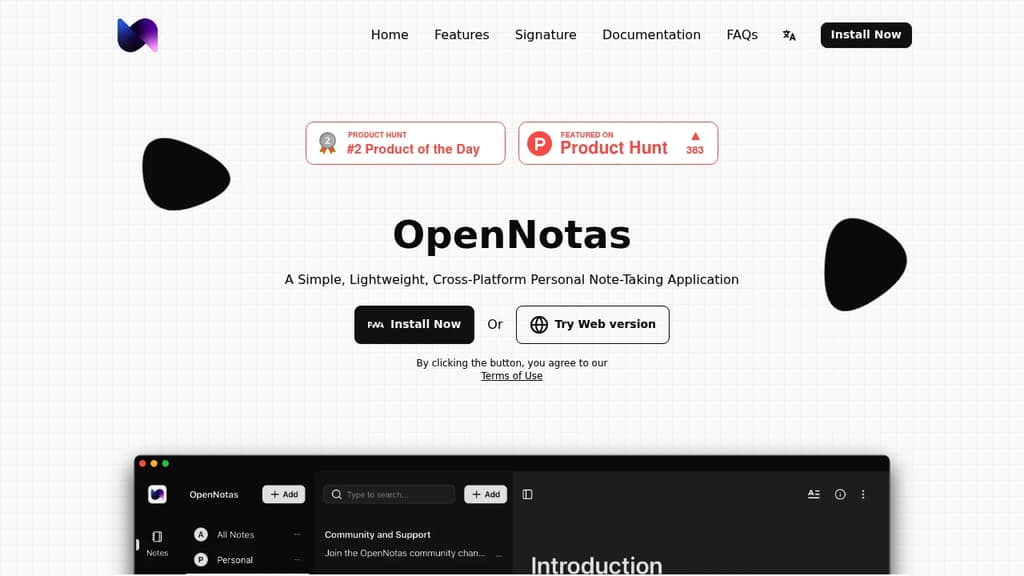
Learn how OpenNotas and Tolaria differ in their key features, development activity, technology stack and community adoption, so you can decide which of these note-taking tools is best for you.

OpenNotas
Last 30 days
Last commit
3 months agoRepository age
2 yearsRepository
tonghoai/opennotas

Tolaria
Last 30 days

Detailed Comparison
Tolaria appears to have several advantages over OpenNotas, particularly in popularity, growth, activity and licensing. Consider your specific needs regarding popularity, growth, activity, technology, maturity, licensing and features when making your decision.
Tolaria appears to have several advantages over OpenNotas, particularly in popularity, growth, activity and licensing. Consider your specific needs regarding popularity, growth, activity, technology, maturity, licensing and features when making your decision.
Community & Popularity
Tolaria significantly outpaces OpenNotas in community adoption with 20,161 stars compared to 179 stars on GitHub. This 112.6x difference suggests Tolaria has a much larger and more active community. In terms of developer contributions, Tolaria has 1,389 forks, indicating strong developer engagement.
Growth Momentum
Tolaria is growing faster, adding 289 stars in the last 30 days (+1.5%) against adding 0 stars for OpenNotas (0%). Tolaria is both larger and pulling further ahead.
Development Activity
Tolaria shows more recent development activity with its last commit 8 hours ago, while OpenNotas was last updated 3 months ago. This suggests Tolaria is being more actively maintained.
Technology Stack
Both tools share common technology foundations, being built with JavaScript, CSS, Typescript, Vue. However, they differ in their additional technology choices: OpenNotas uses Nuxt.js while Tolaria leverages Bash, JSX, Python, Rust, C, Objective-C, Tauri.
Project Maturity
OpenNotas has been in development longer, starting 2 years ago, compared to Tolaria which began 8 months ago. This 1.8-year head start suggests OpenNotas may have more mature features and established processes.
Licensing
Tolaria is licensed under AGPL-3.0, while OpenNotas's license terms are not publicly specified.
Use Cases & Features
Both tools serve similar use cases in Note-Taking, Secure & Encrypted Notes. However, they also have distinct specializations: OpenNotas also focuses on Personal Knowledge Management (PKM) while Tolaria extends into Collaborative Notes & Wikis.
Other tool comparisons to consider
OpenNotasvs
 AppFlowyOpenNotas
vs
 MemosOpenNotas
vs
 JoplinOpenNotas
vs
 SiYuanOpenNotas
vs
 LogseqOpenNotas
vs
 NotesnookOpenNotas
vs
 BlinkoOpenNotas
vs
 AnyTypeOpenNotas
vs
 Standard NotesOpenNotas
vs
 Beaver NotesOpenNotas
vs
 ZenOpenNotas
vs
 DarkwriteOpenNotas
vs
 itsnotesOpenNotas
vs
 JustnoteTolaria
vs
MemosTolariavs
JoplinTolariavs
SiYuanTolariavs
LogseqTolariavs
NotesnookTolariavs
BlinkoTolariavs
AnyTypeTolariavs
 SilverbulletTolaria
vs
Standard NotesTolariavs
Beaver NotesTolariavs
ZenTolariavs
DarkwriteTolariavs
itsnotesTolariavs
Justnote Postiz – The All-in-One agentic social media scheduling tool