Notesnook vs Tolaria
Learn how Notesnook and Tolaria differ in their key features, development activity, technology
stack and community adoption, so you can decide which of these note-taking tools is best for you.
Learn how Notesnook and Tolaria differ in their key features, development activity, technology stack and community adoption, so you can decide which of these note-taking tools is best for you.

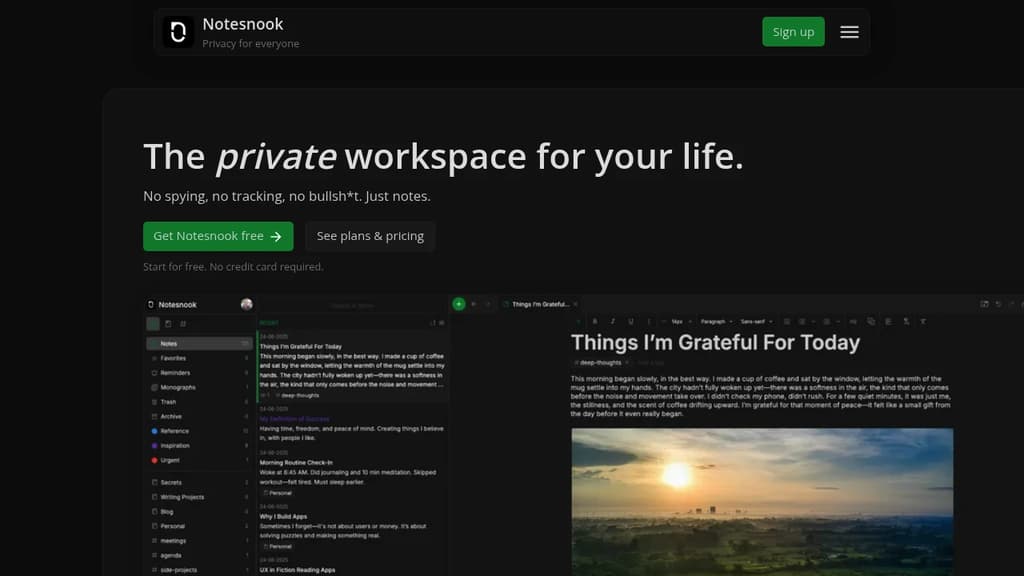
Notesnook
Last 30 days

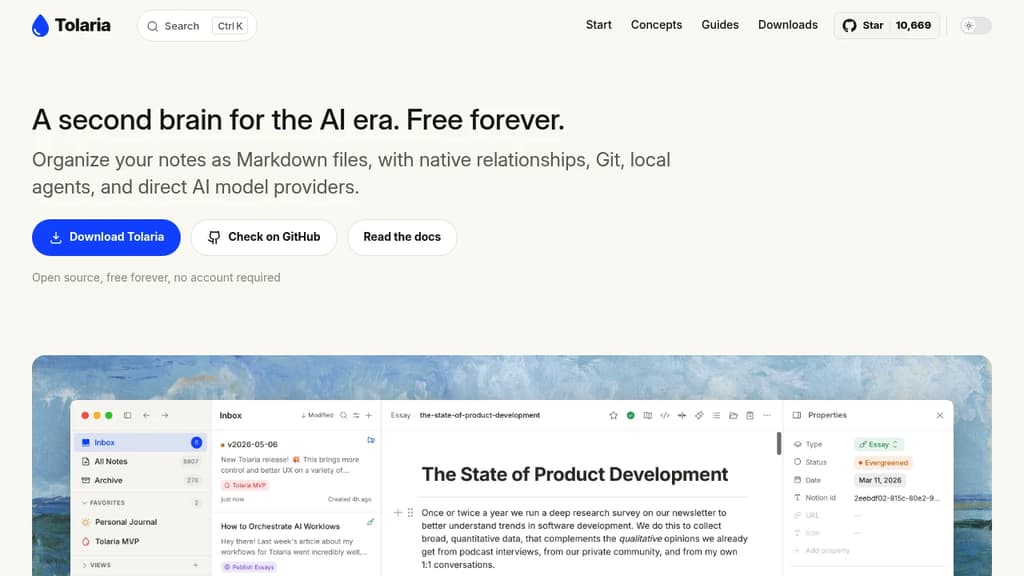
Tolaria
Last 30 days
Detailed Comparison
Notesnook appears to have several advantages over Tolaria, particularly in maturity and features. Consider your specific needs regarding popularity, growth, activity, technology, maturity, licensing and features when making your decision.
Notesnook appears to have several advantages over Tolaria, particularly in maturity and features. Consider your specific needs regarding popularity, growth, activity, technology, maturity, licensing and features when making your decision.
Community & Popularity
Both tools have similar popularity levels, with Notesnook having 14,820 stars and Tolaria having 20,161 stars on GitHub. In terms of developer contributions, Tolaria has 1,389 forks, indicating strong developer engagement.
Growth Momentum
Notesnook and Tolaria are moving at much the same rate, adding 195 stars and adding 289 stars respectively over the last 30 days (+1.3% vs +1.5%). Neither is pulling away from the other on momentum alone.
Development Activity
Both projects show recent activity, with Notesnook last updated 19 hours ago and Tolaria 8 hours ago.
Technology Stack
Both tools share common technology foundations, being built with JavaScript, CSS, Typescript, JSX, C, Objective-C. However, they differ in their additional technology choices: Notesnook uses Java, Swift, Ruby, Kotlin, MATLAB, Remix while Tolaria leverages Bash, Python, Rust, Vue, Tauri.
Project Maturity
Notesnook has been in development longer, starting 6 years ago, compared to Tolaria which began 8 months ago. This 4.9-year head start suggests Notesnook may have more mature features and established processes.
Licensing
The projects use different licenses: Notesnook is licensed under GPL-3.0 while Tolaria uses AGPL-3.0. Consider the licensing requirements when choosing for your project.
Use Cases & Features
Both tools serve similar use cases in Note-Taking, Secure & Encrypted Notes. However, they also have distinct specializations: Notesnook also focuses on Personal Knowledge Management (PKM) while Tolaria extends into Collaborative Notes & Wikis.
Hosting & Deployment
Notesnook provides self-hosting options for complete data control and customization, while Tolaria may be primarily cloud-based or require different deployment approaches.
Other tool comparisons to consider
Notesnookvs
 AppFlowyNotesnook
vs
 MemosNotesnook
vs
 JoplinNotesnook
vs
 SiYuanNotesnook
vs
 LogseqNotesnook
vs
 BlinkoNotesnook
vs
 AnyTypeNotesnook
vs
 SilverbulletNotesnook
vs
 Standard NotesNotesnook
vs
 Beaver NotesNotesnook
vs
 ZenNotesnook
vs
 DarkwriteNotesnook
vs
 OpenNotasNotesnook
vs
 itsnotesNotesnook
vs
 JustnoteTolaria
vs
MemosTolariavs
JoplinTolariavs
SiYuanTolariavs
LogseqTolariavs
BlinkoTolariavs
AnyTypeTolariavs
SilverbulletTolariavs
Standard NotesTolariavs
Beaver NotesTolariavs
ZenTolariavs
DarkwriteTolariavs
OpenNotasTolariavs
itsnotesTolariavs
Justnote Sent – Messaging Infrastructure for Developers. One API for SMS, WhatsApp, and RCS across 190+ countries.