Beaver Notes vs Notesnook
Learn how Beaver Notes and Notesnook differ in their key features, development activity, technology
stack and community adoption, so you can decide which of these note-taking tools is best for you.
Learn how Beaver Notes and Notesnook differ in their key features, development activity, technology stack and community adoption, so you can decide which of these note-taking tools is best for you.

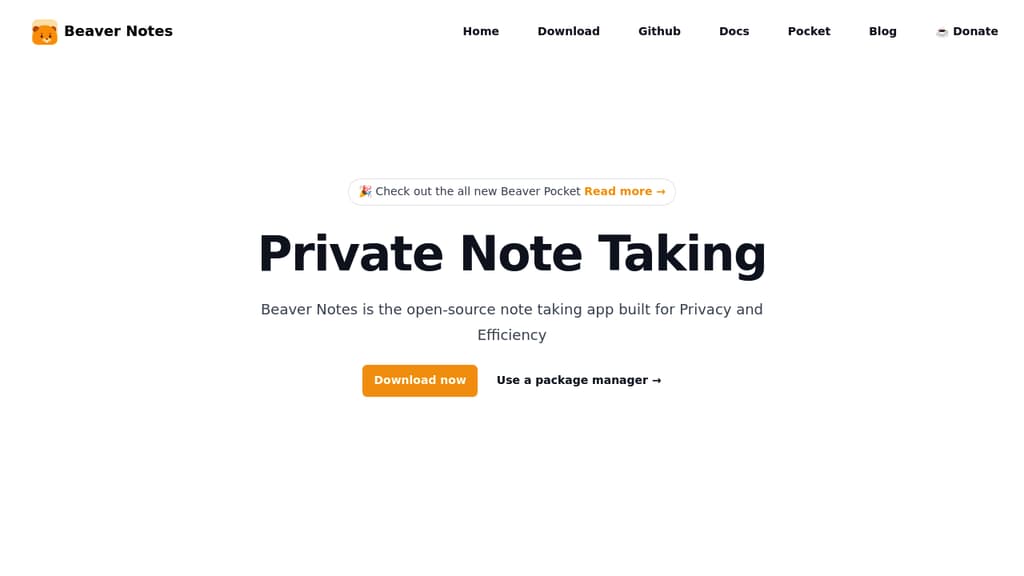
Beaver Notes
Last 30 days
Last commit
7 days agoRepository age
3 yearsVersion
4.4.0License
MITRepository
beaver-notes

Notesnook
Last 30 days

Detailed Comparison
Notesnook appears to have several advantages over Beaver Notes, particularly in popularity, growth, maturity and features. Consider your specific needs regarding popularity, growth, activity, technology, maturity, licensing and features when making your decision.
Notesnook appears to have several advantages over Beaver Notes, particularly in popularity, growth, maturity and features. Consider your specific needs regarding popularity, growth, activity, technology, maturity, licensing and features when making your decision.
Community & Popularity
Notesnook significantly outpaces Beaver Notes in community adoption with 14,820 stars compared to 1,354 stars on GitHub. This 10.9x difference suggests Notesnook has a much larger and more active community. In terms of developer contributions, Notesnook has 1,036 forks, indicating strong developer engagement.
Growth Momentum
Notesnook is growing faster, adding 195 stars in the last 30 days (+1.3%) against adding 11 stars for Beaver Notes (+0.8%). Notesnook is both larger and pulling further ahead.
Development Activity
Both projects show recent activity, with Beaver Notes last updated 7 days ago and Notesnook 19 hours ago.
Technology Stack
Both tools share common technology foundations, being built with JavaScript, CSS, Typescript, JSX. However, they differ in their additional technology choices: Beaver Notes uses SCSS, Vue while Notesnook leverages C, Objective-C, Java, Swift, Ruby, Kotlin, MATLAB, Remix.
Project Maturity
Notesnook has been in development longer, starting 6 years ago, compared to Beaver Notes which began 3 years ago. This 2.3-year head start suggests Notesnook may have more mature features and established processes.
Licensing
Beaver Notes uses the MIT license, which is more permissive than Notesnook's GPL-3.0 license, potentially offering greater flexibility for commercial use and integration.
Use Cases & Features
Both tools serve similar use cases in Note-Taking, Personal Knowledge Management (PKM), Secure & Encrypted Notes.
Hosting & Deployment
Notesnook provides self-hosting options for complete data control and customization, while Beaver Notes may be primarily cloud-based or require different deployment approaches.
Other tool comparisons to consider
Beaver Notesvs
 AppFlowyBeaver Notes
vs
 MemosBeaver Notes
vs
 JoplinBeaver Notes
vs
 SiYuanBeaver Notes
vs
 LogseqBeaver Notes
vs
 TolariaBeaver Notes
vs
 BlinkoBeaver Notes
vs
 AnyTypeBeaver Notes
vs
 SilverbulletBeaver Notes
vs
 Standard NotesBeaver Notes
vs
 ZenBeaver Notes
vs
 DarkwriteBeaver Notes
vs
 OpenNotasBeaver Notes
vs
 JustnoteNotesnook
vs
AppFlowyNotesnookvs
MemosNotesnookvs
JoplinNotesnookvs
SiYuanNotesnookvs
LogseqNotesnookvs
TolariaNotesnookvs
BlinkoNotesnookvs
AnyTypeNotesnookvs
SilverbulletNotesnookvs
Standard NotesNotesnookvs
ZenNotesnookvs
DarkwriteNotesnookvs
OpenNotasNotesnookvs
 itsnotesNotesnook
vs
Justnote Stellar Hosted – Managed Open Source software hosting in the EU: secure, compliant, fast.