Blinko vs Darkwrite
Learn how Blinko and Darkwrite differ in their key features, development activity, technology
stack and community adoption, so you can decide which of these note-taking tools is best for you.
Learn how Blinko and Darkwrite differ in their key features, development activity, technology stack and community adoption, so you can decide which of these note-taking tools is best for you.

Blinko
Last 30 days
Last commit
2 months agoRepository age
2 yearsVersion
1.8.8License
GPL-3.0Self-hosted
YesRepository
blinko-space/blinko


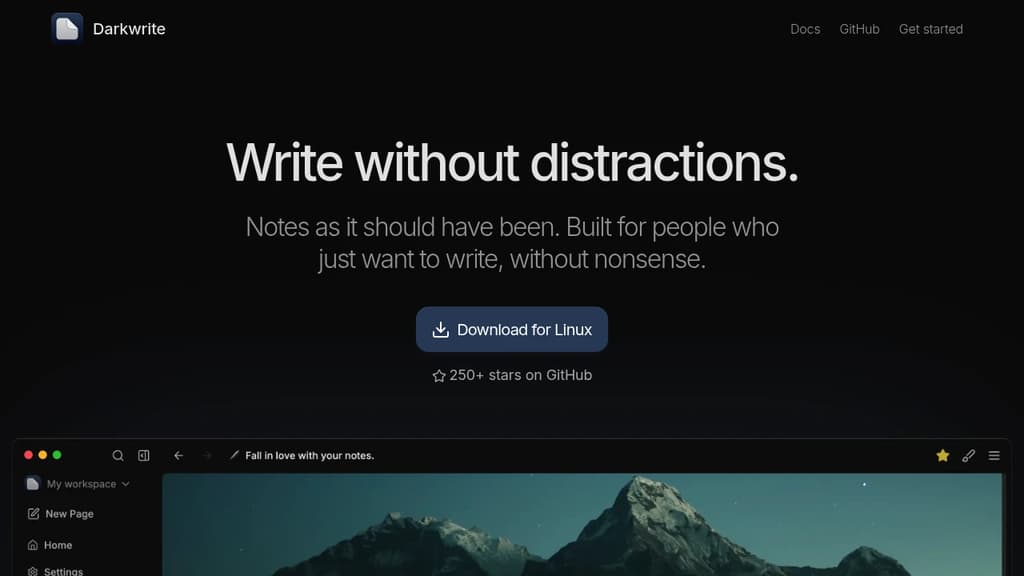
Darkwrite
Last 30 days
Detailed Comparison
Both Blinko and Darkwrite have their unique strengths and serve similar purposes effectively. Consider your specific needs regarding popularity, growth, activity, technology, maturity, licensing and features when making your decision.
Both Blinko and Darkwrite have their unique strengths and serve similar purposes effectively. Consider your specific needs regarding popularity, growth, activity, technology, maturity, licensing and features when making your decision.
Community & Popularity
Blinko significantly outpaces Darkwrite in community adoption with 11,107 stars compared to 319 stars on GitHub. This 34.8x difference suggests Blinko has a much larger and more active community. In terms of developer contributions, Blinko has 789 forks, indicating moderate developer engagement.
Growth Momentum
Darkwrite is growing faster, adding 3 stars in the last 30 days (+0.9%) against adding 72 stars for Blinko (+0.7%). Darkwrite is the smaller project of the two, so it is closing the gap rather than extending a lead.
Development Activity
Darkwrite shows more recent development activity with its last commit 8 days ago, while Blinko was last updated 2 months ago. This suggests Darkwrite is being more actively maintained.
Technology Stack
Both tools share common technology foundations, being built with JavaScript, CSS, Bash, Typescript, JSX. However, they differ in their additional technology choices: Blinko uses Rust, Kotlin, Tauri while Darkwrite leverages Next.js.
Project Maturity
Darkwrite has been in development longer, starting 5 years ago, compared to Blinko which began 2 years ago. This 2.6-year head start suggests Darkwrite may have more mature features and established processes.
Licensing
The projects use different licenses: Blinko is licensed under GPL-3.0 while Darkwrite uses AGPL-3.0. Consider the licensing requirements when choosing for your project.
Use Cases & Features
Both tools serve similar use cases in Note-Taking. However, they also have distinct specializations: Blinko also focuses on Personal Knowledge Management (PKM) while Darkwrite extends into Secure & Encrypted Notes.
Hosting & Deployment
Blinko provides self-hosting options for complete data control and customization, while Darkwrite may be primarily cloud-based or require different deployment approaches.
Other tool comparisons to consider
Blinkovs
 AppFlowyBlinko
vs
 MemosBlinko
vs
 JoplinBlinko
vs
 SiYuanBlinko
vs
 LogseqBlinko
vs
 TolariaBlinko
vs
 NotesnookBlinko
vs
 AnyTypeBlinko
vs
 SilverbulletBlinko
vs
 Standard NotesBlinko
vs
 Beaver NotesBlinko
vs
 OpenNotasBlinko
vs
 JustnoteDarkwrite
vs
MemosDarkwritevs
JoplinDarkwritevs
SiYuanDarkwritevs
LogseqDarkwritevs
TolariaDarkwritevs
NotesnookDarkwritevs
AnyTypeDarkwritevs
SilverbulletDarkwritevs
Standard NotesDarkwritevs
Beaver NotesDarkwritevs
 ZenDarkwrite
vs
OpenNotasDarkwritevs
 itsnotesDarkwrite
vs
Justnote InfluxDB – The purpose-built time series platform for high-velocity ingestion and real-time queries at scale.