
WireGuard
VPN protocol that runs inside the Linux kernel, using public-key cryptography to create encrypted tunnels across UDP with minimal configuration.
Open Source Alternative to:




Last 30 days
Last commit
6 months agoRepository age
7 yearsLicense
GPL-2.0Repository
wireguard-tools
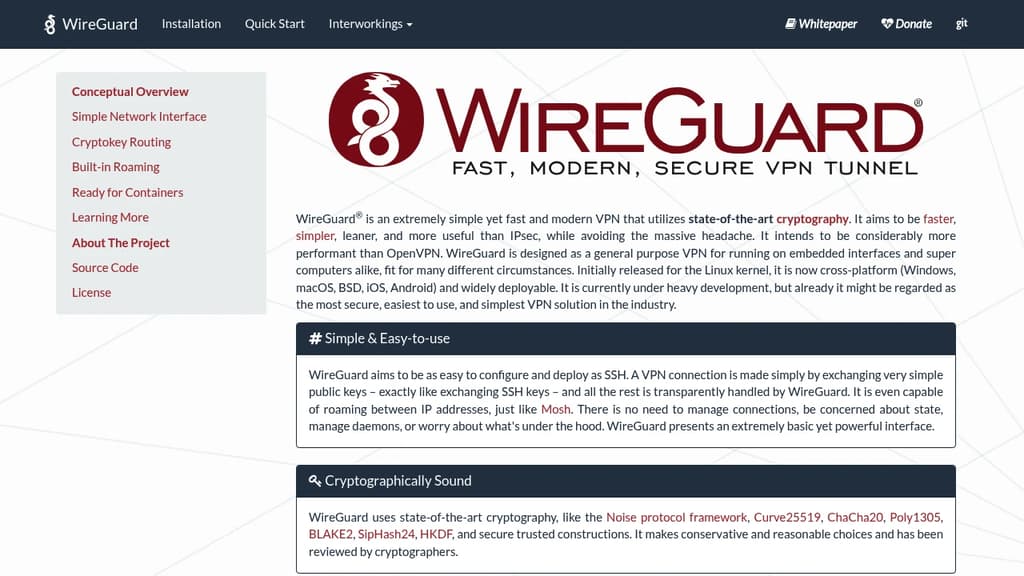
WireGuard is a VPN protocol and implementation designed to be far simpler than OpenVPN or IPsec while outperforming both. It runs inside the Linux kernel and is also available on Windows, macOS, BSD, iOS, and Android. The core idea: set up a network interface, exchange public keys with peers (much like SSH keys), and the tunnel just works.
Configuration is intentionally minimal. There's no connection state to manage, no daemons to babysit, and no complex certificate infrastructure. Each peer has a private key and a list of allowed IP addresses. That pairing of public keys to IPs is what WireGuard calls Cryptokey Routing, and it handles both authentication and access control in one clean mechanism.
Key capabilities:
- Modern cryptography using a curated, conservative set of primitives (Curve25519, ChaCha20, Poly1305, BLAKE2, and others), reviewed by cryptographers
- Tiny codebase with a minimal attack surface, auditable by a single person rather than requiring a large security team
- High throughput from kernel-level packet handling combined with fast cryptographic primitives, suitable for everything from smartphones to backbone routers
- Built-in roaming where both client and server automatically track each other's current IP endpoint, so connections survive network changes
- Container-ready with network namespace support, letting you move a WireGuard interface directly into a Docker container as its sole network path
- IPv4 and IPv6 support, including encapsulating one inside the other
Because identity and IP address are tightly coupled, firewall rules stay simple. You don't need complex extensions to verify packet authenticity. A rule matching an IP on a WireGuard interface is already a cryptographic guarantee.
Several higher-level tools build on WireGuard to add management UIs, access control, and multi-user features. Netbird, Firezone, Defguard, and Pangolin are all examples that use WireGuard as their tunneling layer while adding their own control planes on top.
The protocol is formally documented in an academic paper, and the kernel components are released under GPLv2.










Last 30 days
Last commit
6 months agoRepository age
7 yearsLicense
GPL-2.0Repository
wireguard-tools
Every Sunday we deconstruct one proprietary app and pick the best open source alternatives worth switching to.
Similar open source projects

Stars
Last commit
License
Stars
Last commit
License
Stars
Last commit
License
 Openlane – Open-source, developer-first platform for automated compliance, risk management, and built-in Trust Center.
 Sent
Sent Sent
Sent