Open Source AppFlowy Alternatives
A curated collection of the 15 best open source alternatives to AppFlowy.
The best open source alternative to AppFlowy is Macro Docs. If that doesn't suit you, we've compiled a ranked list of other open source AppFlowy alternatives to help you find a suitable replacement. Other interesting open source alternatives to AppFlowy are: Affine, Joplin, SiYuan, and Logseq.
AppFlowy alternatives are mainly Note-Taking Tools but may also be Personal Knowledge Management (PKM) Tools or Collaborative Notes & Wikis. Browse these if you want a narrower list of alternatives or looking for a specific functionality of AppFlowy.

Written by Piotr Kulpinski


Collaborative markdown documents with real-time CRDT editing, AI agent cursors, mention linking, and built-in properties tied to your tasks, channels, and email.
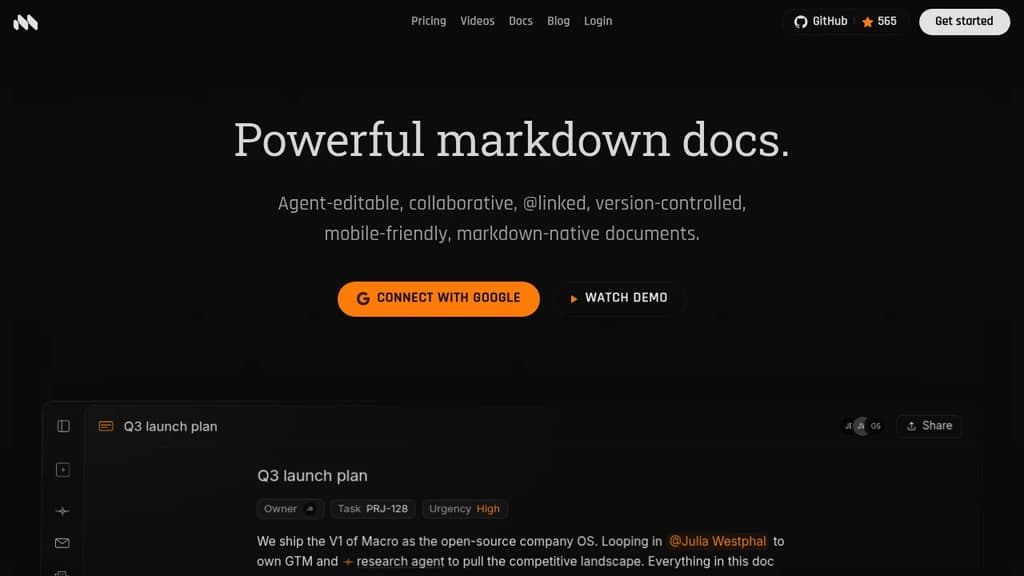
Macro is a markdown-native document editor built to live inside a broader workspace, not alongside one. Every doc connects directly to tasks, email, channels, and AI agents through @mentions that render as live inline pills. What sets Macro apart from tools like Notion or Google Docs is the agent layer. AI agents can edit documents alongside you with a live cursor, not just suggest a diff.
Key capabilities include:
- @mention anything: people, docs, tasks, channels, and calls all render as live inline pills inside any page.
- Markdown-native: type standard markdown and it formats in real time; export back to clean plain markdown anytime.
- Document properties: attach status, assignee, tags, dates, and custom fields directly to a doc without leaving the editor.
- Slash commands: insert headings, tables, code blocks, math equations, and task items with a single keystroke.
- Inline comments and version history: comment on any selection, resolve threads, and restore or fork any past version.
- Unified search: one search index across docs, tasks, email, and channels.
The editing foundation is built on CRDTs (Conflict-free Replicated Data Types), which means multiple people can type on the same line simultaneously without conflicts. Edits apply locally first and reconcile in the background, so the experience stays fast even offline. The backend is written in Rust with a SolidJS frontend, and each document runs as its own Durable Object in the cloud, keeping latency low. Macro is licensed under AGPLv3.
Macro is aimed at teams who want the writing experience of something like Outline or Logseq but need their docs to stay in sync with everything else happening at work. Things can be @mentioned directly in a doc and given context from tasks, channels, or email threads in the same workspace.

An open-source, local-first knowledge base that merges structured docs, infinite whiteboards, databases, and AI into a single workspace for teams and creators.
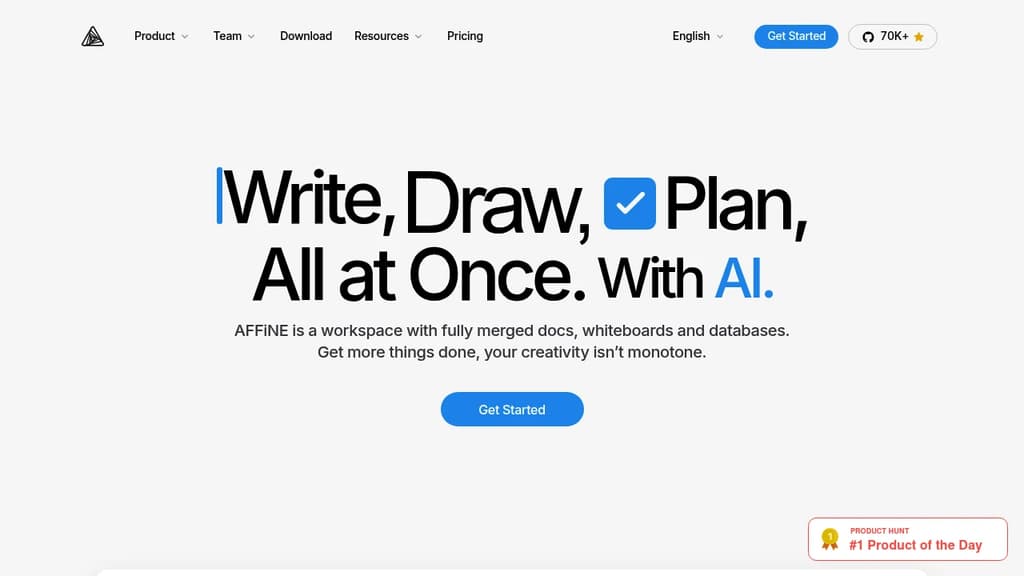
AFFiNE brings together the tools that most teams keep separate: a block-based document editor, an infinite whiteboard, Kanban boards, and a database layer, all inside one workspace. It's built for people who are tired of copying information between a wiki, a whiteboard app, and a project tracker. Everything lives in one place, and it's connected.
The local-first design is a genuine differentiator. Your data sits on your device by default, not on someone else's server. Sync is available, but you're not forced into a cloud subscription to use the core product. For teams with privacy requirements or individuals who want full ownership of their notes and plans, that matters.
Key capabilities:
- Edgeless mode turns any page into an infinite canvas where you can sketch, drag in documents, add sticky notes, and map out ideas spatially
- Block-based editing lets you build documents from reusable content blocks, mixing text, images, databases, and embeds freely
- Kanban boards sit alongside docs for project tracking without needing a separate tool like Trello or Jira
- AI integration assists with writing, summarizing, and planning directly inside the workspace
- Templates cover common use cases out of the box, from meeting notes to project plans
- Real-time collaboration lets teams work on the same page simultaneously
Compared to tools like AppFlowy or AnyType, AFFiNE leans harder into the visual side. The whiteboard isn't an afterthought; it's a first-class mode that can hold entire knowledge maps. Compared to Outline, it's less focused on structured wikis and more on freeform, mixed-media workspaces.
Free for individuals. Teams and commercial users pay for additional features. The source code is fully public, so self-hosting is an option for those who want it.

Cross-platform note-taking app with end-to-end encryption, Markdown support, web clipping, and sync via Dropbox, OneDrive, or Joplin Cloud.
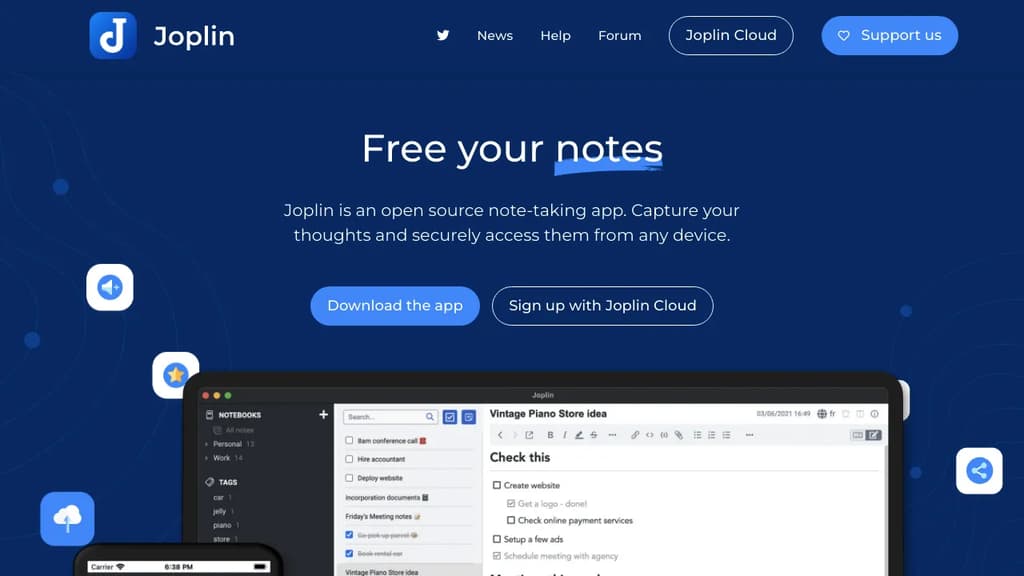
Joplin is a note-taking app built around two principles: your data stays yours, and it works everywhere. It runs on Windows, macOS, Linux, Android, and iOS, with a terminal app for those who prefer the command line. Notes are stored in an open format, so you're never locked in.
The headline feature is end-to-end encryption (E2EE). Unlike Evernote or OneNote, Joplin encrypts your notes before they leave your device, meaning no third party can read them, not even the sync provider. For anyone serious about keeping notes private, that's a meaningful distinction.
What you can do with it:
- Write in Markdown or Rich Text depending on your preference, with support for math expressions and diagrams built in
- Clip web pages directly into notes using browser extensions for Chrome and Firefox
- Attach anything: images, audio, PDFs, and videos all live inside notes
- Sync across devices via Joplin Cloud, Dropbox, or OneDrive
- Collaborate and share through Joplin Cloud, including publishing individual notes to a public URL
- Extend the app with plugins, custom themes, and a full Extension API for building your own tools
Joplin Cloud, the optional hosted sync service, is based in France and subject to EU privacy law. It's a paid add-on, but Joplin works fine with Dropbox or OneDrive if you'd rather not pay.
The plugin ecosystem is mature. There are community-built plugins for task management, kanban boards, note templates, and more, making it closer to a personal knowledge base than a simple notepad. If you've outgrown Google Keep or want something more private than Apple Notes, Joplin covers a lot of ground without requiring a subscription.

Personal knowledge management system with WYSIWYG block editing, bidirectional links, spaced repetition flashcards, a relational database, and end-to-end encrypted sync.
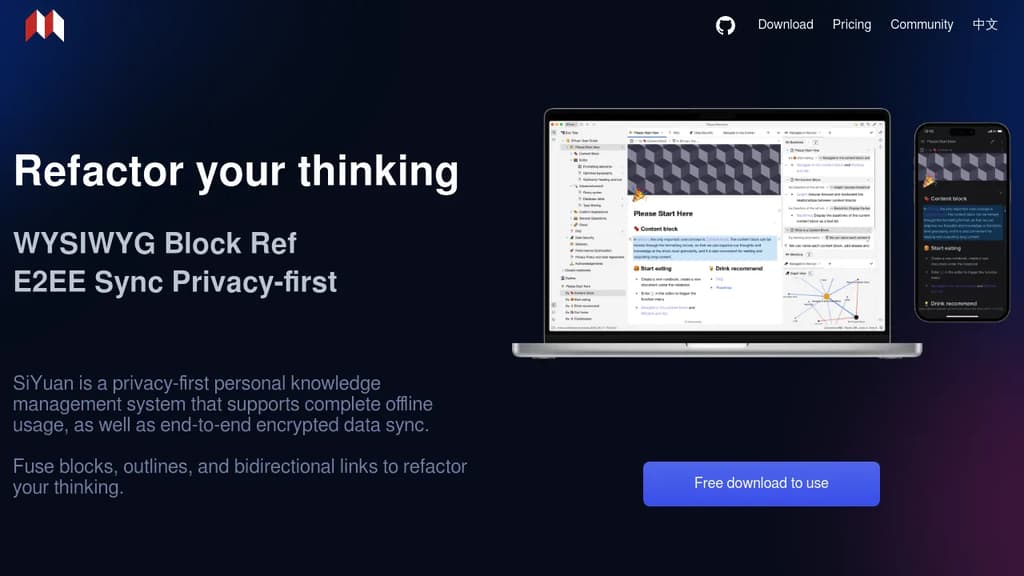
SiYuan is a personal knowledge management tool built around a single core idea: everything is a block. Documents, headings, paragraphs, lists, even pages themselves are all blocks you can reference, link, move, and reorganize without breaking existing connections. It's aimed at people who want a Logseq- or Obsidian-style networked knowledge system but with stronger privacy guarantees and a fully offline-capable architecture.
The editing experience is WYSIWYG with Markdown support. SiYuan ships with 20+ block-level element types and 10+ inline elements, covering most typesetting needs out of the box. Widget blocks handle more specialized cases. Large documents with millions of words load smoothly through dynamic rendering, so file size doesn't become a bottleneck.
Key capabilities:
- Bidirectional links at the block level, not just the page level. Backlinks show unlinked mentions, and a global relationship graph gives a visual map of how your knowledge connects.
- Database blocks with relation and rollup support, letting you link two databases and surface aggregated data across them.
- Spaced repetition flashcards built in, using an algorithm to schedule reviews based on memory decay.
- AI writing assistance for drafting, translation, summarization, grammar correction, and Q&A, accessed directly inside the editor.
- List outlines with folding, rich typography per item, and full integration with document structure.
- Zoom-in focus mode on any block, with breadcrumb navigation to keep context.
On the privacy side, all data lives on your device by default. Sync uses end-to-end encryption with incremental transfers to minimize bandwidth. No network connection is required to use it. SiYuan can also run as a local server accessible from a phone over a LAN, or be self-hosted via Docker for small-team collaboration with access controlled by an authorization code. For people comparing AppFlowy or AnyType, SiYuan's block-reference model and built-in spaced repetition are distinctive features that the others don't combine in one package.

Local-first, open-source knowledge management tool with bidirectional linking, outlines, flashcards, PDF annotations, and whiteboards for building a connected second brain.
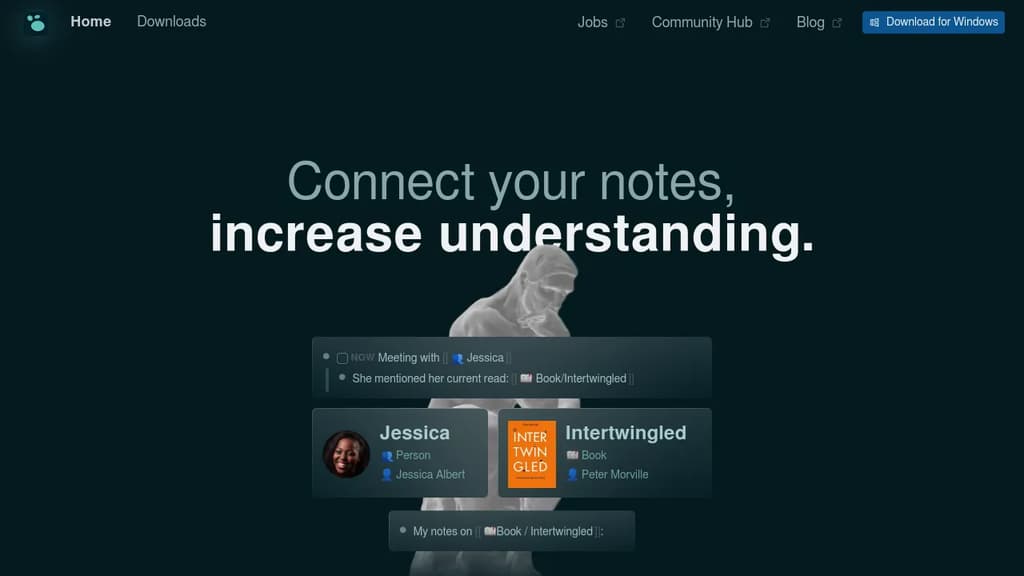
Logseq is a local-first knowledge base for people who work with a lot of information and can't afford to lose the thread. Your notes live as plain Markdown files on your own device, so you own them completely. No subscription required for personal use, no vendor lock-in, and no cloud dependency unless you want one.
It's built around an outliner model where every bullet is a block you can reference, embed, or query from anywhere in your notes. That structure makes it easy to build connections between ideas over time rather than hunting through disconnected documents. If you've tried tools like Obsidian or Roam Research and wanted something fully open source with strong privacy defaults, Logseq is the closest match.
Key capabilities:
- Bidirectional linking connects pages and blocks so related ideas surface automatically
- Outliner-based editing lets you nest, collapse, and reorganize thoughts at any depth
- Flashcards turn any block into a spaced-repetition card for memorizing facts
- PDF annotations keep highlights and notes alongside the source document
- Whiteboards give you an infinite canvas to arrange and connect blocks visually
- Queries let you pull structured tables of information from across your notes
- 150+ plugins extend the core with community-built functionality
- Encrypted sync keeps notes consistent across devices without exposing your data
The daily journal is the default entry point. Capture everything there and let Logseq's linking and query system turn that raw input into something navigable. It suits students reviewing class notes, writers outlining drafts, developers keeping project context, and anyone who needs meeting notes that don't disappear into a folder.
Compared to a tool like Notion, Logseq keeps everything local and doesn't require a browser. Unlike SiYuan or AnyType, its plain-text Markdown storage means your notes are readable in any editor, long after the app itself might change.

Team knowledge base with real-time collaboration, AI-powered search, Slack integration, and self-hosting support for internal docs and wikis.
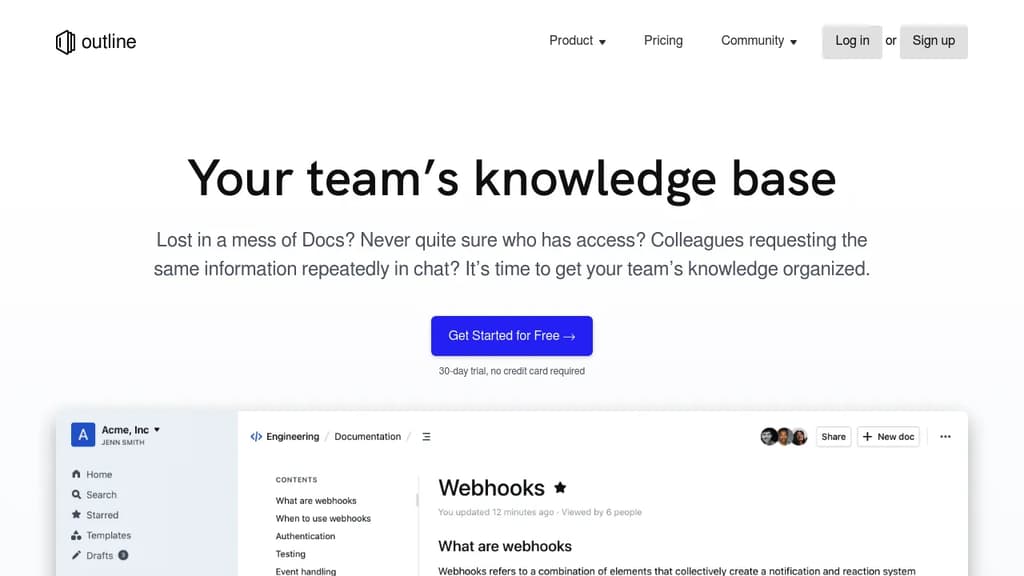
Outline is a team knowledge base built for companies that have outgrown scattered docs, messy shared drives, and repeated Slack questions. It gives teams a single place to write, organize, and find internal documentation, from product specs and onboarding guides to meeting notes and support answers. It's available as a cloud-hosted service or self-hosted on your own infrastructure.
The editor is fast. Documents load instantly, search returns results in milliseconds, and the UI stays snappy even in large workspaces. Writing feels close to plain text, with markdown support and slash commands, but you also get interactive embeds, real-time multiplayer editing, and threaded comments for keeping conversations tied to specific content.
Key capabilities include:
- AI-powered search that lets you ask questions about your documents and get direct answers, not just a list of links
- Slack integration for searching, sharing, and asking questions without leaving chat, plus channel notifications when docs change
- Granular permissions with read/write controls, user groups, guest access, and public sharing via link
- Custom branding with your own domain, colors, and logo
- 20+ integrations including Figma and Loom
- Localization with RTL support and translations in 20 languages
Outline sits in the same space as tools like Docmost or AppFlowy for collaborative wikis, but it's particularly focused on speed and team-wide usability rather than personal note-taking. Unlike personal tools such as Logseq, Outline is designed around shared workspaces with access controls from the start.
The codebase is open source, and self-hosting is a first-class option for teams that need to keep data on their own servers. A cloud-hosted plan with a 30-day free trial is also available for teams that want to get started without managing infrastructure.

Self-hosted wiki platform for enterprise teams with real-time collaboration, built-in AI, SSO, RBAC permissions, and compliance support for ITAR, FedRAMP, and GDPR.
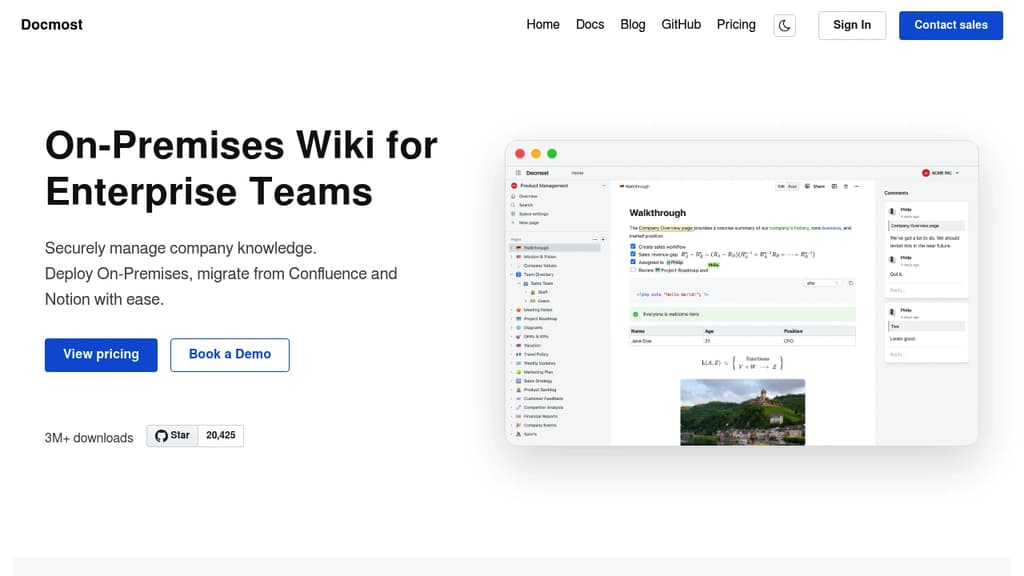
Docmost is a self-hosted wiki platform built for teams that need full control over their data. It's aimed at organizations where compliance isn't optional: defense contractors, regulated industries, and companies subject to GDPR or FedRAMP requirements. You deploy it on your own servers, including air-gapped or isolated environments, and your data never leaves your infrastructure.
The editor supports rich text, tables, code blocks, and real-time collaboration with live cursors. Multiple people can edit the same page simultaneously, with changes syncing instantly across devices. Pages are organized into team spaces, so departments or projects can maintain their own areas without everything bleeding together.
Key capabilities:
- AI assistant that works with self-hosted models (Ollama, vLLM) or cloud providers (OpenAI, Gemini, Azure OpenAI). Chat with your knowledge base, get answers with source citations, and search semantically across all spaces.
- MCP server support exposes your wiki to AI tools like Claude or Cursor via the Model Context Protocol, with no vendor lock-in.
- Built-in diagramming via Draw.io, Excalidraw, and Mermaid, covering everything from UML to quick whiteboard sketches.
- Page verification workflows for tracking reviews and approvals, supporting ISO 9001, ISO 27001, and SOC 2 compliance.
- Enterprise authentication with SAML 2.0, OpenID Connect, LDAP, and MFA.
- RBAC permissions with granular control over who can view, edit, or administer content.
Teams migrating from Confluence or Notion can import existing content directly, including HTML and Markdown files. Integrations cover Figma, Airtable, Google Drive, Miro, Loom, and others, so pages can embed content from tools teams already use.
Docmost sits in the same space as Outline and XWiki, but its combination of self-hosted AI, MCP support, and compliance-focused deployment options makes it a strong fit for organizations that need a collaborative knowledge base without relying on third-party cloud infrastructure.

End-to-end encrypted note-taking app with zero-knowledge architecture, cross-device sync, web clipper, and a self-hostable sync server.
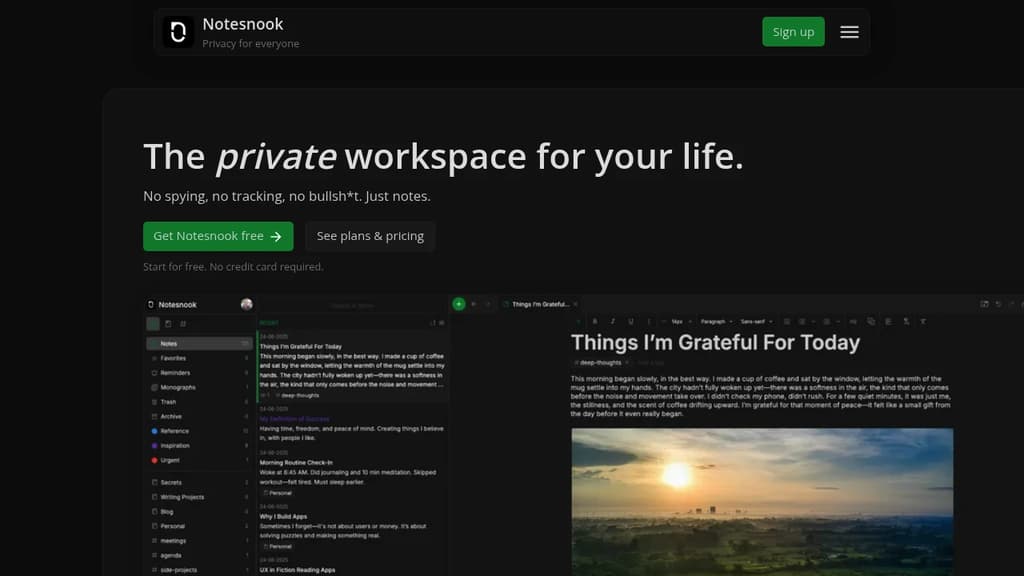
Notesnook is a secure, encrypted note-taking app built around one principle: your notes are yours alone. Every note is encrypted on your device before it syncs anywhere. The company can't read your data. Neither can anyone else.
It's a direct alternative to Evernote, OneNote, and similar apps that store your notes in plaintext on their servers. Notesnook takes a different approach with XChaCha20 encryption and Argon2 key derivation, and you can verify it yourself using their open source tool, Vericrypt, which works entirely offline against real account data.
The full client and sync server are open source. You can self-host the sync server if you want complete independence from their infrastructure.
Key features:
- End-to-end encryption on every note, notebook, and attachment, at rest and in transit
- Cross-device sync across mobile, desktop, and browser, all encrypted
- Notes vault for password-protecting your most sensitive notes with an additional layer of encryption
- App lock that automatically locks your database when you step away
- Rich editor with tables, task lists, math formulas, code blocks, image embeds, outlines, and Markdown
- Bidirectional note linking to connect related ideas, useful for research or planning workflows similar to Logseq
- Web Clipper for saving pages and articles without tracking
- Reminders built in, so you don't need a separate task app
- Password-protected sharing for sending notes to others securely
Notesnook works well as a privacy-focused alternative to Joplin or Standard Notes for users who want a polished interface alongside strong encryption. The free tier covers the core experience across all platforms, with a paid plan for power users.

The next generation of open-source AI-powered card notes designed to help you quickly capture and organize inspiration so that ideas never run out.

Blinko is a powerful self-hosted note-taking solution that puts you in control of your personal knowledge management. With its intuitive interface, you can:
- Create and organize notes with rich text formatting and markdown support
- Build connections between related notes to create a personal knowledge graph
- Keep your data private and secure by self-hosting on your own infrastructure
- Access your notes from anywhere through web and mobile interfaces
- Import and export notes in standard formats for data portability
- Customize the experience with themes and plugins
Perfect for students, researchers, writers, and anyone who wants to build a structured personal knowledge base while maintaining complete control over their data.

A local-first, encrypted workspace for notes, tasks, databases, and chats. Your data stays on your device, syncs peer-to-peer, and never passes through a central server.
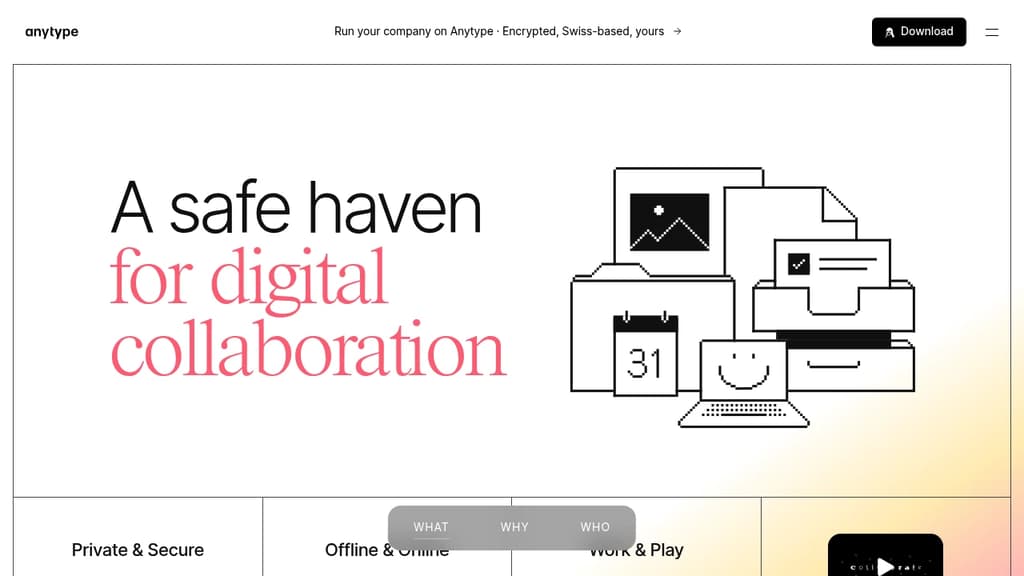
Anytype is a local-first workspace where your data lives on your device, encrypted with keys only you hold. It's built for people who want the flexibility of a tool like Notion or Nuclino without handing their data to a company's servers. Notes, tasks, databases, wikis, and chats all live in one place, and none of it is readable by anyone but you.
The privacy model is the core differentiator. Anytype uses on-device encryption by default. No server sits between your devices; sync happens peer-to-peer over local networks. You can also self-host your own backup node. There's no account recovery through a third party because no third party ever has your keys.
Beyond privacy, it's a capable creation tool:
- Block-based editor for composing pages, notes, and documents with rich formatting
- Databases with multiple views including table, kanban, and gallery layouts
- Templates to standardize recurring structures across your workspace
- Graph view to visualize relationships between objects
- Widgets for surfacing frequently used content on your home screen
- Offline-first operation, so the app works fully without an internet connection
- Native mobile apps for iOS and Android with touch-optimized navigation
The object model is flexible. Everything in Anytype is an "object" with its own type and relations, which means a task, a contact, a note, and a project can all link to each other in structured ways. It's closer to a personal knowledge graph than a simple note-taking app.
For teams, Anytype supports shared spaces with collaborative editing, making it a self-sovereign alternative to tools like Affine for groups that need both privacy and real-time collaboration. A business tier adds features for larger organizations.
The underlying protocols are open, built by Any, a Swiss non-profit association, so third-party developers can build on top of them without permission.

A self-hosted, browser-based note-taking system that turns plain Markdown pages into a queryable, scriptable knowledge base you control.
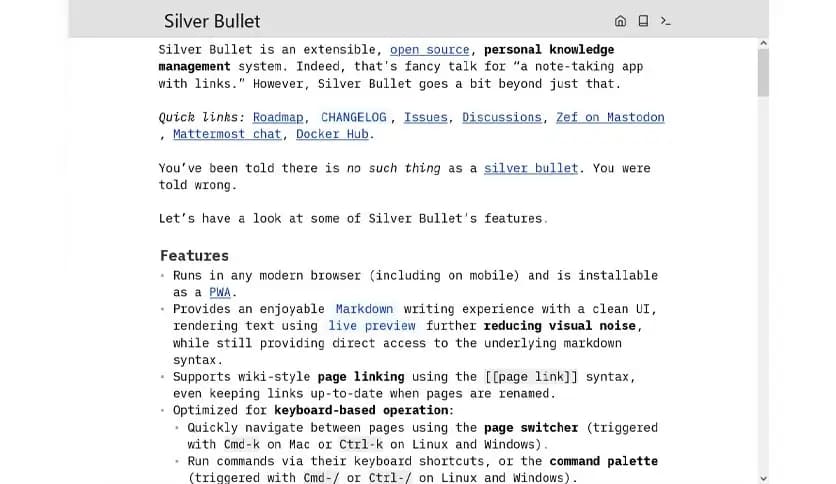
SilverBullet is a self-hosted web app that blends a clean Markdown editor with wiki-style linking, a built-in query language, and a Lua scripting environment. It's aimed at people who want more than a static notes app but don't want to stitch together separate tools to get there.
Your notes live as Markdown files in what SilverBullet calls a "space." You can browse them like a traditional app or follow bi-directional links like a wiki. The live-preview editor keeps things readable while you write, and a page picker lets you jump around quickly.
What sets it apart from tools like Logseq or SiYuan is the depth of its programmability:
- Space Lua scripting lets you write custom logic directly inside your notes, generating content dynamically at render time.
- SLIQ (Space Lua Integrated Query) lets you query your own notes like a database, pulling in tasks, tags, or page metadata on the fly.
- Templates can be driven by queries, so a "product features" page or a "recent pages" list stays current without manual updates.
- Bi-directional links connect pages automatically, and linked mentions surface everywhere a page is referenced.
- Tagging and custom attributes let you annotate pages with structured data that queries can sort, filter, and display.
- Task tracking works across your entire space, so you can collect incomplete tasks from all your pages in one view.
SilverBullet runs as a single self-contained server or container, which means you deploy it on a VPS, a Raspberry Pi, or anywhere you control. Your data stays yours. There's no account to create, no sync service to trust.
It's a good fit for writers who want structure without friction, for outliners who need hierarchy, and especially for people comfortable writing a little Lua who want their notes to do real work.

XWiki is a flexible, feature-rich wiki software that helps organizations structure and share knowledge efficiently.
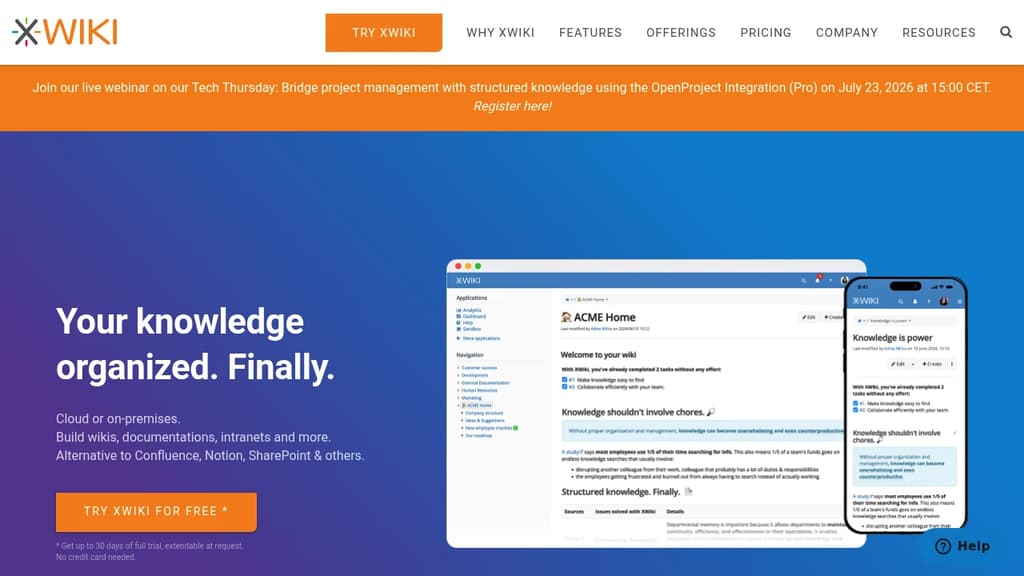
XWiki is an enterprise-grade, open-source platform for knowledge management and collaboration. It offers a unique "Structured Wiki" concept, combining the flexibility of wikis with powerful organization features.
Key benefits include:
-
Structured Knowledge: XWiki goes beyond traditional wikis by allowing users to create structured content, making information easier to organize and find.
-
Customization: The platform is highly adaptable, supporting custom applications and workflows to meet specific organizational needs.
-
Collaboration Tools: XWiki provides robust features for team collaboration, including real-time editing, comments, and version control.
-
Security and Access Control: Granular permissions and access controls ensure that sensitive information remains protected.
-
Integration: XWiki can integrate with various third-party tools and systems, enhancing its functionality and fitting into existing workflows.
-
Open Source: As an open-source solution, XWiki offers transparency, community support, and freedom from vendor lock-in.
-
Scalability: XWiki is designed to handle large amounts of data and users, making it suitable for organizations of all sizes.
-
Multiple Deployment Options: Available as a cloud service or for on-premises installation, providing flexibility in deployment.
XWiki is trusted by over 800 teams worldwide, including major organizations like Amazon, SNCF, and CNFPT. It's particularly well-suited for creating knowledge bases, managing procedures, building intranets, and developing custom collaborative applications.
Whether you're looking for a standard solution or a custom-tailored platform, XWiki offers the tools and services to streamline your organization's knowledge sharing and collaboration processes.

A privacy-focused, offline-first note-taking app that stores everything on your device, with Markdown, note linking, file attachments, LaTeX math, and bring-your-own sync.
Beaver Notes is a local-first note-taking app that keeps your data on your device by default. There are no accounts to create, no servers to trust, and no telemetry phoning home. It's MIT-licensed and built for people who want full ownership of their notes without trading away convenience.
The core idea is simple: everything works offline, and you decide whether and how to sync. Instead of locking you into a proprietary cloud, Beaver lets you bring your own cloud provider to move notes across devices on your terms.
The feature set covers more ground than a basic editor:
- Note linking connects ideas across your notes, building a personal web of information similar to what you'd find in tools like Logseq
- Tags and labels keep notes organized without complex folder hierarchies
- File attachments let you embed PDFs, images, and audio directly in a note
- LaTeX math renders equations inline as you type, useful for science and engineering notes
- Drawing lets you insert sketches or handwritten sections from any device, and those drawings travel with the note when you share it
- Command prompt gives keyboard-first access to search, settings, and actions without touching the mouse
- Markdown support throughout, with shortcuts that keep your hands on the keyboard
Sharing is built in too. You can send notes to other apps or people directly, and shared notes carry their embedded drawings and files along with them.
Beaver sits in a different lane from cloud-dependent tools like Notesnook or Memos. It's not trying to be a team collaboration platform or an AI-assisted workspace. The focus is on a fast, distraction-free writing environment that respects your privacy by design, not as a setting you have to hunt down.

OpenNotas is a multi-platform, end-to-end encrypted note-taking app that offers simplicity, synchronization, and offline functionality.
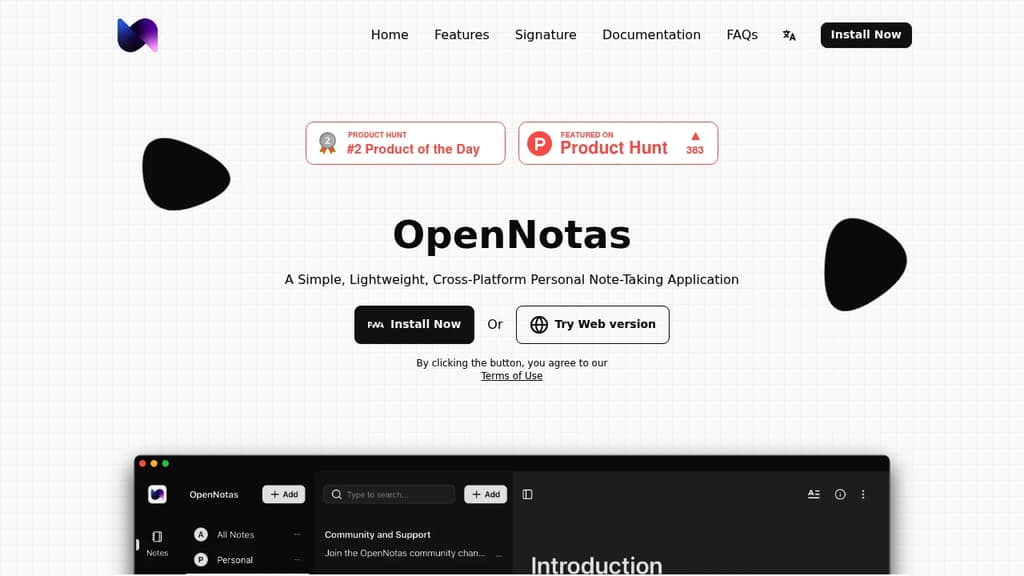
OpenNotas is a versatile and user-friendly note-taking application designed for personal use across multiple platforms. Here are its key features and benefits:
-
Simplicity: OpenNotas boasts an intuitive interface, allowing users to start writing notes immediately without navigating complex settings.
-
Multi-platform support: Available on various devices and operating systems, including mobile phones, computers, Windows, Linux, and macOS.
-
Synchronization: Users can sync their notes across devices through Adapter configuration, ensuring access to their information from anywhere.
-
End-to-End Encryption (E2EE): Utilizes AES algorithm to encrypt note data before storing it on the server, guaranteeing data security and privacy.
-
Offline functionality: OpenNotas can be used without an internet connection, with data stored locally and synced when connectivity is restored.
-
Free and open-source: The application is completely free to use and has its source code openly available.
-
Customizable sync options: Users can set up note syncing across devices through Adapter configuration, providing flexibility in how data is managed.
-
Data control: OpenNotas does not store user note data on its servers, giving users full control over their information.
-
Multiple language support: The application is available in various languages, including English, Vietnamese, and Traditional Chinese.
OpenNotas strikes a balance between simplicity and functionality, making it an excellent choice for users who prioritize privacy, ease of use, and cross-platform availability in their note-taking solution.

Justnote is a secure note-taking app that lets you easily create and sync notes across devices while maintaining full control of your data.
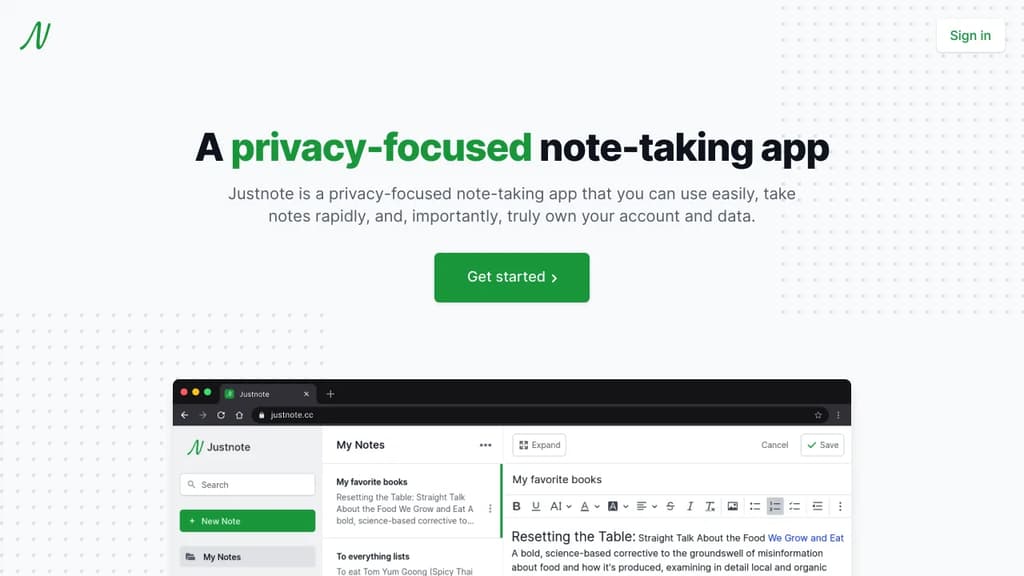
Justnote is a privacy-focused note-taking app designed for simplicity, speed, and data ownership. Key features include:
- Simple and fast interface for quick note-taking on any device
- End-to-end encryption to keep your notes private and secure
- Cross-device syncing to access notes anywhere
- Web3 technology that gives you full control of your account and data
- No ads or data mining
- Rich text editor with formatting options
- Dark mode for comfortable night-time use
- Available on web, iOS, and Android
Justnote uses blockchain technology from Stacks to create a truly decentralized app where only you can access and control your account and notes. Your data is encrypted and stored on servers of your choice.
With Justnote, you can quickly jot down ideas, to-do lists, and other notes without worrying about privacy or losing access to your data. The clean, distraction-free interface lets you focus on your thoughts.
Whether you need a simple notepad for quick memos or a secure place to store sensitive information, Justnote provides an easy-to-use and private note-taking experience across all your devices.

People are looking for alternatives to...
View all alternatives
Claude Code

Spotify

CapCut

Claude

Notion

Lovable
 Stellar Hosted – Managed Open Source software hosting in the EU: secure, compliant, fast.


 Postiz