
Deepnote
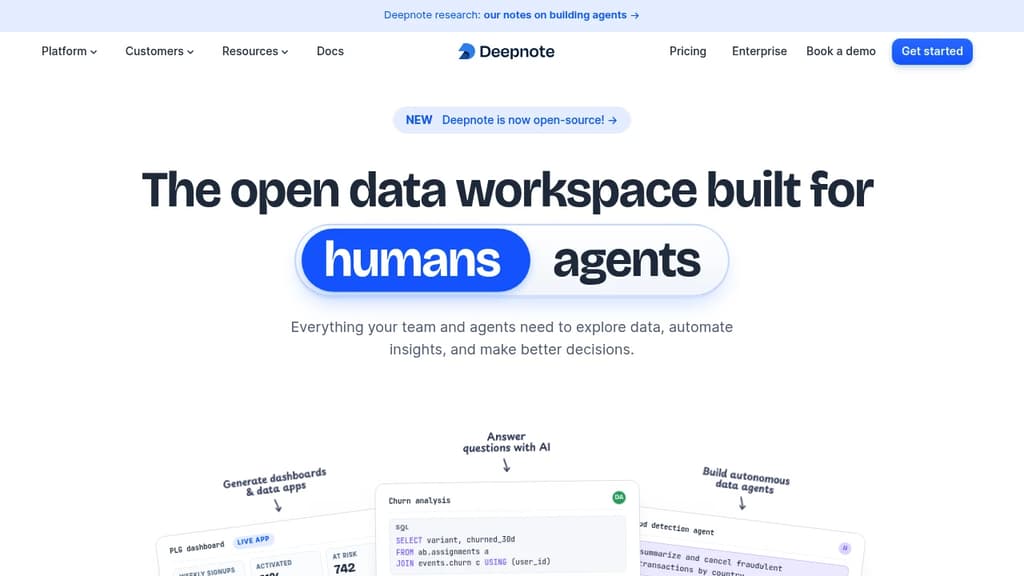
Deepnote is an open-source collaborative notebook for data analysts and scientists, combining Python, SQL, AI assistance, and live sharing in one cloud platform.




Last 30 days
Last commit
6 hours agoRepository age
1 yearVersion
0.6.0License
Apache-2.0Repository
deepnote/deepnote
Deepnote is a cloud-based data notebook built for teams. It combines Python, SQL, and R in a single environment, adds AI that understands your codebase and data stack, and makes real-time collaboration as straightforward as sharing a link. It's now fully open-source under Apache 2.0, making it a credible alternative to tools like Hex or hosted Jupyter setups.
The AI layer goes beyond code completion. Deepnote's assistant is aware of your schema, your existing code, and your business context. It can generate queries, explain results, debug errors, and surface drivers behind a metric shift. You describe what you want to find; it writes the analysis. For teams without dedicated data engineers, that matters.
Beyond notebooks, Deepnote covers a surprising range of output types:
- Dashboards and data apps built directly from notebook outputs, with custom layouts and input controls
- Scheduled notebooks that run hourly, daily, or on any cadence you set
- API deployment so models or queries can be served as live endpoints
- GPU compute for ML workloads, selectable from the environment settings
- Data agents that can plan, query, train, and publish results autonomously
SQL is a first-class citizen here, not an afterthought. You can query warehouses directly in SQL blocks, use dbt metadata and Jinja templating, and mix SQL and Python in the same notebook. Connections to Snowflake, BigQuery, Spark, and other major sources are built in. For natural language querying fans, the AI layer can write the SQL for you.
Collaboration works like a shared document. Multiple people can edit simultaneously, comment on individual blocks, and review changes. Sharing externally is a single link or email invite, with RBAC and SSO available for teams that need tighter access control. Deepnote is HIPAA, SOC 2, and GDPR compliant.
You can start locally in VS Code using the Deepnote extension and push to the cloud when you need more compute or want to share results. Over 500,000 data professionals use it, including teams at 96 of the top 100 universities. For open-source notebook users who've outgrown plain Jupyter, it's a well-rounded step up.
Tags:












Last 30 days
Last commit
6 hours agoRepository age
1 yearVersion
0.6.0License
Apache-2.0Repository
deepnote/deepnote
Every Sunday we deconstruct one proprietary app and pick the best open source alternatives worth switching to.
Similar open source projects

Stars
Last commit
License
Stars
Last commit
License
Stars
Last commit
License
 Docmost – Open-source wiki software with real-time collaboration, diagrams, AI, SSO, RBAC permissions and more.
 Bright Data
 Capture