Open Source Hex Alternatives
A curated collection of the 4 best open source alternatives to Hex.
The best open source alternative to Hex is Redash. If that doesn't suit you, we've compiled a ranked list of other open source Hex alternatives to help you find a suitable replacement. Other interesting open source alternatives to Hex are: Teable, Lightdash, and Deepnote.
Hex alternatives are mainly BI Platforms but may also be Data Visualization Tools or Low-Code/No-Code Platforms. Browse these if you want a narrower list of alternatives or looking for a specific functionality of Hex.

Written by Piotr Kulpinski


Redash is an open-source data visualization and analytics platform that helps teams make sense of their data through SQL queries and interactive dashboards.
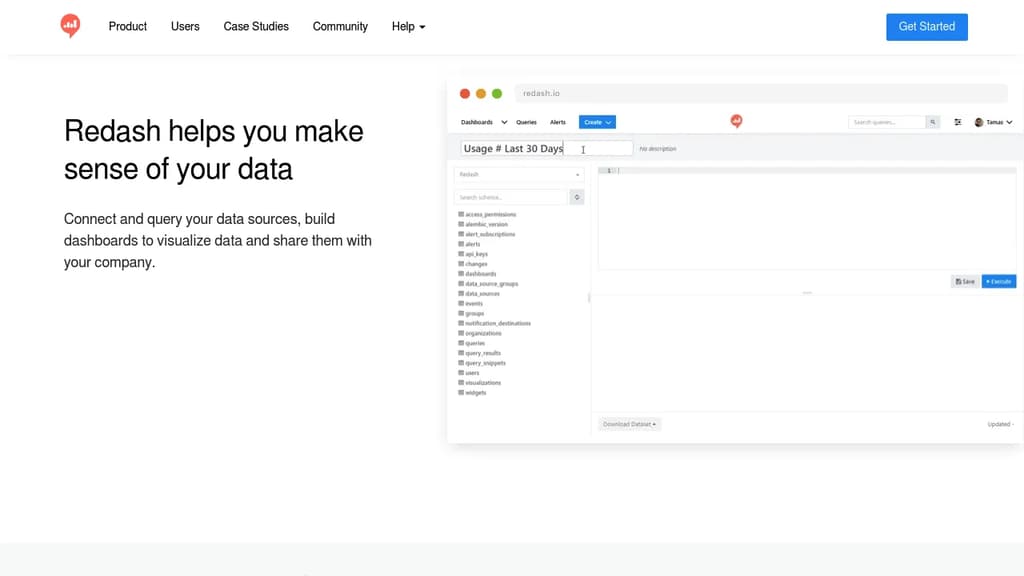
Redash is a powerful, open-source data visualization and analytics platform designed to help teams connect, query, visualize, and share their data effectively. Here's what makes Redash stand out:
-
Versatile Data Connectivity:
- Supports a wide range of data sources, including SQL, NoSQL, Big Data, and APIs
- Allows querying from multiple sources to answer complex questions
-
Powerful Query Editor:
- Intuitive SQL editor with schema browsing and click-to-insert functionality
- Ability to create and reuse query snippets for efficiency
-
Interactive Dashboards:
- Drag-and-drop interface for creating customizable dashboards
- Resize and arrange visualizations to suit your needs
- Schedule automatic refreshes from data sources
-
Collaboration and Sharing:
- Share dashboards with team members or make them public
- User management features for access control
-
Visualizations and Alerts:
- Create various types of visualizations to represent your data
- Set up alerts to stay informed about important data changes
-
Open-Source Advantage:
- Customize and add features to suit your specific needs
- No vendor lock-in
- Active community for support and contributions
-
API Access:
- Integrate Redash with other tools and services using its API
Redash is trusted by data-driven companies to make sense of their information, enabling better decision-making and deeper understanding of their data. Whether you're a small startup or a large enterprise, Redash provides the tools you need to turn your data into actionable insights.

Open-source platform combining powerful database capabilities with a user-friendly spreadsheet interface for efficient data management and collaboration.
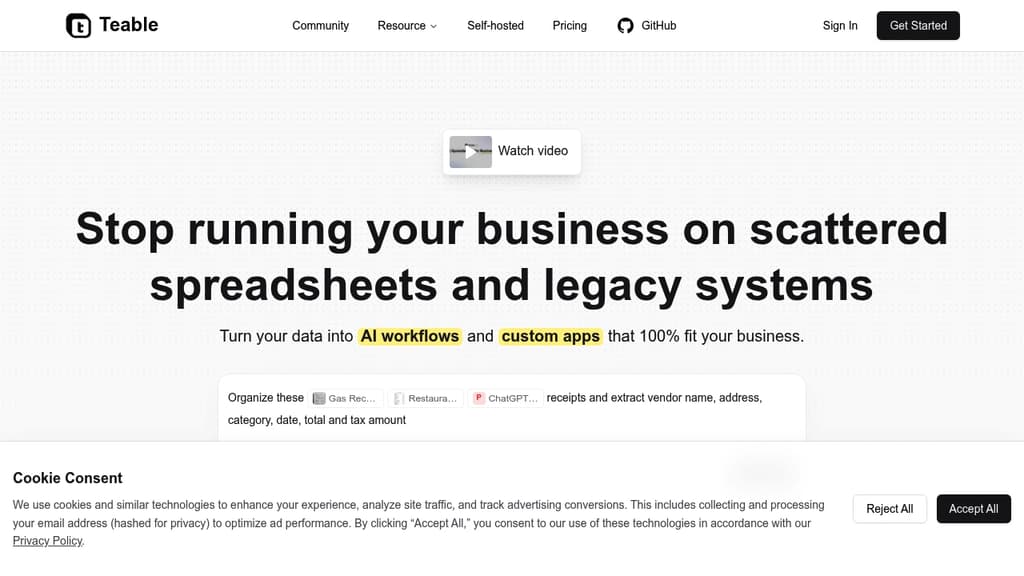
Teable revolutionizes data management by seamlessly blending the robustness of a database with the familiarity of a spreadsheet. This innovative open-source platform offers a unique solution for teams and individuals seeking efficient, flexible, and collaborative data handling.
Key benefits of Teable include:
- Intuitive Interface: Enjoy the ease of spreadsheet-like interactions while harnessing the power of a relational database.
- Powerful Data Relationships: Create complex data structures and relationships effortlessly, enabling sophisticated data modeling.
- Real-time Collaboration: Work together seamlessly with multiple users, ensuring everyone stays on the same page.
- Customizable Views: Tailor your data presentation with various view options, including grid, gallery, and Kanban boards.
- API Integration: Connect Teable to your existing tools and workflows through its robust API.
- Data Security: Benefit from enterprise-grade security measures to keep your sensitive information protected.
- Scalability: Handle large datasets and complex operations with ease, thanks to Teable's efficient architecture.
- Open-Source Advantage: Leverage the transparency, customizability, and community support that comes with open-source software.
Whether you're managing projects, organizing inventory, or analyzing data, Teable adapts to your needs. Experience the future of data management where flexibility meets functionality, all in one powerful, user-friendly platform.

Self-serve analytics platform that transforms dbt models into interactive dashboards, enabling data-driven decisions across organizations.
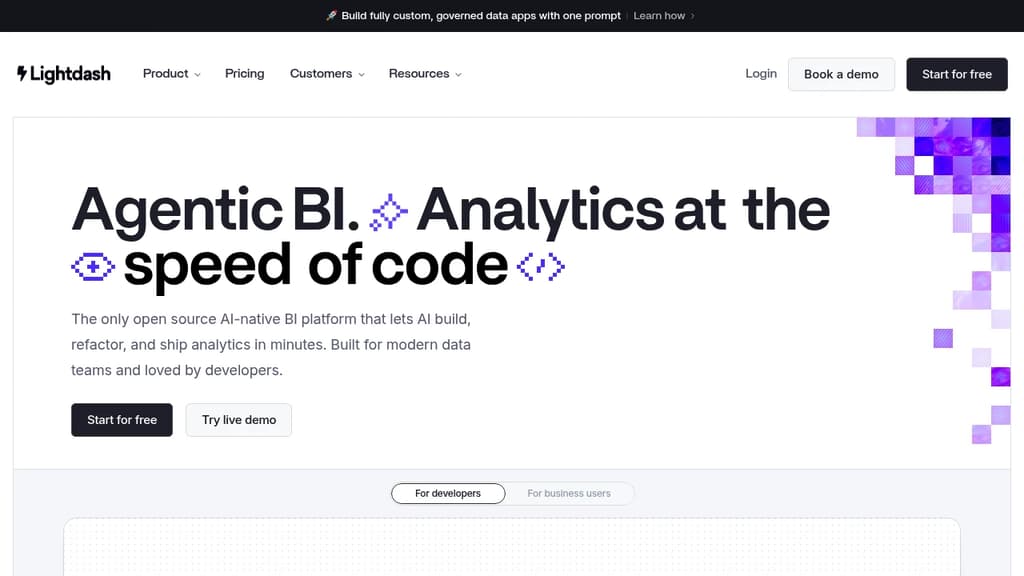
Lightdash revolutionizes business intelligence for data teams leveraging dbt. This open-source platform seamlessly integrates with your existing data stack, allowing you to create powerful dashboards and explore data with ease.
Key benefits of Lightdash include:
- dbt Integration: Automatically turns your dbt models into explorable tables, ensuring consistency between your data warehouse and BI layer.
- Self-Serve Analytics: Empowers non-technical users to create charts, dashboards, and explore data without writing SQL.
- Version Control: Native Git integration enables version control for your metrics, dimensions, and dashboards.
- Customizable Visualizations: Create a wide range of charts and graphs to best represent your data.
- Collaborative Features: Share dashboards, set up alerts, and collaborate with team members seamlessly.
- Open-Source Flexibility: Benefit from community contributions and customize the platform to fit your specific needs.
- Cloud or Self-Hosted: Choose between Lightdash Cloud for hassle-free setup or self-host for complete control.
Lightdash bridges the gap between data engineering and business users, fostering a data-driven culture across your organization. By leveraging your existing dbt models, it ensures a single source of truth and accelerates time-to-insight for all stakeholders.

Deepnote is an open-source collaborative notebook for data analysts and scientists, combining Python, SQL, AI assistance, and live sharing in one cloud platform.
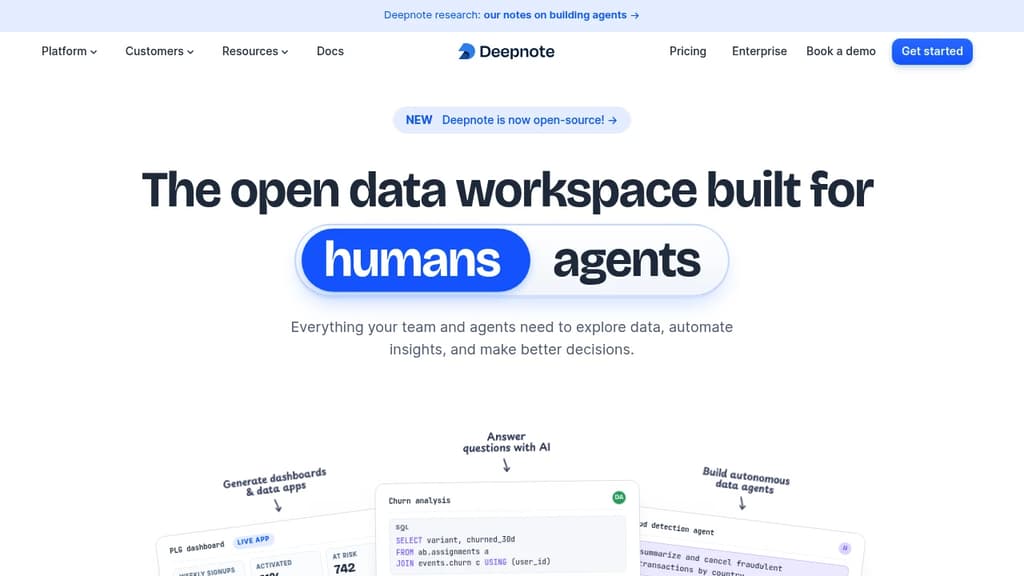
Deepnote is a cloud-based data notebook built for teams. It combines Python, SQL, and R in a single environment, adds AI that understands your codebase and data stack, and makes real-time collaboration as straightforward as sharing a link. It's now fully open-source under Apache 2.0, making it a credible alternative to tools like Hex or hosted Jupyter setups.
The AI layer goes beyond code completion. Deepnote's assistant is aware of your schema, your existing code, and your business context. It can generate queries, explain results, debug errors, and surface drivers behind a metric shift. You describe what you want to find; it writes the analysis. For teams without dedicated data engineers, that matters.
Beyond notebooks, Deepnote covers a surprising range of output types:
- Dashboards and data apps built directly from notebook outputs, with custom layouts and input controls
- Scheduled notebooks that run hourly, daily, or on any cadence you set
- API deployment so models or queries can be served as live endpoints
- GPU compute for ML workloads, selectable from the environment settings
- Data agents that can plan, query, train, and publish results autonomously
SQL is a first-class citizen here, not an afterthought. You can query warehouses directly in SQL blocks, use dbt metadata and Jinja templating, and mix SQL and Python in the same notebook. Connections to Snowflake, BigQuery, Spark, and other major sources are built in. For natural language querying fans, the AI layer can write the SQL for you.
Collaboration works like a shared document. Multiple people can edit simultaneously, comment on individual blocks, and review changes. Sharing externally is a single link or email invite, with RBAC and SSO available for teams that need tighter access control. Deepnote is HIPAA, SOC 2, and GDPR compliant.
You can start locally in VS Code using the Deepnote extension and push to the cloud when you need more compute or want to share results. Over 500,000 data professionals use it, including teams at 96 of the top 100 universities. For open-source notebook users who've outgrown plain Jupyter, it's a well-rounded step up.

People are looking for alternatives to...
View all alternatives
Spotify

Claude Code

CapCut

Claude

Notion

Lovable
 Docmost – Open-source wiki software with real-time collaboration, diagrams, AI, SSO, RBAC permissions and more.
 Sent
Sent