Open Source Snowflake Alternatives
A curated collection of the 10 best open source alternatives to Snowflake.
The best open source alternative to Snowflake is ClickHouse. If that doesn't suit you, we've compiled a ranked list of other open source Snowflake alternatives to help you find a suitable replacement. Other interesting open source alternatives to Snowflake are: TimescaleDb, Cube, Apache Druid, and Databend.
Snowflake alternatives are mainly Relational Databases (SQL) but may also be Cloud Data Warehouses or Time Series Databases. Browse these if you want a narrower list of alternatives or looking for a specific functionality of Snowflake.

Written by Piotr Kulpinski


High-performance columnar OLAP database system for real-time analytics on big data, with SQL support and linear scalability.
ClickHouse is a powerful open-source columnar database management system designed for online analytical processing (OLAP) of big data. It offers unparalleled performance and efficiency, making it an ideal choice for businesses dealing with massive datasets and complex analytical queries.
Key benefits of ClickHouse include:
- Exceptional Speed: Process billions of rows and terabytes of data in seconds, thanks to its columnar storage format and advanced query optimization techniques.
- Linear Scalability: Easily scale horizontally across commodity hardware to handle growing data volumes without compromising performance.
- SQL Support: Familiar SQL syntax with extensions for analytical queries, making it accessible to data analysts and engineers.
- Real-time Data Ingestion: Insert and query data simultaneously, enabling real-time analytics on fresh data.
- Compression: Highly efficient data compression reduces storage costs and improves query performance.
- Fault Tolerance: Built-in replication and sharding capabilities ensure high availability and data reliability.
- Versatility: Support for a wide range of data types, including arrays and nested structures, accommodating diverse analytical needs.
- Integration: Seamless integration with popular data processing tools and ecosystems, enhancing its utility in modern data stacks.
ClickHouse empowers organizations to unlock insights from their data at unprecedented speeds, enabling data-driven decision-making and innovative analytical applications across industries.

PostgreSQL extension for time-series data with automatic partitioning, up to 95% columnar compression, continuous aggregates, and ~200 native SQL functions.
TimescaleDB is a PostgreSQL extension that turns Postgres into a purpose-built time-series database. It's designed for teams that want specialized time-series performance without abandoning the SQL ecosystem they already know. Sensor data, on-chain events, application metrics, customer behavior – if it's timestamped and high-volume, this is what it's built for.
The core abstraction is the hypertable: a regular Postgres table that's automatically partitioned by time (or ID) under the hood. Partition skipping at query planning means the database eliminates irrelevant chunks before scanning begins, so queries stay fast even as data grows into billions of rows.
Key capabilities:
- Hybrid row/columnar storage – recent data stays in the rowstore for fast ingest and point lookups; older data auto-converts to columnar format for analytical scans, with SIMD-accelerated vectorized execution
- Compression up to 95% – delta, dictionary, and RLE encodings compress historical data aggressively, and queries can filter directly on compressed data without decompressing first
- Continuous aggregates – incrementally refreshed materialized views that update in parallel batches; real-time mode includes the latest uncommitted data so dashboards never go stale
- ~200 time-series SQL functions – hyperfunctions cover time-weighted averages, interpolation, gap-filling, and partial aggregations that avoid reprocessing historical data
- Automated data management – built-in job scheduler handles retention policies, columnstore conversion, and aggregate refresh with configurable retries and full auditability
Because it's 100% PostgreSQL-compatible, existing Postgres tooling, drivers, ORMs, and extensions all work without modification. That's a meaningful difference from purpose-built alternatives like InfluxDB, QuestDB, or TDengine, which require learning new query languages or migration overhead.
Cloudflare uses it to balance analytical performance with operational simplicity, keeping analytical and configuration data under one roof. The project has 22,000+ GitHub stars and an active Slack community of 12,000+ members.

Cube is a universal semantic layer that connects data sources to analytics tools, providing consistent definitions and fast queries.
Cube is an open-source universal semantic layer that acts as a bridge between your data sources and analytics tools. It provides a centralized place to define data models, metrics, and access controls that can be used consistently across your entire data stack.
Key benefits of Cube:
- Unified data modeling: Define your metrics, dimensions, and business logic once in Cube and reuse them across all your BI tools, dashboards, and data apps. This ensures consistency and saves time.
- Powerful caching and pre-aggregations: Cube optimizes query performance with intelligent caching and pre-aggregation strategies, delivering fast analytics even on large datasets.
- Flexible API options: Access your data through REST, GraphQL, SQL, or MDX APIs. This allows you to integrate Cube with virtually any front-end tool or custom application.
- Fine-grained access control: Implement row-level and column-level security policies directly in your semantic layer, ensuring data governance across all connected tools.
- Multi-database support: Connect to popular databases and data warehouses like Postgres, MySQL, BigQuery, Snowflake, and more.
- Developer-friendly: Built with a code-first approach, Cube integrates seamlessly into modern data engineering workflows with features like version control and CI/CD support.
By centralizing data definitions and optimizing query performance, Cube helps data teams deliver more consistent, faster, and secure analytics experiences across their organization.

Columnar, time-indexed analytics database built for streaming and batch data at scale, handling billions to trillions of rows with millisecond query response times.
Apache Druid is an OLAP database built for teams that need fast, concurrent analytics on massive datasets without pre-caching queries or pre-defining schemas. It targets use cases where query latency must stay low even as data volumes and concurrent users grow into the hundreds of thousands of queries per second.
Druid sits in the same space as tools like ClickHouse and QuestDB, but its architecture is distinctly oriented around streaming-first ingestion and elastic, loosely coupled components.
What makes it fast:
- Scatter/gather query engine preloads data into memory or local storage, avoiding data movement and network latency during query execution
- Automatic columnarization on ingestion, combined with dictionary encoding, bitmap indexing, and type-aware compression, means queries touch only the data they need
- Time-based indexing is a first-class citizen, which benefits time-series and event-driven workloads considerably
Streaming and batch ingestion:
Druid connects natively to Apache Kafka and Amazon Kinesis without additional connectors, supporting query-on-arrival at millions of events per second. Historical batch data and live streaming data are queryable through the same interface. Schema auto-discovery handles column detection and type inference automatically, updating as data evolves.
Operational features include configurable tiering with quality-of-service controls for mixed workloads, automatic continuous backup, multi-node replication, and automated recovery. These make it practical to run as a production system without constant manual intervention.
Analysts and developers use standard SQL across ingestion, transformation, and querying. Join operations work both at ingestion time and at query time, with best performance when tables are pre-joined during ingestion.
For teams evaluating time-series alternatives or looking beyond InfluxDB for higher-concurrency OLAP workloads, Druid's architecture handles cardinality and dimensionality that would slow down general-purpose databases significantly.

Databend is an open-source, elastic cloud data warehouse built for high-performance analytics and seamless integration with popular data tools.
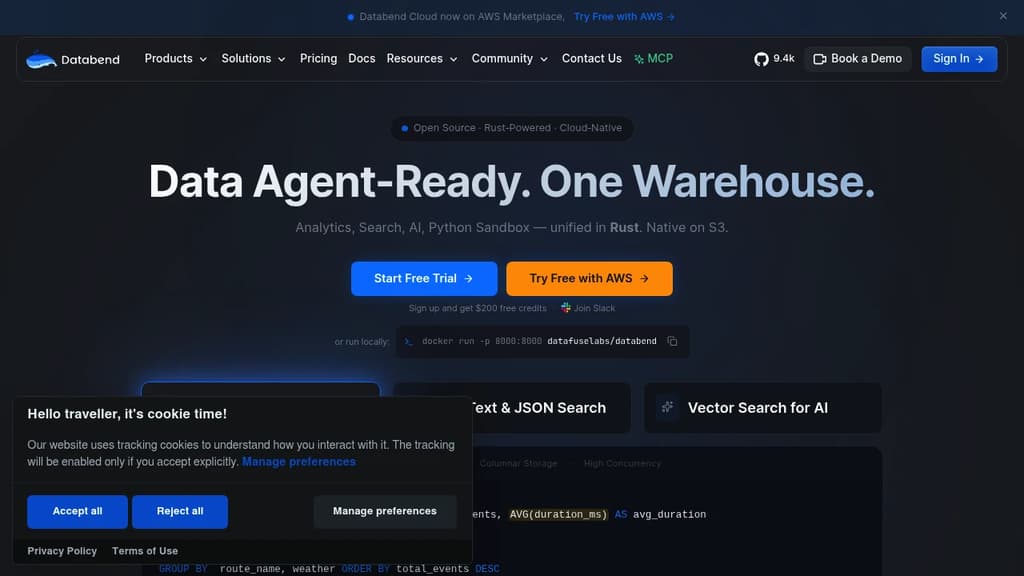
Databend is an open-source cloud data warehouse designed for high-performance analytics at scale. Some key features and benefits include:
- Cloud-native architecture optimized for object storage platforms
- SQL:2011 compliant with support for complex queries and time travel
- Seamless integration with popular BI, ETL, and data science tools
- Native AI capabilities to enhance analytics workflows
- Robust security with role-based and data-based access controls
- Sub-second analytics for real-time insights
- Efficient compression and storage for logs and event data
- Data archiving capabilities for long-term retention
- Massively parallel processing for large-scale offline computing
Databend offers fully-managed cloud, self-hosted enterprise, and free community editions to suit different needs. The cloud version provides a pay-as-you-go model with multi-region availability on AWS.
Benchmarks show Databend Cloud outperforming Snowflake by 10-36% on TPC-H queries while costing significantly less. The platform integrates easily with popular data systems and tools to enable end-to-end analytics workflows.
With its combination of performance, flexibility and cost-efficiency, Databend aims to be an economical alternative to established cloud data warehouses for organizations looking to unlock insights from their data at scale.

Deep Lake is an open-source database for storing, querying and managing complex AI data like images, audio, and embeddings.
Deep Lake is an open-source tensor database designed specifically for AI and machine learning workflows. It allows you to efficiently store, query, and manage complex unstructured data like images, audio, video, and embeddings.
Some key features of Deep Lake:
- Tensor storage: Store data as tensors for fast streaming to ML models
- Vector search: Built-in vector similarity search for embeddings and other high-dimensional data
- Querying: SQL-like querying capabilities for complex data filtering
- Versioning: Git-like versioning to track changes to datasets over time
- Visualization: Visualize datasets and embeddings directly in notebooks or browser
- Streaming: Stream data directly to ML frameworks like PyTorch and TensorFlow
- Cloud integration: Seamlessly work with data stored in cloud object stores
Deep Lake aims to simplify ML data management and accelerate the development of AI applications. It provides a standardized way to work with unstructured data across the ML lifecycle - from data preparation to model training to deployment.
The open-source nature allows for customization and integration into existing ML workflows. Deep Lake can significantly reduce data preparation time and enable faster experimentation and iteration on ML models.

CloudQuery is an open-source ELT platform that enables easy data integration from hundreds of cloud and security tools to any destination.
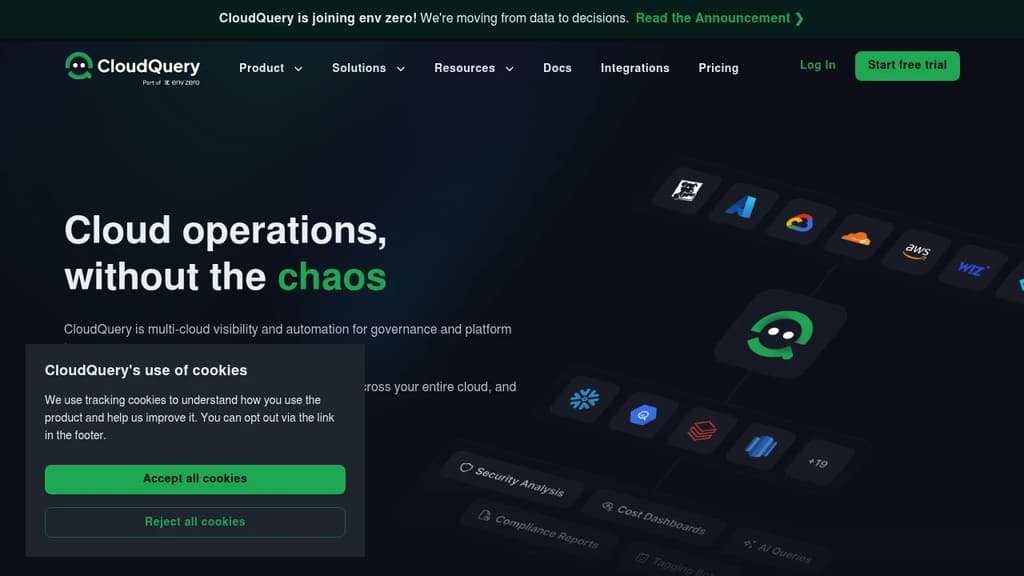
CloudQuery is a powerful open-source ELT (Extract, Load, Transform) platform designed for simplicity, performance, and extensibility. It allows users to easily sync data from hundreds of cloud and security tools to any destination.
Key features and benefits:
- Wide range of integrations: CloudQuery supports hundreds of source plugins, including major cloud providers (AWS, GCP, Azure), security tools, and more.
- Flexible destinations: Data can be loaded into various destinations, including databases, data warehouses, and analytics platforms.
- High performance: Native connectors and columnar data streaming protocol ensure low memory footprint and increased performance.
- Simplicity and portability: The CloudQuery CLI and connectors have zero external dependencies, making it easy to run locally, in the cloud, or embedded in orchestrators.
- Open-source SDK: Developers can write custom connectors in any language using the CloudQuery SDK, which provides built-in scheduling, rate-limiting, transformation, and documentation capabilities.
- Versatile use cases: CloudQuery can be used for cloud infrastructure and security analysis, database migration, engineering analytics, and more.
CloudQuery's architecture makes it ideal for businesses looking to centralize their data from various sources, enabling better decision-making, improved security posture, and streamlined operations. Whether you're a cloud team, product manager, or developer, CloudQuery offers a flexible solution for your data integration needs.

Distributed SQL database designed for high-speed ingestion and complex queries on massive datasets, ideal for IoT and time-series data.
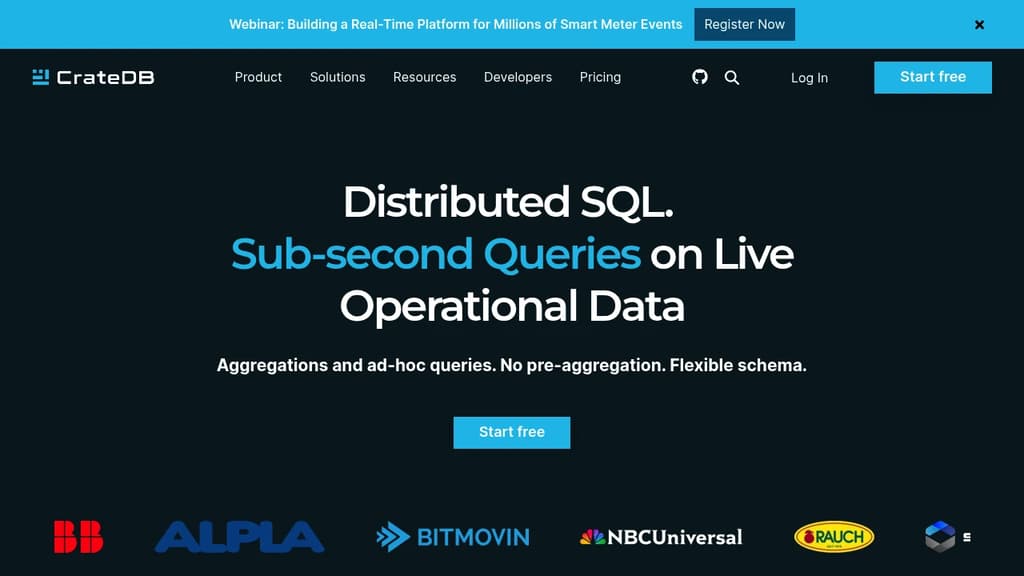
CrateDB is a powerful, distributed SQL database that excels in handling massive amounts of machine data in real-time. Built for the modern data landscape, it offers:
- Scalability: Easily scale horizontally across clusters to handle growing data volumes and user loads.
- Real-time analytics: Perform complex queries on large datasets with sub-second response times.
- Time-series optimization: Specifically designed to efficiently store and query time-series and IoT data.
- SQL + NoSQL: Combine the familiarity of SQL with the flexibility of schemaless data.
- Full-text search: Built-in Lucene-based full-text search capabilities for comprehensive data exploration.
- Multi-model: Support for structured, semi-structured, and geospatial data in a single database.
- Cloud-native: Containerized architecture for easy deployment in cloud environments.
- Low operational overhead: Self-healing clusters and automated sharding reduce management complexity.
CrateDB empowers organizations to derive actionable insights from their machine data, supporting use cases from IoT analytics and monitoring to log analysis and real-time dashboards. With its unique architecture, CrateDB bridges the gap between traditional relational databases and modern NoSQL systems, offering the best of both worlds for data-intensive applications.

Deepnote is an open-source collaborative notebook for data analysts and scientists, combining Python, SQL, AI assistance, and live sharing in one cloud platform.
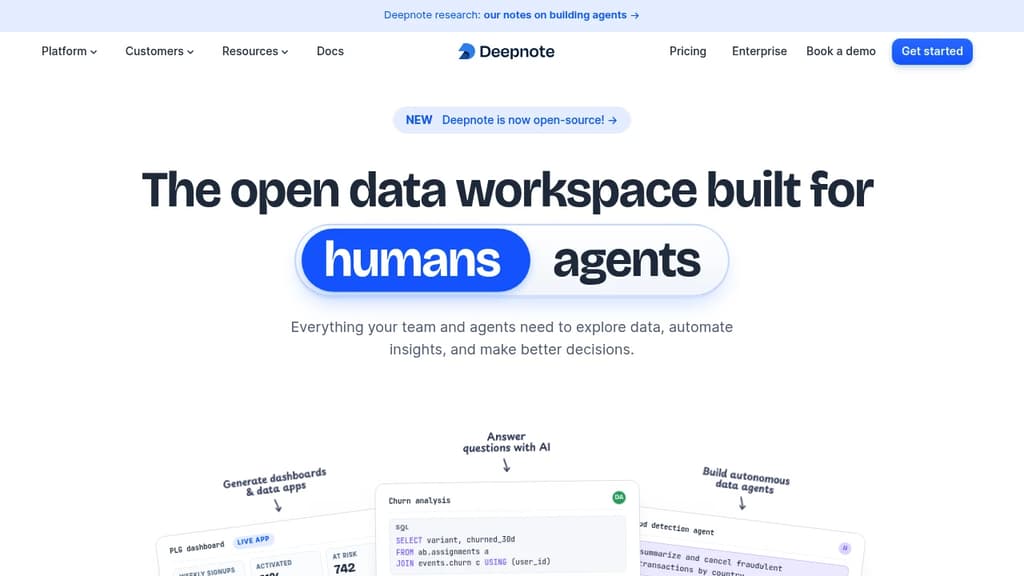
Deepnote is a cloud-based data notebook built for teams. It combines Python, SQL, and R in a single environment, adds AI that understands your codebase and data stack, and makes real-time collaboration as straightforward as sharing a link. It's now fully open-source under Apache 2.0, making it a credible alternative to tools like Hex or hosted Jupyter setups.
The AI layer goes beyond code completion. Deepnote's assistant is aware of your schema, your existing code, and your business context. It can generate queries, explain results, debug errors, and surface drivers behind a metric shift. You describe what you want to find; it writes the analysis. For teams without dedicated data engineers, that matters.
Beyond notebooks, Deepnote covers a surprising range of output types:
- Dashboards and data apps built directly from notebook outputs, with custom layouts and input controls
- Scheduled notebooks that run hourly, daily, or on any cadence you set
- API deployment so models or queries can be served as live endpoints
- GPU compute for ML workloads, selectable from the environment settings
- Data agents that can plan, query, train, and publish results autonomously
SQL is a first-class citizen here, not an afterthought. You can query warehouses directly in SQL blocks, use dbt metadata and Jinja templating, and mix SQL and Python in the same notebook. Connections to Snowflake, BigQuery, Spark, and other major sources are built in. For natural language querying fans, the AI layer can write the SQL for you.
Collaboration works like a shared document. Multiple people can edit simultaneously, comment on individual blocks, and review changes. Sharing externally is a single link or email invite, with RBAC and SSO available for teams that need tighter access control. Deepnote is HIPAA, SOC 2, and GDPR compliant.
You can start locally in VS Code using the Deepnote extension and push to the cloud when you need more compute or want to share results. Over 500,000 data professionals use it, including teams at 96 of the top 100 universities. For open-source notebook users who've outgrown plain Jupyter, it's a well-rounded step up.

Leverage advanced analytics with a modern PostgreSQL kernel. 100% open source for robust data solutions.
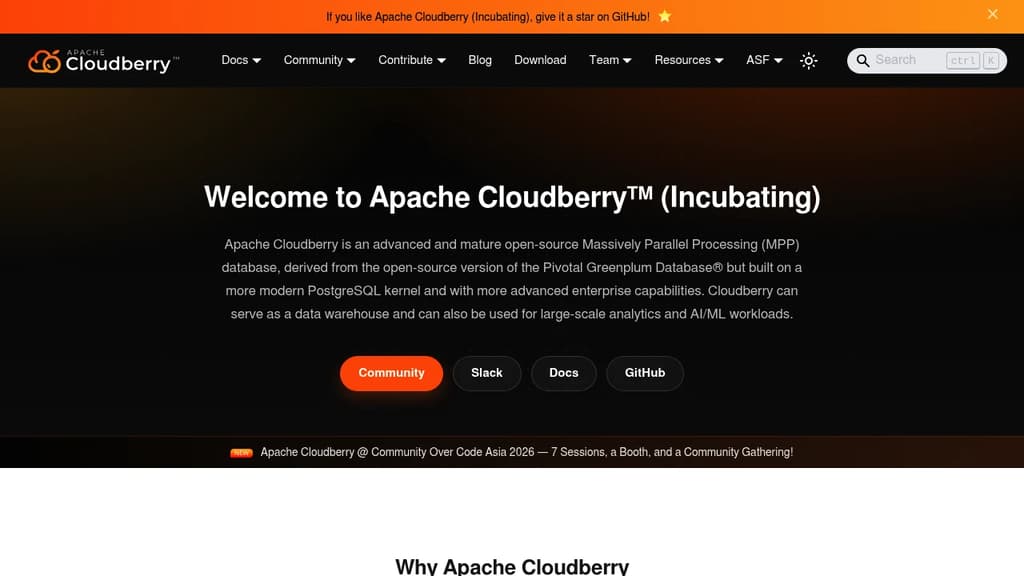
Apache Cloudberry is a cutting-edge open-source Massively Parallel Processing (MPP) database, designed for large-scale analytics and AI/ML workloads. Built on a modern PostgreSQL 14.4 kernel, it offers enhanced enterprise capabilities while maintaining compatibility with Greenplum Database. Fully open source, it allows you to maximize your data's value with robust features.
Key Benefits:
- Advanced Analytics: Ideal for data warehousing and complex analytics.
- Enterprise-Ready: Modern kernel with enhanced capabilities.
- Community Driven: Contribute and collaborate with a vibrant community.
Apache Cloudberry is currently incubating at The Apache Software Foundation, ensuring a stable and community-driven development process. Whether you're migrating from Greenplum or starting fresh, Cloudberry offers a seamless transition with tools like gpbackup. Join the community to contribute and explore the potential of your data.

People are looking for alternatives to...
View all alternatives
Claude Code

Spotify

CapCut

Claude
Notion

Lovable
 Openlane – Open-source, developer-first platform for automated compliance, risk management, and built-in Trust Center.

 Docmost