/dev/push vs ZaneOps
Learn how /dev/push and ZaneOps differ in their key features, development activity, technology
stack and community adoption, so you can decide which of these paas & deployment tools is best for you.
Learn how /dev/push and ZaneOps differ in their key features, development activity, technology stack and community adoption, so you can decide which of these paas & deployment tools is best for you.

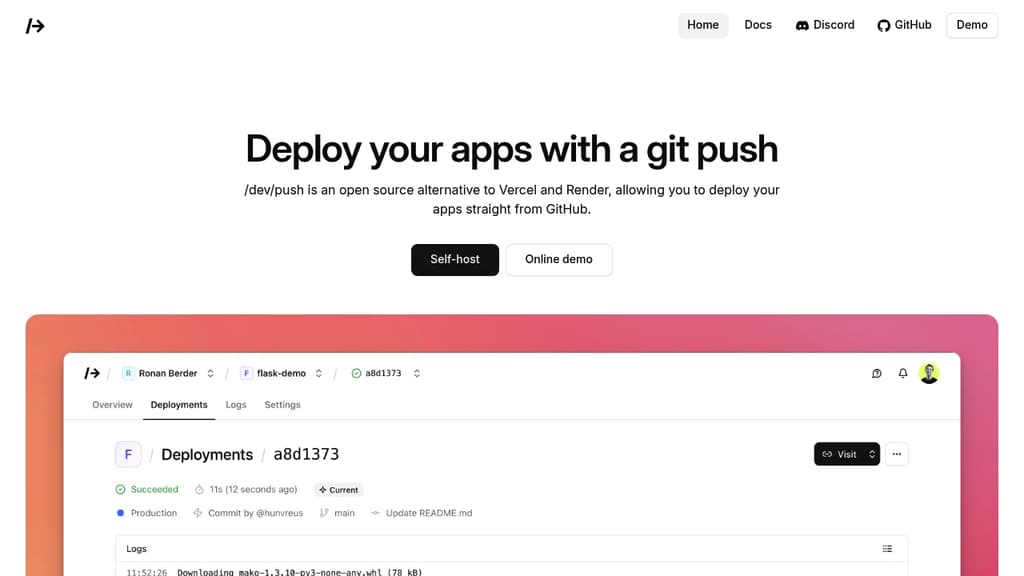
/dev/push
Last 30 days
Last commit
14 days agoRepository age
2 yearsVersion
v1.1.0License
MITRepository
hunvreus/devpush

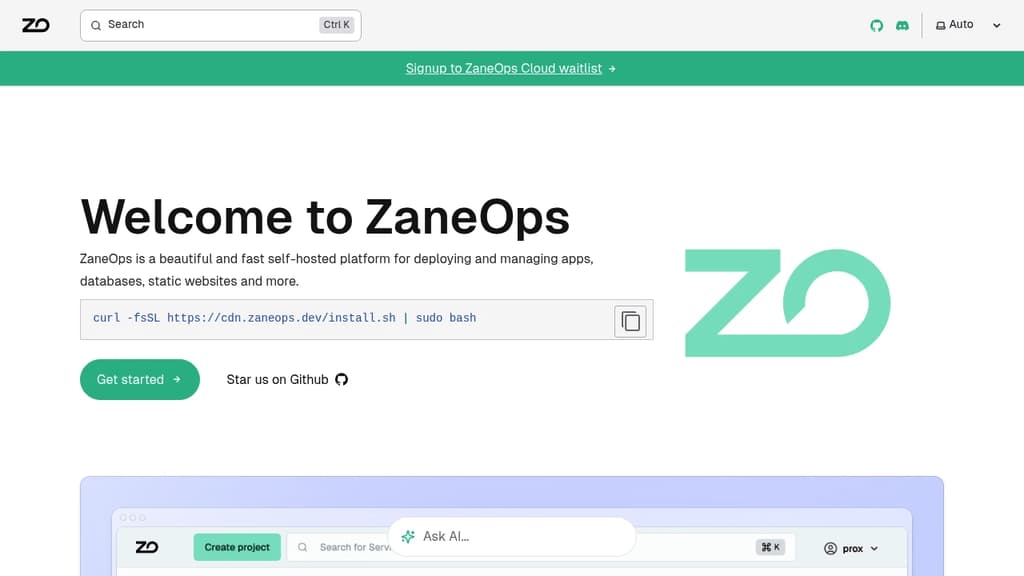
ZaneOps
Last 30 days
Last commit
1 day agoRepository age
3 yearsVersion
v1.15.2License
MITSelf-hosted
YesRepository
zane-ops/zane-ops
Detailed Comparison
Both /dev/push and ZaneOps have their unique strengths and serve similar purposes effectively. Consider your specific needs regarding popularity, growth, activity, technology, maturity, licensing and features when making your decision.
Both /dev/push and ZaneOps have their unique strengths and serve similar purposes effectively. Consider your specific needs regarding popularity, growth, activity, technology, maturity, licensing and features when making your decision.
Community & Popularity
/dev/push significantly outpaces ZaneOps in community adoption with 4,832 stars compared to 1,395 stars on GitHub. This 3.5x difference suggests /dev/push has a much larger and more active community. In terms of developer contributions, /dev/push has 189 forks, indicating moderate developer engagement.
Growth Momentum
/dev/push is growing faster, adding 67 stars in the last 30 days (+1.4%) against adding 7 stars for ZaneOps (+0.5%). /dev/push is both larger and pulling further ahead.
Development Activity
Both projects show recent activity, with /dev/push last updated 14 days ago and ZaneOps 1 day ago.
Technology Stack
Both tools share common technology foundations, being built with CSS, Bash, Python. However, they differ in their additional technology choices: /dev/push uses JavaScript while ZaneOps leverages Typescript, JSX, Django.
Project Maturity
Both projects started around the same time, with /dev/push beginning 2 years ago and ZaneOps 3 years ago.
Licensing
Both projects use the MIT license, providing identical terms for usage and distribution.
Use Cases & Features
Both tools serve similar use cases in PaaS & Deployment Tools. However, they also have distinct specializations: /dev/push also focuses on CI/CD Platforms.
Hosting & Deployment
ZaneOps provides self-hosting options for complete data control and customization, while /dev/push may be primarily cloud-based or require different deployment approaches.






 Stellar Hosted – Managed Open Source software hosting in the EU: secure, compliant, fast.