Open Source TimescaleDb Alternatives
A curated collection of the 8 best open source alternatives to TimescaleDb.
The best open source alternative to TimescaleDb is InfluxDB. If that doesn't suit you, we've compiled a ranked list of other open source TimescaleDb alternatives to help you find a suitable replacement. Other interesting open source alternatives to TimescaleDb are: TDengine, VictoriaMetrics, QuestDB, and Apache Druid.
TimescaleDb alternatives are mainly Time Series Databases but may also be Relational Databases (SQL) or Infrastructure Monitoring Tools. Browse these if you want a narrower list of alternatives or looking for a specific functionality of TimescaleDb.

Written by Piotr Kulpinski


InfluxDB handles high-velocity, high-resolution time series data at scale, built for telemetry, edge devices, IoT, and physical AI workloads.
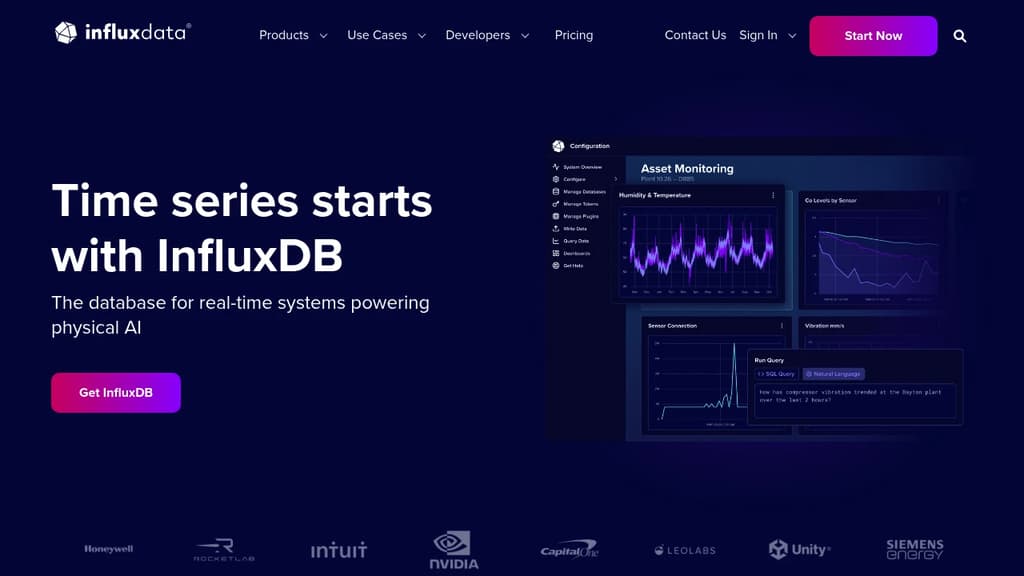
InfluxDB is a time series database built specifically for systems that generate continuous, high-resolution data. Think industrial sensors, satellite telemetry, power grids, and infrastructure monitoring. General-purpose databases weren't designed for this kind of workload, and the performance difference shows at scale.
The core strength is ingest speed. InfluxDB handles millions of data points per second without sacrificing query latency or blowing up storage costs. It uses efficient compression and stores data in Parquet format, which keeps footprint manageable even over long retention windows. Cold data gets automatically evicted and streamed into data lakes, warehouses, or AI/ML pipelines, so you're not paying hot-storage prices for data you rarely touch.
Key capabilities include:
- High-speed ingest – Millions of series ingested continuously without performance degradation
- Real-time analytics – SQL-based querying across unlimited series with low latency
- Edge-to-cloud continuity – Capture data at the source and analyze it anywhere without pipeline redesign
- Lakehouse integration – Automatic eviction of cold data into lakes, warehouses, and AI/ML systems
- 400+ Telegraf plugins – The open source Telegraf agent connects InfluxDB to virtually any data source, with over 5 billion downloads
- Client libraries – Official support for Python, Go, JavaScript, Java, and C#
Deployment is flexible. You can run it self-managed on-prem or at the edge, or use the fully managed cloud offering. Both options share the same engine, so you're not locked into a single environment.
Compared to alternatives like QuestDB, TDengine, or Timescale, InfluxDB has the largest installed base in its category, with over 1 million live open source instances and more than 2,800 contributors. It's ranked the top time series database by DB-Engines.
The tool targets engineers building monitoring systems, physical AI pipelines, aerospace telemetry platforms, and industrial data historians. If your workload involves continuous sensor streams and you need both fast writes and fast reads, InfluxDB is built around exactly that problem.

High-performance time-series database with industrial data management, built-in stream analytics, and AI-driven anomaly detection for operational environments.

TDengine is built for industrial organizations that need to move beyond legacy historians. It combines a high-performance time-series database with an industrial data management layer, giving engineers a single platform to ingest, store, contextualize, and analyze large-scale operational data.
The open-source core (TDengine TSDB) handles the heavy lifting: a specialized storage engine tuned for time-series workloads that claims 10x the performance of general-purpose databases at a fraction of the storage cost. Automated tiered storage and S3 support keep the data footprint manageable as data volumes grow.
On top of the database sits the historian layer, which is where TDengine differentiates itself from tools like InfluxDB or GreptimeDB:
- Industrial connectivity via OPC, MQTT, and Kafka with built-in ETL for cleaning and transforming data at ingestion
- Asset contextualization through a tree hierarchy, reusable templates, and rich metadata, so raw sensor data becomes meaningful operational context
- Stream analytics that continuously monitor data to generate KPIs and trigger alerts without manual rule configuration
- Process analytics including batch comparison, trend analysis, and correlation tools for root cause investigation
- AI-driven anomaly detection and forecasting powered by TDgpt, running directly inside the database without external tooling
- Zero-Query Intelligence that automatically surfaces dashboards, insights, and KPI recommendations based on data and business context
The AI assistant can generate analyses on demand and investigate alerts, making it practical for operations teams rather than just data engineers. This positions TDengine as a direct alternative to GE Proficy Historian and similar industrial historians, but with an open-source foundation that avoids vendor lock-in.
Security features include role-based access controls, IP whitelisting, data encryption, and backup and disaster recovery options, which matter in regulated industrial environments. The platform integrates with third-party BI and AI tools over open interfaces, so it fits into existing workflows rather than replacing them wholesale.

Time series database and monitoring platform compatible with Prometheus, handling billions of metrics with lower resource usage than most alternatives.
VictoriaMetrics is a time series database and observability platform built for teams that need to store and query large volumes of metrics, logs, and traces without the cost and complexity that typically comes with scale. It works as a drop-in replacement for Prometheus, so existing queries, dashboards in Grafana, and scrape configs carry over without rewriting anything.
The core appeal is efficiency. Organizations routinely report 5x to 10x reductions in storage and compute costs compared to Prometheus, Mimir, or InfluxDB at equivalent workloads. It handles millions of metrics per second on modest hardware, which makes it practical anywhere from a Raspberry Pi home lab to thousand-core distributed clusters.
Key capabilities include:
- MetricsQL: an extended query language compatible with PromQL, with additional functions for common monitoring patterns
- Long-term retention: store metrics for months or years rather than days, with optional downsampling in the enterprise tier
- High cardinality handling: stays performant where Prometheus struggles under large numbers of active time series
- OpenTelemetry support: ingest traces and logs alongside metrics through a unified stack
- Horizontal scalability: a cluster mode distributes ingestion and storage across nodes for very high throughput
- Single-binary simplicity: the single-node version runs as one process with no external dependencies
VictoriaMetrics competes directly with tools like OpenObserve, HyperDX, and GreptimeDB in the open source observability space. Its strongest differentiator is the combination of Prometheus compatibility and genuine resource efficiency at scale. Teams already running Prometheus can migrate incrementally, often within minutes, without touching their alerting rules or existing instrumentation.
An enterprise tier adds multi-tenancy, anomaly detection, downsampling, and dedicated engineering support. The open source version covers the full core feature set with no artificial limits on retention or ingestion rate.

Open-source time-series database offering massive ingestion throughput, millisecond queries, and SQL extensions, designed for optimal performance at any hardware scale.
QuestDB delivers exceptional performance for time-series data management with features that set it apart:
- Massive Ingestion Capability: Handles over 4 million rows per second per node, making it ideal for high-frequency data collection
- SQL Compatibility: Offers powerful time-series extensions while maintaining familiar SQL syntax and PostgreSQL wire protocol
- Hardware Efficiency: Performs effectively on both minimal hardware (like Raspberry Pi) and enterprise-grade servers
- Built-in Features: Includes out-of-box support for deduplication, out-of-order indexing, and real-time aggregations
- Integration Ready: Compatible with popular tools like Grafana, Pandas, Python, and various data streaming platforms
Used by major financial institutions and enterprises for real-time analytics, market data processing, and IoT applications.

Columnar, time-indexed analytics database built for streaming and batch data at scale, handling billions to trillions of rows with millisecond query response times.
Apache Druid is an OLAP database built for teams that need fast, concurrent analytics on massive datasets without pre-caching queries or pre-defining schemas. It targets use cases where query latency must stay low even as data volumes and concurrent users grow into the hundreds of thousands of queries per second.
Druid sits in the same space as tools like ClickHouse and QuestDB, but its architecture is distinctly oriented around streaming-first ingestion and elastic, loosely coupled components.
What makes it fast:
- Scatter/gather query engine preloads data into memory or local storage, avoiding data movement and network latency during query execution
- Automatic columnarization on ingestion, combined with dictionary encoding, bitmap indexing, and type-aware compression, means queries touch only the data they need
- Time-based indexing is a first-class citizen, which benefits time-series and event-driven workloads considerably
Streaming and batch ingestion:
Druid connects natively to Apache Kafka and Amazon Kinesis without additional connectors, supporting query-on-arrival at millions of events per second. Historical batch data and live streaming data are queryable through the same interface. Schema auto-discovery handles column detection and type inference automatically, updating as data evolves.
Operational features include configurable tiering with quality-of-service controls for mixed workloads, automatic continuous backup, multi-node replication, and automated recovery. These make it practical to run as a production system without constant manual intervention.
Analysts and developers use standard SQL across ingestion, transformation, and querying. Join operations work both at ingestion time and at query time, with best performance when tables are pre-joined during ingestion.
For teams evaluating time-series alternatives or looking beyond InfluxDB for higher-concurrency OLAP workloads, Druid's architecture handles cardinality and dimensionality that would slow down general-purpose databases significantly.

Apache IoTDB manages industrial IoT time-series data with high-throughput read/write, edge-cloud sync, ultra-high compression, and integrations with Hadoop, Spark, Flink, and Grafana.
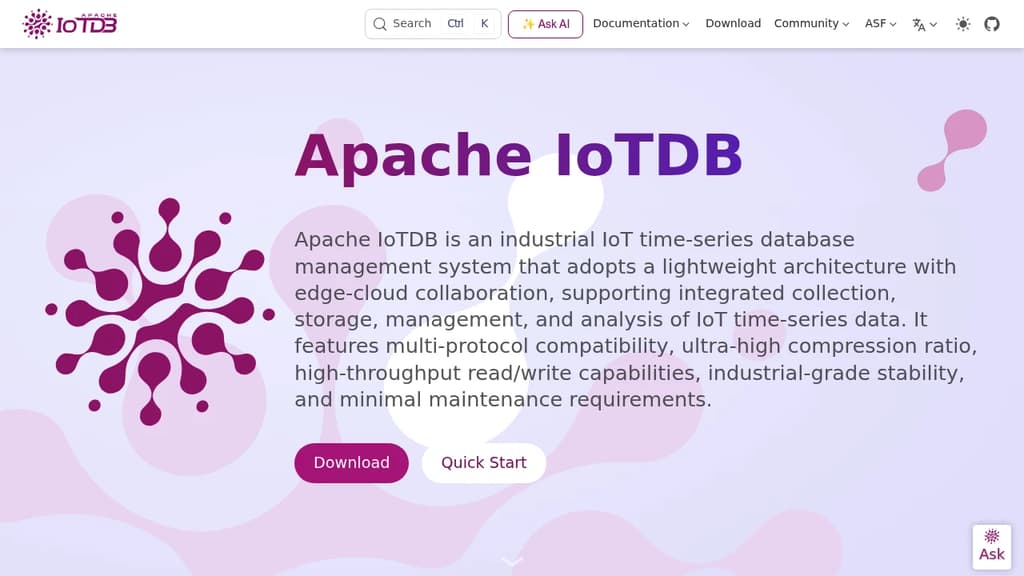
Apache IoTDB is a time-series database management system built specifically for industrial IoT environments. Where general-purpose databases struggle with millions of concurrent device connections and the relentless write pressure of sensor data, IoTDB is designed from the ground up for exactly that. It fits into IoT database deployments ranging from edge nodes to full cloud infrastructure, with a lightweight architecture that keeps hardware costs low.
The core appeal is scale without complexity. IoTDB can ingest data from millions of low-power devices simultaneously, while keeping disk storage costs remarkably low through a high compression ratio (under $0.23 per GB on hard disk). That's a meaningful difference for deployments measuring storage in terabytes.
Key capabilities include:
- High-throughput writes that handle mass device connectivity without batching workarounds
- Fuzzy directory search for navigating complex, deeply nested time-series hierarchies from heterogeneous device fleets
- Rich query semantics including time alignment across devices and sensors, time-dimension aggregation, and field-level computation
- Edge-cloud sync via a built-in Data Synchronization Tool, so data flows reliably between on-premise machines and cloud platforms
- Flexible deployment from one-click cloud install to desktop terminal tools
- Open ecosystem integrations with Hadoop, Spark, Flink, and Grafana out of the box
Compared to alternatives like InfluxDB or QuestDB, IoTDB leans heavily into industrial use cases: energy grids, railways, aerospace telemetry, steel manufacturing, and smart factories. It supports multi-protocol compatibility and targets environments where uptime and data integrity matter more than developer ergonomics.
If your data comes from physical infrastructure rather than application logs or financial ticks, IoTDB is worth evaluating seriously.

Distributed SQL database designed for high-speed ingestion and complex queries on massive datasets, ideal for IoT and time-series data.
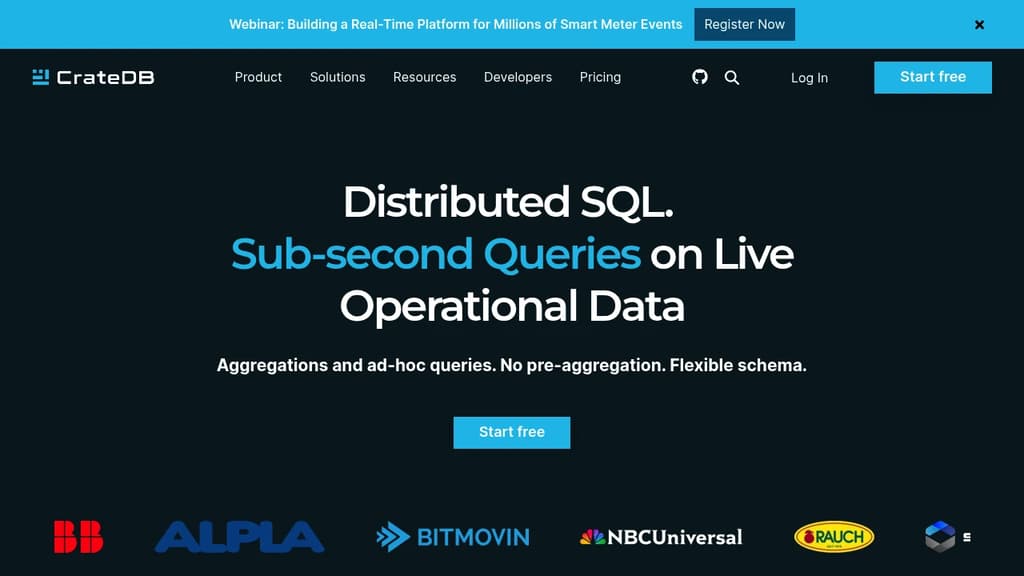
CrateDB is a powerful, distributed SQL database that excels in handling massive amounts of machine data in real-time. Built for the modern data landscape, it offers:
- Scalability: Easily scale horizontally across clusters to handle growing data volumes and user loads.
- Real-time analytics: Perform complex queries on large datasets with sub-second response times.
- Time-series optimization: Specifically designed to efficiently store and query time-series and IoT data.
- SQL + NoSQL: Combine the familiarity of SQL with the flexibility of schemaless data.
- Full-text search: Built-in Lucene-based full-text search capabilities for comprehensive data exploration.
- Multi-model: Support for structured, semi-structured, and geospatial data in a single database.
- Cloud-native: Containerized architecture for easy deployment in cloud environments.
- Low operational overhead: Self-healing clusters and automated sharding reduce management complexity.
CrateDB empowers organizations to derive actionable insights from their machine data, supporting use cases from IoT analytics and monitoring to log analysis and real-time dashboards. With its unique architecture, CrateDB bridges the gap between traditional relational databases and modern NoSQL systems, offering the best of both worlds for data-intensive applications.

Leverage advanced analytics with a modern PostgreSQL kernel. 100% open source for robust data solutions.
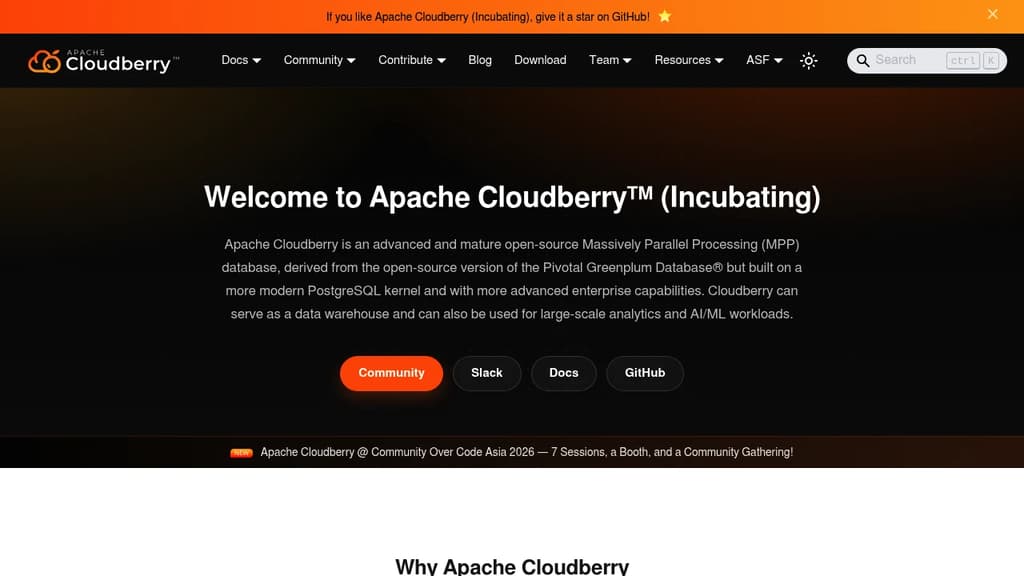
Apache Cloudberry is a cutting-edge open-source Massively Parallel Processing (MPP) database, designed for large-scale analytics and AI/ML workloads. Built on a modern PostgreSQL 14.4 kernel, it offers enhanced enterprise capabilities while maintaining compatibility with Greenplum Database. Fully open source, it allows you to maximize your data's value with robust features.
Key Benefits:
- Advanced Analytics: Ideal for data warehousing and complex analytics.
- Enterprise-Ready: Modern kernel with enhanced capabilities.
- Community Driven: Contribute and collaborate with a vibrant community.
Apache Cloudberry is currently incubating at The Apache Software Foundation, ensuring a stable and community-driven development process. Whether you're migrating from Greenplum or starting fresh, Cloudberry offers a seamless transition with tools like gpbackup. Join the community to contribute and explore the potential of your data.

People are looking for alternatives to...
View all alternatives
Claude Code

Spotify

CapCut

Claude
Notion

Lovable
 Openlane – Open-source, developer-first platform for automated compliance, risk management, and built-in Trust Center.

 Openlane