Open Source GE Proficy Historian Alternatives
A curated collection of the 2 best open source alternatives to GE Proficy Historian.
The best open source alternative to GE Proficy Historian is TDengine. If that doesn't suit you, we've compiled a ranked list of other open source GE Proficy Historian alternatives to help you find a suitable replacement. Other interesting open source alternative to GE Proficy Historian is Apache IoTDB.
GE Proficy Historian alternatives are mainly Time Series Databases. Browse these if you want a narrower list of alternatives or looking for a specific functionality of GE Proficy Historian.

Written by Piotr Kulpinski


High-performance time-series database with industrial data management, built-in stream analytics, and AI-driven anomaly detection for operational environments.
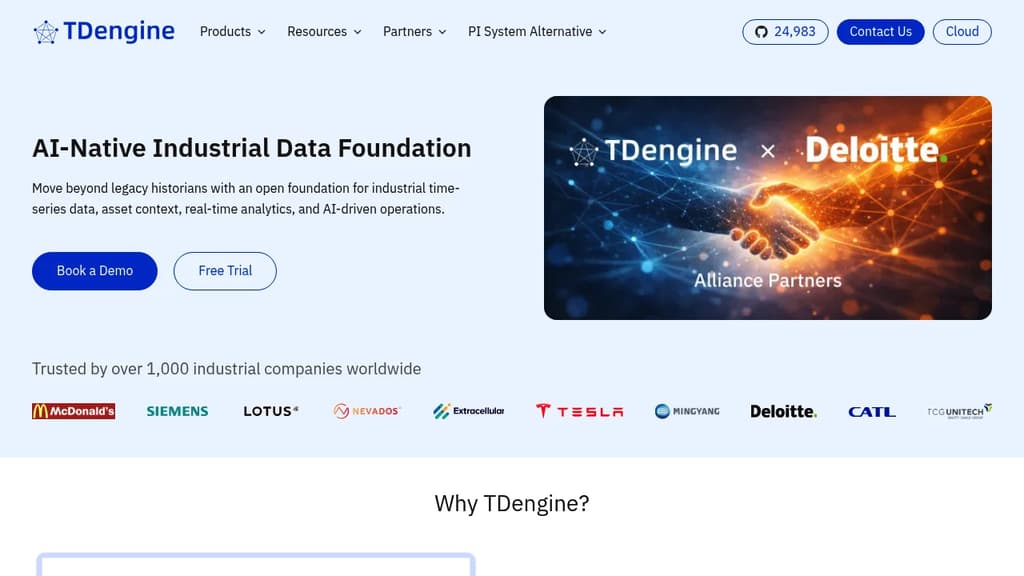
TDengine is built for industrial organizations that need to move beyond legacy historians. It combines a high-performance time-series database with an industrial data management layer, giving engineers a single platform to ingest, store, contextualize, and analyze large-scale operational data.
The open-source core (TDengine TSDB) handles the heavy lifting: a specialized storage engine tuned for time-series workloads that claims 10x the performance of general-purpose databases at a fraction of the storage cost. Automated tiered storage and S3 support keep the data footprint manageable as data volumes grow.
On top of the database sits the historian layer, which is where TDengine differentiates itself from tools like InfluxDB or GreptimeDB:
- Industrial connectivity via OPC, MQTT, and Kafka with built-in ETL for cleaning and transforming data at ingestion
- Asset contextualization through a tree hierarchy, reusable templates, and rich metadata, so raw sensor data becomes meaningful operational context
- Stream analytics that continuously monitor data to generate KPIs and trigger alerts without manual rule configuration
- Process analytics including batch comparison, trend analysis, and correlation tools for root cause investigation
- AI-driven anomaly detection and forecasting powered by TDgpt, running directly inside the database without external tooling
- Zero-Query Intelligence that automatically surfaces dashboards, insights, and KPI recommendations based on data and business context
The AI assistant can generate analyses on demand and investigate alerts, making it practical for operations teams rather than just data engineers. This positions TDengine as a direct alternative to GE Proficy Historian and similar industrial historians, but with an open-source foundation that avoids vendor lock-in.
Security features include role-based access controls, IP whitelisting, data encryption, and backup and disaster recovery options, which matter in regulated industrial environments. The platform integrates with third-party BI and AI tools over open interfaces, so it fits into existing workflows rather than replacing them wholesale.

Apache IoTDB manages industrial IoT time-series data with high-throughput read/write, edge-cloud sync, ultra-high compression, and integrations with Hadoop, Spark, Flink, and Grafana.
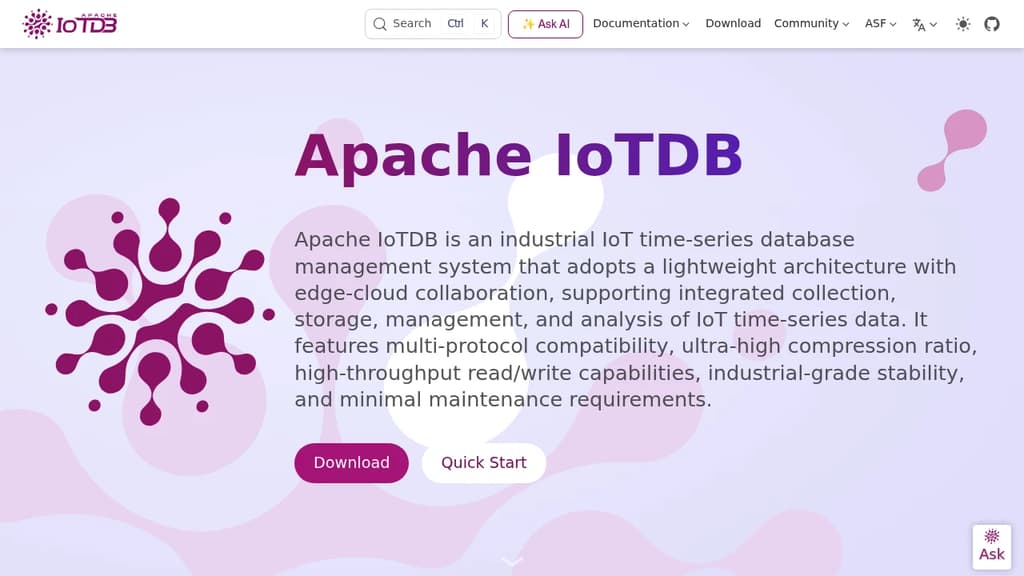
Apache IoTDB is a time-series database management system built specifically for industrial IoT environments. Where general-purpose databases struggle with millions of concurrent device connections and the relentless write pressure of sensor data, IoTDB is designed from the ground up for exactly that. It fits into IoT database deployments ranging from edge nodes to full cloud infrastructure, with a lightweight architecture that keeps hardware costs low.
The core appeal is scale without complexity. IoTDB can ingest data from millions of low-power devices simultaneously, while keeping disk storage costs remarkably low through a high compression ratio (under $0.23 per GB on hard disk). That's a meaningful difference for deployments measuring storage in terabytes.
Key capabilities include:
- High-throughput writes that handle mass device connectivity without batching workarounds
- Fuzzy directory search for navigating complex, deeply nested time-series hierarchies from heterogeneous device fleets
- Rich query semantics including time alignment across devices and sensors, time-dimension aggregation, and field-level computation
- Edge-cloud sync via a built-in Data Synchronization Tool, so data flows reliably between on-premise machines and cloud platforms
- Flexible deployment from one-click cloud install to desktop terminal tools
- Open ecosystem integrations with Hadoop, Spark, Flink, and Grafana out of the box
Compared to alternatives like InfluxDB or QuestDB, IoTDB leans heavily into industrial use cases: energy grids, railways, aerospace telemetry, steel manufacturing, and smart factories. It supports multi-protocol compatibility and targets environments where uptime and data integrity matter more than developer ergonomics.
If your data comes from physical infrastructure rather than application logs or financial ticks, IoTDB is worth evaluating seriously.

People are looking for alternatives to...
View all alternatives
Claude Code

Spotify

CapCut

Claude
Notion

Lovable
 InfluxDB – The purpose-built time series platform for high-velocity ingestion and real-time queries at scale.
 Windshift