Open Source Opsgenie Alternatives
A curated collection of the 5 best open source alternatives to Opsgenie.
The best open source alternative to Opsgenie is Keep. If that doesn't suit you, we've compiled a ranked list of other open source Opsgenie alternatives to help you find a suitable replacement. Other interesting open source alternatives to Opsgenie are: OneUptime, Nagios, Operational, and Wachd.
Opsgenie alternatives are mainly Infrastructure Monitoring Tools but may also be Monitoring & Observability Tools or Performance Monitoring (APM) Tools. Browse these if you want a narrower list of alternatives or looking for a specific functionality of Opsgenie.

Written by Piotr Kulpinski


Open-source platform for centralizing alerts, automating responses, and enhancing incident management across your tech stack.
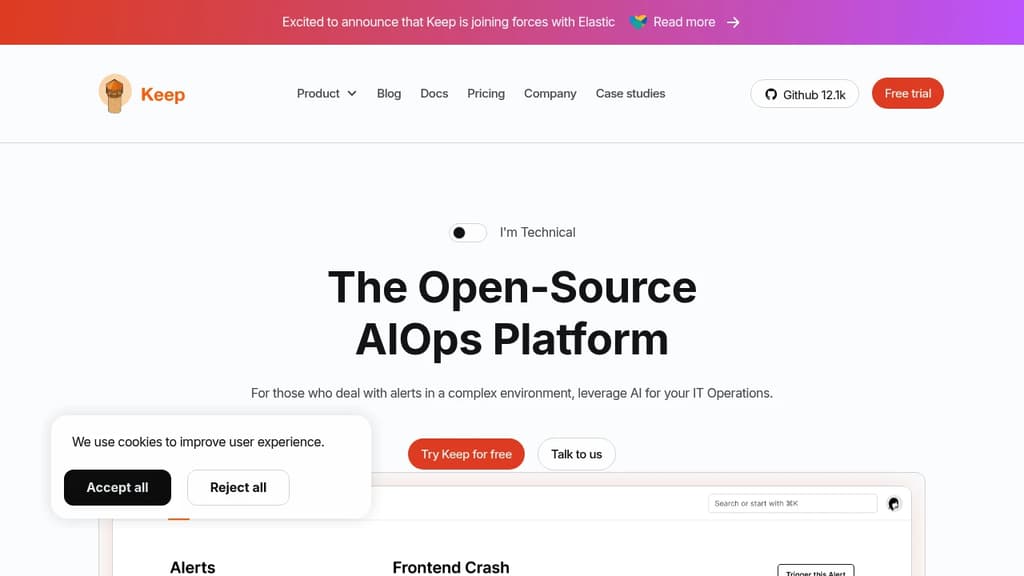
Keep is an innovative open-source solution designed to revolutionize how teams handle monitoring, alerting, and incident response. By centralizing alerts from various sources and providing powerful automation capabilities, Keep significantly enhances operational efficiency and reduces mean time to resolution (MTTR).
Key benefits of Keep include:
- Centralized Alert Management: Aggregate alerts from multiple monitoring tools, providing a single source of truth for your entire infrastructure.
- Powerful Automation: Create custom workflows to automate repetitive tasks, reducing manual intervention and human error.
- Flexible Integration: Seamlessly connect with popular monitoring tools, ticketing systems, and communication platforms.
- Advanced Filtering and Routing: Intelligently categorize and route alerts based on predefined rules, ensuring the right team members are notified.
- Customizable Dashboards: Gain instant visibility into your system's health with tailored, real-time dashboards.
- Collaborative Incident Response: Facilitate team collaboration during incidents with integrated communication tools and shared context.
- Open-Source Advantage: Benefit from community-driven development, transparency, and the ability to customize the platform to your specific needs.
By adopting Keep, organizations can streamline their monitoring processes, reduce alert fatigue, and respond to incidents more efficiently. This powerful tool empowers teams to focus on what matters most: maintaining system reliability and delivering exceptional user experiences.

All-in-one solution for uptime monitoring, incident management, and status pages to keep your services running smoothly
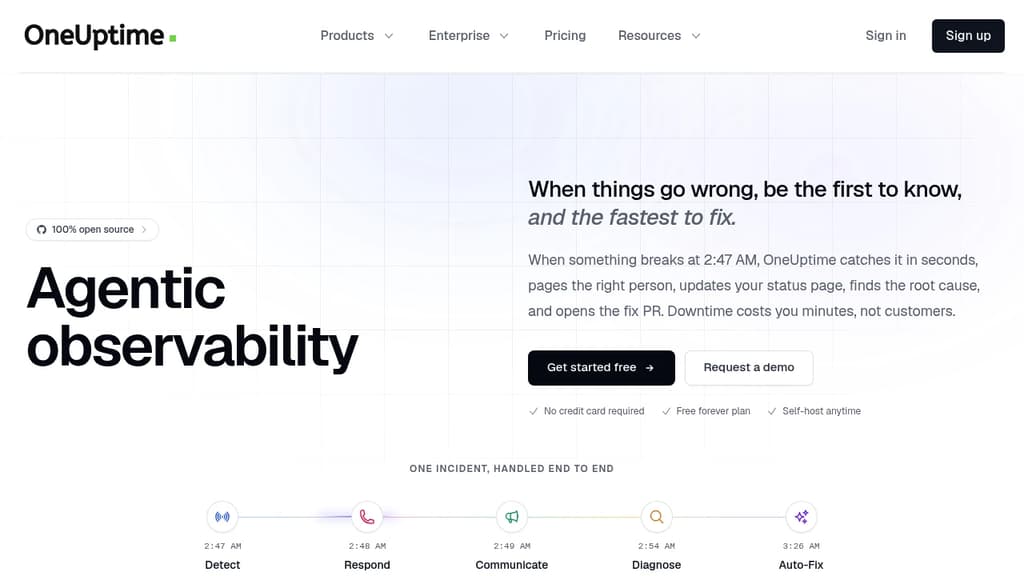
OneUptime is a powerful, open-source platform designed to help businesses maintain optimal service reliability and performance. By combining essential features into a single, intuitive solution, OneUptime streamlines your operations and enhances your ability to respond to issues quickly and effectively.
Key benefits of OneUptime include:
- Unified Monitoring: Keep track of your entire infrastructure with comprehensive uptime monitoring for websites, APIs, and servers.
- Proactive Alerts: Receive instant notifications through various channels when issues arise, allowing for rapid response and minimized downtime.
- Incident Management: Efficiently handle and resolve incidents with built-in tools for team collaboration, task assignment, and progress tracking.
- Custom Status Pages: Create branded, real-time status pages to keep your customers informed about service availability and ongoing incidents.
- Performance Insights: Gain valuable insights into your system's performance with detailed metrics and analytics.
- Flexible Integrations: Seamlessly integrate with popular tools and services to enhance your existing workflow.
- Open-Source Advantage: Benefit from community-driven development, transparency, and the ability to customize the platform to your specific needs.
With OneUptime, you can ensure your services remain reliable, your team stays informed, and your customers experience minimal disruption. Whether you're a small startup or a large enterprise, OneUptime provides the tools you need to maintain high availability and build trust with your users.

Free open source IT monitoring solution for servers, networks, and applications. Trusted by 1M+ users worldwide with powerful alerting and enterprise-grade features.
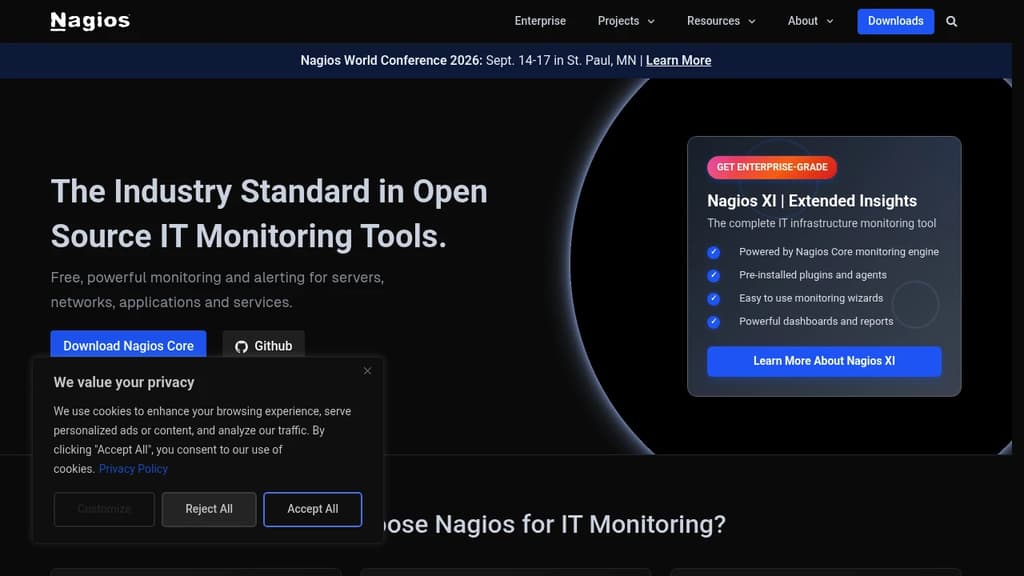
Nagios is the industry-standard open source monitoring solution that has been protecting critical IT infrastructure for over 25 years. Trusted by more than 1 million users worldwide, this powerful platform provides comprehensive monitoring and alerting for servers, networks, applications, and services.
The platform offers complete infrastructure monitoring capabilities, supporting Windows, Linux systems, and network devices to prevent downtime before it impacts business operations. With its powerful plugin architecture, users can extend functionality through thousands of community-developed plugins, including NRPE, NSCA, and custom monitoring solutions.
Key benefits include:
- Free, enterprise-grade monitoring with intuitive wizards and dashboards
- 573+ community add-ons available through Nagios Exchange
- Pre-configured solutions including Nagios XI for extended insights
- Global community support with active development and contributions
- Proven reliability with 4+ years in production environments
The Nagios Core Services Platform provides everything needed in one comprehensive package, including the monitoring engine, 50+ official plugins, cross-platform agents, and configuration tools. Whether you're monitoring simple setups or complex enterprise infrastructure, Nagios delivers the flexibility and reliability needed to maintain optimal system performance.

Track critical events, receive instant notifications, and respond to product activities with customizable webhooks and action buttons
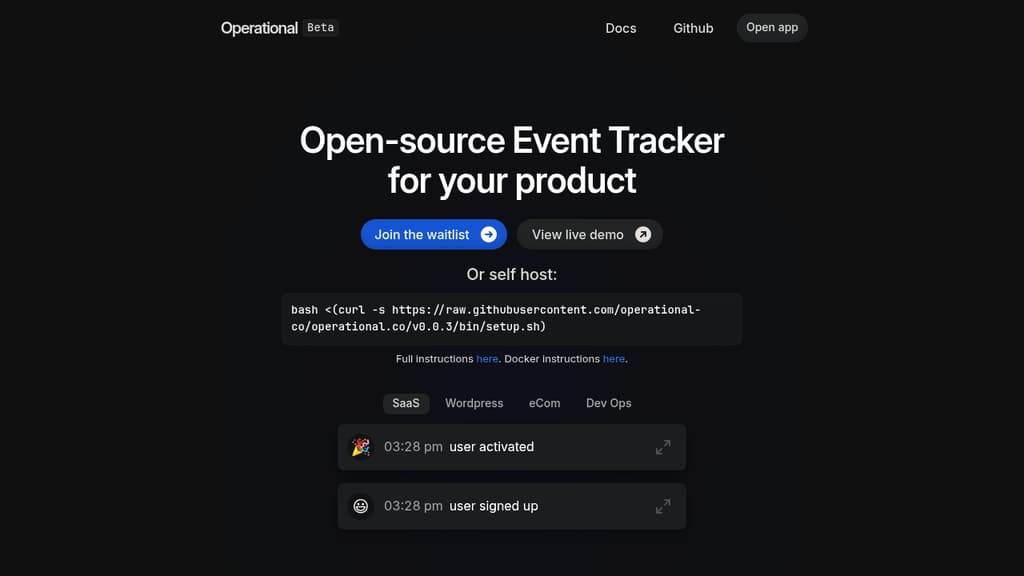
Operational is a purpose-built event tracking system for tech products that helps you stay on top of critical activities in real-time. The platform offers powerful features like:
- Instant notifications - Get push alerts for important events directly on mobile or web
- Action buttons - Trigger custom webhooks to respond to events immediately
- Workflow chaining - Connect related events to understand complex user journeys
- Rich event context - Capture detailed metadata like IP addresses, user info, and JSON payloads
- Simple integration - Quick setup with copy-paste code snippets and a developer playground
Unlike analytics tools that focus on trends, Operational provides granular visibility into individual events as they happen. The open-source platform can be self-hosted or used as a cloud service, making it ideal for developers who need real-time operational insights without complex setup.

Receive alerts from Grafana, Datadog, and Prometheus with AI-generated root cause analysis. Self-hosted on Kubernetes, fully air-gapped capable, Apache 2.0 licensed.
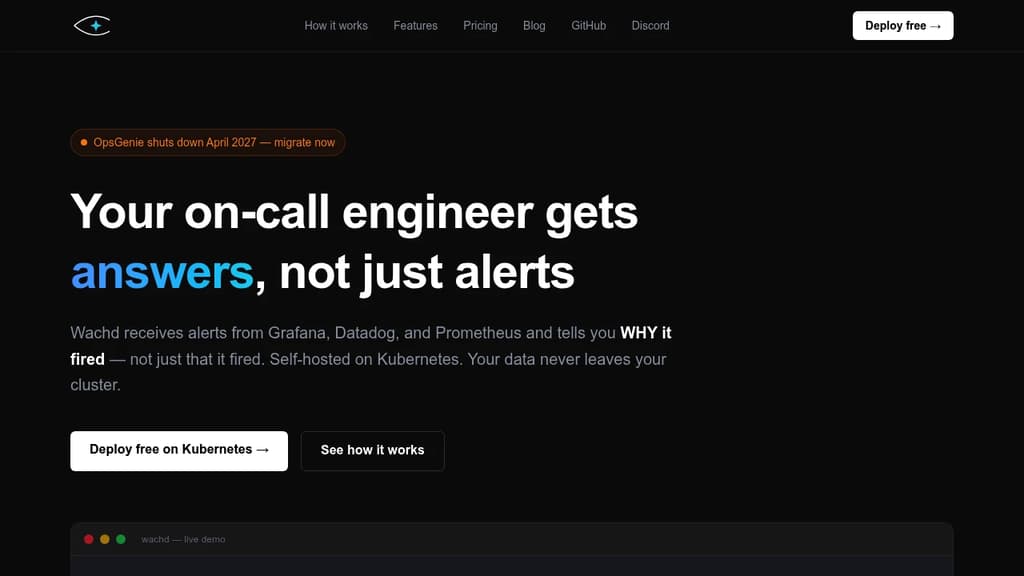
Wachd transforms on-call response by delivering root cause analysis alongside alerts instead of just firing notifications. When an alert triggers at 3am, your engineer receives not just "HighErrorRate firing" but a plain-English diagnosis correlating recent commits, error logs, and metric history—powered by your choice of AI backend.
Key capabilities include:
- AI root cause analysis - Correlates commits, logs, and metrics into actionable insights using Ollama, Claude, OpenAI, or Gemini
- Flexible on-call scheduling - Primary and secondary rotations with time-window restrictions and self-service overrides
- Per-user notification rules - Email, SMS, voice calls, and Slack in your preferred order with intelligent escalation
- Air-gapped ready - Run Ollama in-cluster with zero outbound API calls for isolated and classified environments
- PII sanitization - Automatically strips emails, IPs, API keys, and account IDs before AI processing
- Multi-tenant isolation - Complete data separation between teams with enforced query-level isolation
- Read-only by design - Connects to infrastructure for analysis only; cannot deploy, restart, or modify anything
- Self-hosted on Kubernetes - Helm chart deployment with support for external or in-cluster databases
Wachd integrates with Grafana, Datadog, Prometheus, Loki, GitHub, GitLab, Slack, Microsoft Teams, and major cloud platforms. The open-source version runs free with unlimited teams and users under Apache 2.0. Paid tiers add cloud AI backends and compliance features for growing teams and enterprises. Your incident data never leaves your cluster, making it ideal for GDPR compliance and regulated environments.

People are looking for alternatives to...
View all alternatives
Claude Code

Spotify

CapCut

Claude

Notion

Lovable
 CodeRabbit – The leading AI Code Review platform. Ship better quality code in 50% less time, with 90% fewer bugs.
 c15t
c15t