Open Source Goose Alternatives
A curated collection of the 6 best open source alternatives to Goose.
The best open source alternative to Goose is AutoGPT. If that doesn't suit you, we've compiled a ranked list of other open source Goose alternatives to help you find a suitable replacement. Other interesting open source alternatives to Goose are: LobeHub, Open Interpreter, Qwen Code, and OpenWork.
Goose alternatives are mainly AI Agent Platforms but may also be AI Coding Agents. Browse these if you want a narrower list of alternatives or looking for a specific functionality of Goose.

Written by Piotr Kulpinski


Platform for building, deploying, and running AI agents that automate repeatable digital work across research, outreach, content, and support without writing code.
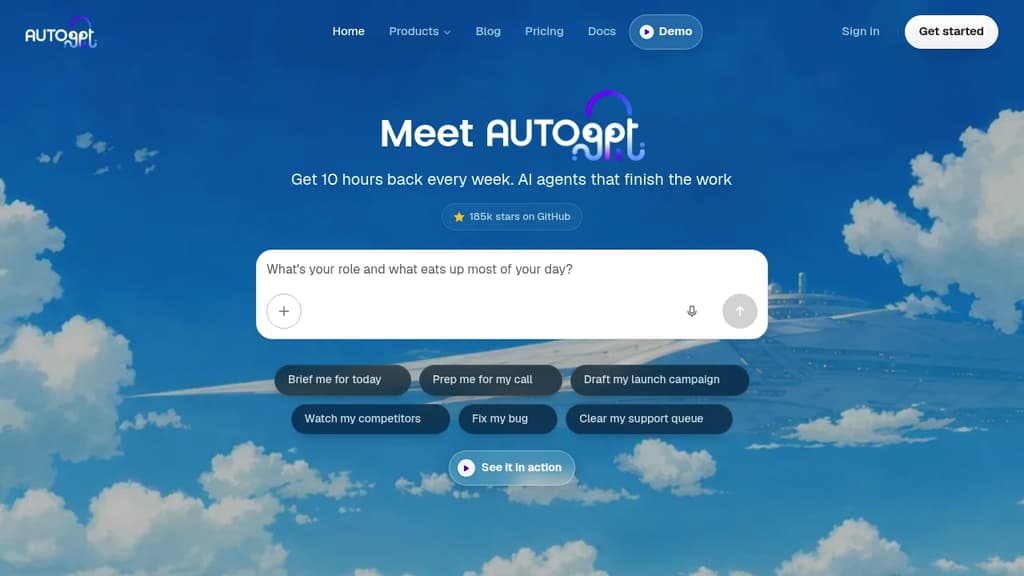
AutoGPT is an AI agent platform for people who want to hand off recurring work entirely, not just get help with a single task. You describe the outcome you want, and an agent plans and executes every step: pulling data, calling AI models, updating spreadsheets, sending messages, and looping back on a schedule. It's built for the kind of work that comes back every day or every week.
There are four ways to interact with the platform:
- AutoPilot lets you describe a job in plain English and builds the agent for you inside the conversation, no flowcharts or prompt engineering required.
- Visual Builder gives you a drag-and-drop canvas of blocks when you need exact control over branching, looping, and routing logic.
- Dashboard shows every agent's status, run history, and spend in one place, with alerts when an agent needs a decision from you.
- Marketplace offers ready-made agents from AutoGPT and the community, browsable without an account and deployable in one click.
On the integration side, the platform ships with dozens of AI models already connected (no API keys needed) and supports services like Gmail, Slack, Google Sheets, Notion, HubSpot, GitHub, and Airtable. Agents can handle chat, image generation, video, transcription, OCR, and more across 45+ platforms.
Common uses include morning briefings assembled from earnings and headlines, prospect research before sales calls, overnight campaign drafts, support ticket triage, and competitor monitoring that only pings you when something actually changes.
AutoGPT is fully open source. Self-hosting is free: you bring your own model API keys and infrastructure and get the same builder and agent runtime as the cloud. The hosted cloud removes the ops burden and covers model usage through a subscription. Teams often prototype in the cloud and move sensitive workloads on-prem later.
For teams that want a visual workflow automation approach rather than agent-based logic, tools like ByteChef or Automa take a different angle. If you're looking for an agent-first experience with a different focus, Eigent is worth comparing. AutoGPT's sweet spot is repeatable, multi-step work you can describe clearly enough to hand to a capable assistant.

Add AI agents to Slack, Discord or Telegram that pick up requests, hand coding to Claude Code or Codex, report back in thread, and learn from your corrections.
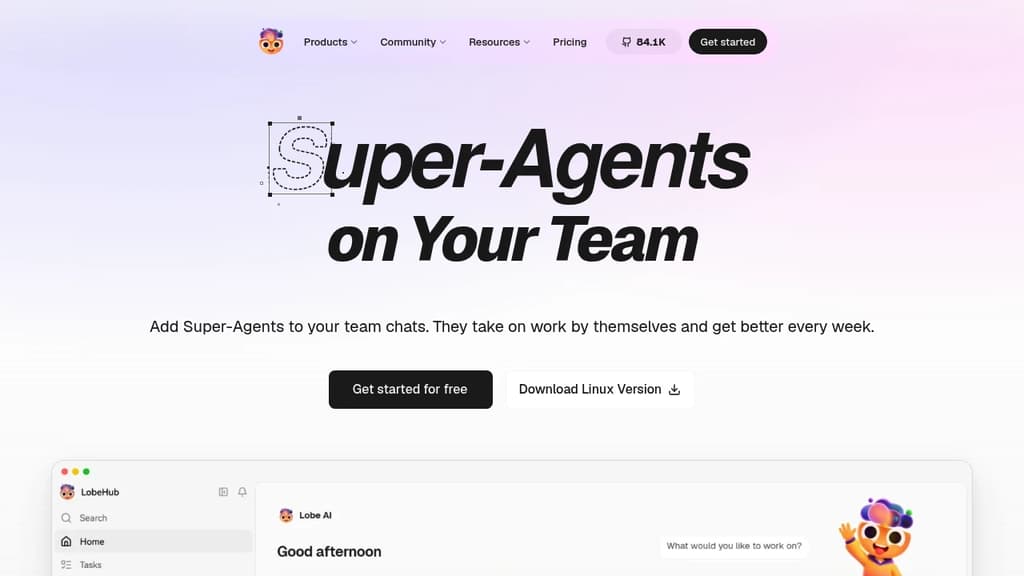
LobeHub is a collaborative agent platform where AI agents join your team chats and take on work. You add an agent to Slack, Discord or Telegram, and it reads the channel history, docs and code before it does anything. It's built for teams that want routine requests handled without someone assigning every task.
The agent can act on its own. With the "speak up on its own" setting on, it spots a feature request that several people have +1'd, creates a task, and starts work without being tagged.
- Coding handoff: it passes the build to Claude Code or Codex and tracks the task
- Acceptance checks: each delivery comes with screenshots or recordings, and you can send back any check that's off
- Pull requests: the PR merges only after you accept
- Thread replies: it tells the people who asked once the work is live
- Permissions: you decide what it can do, for example opening PRs freely while deploys need your OK
- Daily brief: a home page lists what finished, what's running, and what needs your decision
The agent also learns. A Self-evolving page shows each area it practices, the lessons you've taught it, and how often it gets things right. Mistakes become lessons, and a rule it keeps breaking is flagged so you can teach it again.
You can start with one agent and add more later, such as separate agents for design, releases and docs. Each teammate can have their own too. Agents remember team preferences, like sending pricing copy to a specific person for sign-off.

Coding agent that lets LLMs write and execute code, manage files, and control your computer using local or low-cost models.
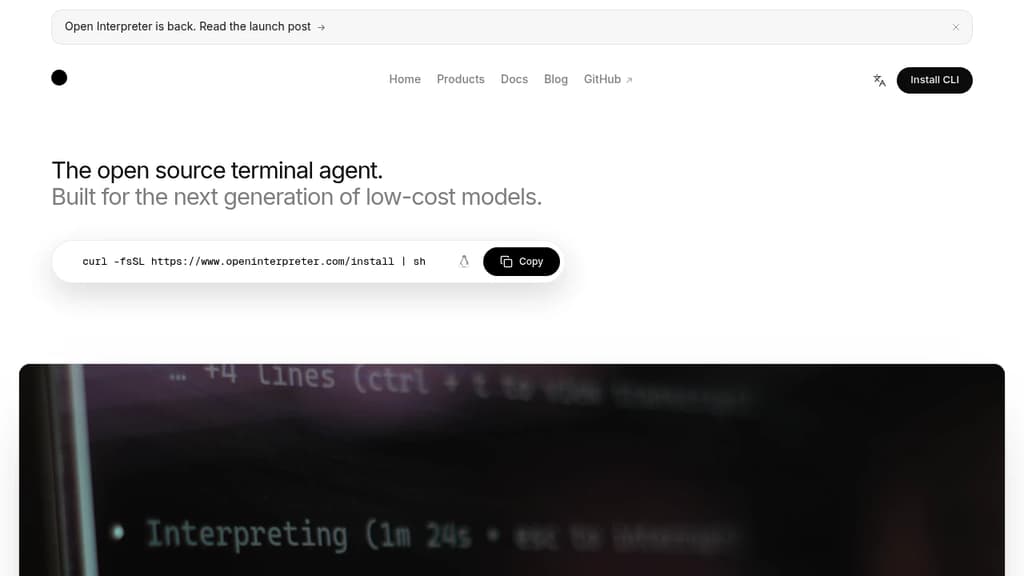
Open Interpreter brings the capabilities of a coding agent to your local machine, without requiring a subscription to a proprietary API. It lets language models write code, run it, browse the web, manage files, and interact with your operating system directly. Think of it as a terminal-based assistant that can actually do things, not just suggest them.
It's built specifically to work well with open-weight and local models, making it a practical choice for anyone who wants to avoid sending code or sensitive data to external servers. You can connect it to models running through Ollama or LocalAI, or point it at hosted providers for more capable models when needed.
Key capabilities include:
- Code execution across Python, JavaScript, Shell, and other languages, run directly in your environment
- File and system access so the agent can read, write, move, and modify files as part of completing tasks
- Web browsing to research, fetch data, or interact with online content
- Multi-model support with easy switching between local and remote LLMs
- Interactive chat interface that keeps context across a session, so you can refine tasks conversationally
- Computer control for more advanced automation tasks
Compared to cloud-only AI coding agent orchestrators like Codex, Open Interpreter puts you in control of which model runs and where. That matters for privacy, cost, and offline use. It also means performance depends heavily on the model you choose. Pair it with a strong open-weight model and it handles real tasks; use a weaker one and you'll feel the limits quickly.
It suits developers, researchers, and power users who want a capable local agent and are comfortable picking and configuring their own models.

Terminal-based AI coding agent that reads your codebase, edits files and runs commands, with support for Qwen, OpenAI, Anthropic, Gemini and local models.
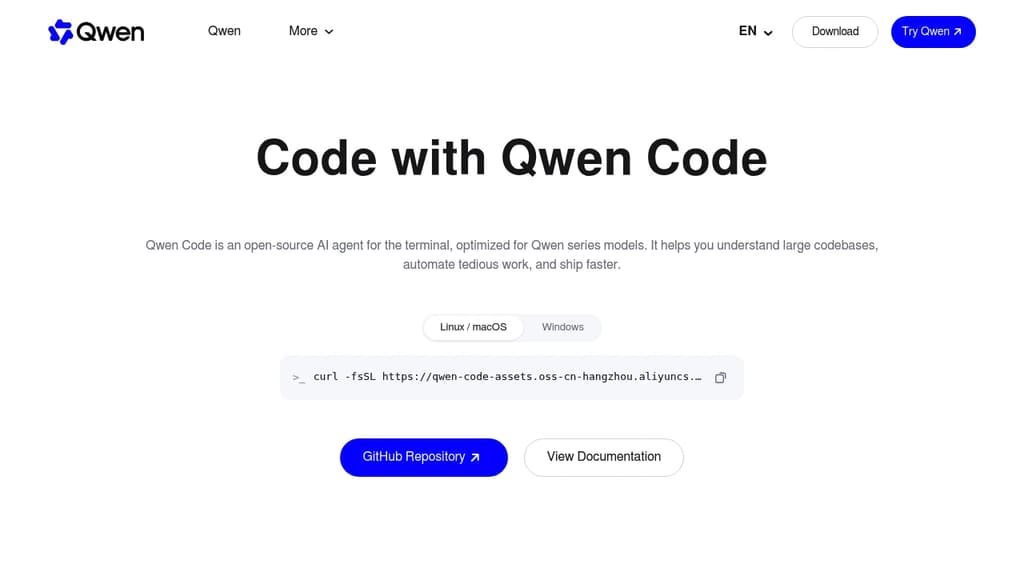
Qwen Code is an open source AI coding agent from the Qwen team at Alibaba. It runs in the terminal and reads your codebase, edits files, runs shell commands, and works through multi-step tasks on your local repository.
The project started from Google's Gemini CLI v0.8.2. Since v0.1 it has been developed independently, with its own features and support for many model providers.
Key capabilities:
- Multi-provider models: works with OpenAI, Anthropic, Gemini and Qwen APIs, any compatible third-party provider, and local models through Ollama or vLLM. You can switch models at runtime.
- Agent features: subagents, agent teams, skills, auto-memory and MCP server support.
- More than a terminal: IDE plugins for VS Code, Zed and JetBrains, a desktop app, a web UI, and SDKs for building on top of the agent.
- Chat integrations: run the agent from Telegram, DingTalk, WeChat or Feishu.
Qwen Code is optimized for Qwen models, and many of those are open-weight, so you can run both the agent and the model on your own hardware. It is a good fit for developers who want a Claude Code alternative without being tied to one model vendor.
Install it with the standalone script, npm (@qwen-code/qwen-code, Node.js 22+) or Homebrew.

Desktop app for teams to run AI agents across 50+ LLMs, share skills and MCP servers org-wide, and automate browser tasks with your own keys.
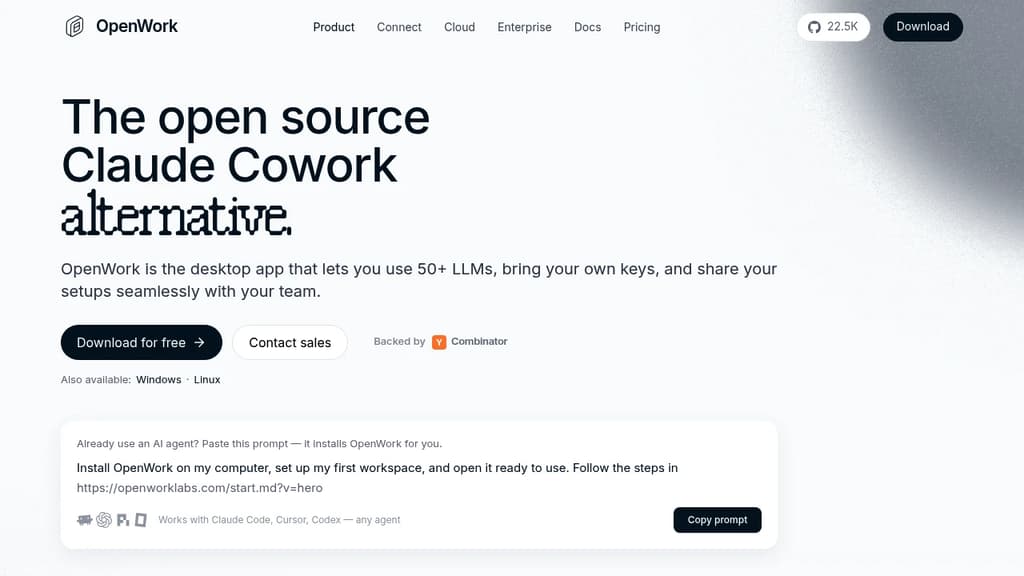
OpenWork is a desktop app (and browser-based workspace) that lets individuals and teams run AI agents against their own files, tools, and data. It's built on OpenCode and positions itself as an open alternative to Claude Cowork, supporting 50+ LLMs from providers like OpenAI, Anthropic, Google, Mistral, and local models, rather than locking you to a single vendor.
The core idea: bring your own API keys, wire in the tools your team already uses, and package everything into reusable setups that anyone can import in one click. No terminal required.
Key capabilities:
- Multi-model support – switch between OpenAI, Anthropic, Gemini, Bedrock, Azure AI Foundry, Mistral, OpenRouter, or local models. Connect your own keys or use a managed provider on cloud plans.
- Browser automation – describe a task in plain language and the agent executes it in a real browser. Like replies, extract data, fill forms, and save results to your machine.
- OpenWork Connect (MCP gateway) – add an MCP server or skill once, and every teammate gets it instantly across desktop, web, and any MCP-compatible client like Claude Code or Cursor. One URL covers your whole org, with auth, roles, and policies applied in transit.
- Skill and plugin sharing – Anthropic-compatible plugins and SKILL.md files work as-is. Teams package skills, configs, and MCP servers into a single shareable link.
- Local-first privacy – in desktop mode, files stay on your machine. Prompts go directly to the LLM provider you choose. Cloud workers are optional and sandboxed.
- Self-host or managed – run it on your own infrastructure or use OpenWork Cloud for central seat management, SSO, and bring-your-own inference.
For teams migrating from Claude Cowork, existing SKILL.md files and MCP servers import without modification. The free desktop app needs no account to start. Team plans add API access and the Extension Marketplace at $10 per seat per month after the first five free seats.

Open-source AI coding agent for the terminal that works with 25+ model providers, keeps sessions on your disk, and ships as a single Go binary with no telemetry.
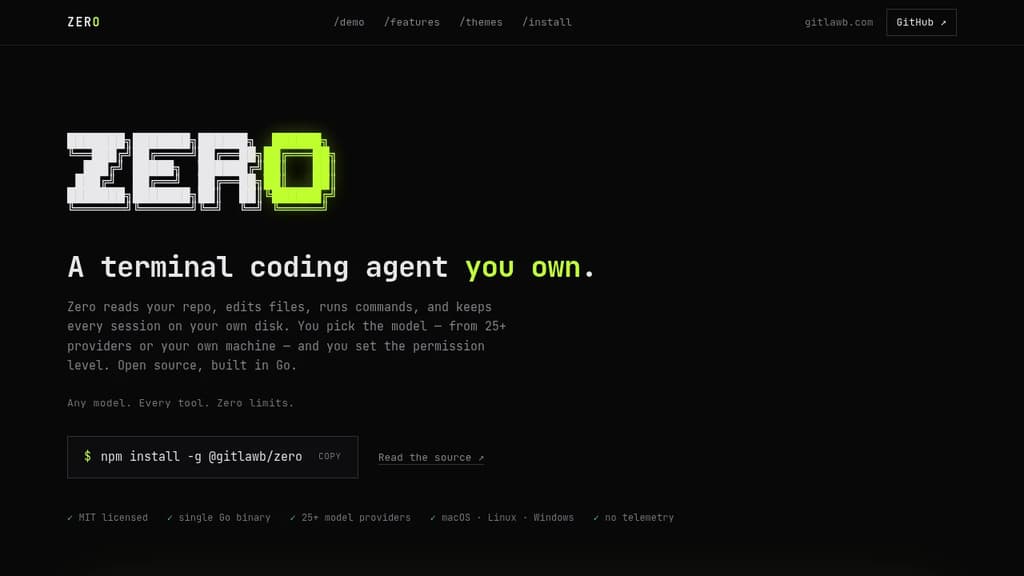
Zero is a terminal coding agent built for developers who want full control over their AI tooling. It reads your repo, edits files, runs commands, and stores every session locally on your disk. No cloud sync, no telemetry, no vendor lock-in on the model side.
The model choice is genuinely open. Zero connects to 25+ providers including OpenAI, Anthropic, Gemini, Mistral, Groq, DeepSeek, Bedrock, Vertex AI, and local options like Ollama and LM Studio. You can switch providers mid-session with /model, or point it at any OpenAI- or Anthropic-compatible endpoint.
Permissions are explicit and visible. Every side effect (file writes, shell commands, network access) is gated, with OS-level sandboxing. Autonomy is an opt-in, not the default. That makes it practical to run in CI as well as interactively.
Key capabilities:
- Headless mode for one-shot or scripted runs with JSON and stream-JSON output, plus reliable exit codes for pipelines
- MCP support in both directions: consume MCP servers over stdio, HTTP, or SSE, or expose Zero itself as an MCP server
- Spec-first runs to draft and review a plan before any file changes
- Specialist subagents to fan work out to focused sub-sessions you can inspect live
- Isolated git worktrees for risky changes you can discard if they don't pan out
- Session history that's searchable, resumable, and forkable from the command line
- Skills and plugins for encoding team conventions in markdown and extending behavior with hooks
- Scheduled agents for recurring jobs like nightly triage or dependency sweeps
- GitHub Action for PR review and CI jobs using the same agent
Sessions live in ~/.config/zero/ and API keys are stored in an encrypted local store. Unlike some other terminal agents, Zero ships as a single Go binary that runs on macOS, Linux, and Windows (x64 and arm64). Twelve contrast-audited themes are included.
It's MIT licensed. You pay your model provider, or nothing at all with a local model.

People are looking for alternatives to...
View all alternatives
Spotify

Claude

Claude Code

CapCut

Lovable

Notion
 Capture – Capture screenshots, generate PDFs, scrape content, extract metadata, and automate browsers with one API.

 Sent