Open Source Claude Cowork Alternatives
A curated collection of the 4 best open source alternatives to Claude Cowork.
The best open source alternative to Claude Cowork is LobeChat. If that doesn't suit you, we've compiled a ranked list of other open source Claude Cowork alternatives to help you find a suitable replacement. Other interesting open source alternatives to Claude Cowork are: OpenWork, Eigent, and Agenta.
Claude Cowork alternatives are mainly AI Agent Platforms but may also be AI Chat Interfaces or AI Personal Assistants. Browse these if you want a narrower list of alternatives or looking for a specific functionality of Claude Cowork.

Written by Piotr Kulpinski


A collaborative platform to create, schedule, and operate AI agents that handle long-running tasks, team workflows, and automated jobs without constant oversight.
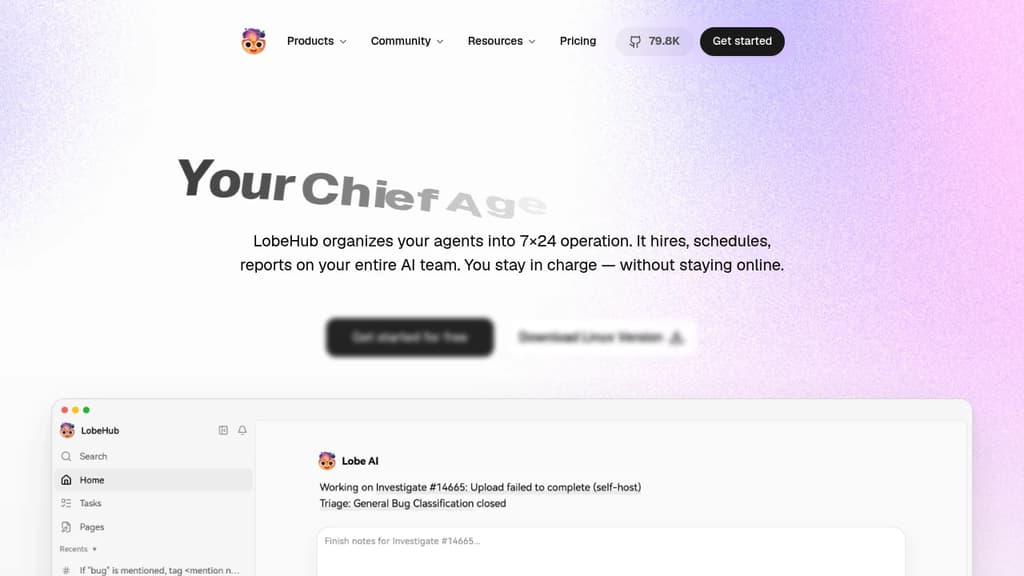
LobeHub is a platform for building and operating teams of AI agents. Rather than managing individual AI tools one at a time, it lets you assemble agents into coordinated groups, assign them tasks, and let them run. Agents report back on progress while you focus on higher-level decisions.
The agent builder starts from a single sentence. From that, LobeHub automatically configures names, roles, skills, and behaviors. Agents connect to a library of over 312,000 skills, and you can attach any model or modality you want. It works with providers like OpenAI and Anthropic, so you're not locked into one AI backend.
For longer or more complex work, LobeHub supports agent groups that self-assemble based on the task at hand. Multiple agents can work in parallel, iterate on each other's output, and handle multi-step jobs. This matters most for things like large-scale issue triage, content workflows, or anything that would otherwise require constant human coordination. Among AI agent platforms, that kind of parallel execution is still relatively rare.
The platform includes several workspace-style features: Pages for writing and refining documents with multiple agents sharing context, Projects for organizing work, Schedules for time-based task automation, and a shared Workspace with visibility controls for teams. There's also an IM Gateway that connects agents to messaging platforms where your team already communicates.
Agents are designed to improve over time. Personal Memory builds a structured, editable model of how you work. Continual Learning adjusts agent behavior based on patterns it observes. Memory is white-box, meaning you can inspect and edit what the system knows about you rather than treating it as a black box. That's a meaningful difference from tools like Khoj, where memory handling is less transparent.
LobeHub is open source and has a community component where agents and skills can be shared. It's built for individuals and teams who want AI to handle ongoing, multi-step work rather than single-turn interactions. If you're already using a knowledge management platform like Pipeshub or a multi-agent framework like Agno, LobeHub sits closer to the operational end of that spectrum, focused on running work rather than just organizing it.

Desktop app for teams to run AI agents across 50+ LLMs, share skills and MCP servers org-wide, and automate browser tasks with your own keys.
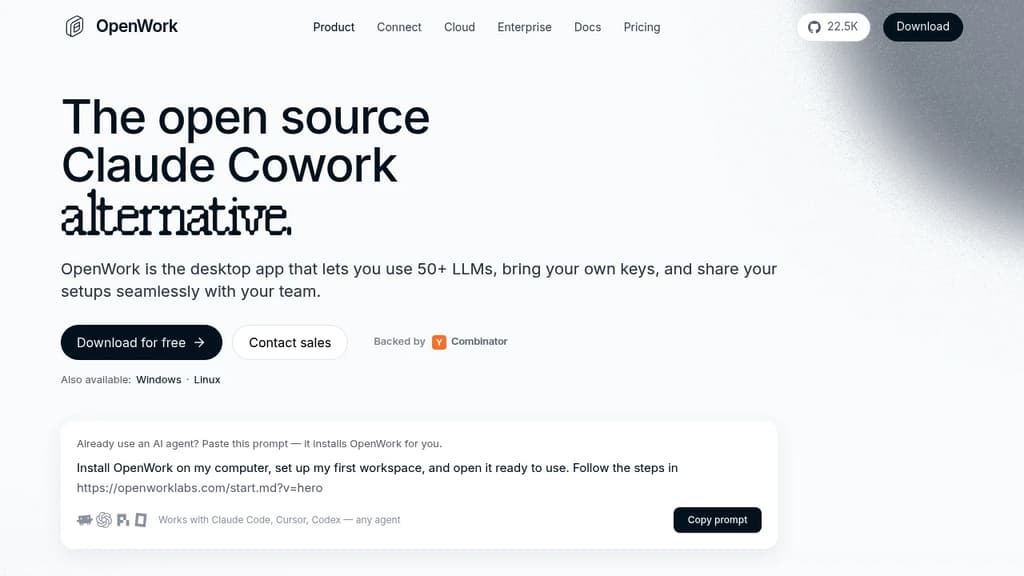
OpenWork is a desktop app (and browser-based workspace) that lets individuals and teams run AI agents against their own files, tools, and data. It's built on OpenCode and positions itself as an open alternative to Claude Cowork, supporting 50+ LLMs from providers like OpenAI, Anthropic, Google, Mistral, and local models, rather than locking you to a single vendor.
The core idea: bring your own API keys, wire in the tools your team already uses, and package everything into reusable setups that anyone can import in one click. No terminal required.
Key capabilities:
- Multi-model support – switch between OpenAI, Anthropic, Gemini, Bedrock, Azure AI Foundry, Mistral, OpenRouter, or local models. Connect your own keys or use a managed provider on cloud plans.
- Browser automation – describe a task in plain language and the agent executes it in a real browser. Like replies, extract data, fill forms, and save results to your machine.
- OpenWork Connect (MCP gateway) – add an MCP server or skill once, and every teammate gets it instantly across desktop, web, and any MCP-compatible client like Claude Code or Cursor. One URL covers your whole org, with auth, roles, and policies applied in transit.
- Skill and plugin sharing – Anthropic-compatible plugins and SKILL.md files work as-is. Teams package skills, configs, and MCP servers into a single shareable link.
- Local-first privacy – in desktop mode, files stay on your machine. Prompts go directly to the LLM provider you choose. Cloud workers are optional and sandboxed.
- Self-host or managed – run it on your own infrastructure or use OpenWork Cloud for central seat management, SSO, and bring-your-own inference.
For teams migrating from Claude Cowork, existing SKILL.md files and MCP servers import without modification. The free desktop app needs no account to start. Team plans add API access and the Extension Marketplace at $10 per seat per month after the first five free seats.
Self-hostable desktop app that runs a coordinated team of AI agents to browse the web, manage files, execute terminal commands, and complete complex workflows.
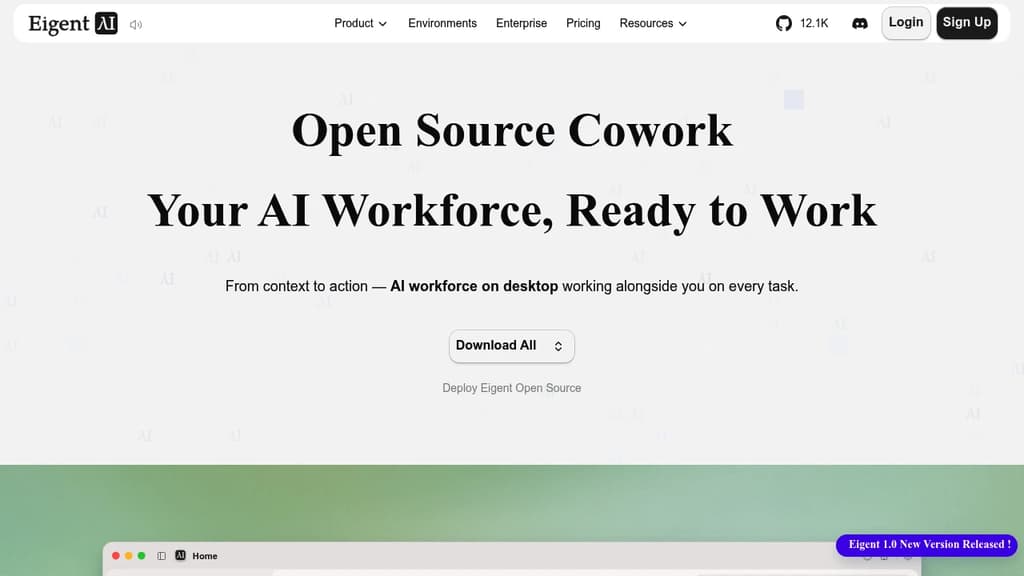
Eigent is a desktop application that puts a multi-agent AI workforce on your machine. You describe a task, and a pool of specialized agents divides it up, works in parallel, and delivers results. It's built for people who want AI to actually finish work, not just assist with it.
The core idea is "cowork": agents operate alongside you in your desktop environment with access to your local files, browser, and terminal. You can run a single focused agent for direct tasks or spin up a full workforce where agents collaborate across steps. A Browser Agent handles web research, a Document Agent reads and writes files, a Terminal Agent runs shell commands, and a Multi-modal Agent processes images and other media.
Key capabilities include:
- Scheduled automation: set recurring workflows so agents run tasks on a timer, even when you're not at your desk
- Local-first execution: files, credentials, and context stay on your machine; nothing has to leave it
- Model agnostic: connect cloud APIs, enterprise model gateways, or local inference. No vendor lock-in
- MCP and skill support: track which tools, skills, and referenced files each agent uses during a task
- Agent folder: every file an agent creates or modifies during a task is surfaced in one place for review
The open source version is fully self-hostable with your own API keys or local models. It's built on CAMEL-AI, a multi-agent framework, and runs on Mac, Windows, and Linux.
For teams doing research-heavy work, competitive analysis, report generation, or any task that involves pulling from multiple sources and producing structured output, Eigent is closer to OpenHands than a simple chat interface. It's designed to complete multi-step work end-to-end rather than hand control back to you at every turn.

Open-source workspace for building and running AI agents: chat-driven development, scheduling, human-in-the-loop approvals, versioning, and tracing. Self-host or use the cloud.
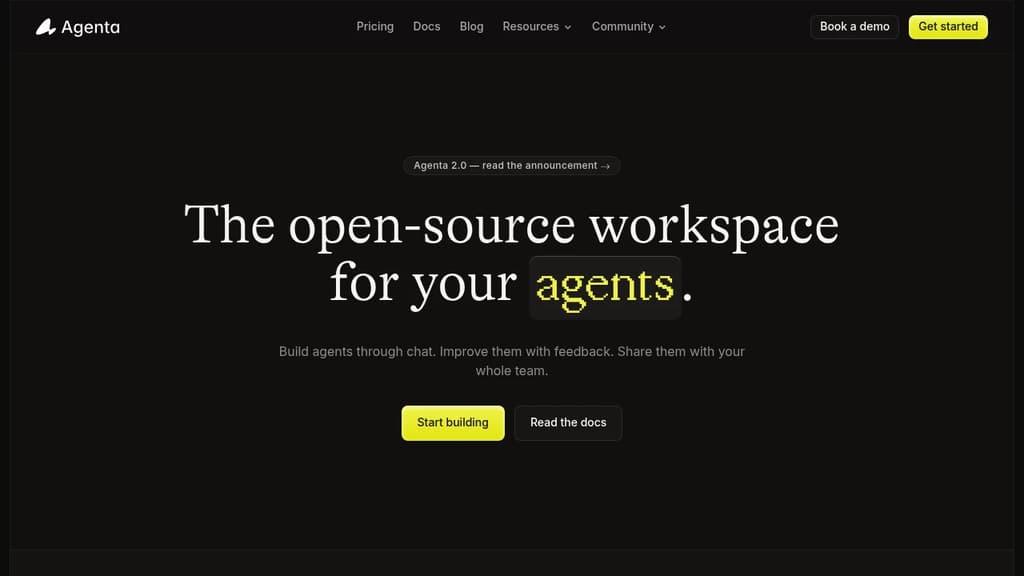
Agenta is a workspace for teams building and operating AI agents. It's built around a simple idea: you should be able to work with an agent in chat, then turn that same conversation into an automated workflow without rewriting anything.
You start by describing what you want done. The agent works with your files, apps, and integrations to get it done. When you're satisfied, you tell it when to run on its own. That's the whole loop.
Key capabilities:
- Chat-first development – build and test agents conversationally, then schedule them to run without you
- Human-in-the-loop controls – consequential actions pause for your approval before anything is sent or changed
- Full versioning – prompts, skills, and tools are versioned like code, with rollback to any point
- Run tracing – every execution shows each step, its cost in tokens and dollars, and where failures occurred
- Continuous improvement – feedback from real runs becomes test cases, and changes are evaluated before they ship
- Open standards – agents are defined as AGENTS.md files with skills and MCP tools, so you can swap the model, harness, or runtime without rewriting the agent
Agenta ships with templates for common jobs: code review, customer support, sales outreach, knowledge retrieval, and operations. The code review agent template, for instance, reads pull request diffs, flags bugs and security issues inline, and tags code owners when sensitive areas like auth or billing are touched.
For teams concerned about data residency, Agenta is MIT-licensed and fully self-hostable. The self-hosted version runs the same code as Agenta Cloud, with no feature gaps or lock-in. When running locally, you can use your existing Claude or ChatGPT subscription rather than paying for a separate API key.
Agenta fits teams that want to move agents from prototype to production without losing visibility into what's actually happening at runtime.

People are looking for alternatives to...
View all alternatives
Spotify

Claude Code

Claude

CapCut

Notion

Lovable
 Postiz – The All-in-One agentic social media scheduling tool
 Capture