Open Source XWiki Alternatives
A curated collection of the 5 best open source alternatives to XWiki.
The best open source alternative to XWiki is Macro Docs. If that doesn't suit you, we've compiled a ranked list of other open source XWiki alternatives to help you find a suitable replacement. Other interesting open source alternatives to XWiki are: AppFlowy, Affine, Outline, and Docmost.
XWiki alternatives are mainly Collaborative Notes & Wikis but may also be Wiki Software or Internal Knowledge Bases. Browse these if you want a narrower list of alternatives or looking for a specific functionality of XWiki.

Written by Piotr Kulpinski


Collaborative markdown documents with real-time CRDT editing, AI agent cursors, mention linking, and built-in properties tied to your tasks, channels, and email.
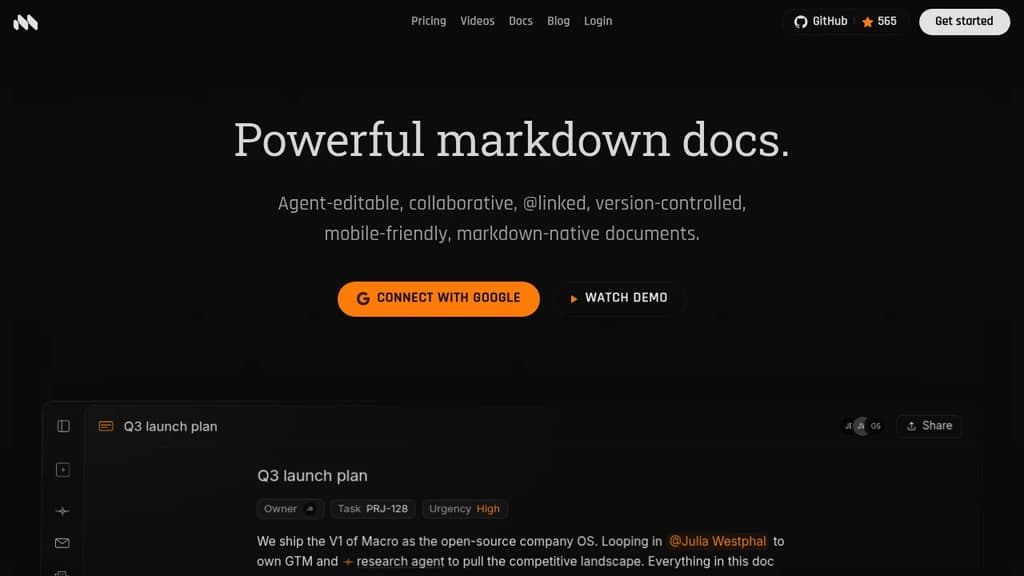
Macro is a markdown-native document editor built to live inside a broader workspace, not alongside one. Every doc connects directly to tasks, email, channels, and AI agents through @mentions that render as live inline pills. What sets Macro apart from tools like Notion or Google Docs is the agent layer. AI agents can edit documents alongside you with a live cursor, not just suggest a diff.
Key capabilities include:
- @mention anything: people, docs, tasks, channels, and calls all render as live inline pills inside any page.
- Markdown-native: type standard markdown and it formats in real time; export back to clean plain markdown anytime.
- Document properties: attach status, assignee, tags, dates, and custom fields directly to a doc without leaving the editor.
- Slash commands: insert headings, tables, code blocks, math equations, and task items with a single keystroke.
- Inline comments and version history: comment on any selection, resolve threads, and restore or fork any past version.
- Unified search: one search index across docs, tasks, email, and channels.
The editing foundation is built on CRDTs (Conflict-free Replicated Data Types), which means multiple people can type on the same line simultaneously without conflicts. Edits apply locally first and reconcile in the background, so the experience stays fast even offline. The backend is written in Rust with a SolidJS frontend, and each document runs as its own Durable Object in the cloud, keeping latency low. Macro is licensed under AGPLv3.
Macro is aimed at teams who want the writing experience of something like Outline or Logseq but need their docs to stay in sync with everything else happening at work. Things can be @mentioned directly in a doc and given context from tasks, channels, or email threads in the same workspace.

Open source collaborative workspace combining notes, databases, and AI with full data ownership, offline support, and self-hosting options.
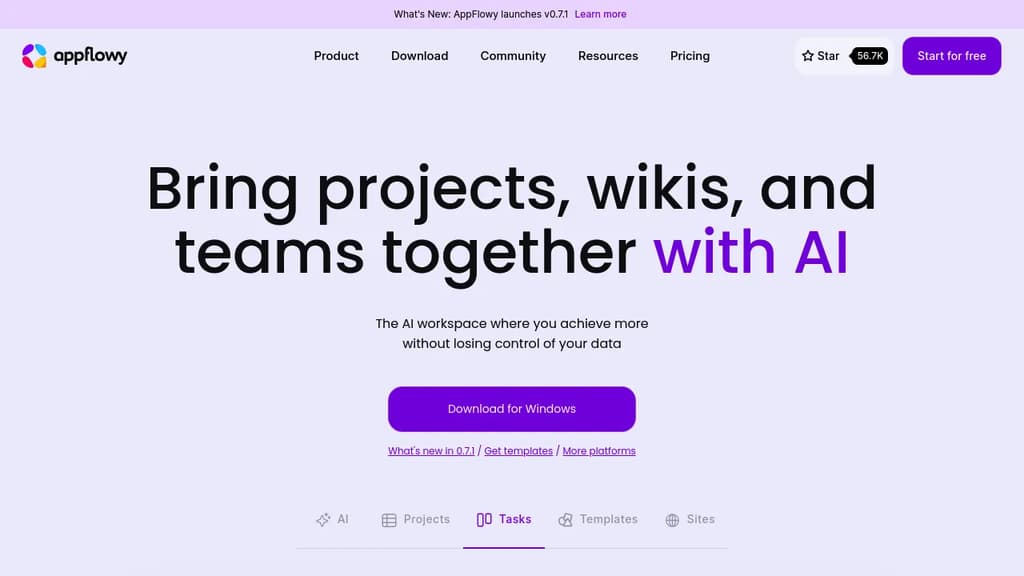
AppFlowy is an open source workspace that brings together documents, wikis, project tracking, and team collaboration in one place. It's built as a self-hostable alternative to tools like Notion, designed for people who want a modern workspace without handing their data to a third-party cloud.
The core of the product is a block-based editor paired with flexible databases. You can build pages with rich content types, attach properties and labels to records, and switch between different views of the same data. Grids, boards, and calendars are all available. Custom themes and fonts let you adjust the look to your preference.
AI is built directly into the workspace, not bolted on as a separate add-on. You can ask questions across your pages, generate and improve writing, and autofill database fields from existing content. AppFlowy supports multiple AI backends including GPT-5, Gemini 2.5, and Claude 3.7, and it also supports running local models like Mistral 7B and Llama 3 on your own machine. That local option matters for teams or individuals who need AI assistance without sending data to external servers — something tools like Flowise AI or Langflow approach from a different angle.
Offline mode is fully supported. The app works without an internet connection and syncs when connectivity returns, across desktop and mobile. iOS and Android apps are available alongside the desktop clients.
Self-hosting is a first-class option, not a workaround. You can run AppFlowy on your own infrastructure with no vendor lock-in. For teams that can't store sensitive information in someone else's cloud, this is a practical path. If you're also evaluating Baserow for database-heavy workflows or OpenWork for team collaboration, AppFlowy sits at the intersection of both.
The project has over 400 contributors and a community spanning more than 215 countries. A plugin and template ecosystem is actively growing, which extends the toolbox beyond what ships by default.

An open-source, local-first knowledge base that merges structured docs, infinite whiteboards, databases, and AI into a single workspace for teams and creators.
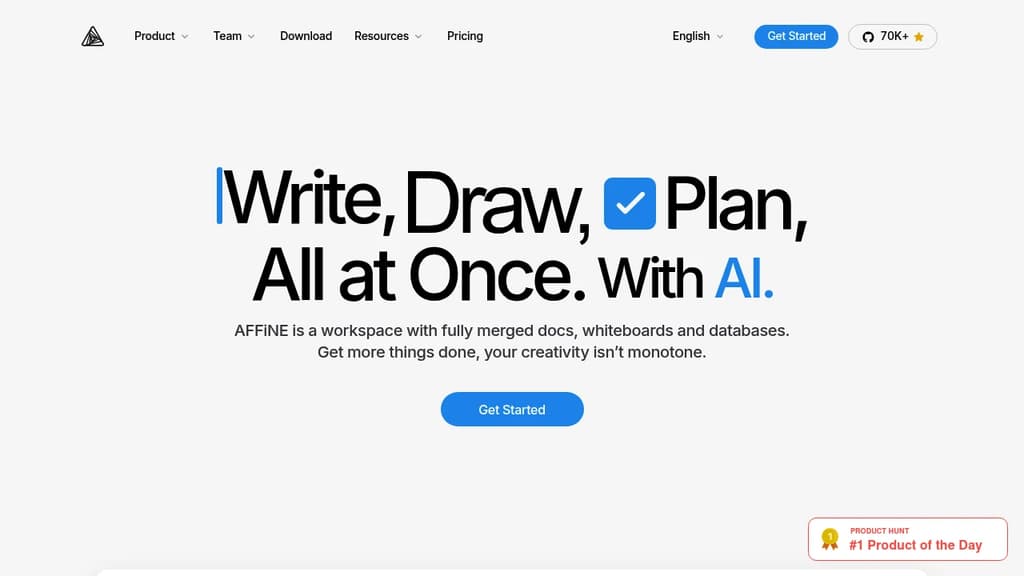
AFFiNE brings together the tools that most teams keep separate: a block-based document editor, an infinite whiteboard, Kanban boards, and a database layer, all inside one workspace. It's built for people who are tired of copying information between a wiki, a whiteboard app, and a project tracker. Everything lives in one place, and it's connected.
The local-first design is a genuine differentiator. Your data sits on your device by default, not on someone else's server. Sync is available, but you're not forced into a cloud subscription to use the core product. For teams with privacy requirements or individuals who want full ownership of their notes and plans, that matters.
Key capabilities:
- Edgeless mode turns any page into an infinite canvas where you can sketch, drag in documents, add sticky notes, and map out ideas spatially
- Block-based editing lets you build documents from reusable content blocks, mixing text, images, databases, and embeds freely
- Kanban boards sit alongside docs for project tracking without needing a separate tool like Trello or Jira
- AI integration assists with writing, summarizing, and planning directly inside the workspace
- Templates cover common use cases out of the box, from meeting notes to project plans
- Real-time collaboration lets teams work on the same page simultaneously
Compared to tools like AppFlowy or AnyType, AFFiNE leans harder into the visual side. The whiteboard isn't an afterthought; it's a first-class mode that can hold entire knowledge maps. Compared to Outline, it's less focused on structured wikis and more on freeform, mixed-media workspaces.
Free for individuals. Teams and commercial users pay for additional features. The source code is fully public, so self-hosting is an option for those who want it.

Team knowledge base with real-time collaboration, AI-powered search, Slack integration, and self-hosting support for internal docs and wikis.
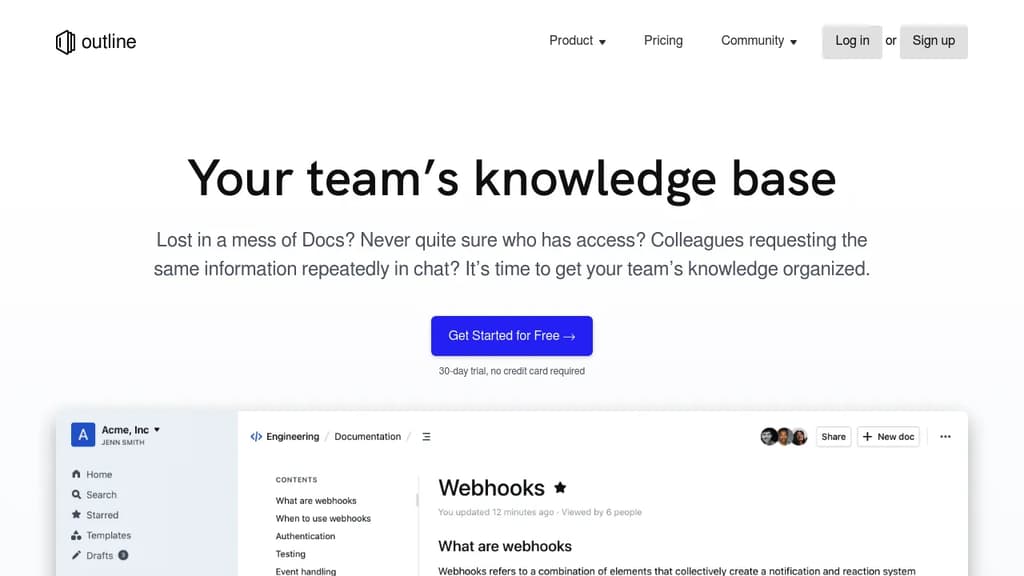
Outline is a team knowledge base built for companies that have outgrown scattered docs, messy shared drives, and repeated Slack questions. It gives teams a single place to write, organize, and find internal documentation, from product specs and onboarding guides to meeting notes and support answers. It's available as a cloud-hosted service or self-hosted on your own infrastructure.
The editor is fast. Documents load instantly, search returns results in milliseconds, and the UI stays snappy even in large workspaces. Writing feels close to plain text, with markdown support and slash commands, but you also get interactive embeds, real-time multiplayer editing, and threaded comments for keeping conversations tied to specific content.
Key capabilities include:
- AI-powered search that lets you ask questions about your documents and get direct answers, not just a list of links
- Slack integration for searching, sharing, and asking questions without leaving chat, plus channel notifications when docs change
- Granular permissions with read/write controls, user groups, guest access, and public sharing via link
- Custom branding with your own domain, colors, and logo
- 20+ integrations including Figma and Loom
- Localization with RTL support and translations in 20 languages
Outline sits in the same space as tools like Docmost or AppFlowy for collaborative wikis, but it's particularly focused on speed and team-wide usability rather than personal note-taking. Unlike personal tools such as Logseq, Outline is designed around shared workspaces with access controls from the start.
The codebase is open source, and self-hosting is a first-class option for teams that need to keep data on their own servers. A cloud-hosted plan with a 30-day free trial is also available for teams that want to get started without managing infrastructure.

Self-hosted wiki platform for enterprise teams with real-time collaboration, built-in AI, SSO, RBAC permissions, and compliance support for ITAR, FedRAMP, and GDPR.
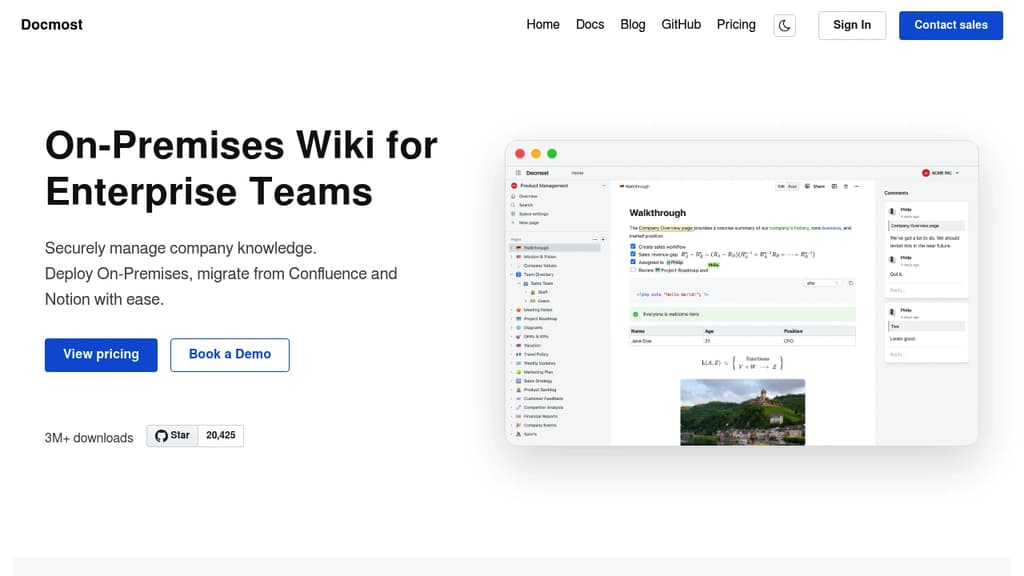
Docmost is a self-hosted wiki platform built for teams that need full control over their data. It's aimed at organizations where compliance isn't optional: defense contractors, regulated industries, and companies subject to GDPR or FedRAMP requirements. You deploy it on your own servers, including air-gapped or isolated environments, and your data never leaves your infrastructure.
The editor supports rich text, tables, code blocks, and real-time collaboration with live cursors. Multiple people can edit the same page simultaneously, with changes syncing instantly across devices. Pages are organized into team spaces, so departments or projects can maintain their own areas without everything bleeding together.
Key capabilities:
- AI assistant that works with self-hosted models (Ollama, vLLM) or cloud providers (OpenAI, Gemini, Azure OpenAI). Chat with your knowledge base, get answers with source citations, and search semantically across all spaces.
- MCP server support exposes your wiki to AI tools like Claude or Cursor via the Model Context Protocol, with no vendor lock-in.
- Built-in diagramming via Draw.io, Excalidraw, and Mermaid, covering everything from UML to quick whiteboard sketches.
- Page verification workflows for tracking reviews and approvals, supporting ISO 9001, ISO 27001, and SOC 2 compliance.
- Enterprise authentication with SAML 2.0, OpenID Connect, LDAP, and MFA.
- RBAC permissions with granular control over who can view, edit, or administer content.
Teams migrating from Confluence or Notion can import existing content directly, including HTML and Markdown files. Integrations cover Figma, Airtable, Google Drive, Miro, Loom, and others, so pages can embed content from tools teams already use.
Docmost sits in the same space as Outline and XWiki, but its combination of self-hosted AI, MCP support, and compliance-focused deployment options makes it a strong fit for organizations that need a collaborative knowledge base without relying on third-party cloud infrastructure.

People are looking for alternatives to...
View all alternatives
Claude Code

Spotify

CapCut

Claude

Notion

Lovable
 Sent – Messaging Infrastructure for Developers. One API for SMS, WhatsApp, and RCS across 190+ countries.
 Sent
Sent