Open Source Supabase Alternatives
A curated collection of the 18 best open source alternatives to Supabase.
The best open source alternative to Supabase is PocketBase. If that doesn't suit you, we've compiled a ranked list of other open source Supabase alternatives to help you find a suitable replacement. Other interesting open source alternatives to Supabase are: Appwrite, Milvus, Qdrant, and Chroma.
Supabase alternatives are mainly Backend-as-a-Service (BaaS) Tools but may also be Vector Databases or PaaS & Deployment Tools. Browse these if you want a narrower list of alternatives or looking for a specific functionality of Supabase.

Written by Piotr Kulpinski


A lightweight, self-hosted backend solution with real-time database, authentication, and file storage capabilities.
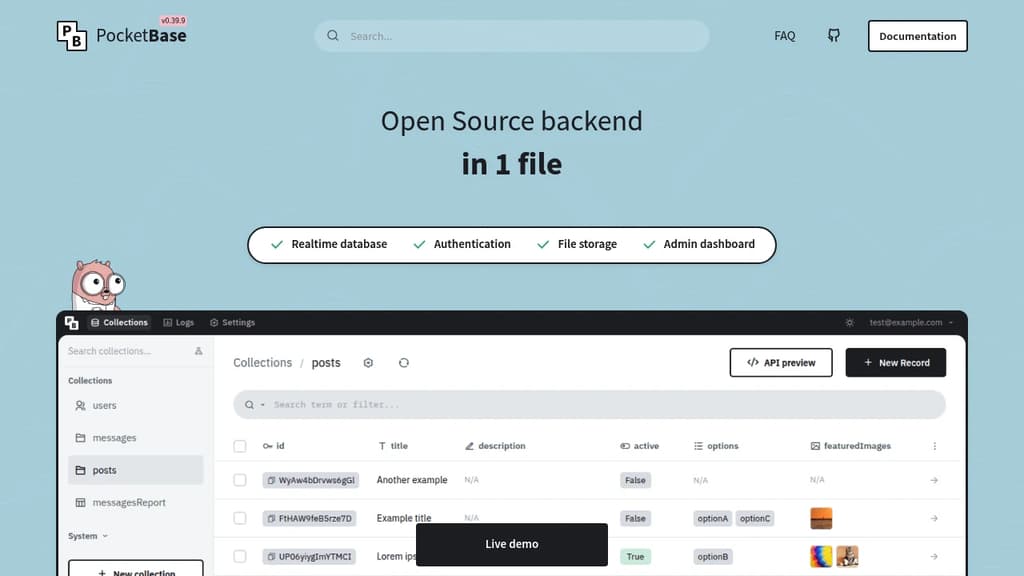
PocketBase is a revolutionary open-source backend solution that simplifies application development by providing a powerful, all-in-one platform. Packaged as a single executable file, it offers a real-time database, authentication system, and file storage, making it an ideal choice for developers seeking efficiency and ease of use.
Key benefits of PocketBase include:
- Simplicity: Get started quickly with minimal setup and configuration.
- Flexibility: Suitable for various project types, from small prototypes to large-scale applications.
- Real-time capabilities: Built-in support for real-time database updates and subscriptions.
- Authentication: Robust user management with multiple auth methods, including email/password and OAuth providers.
- File storage: Integrated file upload and serving functionality.
- Admin UI: User-friendly web interface for managing your application's data and settings.
- API-first design: RESTful and real-time APIs for seamless integration with front-end frameworks.
- Cross-platform: Runs on Windows, macOS, and Linux.
- Extensibility: Expand functionality with hooks and custom API endpoints.
PocketBase empowers developers to build feature-rich applications without the complexity of traditional backend setups. Its lightweight nature and comprehensive feature set make it an excellent choice for both beginners and experienced developers looking to streamline their development process.

Open-source development platform with built-in backend infrastructure, web hosting, and security features. Scale applications using your preferred programming languages.
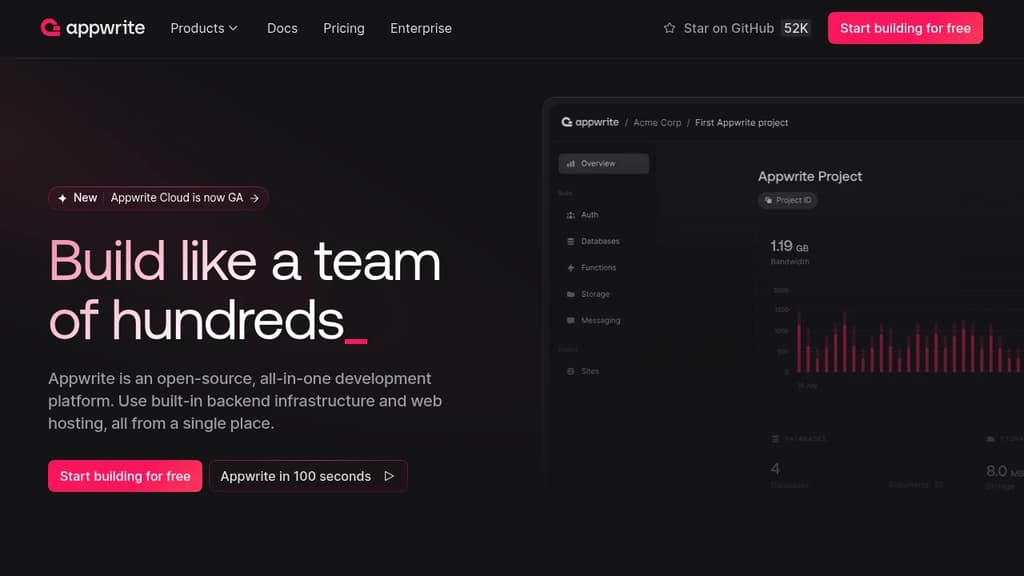
Appwrite is a comprehensive open-source development platform that provides everything developers need to build and scale applications efficiently. The platform combines backend infrastructure, web hosting, and security features in a single, unified solution.
Key benefits include:
- All-in-one platform - Backend services, databases, authentication, and hosting from one place
- Language flexibility - Work with your preferred programming languages and frameworks
- Built-in security - Security-first approach with compliance features built by default
- Global infrastructure - Multiple cloud regions and edge locations for reduced latency
- Proven scalability - Handles millions of requests and database operations monthly
The platform has helped companies like DevKind reduce development time by 60% and K-Collect cut infrastructure costs by 700%. With thousands of developers already using Appwrite, it's trusted by organizations worldwide for both passion projects and enterprise applications.
Pricing options range from free for small projects to custom enterprise solutions, making it accessible for teams of any size. The platform's Swiss Army Knife approach lets you choose and use only the tools you need, reducing complexity while maintaining powerful functionality.

Open-source vector database optimized for similarity search, scaling to billions of vectors with minimal performance loss
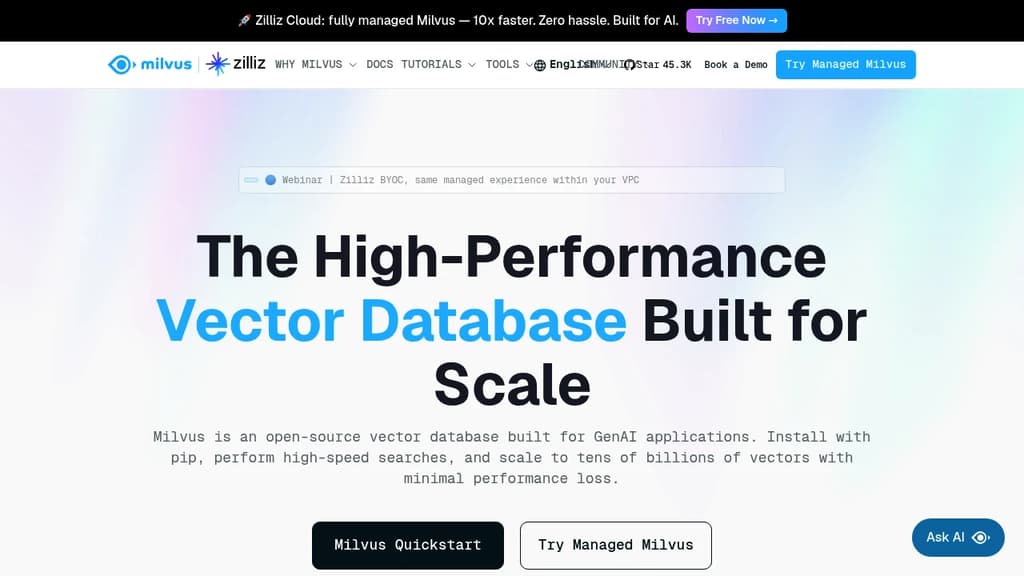
Milvus is an open-source vector database built specifically for GenAI applications. It offers high-performance similarity search capabilities and seamless scalability to handle billions of vectors.
Key features:
- Easy installation: Get started quickly with a simple pip install
- Blazing-fast searches: Perform high-speed similarity searches on massive vector datasets
- Elastic scalability: Scale effortlessly to tens of billions of vectors with minimal performance impact
- Flexible deployment: Choose from lightweight Milvus Lite for prototyping, robust Standalone for production, or fully distributed deployment for enterprise-scale workloads
- Rich ecosystem: Integrates smoothly with popular AI tools like LangChain, LlamaIndex, OpenAI, and more
- Advanced capabilities: Supports metadata filtering, hybrid search, multi-vector queries and other powerful features
Milvus empowers developers to build robust and scalable GenAI applications across various domains including image retrieval, recommendation systems, and semantic search. Its focus on performance, scalability and ease-of-use makes it a top choice for vector similarity search at any scale.

Qdrant is an open-source vector database that provides high-performance similarity search for AI and machine learning applications.
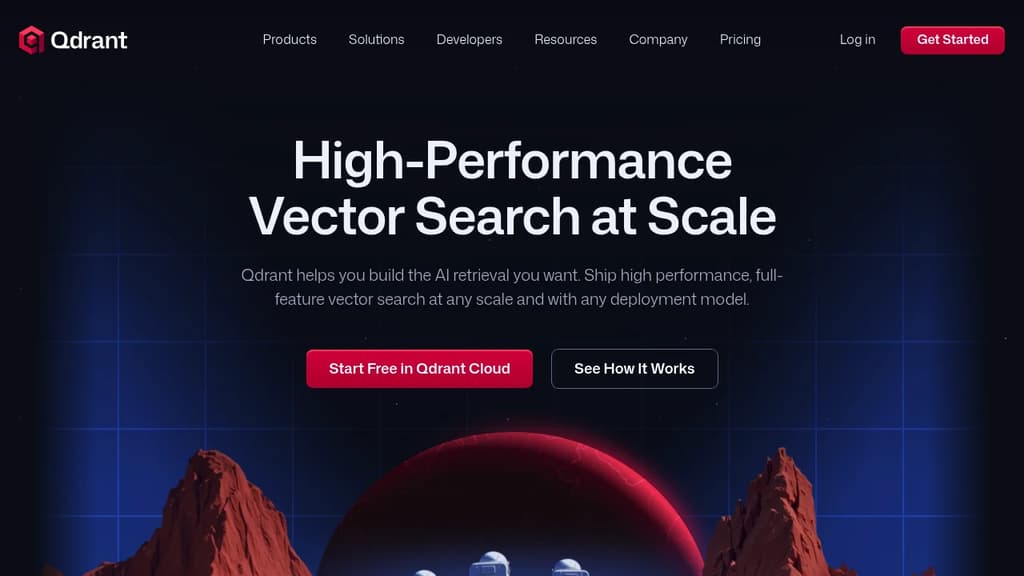
Qdrant is a powerful open-source vector database designed for high-performance similarity search in AI and machine learning applications. Built with Rust for unmatched speed and reliability, Qdrant excels at handling billions of high-dimensional vectors.
Key features:
- Cloud-native scalability: Easily scale vertically and horizontally with zero-downtime upgrades
- Flexible deployment: Quick setup with Docker for local testing or cloud deployment
- Cost-efficient storage: Built-in compression options to dramatically reduce memory usage
- Advanced search capabilities: Supports semantic search and handles multimodal data efficiently
- Easy integration: Lean API for seamless integration with existing systems
Qdrant is ideal for powering recommendation systems, advanced search applications, and retrieval augmented generation (RAG) workflows. Its ability to quickly process complex queries on large datasets makes it suitable for a wide range of AI-driven use cases.
Real-world impact: Trusted by leading companies like Bosch, Cognizant, and Bayer for enterprise-scale AI applications. Qdrant consistently outperforms alternatives in ease of use, performance, and value.
Whether you're building a cutting-edge AI product or enhancing existing applications with vector search capabilities, Qdrant provides the speed, scalability, and flexibility needed to bring your ideas to life.

Open-source vector database designed for AI applications. Store, search, and retrieve embeddings with semantic similarity matching and metadata filtering.
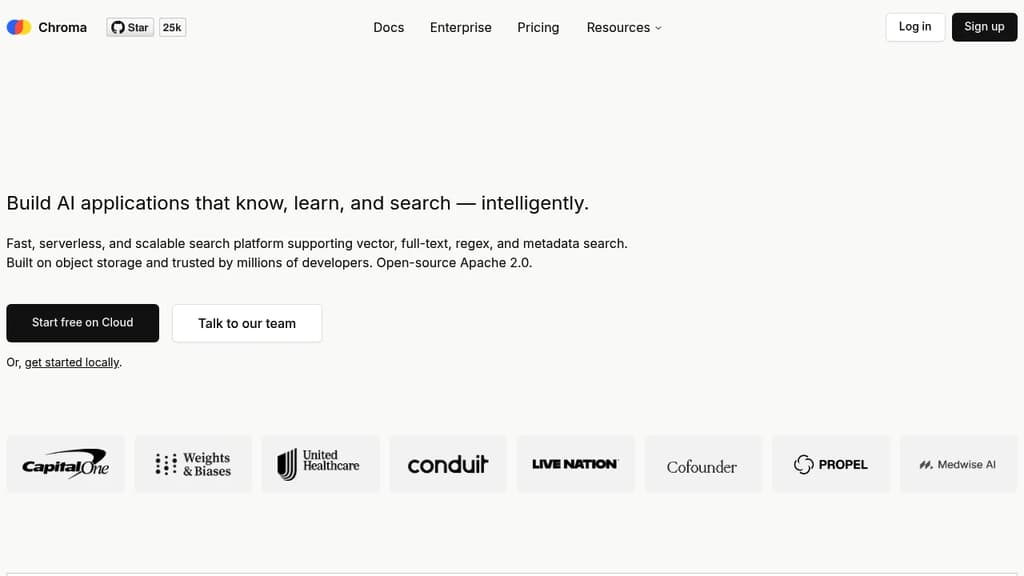
Chroma is a powerful open-source vector database specifically built for AI applications that need efficient storage and retrieval of embeddings. Perfect for developers building RAG (Retrieval-Augmented Generation) systems, semantic search engines, and AI-powered applications.
Key features include:
- Vector storage and similarity search - Store high-dimensional embeddings and perform fast semantic similarity queries
- Metadata filtering - Combine vector search with traditional filtering for precise results
- Multiple embedding models - Support for OpenAI, Sentence Transformers, and custom embedding functions
- Flexible deployment - Run locally, in-memory, or deploy to production with persistent storage
- Simple Python API - Get started quickly with intuitive methods for adding, querying, and managing collections
- Language integrations - Native support for Python and JavaScript with additional language bindings
Whether you're building a chatbot that needs to search through documents, creating a recommendation system, or developing any AI application requiring semantic search capabilities, Chroma provides the foundation you need with minimal setup and maximum flexibility.

Cloud-native, auto-scaling Postgres with instant branching, bottomless storage, and pay-per-use pricing
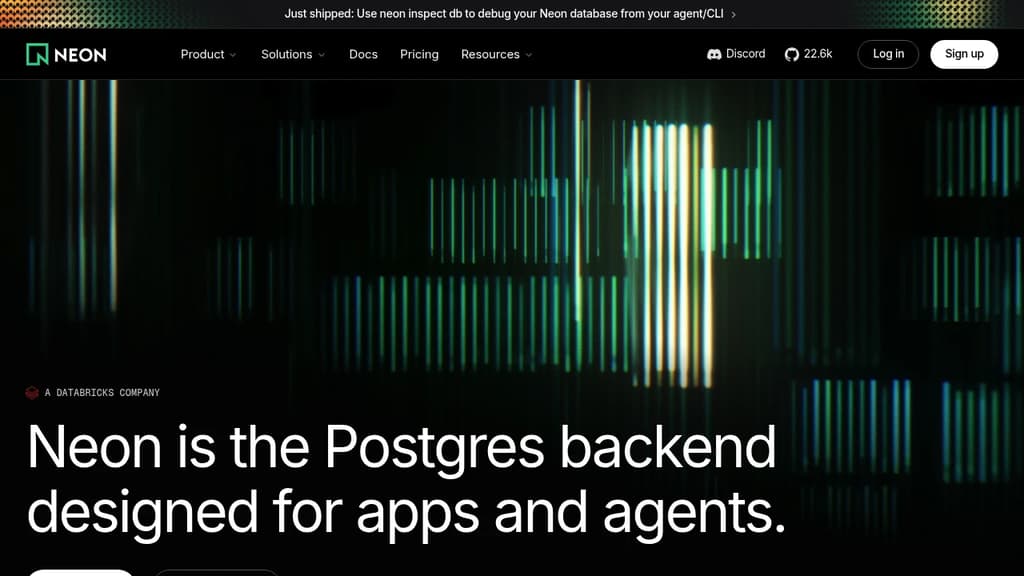
Neon Postgres revolutionizes database management with its serverless, cloud-native architecture. Built for modern applications, it offers a powerful combination of features that enhance developer productivity and optimize resource usage.
Key benefits include:
- Serverless Architecture: Enjoy automatic scaling and pay only for the resources you use, eliminating the need for manual capacity planning.
- Instant Branching: Create database branches in seconds, perfect for development, testing, and CI/CD workflows.
- Bottomless Storage: Leverage separated storage and compute with practically unlimited capacity, ensuring your data grows with your application.
- Multi-Cloud Support: Deploy across multiple cloud providers for enhanced reliability and global presence.
- Advanced Security: Benefit from built-in encryption, access controls, and compliance features to keep your data safe.
- Postgres Compatibility: Utilize the full power of Postgres, including extensions and the latest versions.
- Developer-Friendly: Integrate seamlessly with modern development tools and frameworks for a smooth workflow.
Neon Postgres combines the reliability of traditional databases with the flexibility of cloud-native solutions, making it an ideal choice for startups, enterprises, and everything in between. Experience the future of database management with Neon Postgres.

Turso provides a simple developer experience with SQLite compatibility, allowing you to build and scale multi-tenant applications with unlimited databases.
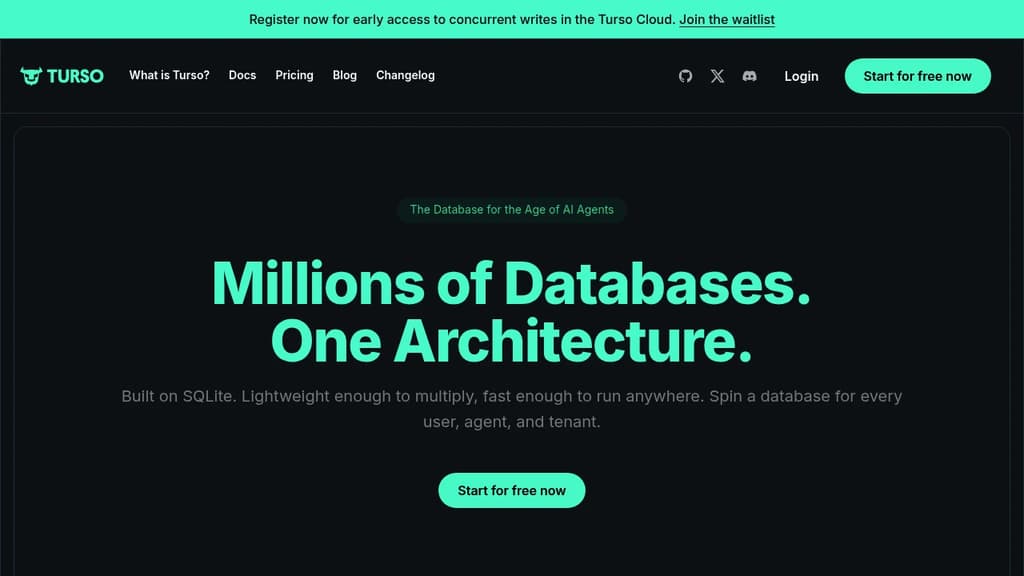
Turso is a powerful database solution designed for developers who want the simplicity of SQLite with the scalability needed for production environments.
Here's why Turso stands out:
-
Multi-tenant AI Applications: Turso enables you to create personalized LLM instances with infinite context windows using unlimited databases. This feature is perfect for building AI-powered applications that require separate data stores for each user or context.
-
On-Device Capabilities: Turso offers SDKs for mobile and on-device AI, allowing you to build powerful offline-capable apps across major platforms. You can optimize LLMs locally using Turso's SQLite-based database within your application, ensuring data privacy and reducing network latency.
-
Vector Search Integration: Seamlessly integrate Vector Embeddings with relational data in single transactions. This feature is crucial for AI and machine learning applications that require efficient similarity searches.
-
Open Source and Secure: Built on libSQL, an open-source SQLite-compatible database engine, Turso ensures your data is always portable. It offers encryption at rest and in transit, with SOC2 and HIPAA compliance available out of the box.
-
Developer-Friendly Experience: Enjoy a simple developer experience that feels like working with SQLite. Turso provides flexible development options, allowing you to work locally or remotely and deploy globally when ready.
-
Scalability and Performance: With features like automatic sync and programmable conflict resolution, Turso keeps your app data fresh and consistent across multiple instances. Its API-first approach and platform API enable efficient, programmatic database management at scale.
Whether you're building a complex AI application, a mobile app with offline capabilities, or a scalable multi-tenant system, Turso provides the tools and flexibility to meet your database needs while maintaining the simplicity developers love about SQLite.

ZITADEL provides a comprehensive identity management solution with easy APIs, customizable workflows, and serverless deployment options.
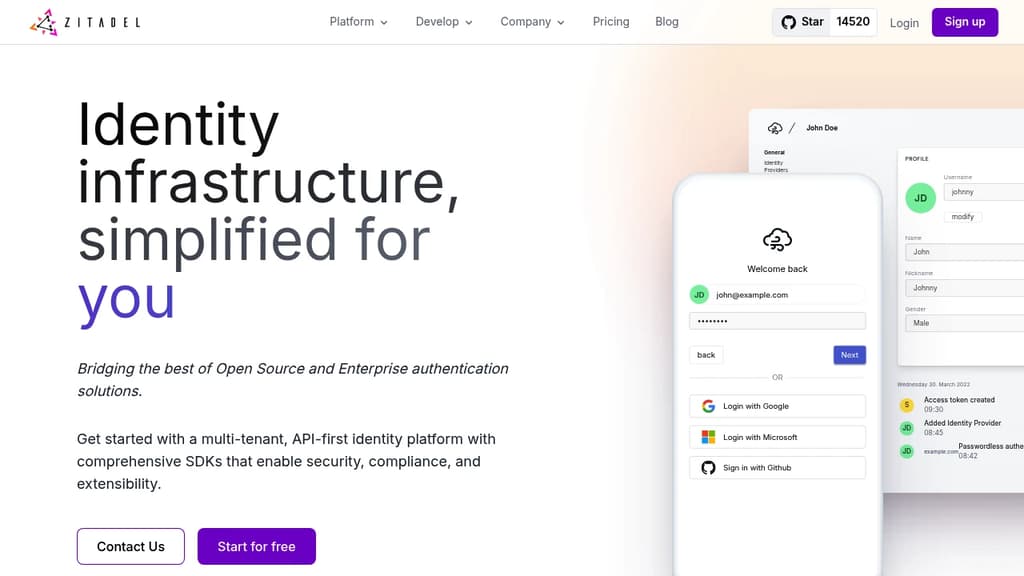
ZITADEL is an all-in-one identity suite designed to streamline application development with robust authentication and authorization capabilities.
Key features:
- Customizable hosted login: Easily authenticate users with a branded, customizable login page
- Modern authentication methods: Support for SSO, social logins, and multi-factor authentication
- Role-based access control: Assign permissions based on user roles for granular authorization
- Multi-tenant architecture: Built-in support for B2B scenarios with organization management
- Extensibility: Customize workflows and integrate ZITADEL into existing systems with Actions
- Developer-friendly: Modern APIs (gRPC and REST) with comprehensive documentation
- Flexible deployment: Run ZITADEL as a managed service or self-host for full control
ZITADEL empowers developers to offload complex identity tasks while maintaining adaptability. With security defaults and custom code extensions, it provides a solid foundation for building scalable applications with sophisticated user management.
Whether you need authentication for a small project or enterprise-grade identity infrastructure, ZITADEL offers the flexibility to grow with your needs. Focus on building your core product features while ZITADEL handles the intricacies of identity management.

Open-source vector database designed for building powerful, production-ready AI applications with hybrid search capabilities and flexible deployment options.
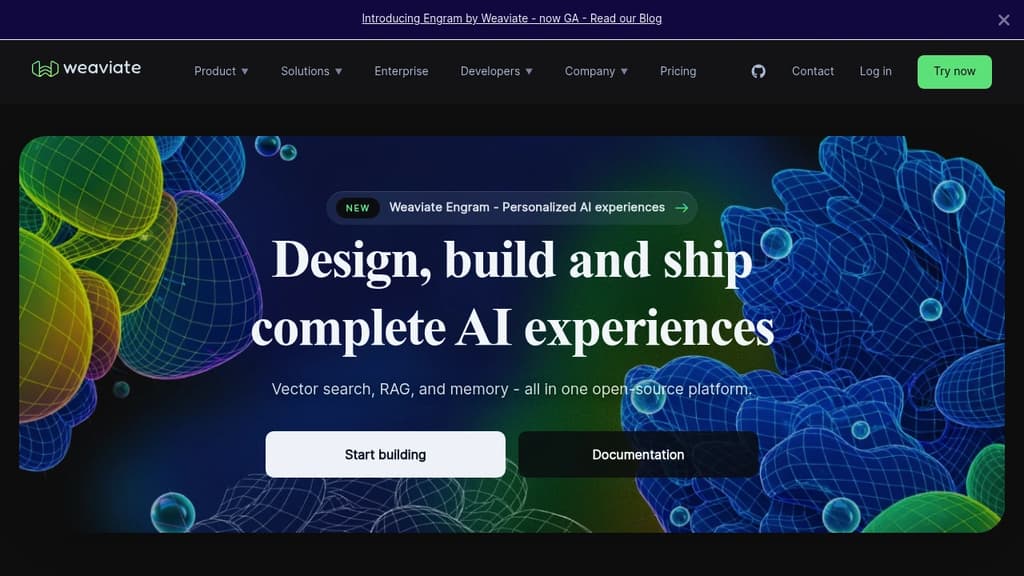
Weaviate is an AI-native vector database that empowers developers to create intuitive applications with less hallucination, data leakage, and vendor lock-in. Key features include:
-
Hybrid Search: Combines vector and keyword techniques for contextual, precise results across all data modalities.
-
RAG (Retrieval-Augmented Generation): Enables building trustworthy generative AI applications using your own data, with privacy and security in mind.
-
Generative Feedback Loops: Enrich datasets with AI-generated answers, improving personalization and reducing manual data cleaning.
-
Flexible Deployment: Available as an open-source platform, managed service, or within your VPC to adapt to your business needs.
-
Pluggable ML Models: Built-in modules for popular machine learning models and frameworks, allowing easy integration.
-
Cost-Efficient Scaling: Advanced multi-tenancy, data compression, and filtering for confident and efficient scaling.
-
Strong Community Support: Open-source with a vibrant community and resources for developers of all levels.
-
Integrations: Supports various neural search frameworks and vectorization modules, including OpenAI, Hugging Face, Cohere, and more.
Weaviate is designed to handle lightning-fast pure vector similarity searches over raw vectors or data objects, even with filters. It's more than just a database – it's a flexible platform for building powerful, production-ready AI applications that can adapt to the evolving needs of businesses in the AI landscape.

Open-source reactive database that keeps your web and mobile apps in sync. Write everything in TypeScript with built-in auth, cron jobs, and AI integration.
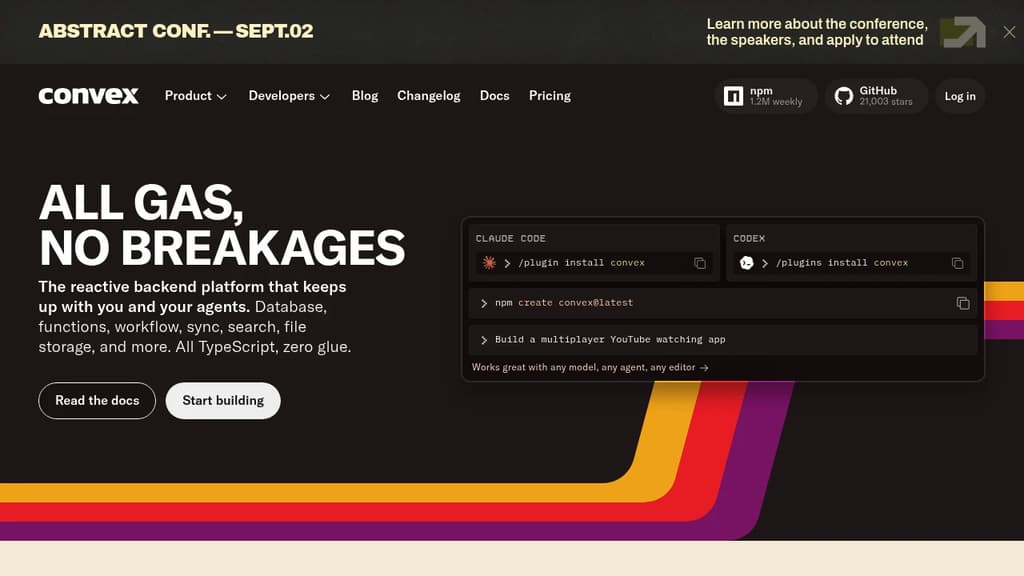
Build your entire backend in pure TypeScript - from database schemas to queries, authentication to APIs. Your backend code lives alongside your frontend code with full type safety and AI-powered code generation.
Real-time synchronization guaranteed - your app automatically reflects changes to frontend code, backend code, and database state instantly. No need for complex state managers, cache invalidation policies, or manual websocket setup.
Backend essentials built-in - create cron jobs, trigger AI workflows, leverage built-in authentication, and access a growing ecosystem of components that solve common backend needs with simple npm installs.
Developer-friendly features:
- End-to-end TypeScript with full autocomplete and type checking
- Reactive queries that update your UI automatically
- Built-in authentication and user management
- Scheduled functions and background jobs
- AI tool integration for enhanced code generation
- Framework agnostic - works with React, Next.js, and more
Enterprise-ready security with SOC 2 Type II compliance, HIPAA compliance, and GDPR verification. Trusted by developers who want the simplicity of Firebase with the power and flexibility of a modern TypeScript-first platform.

A powerful platform for building cloud backends, automating infrastructure, and simplifying development workflows for faster, more efficient coding.
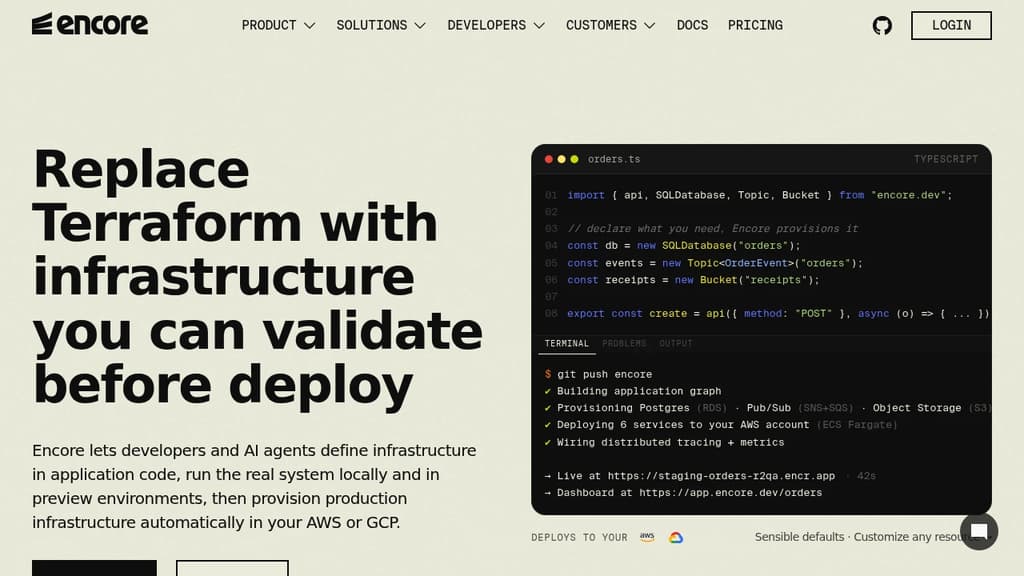
Encore revolutionizes backend development by providing a seamless, integrated platform that combines the power of cloud infrastructure with the simplicity of local development. By abstracting away the complexities of distributed systems, Encore allows developers to focus on writing business logic while automatically handling scalability, deployment, and infrastructure management.
Key benefits of Encore include:
- Rapid Development: Write clean, idiomatic Go code without boilerplate, allowing you to build production-ready backends in record time.
- Automatic Infrastructure: Encore generates and manages your cloud infrastructure, eliminating the need for manual configuration and reducing operational overhead.
- Built-in Observability: Gain deep insights into your application's performance with automatically instrumented tracing, logging, and metrics.
- Local-to-Cloud Consistency: Develop and test locally with the same environment as production, ensuring smooth transitions and reducing deployment surprises.
- API-First Approach: Automatically generate API documentation and type-safe clients, improving collaboration between frontend and backend teams.
- Effortless Scaling: Design your application for scale from day one, with Encore handling the complexities of distributed systems and database management.
- Developer-Centric Workflow: Enjoy a streamlined development experience with features like automatic hot reloading, integrated testing, and collaborative debugging.
By choosing Encore, teams can significantly reduce time-to-market, improve code quality, and focus on delivering value to their users instead of wrestling with infrastructure complexities.

Instant is a database solution for building real-time and offline-enabled applications, simplifying the development of collaborative products.
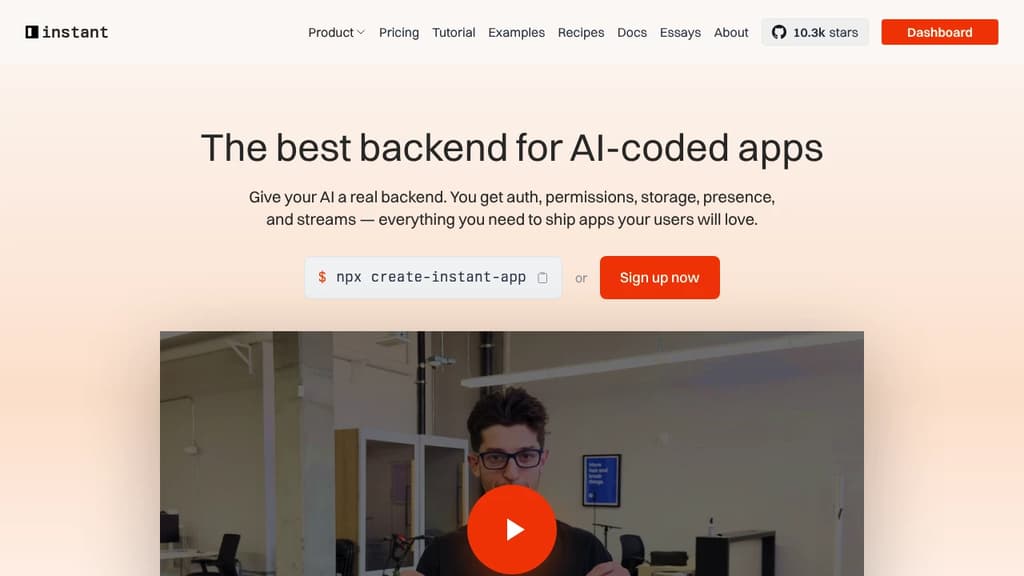
Instant is a revolutionary database solution designed for developers building real-time and offline-enabled applications. It simplifies the process of creating collaborative products like Notion or Figma by providing a database that can be subscribed to directly in the browser.
Key features and benefits:
-
Realtime Updates: Instant handles optimistic updates and rollbacks automatically, allowing developers to focus on writing frontend code without worrying about complex backend logic.
-
Multiplayer Support: Built-in infrastructure for collaborative experiences, including live updates across devices and user accounts.
-
Offline Mode: Applications built with Instant work seamlessly offline, with local caching and automatic reconciliation when users come back online.
-
Easy Integration: Developers can write relational queries directly in their app, and Instant takes care of the rest, including servers, auth, permissions, and endpoints.
-
Scalability: Start without a backend and scale to complex use cases as needed. Instant provides an admin SDK for custom backend logic when required.
-
Enhanced User Experience: Easily implement features like shared cursors, typing indicators, and presence information with minimal code.
-
Cross-Platform Compatibility: Works across web and mobile platforms, allowing developers to reuse data logic across different environments.
Instant is backed by Y Combinator and has received praise from industry leaders, including the co-founder of Firebase and engineers from Meta, Stripe, and OpenAI. The team behind Instant consists of senior and staff engineers from Facebook and Airbnb, bringing deep expertise to solve one of the largest problems in frontend development today.
By using Instant, developers can significantly reduce development time and complexity, focusing on building great user experiences rather than dealing with the intricacies of real-time data synchronization and offline support.

Fully managed backend infrastructure with built-in authentication, database, storage, and serverless functions for rapid application development.
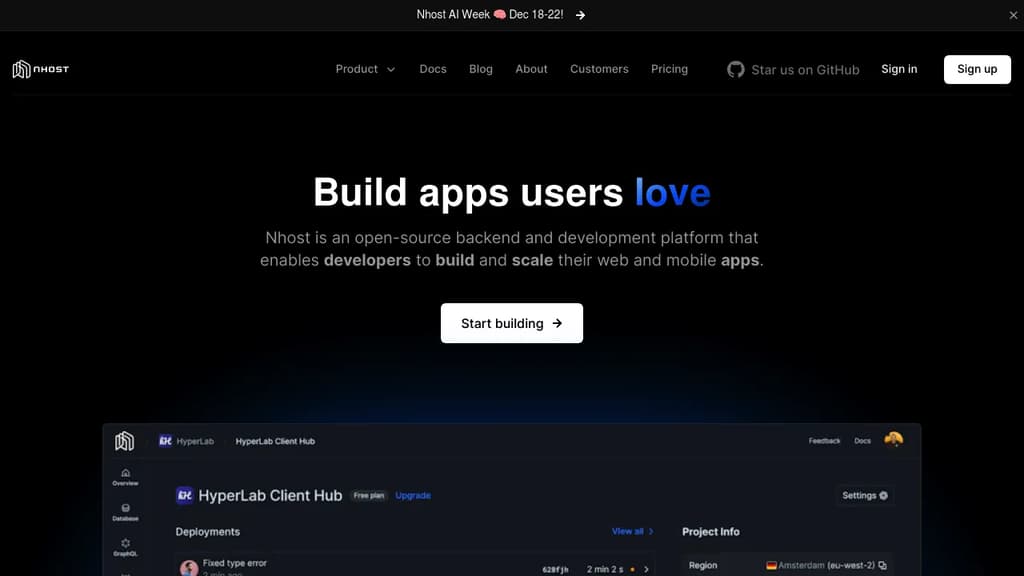
NHost is a comprehensive serverless backend platform designed to accelerate modern application development. By providing a fully managed infrastructure, NHost eliminates the complexities of backend setup and maintenance, allowing developers to focus on building exceptional user experiences.
Key benefits of NHost include:
- Instant Setup: Get started in minutes with a pre-configured backend environment, saving valuable development time.
- Built-in Authentication: Secure user management with support for multiple authentication methods, including social logins and JWT tokens.
- Scalable Database: Utilize a powerful PostgreSQL database that automatically scales to meet your application's demands.
- Serverless Functions: Deploy and run custom logic without managing servers, supporting various programming languages.
- File Storage: Easily manage and serve user-generated content with integrated file storage capabilities.
- GraphQL API: Access your data through a flexible and efficient GraphQL API, simplifying client-side development.
- Real-time Subscriptions: Keep your app's data in sync across devices with real-time updates via WebSocket connections.
- Local Development: Seamlessly develop and test your applications locally with NHost's CLI tools.
- Customizable Workflows: Automate tasks and integrate with third-party services using event-triggered actions.
NHost's platform is designed to be developer-friendly, offering comprehensive documentation, SDKs for popular frameworks, and a supportive community. Whether you're building a startup MVP or scaling an enterprise application, NHost provides the tools and infrastructure to bring your ideas to life quickly and efficiently.

Rust-built native graph-vector database combining vector similarity search and graph traversals. 10x faster development with unified architecture, sub-1ms queries.
HelixDB is a groundbreaking native graph-vector database that eliminates the need for multiple databases by unifying vector similarity search and graph traversal operations in a single, high-performance engine. Built in Rust and backed by Y Combinator and NVIDIA, it's specifically designed for AI agents, RAG systems, and applications requiring advanced contextual retrieval.
Key performance advantages:
- Vector similarity search: ~2ms average response time
- Graph traversals: Sub-1ms execution speed
- Cost reduction: Up to 50% lower operational costs by eliminating architectural complexity
- Type-safe queries: Advanced static analysis with real-time feedback and autocomplete
Developer-friendly features:
- Simple CLI installation with
curl -sSL "https://install.helix-db.com" | bash - Hybrid query traversals combining vector and graph operations seamlessly
- Comprehensive SDKs and extensive documentation
- Local deployment or managed cloud service options
Enterprise support includes:
- 24/7 expert monitoring and support
- Enterprise-grade security and compliance
- Automatic scaling for traffic spikes
- 99.99% uptime guarantee
Perfect for teams building next-generation AI applications who want to reduce database complexity while achieving industry-leading performance. The growing developer community and active support channels make it easy to get started and scale efficiently.

Lightweight Firebase alternative with database, auth, storage, and workflows. Framework-agnostic backend that integrates with NextJS, Remix, Hono and more.
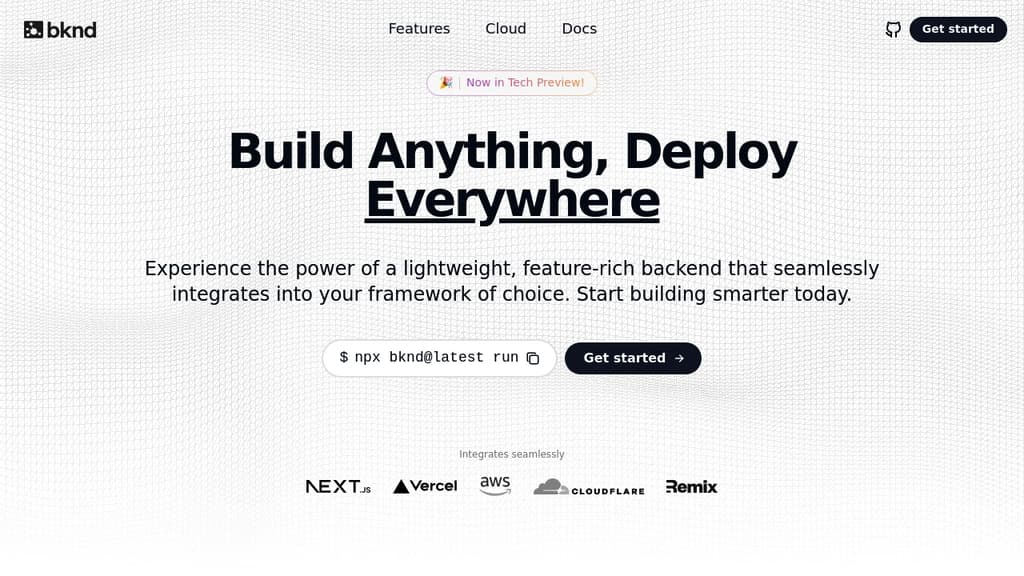
BKND is a comprehensive backend solution designed for modern developers who need flexibility without complexity. This lightweight Firebase alternative provides all essential backend services while maintaining the freedom to deploy anywhere.
Core Features:
- Database: Define, query, and control your data with intuitive tools
- Authentication: Implement reliable auth strategies with minimal setup
- Storage & Media: Manage and serve media files effortlessly
- Workflows: Design automated processes with visual workflow builder
Built for Modern Development:
- Edge-optimized - Runs in any JavaScript environment with minimal overhead
- Framework-friendly - Seamless integration with NextJS, Remix, Hono, or standalone deployment
- Web standards foundation - Built on JSON Schema and OAuth/OIDC for maximum interoperability
- Adapter-first approach - Leverage existing infrastructure or extend with custom adapters
The platform offers complete extensibility through its workflow builder, allowing you to inject custom logic into system events. As an open source solution, you maintain full control over your backend while benefiting from community contributions.
Get started instantly with npx bknd@latest run and experience a backend that adapts to your needs, not the other way around.

SlateDB is an embedded storage engine that leverages object storage for durability, scalability, and simplified replication without the need for disk management.
SlateDB is an innovative embedded storage engine that revolutionizes data management by building on top of object storage.
Here are its key features and benefits:
- Object Store Durability: SlateDB inherits the exceptional durability of your chosen object store, offering up to 99.999999999% durability. This ensures your data remains safe and accessible.
- Zero-Disk Architecture: By running without disks, SlateDB eliminates common issues like disk failures and corruption. This design simplifies infrastructure management and reduces hardware-related concerns.
- Simple Replication: SlateDB leverages the underlying object store's replication capabilities, removing the need for complex custom replication protocols. This approach streamlines data distribution and backup.
- Tunable Performance: Configure SlateDB to optimize for your specific needs, whether it's low latency, cost-efficiency, or high durability. This flexibility allows you to balance performance and resources effectively.
- Scalable Readers: Supporting a single writer and multiple readers, SlateDB is designed for concurrent access. It also includes built-in detection and fencing of zombie writers, ensuring data consistency.
- Built in Rust: As an embeddable library written in Rust, SlateDB offers performance, safety, and cross-language compatibility. Use it with your preferred programming language for seamless integration.
SlateDB simplifies database management by abstracting away many low-level concerns, allowing developers to focus on building their applications rather than managing infrastructure. Its design makes it particularly suitable for cloud-native applications, distributed systems, and scenarios where durability and scalability are crucial.

Nitric automates cloud infrastructure provisioning from your application code for AWS, GCP and Azure
Nitric is an open source universal backend framework that provides infrastructure from code and pluggable deployment automation. It allows developers to declare infrastructure requirements in code for common cloud resources and provides a convenient interface to interact with them.
Key benefits of Nitric include:
-
Effortless infrastructure from code: Use code to declare infrastructure requirements and get deployment automation from customizable plugins. This simplifies provisioning and managing cloud resources.
-
Cloud portability: Nitric makes applications portable across cloud providers, unlocking access to the best cloud features without vendor lock-in. It supports AWS, Google Cloud, and Azure out of the box.
-
Local development: Fine tune your application offline from your first commit. Prototype, develop and test your application without incurring cloud costs.
-
Simplified security: Application security is made simple with declarative resource access that is automatically synced with deployment automation.
-
Intuitive APIs: Common tasks are made intuitive and easy, without limiting fine-grained control when needed.
-
Extensible automation: Use existing Nitric plugins or build custom ones. Nitric enhances automation tools like Terraform, Pulumi and others.
Nitric supports key cloud resources like APIs, storage, databases, messaging, and more. It provides a consistent developer experience for working with these resources across different cloud providers.
The framework aims to streamline backend development by abstracting away infrastructure complexities, while still giving developers full control when needed. This allows teams to focus more on building application logic rather than managing cloud infrastructure.

Build and manage custom databases with ease, create type-safe APIs, and develop applications quickly
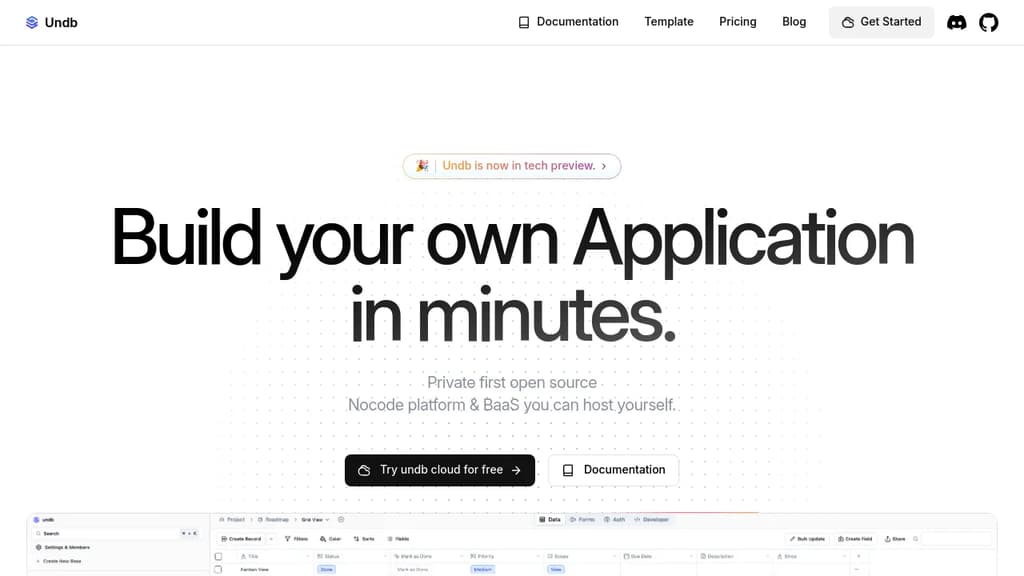
Undb is an innovative open-source platform that empowers users to build and manage their own databases without coding. This local-first, offline-first solution offers a range of powerful features:
- Diverse view options: Easily organize your data with grid, kanban, gallery, and form views
- Custom database creation: Build tailored databases to suit your specific needs
- Type-safe API generation: Automatically create APIs for your data structures
- Application development: Rapidly build custom applications on top of your databases
- Privacy-focused: Host the platform yourself for complete data control
- Template library: Get started quickly with pre-built project templates
Undb combines the flexibility of no-code tools with the power of a backend-as-a-service, making it an excellent choice for developers, businesses, and individuals looking for a self-hosted Airtable alternative. Whether you're managing projects, organizing data, or prototyping applications, Undb provides the tools to streamline your workflow and boost productivity.

People are looking for alternatives to...
View all alternatives
Spotify

Claude Code

CapCut

Claude

Notion

Lovable
 Sent – Messaging Infrastructure for Developers. One API for SMS, WhatsApp, and RCS across 190+ countries.



 CodeRabbit