Open Source ScrapingBee Alternatives
A curated collection of the 3 best open source alternatives to ScrapingBee.
The best open source alternative to ScrapingBee is Firecrawl. If that doesn't suit you, we've compiled a ranked list of other open source ScrapingBee alternatives to help you find a suitable replacement. Other interesting open source alternatives to ScrapingBee are: Maxun and fastCRW.
ScrapingBee alternatives are mainly Scraping Platforms & SDKs but may also be Web Crawlers. Browse these if you want a narrower list of alternatives or looking for a specific functionality of ScrapingBee.

Written by Piotr Kulpinski


API for AI agents to search, scrape, crawl, and interact with the live web, returning clean Markdown, structured JSON, or screenshots from any page.
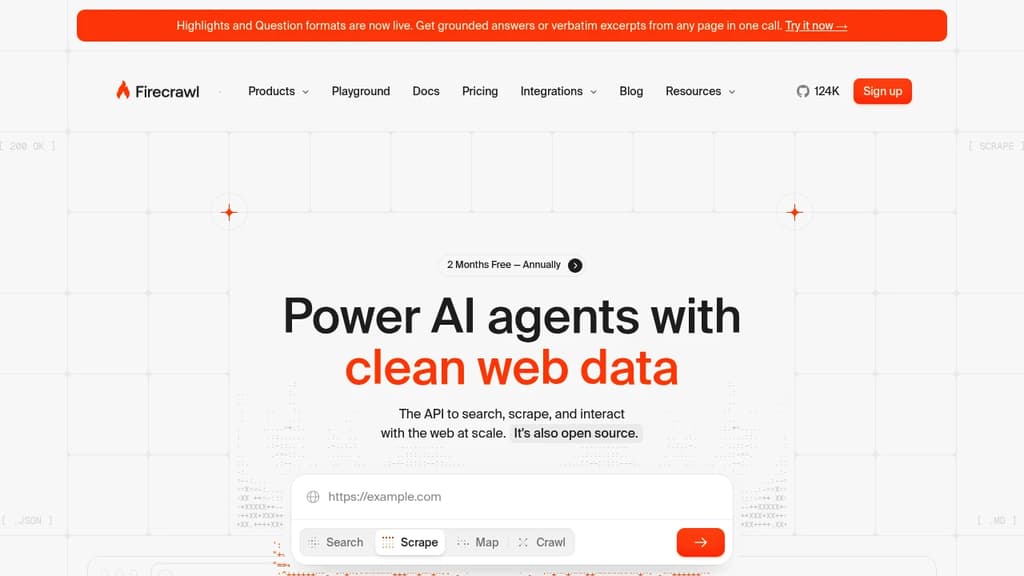
Firecrawl is a web data API built specifically for AI systems. It takes the messy, JavaScript-heavy, human-oriented web and converts it into structured data that agents and LLM pipelines can actually use. Over 80,000 companies rely on it, from indie developers wiring up AI search tools to teams at Apple and Canva running production-scale pipelines.
The three core capabilities work together:
- Search returns full-page Markdown alongside results, so one call goes from a query to usable content without a separate scrape step.
- Scrape handles JavaScript rendering, smart waits, and dynamic content automatically. Pass a URL and get back Markdown, HTML, screenshots, metadata, or structured JSON via a schema you define.
- Interact goes further. It lets agents click, scroll, type, and navigate multi-step flows, reaching data behind logins, pagination, or any sequence of actions a static scrape can't touch.
For browser automation for AI use cases, Firecrawl connects directly to MCP-compatible clients like Cursor, Claude, and Windsurf. There's also a CLI and official SDKs for Python, Node.js, Go, Rust, Java, and Elixir.
Under the hood, it covers 96% of the web with a reported P95 latency of 3.4 seconds across millions of pages. The hosted version adds proprietary infrastructure for proxy management and rendering reliability. The self-hostable version is the largest open source repo in the web crawlers space, with over 100,000 GitHub stars.
Common use cases include deep research agents, RAG pipelines, lead enrichment, competitive intelligence, and price monitoring. The free tier covers 1,000 pages per month, with paid plans scaling to millions of pages for larger workloads.
Unlike scraping tools that stop at raw HTML, Firecrawl parses PDFs and DOCX files, extracts structured data against a JSON schema, and caches results against a growing web index. It's a practical fit for any AI workflow that needs reliable, clean input from the live web.
Turn any website into structured data using a visual recorder, natural language prompts, or API. Includes proxy rotation, scheduling, and webhook integrations.
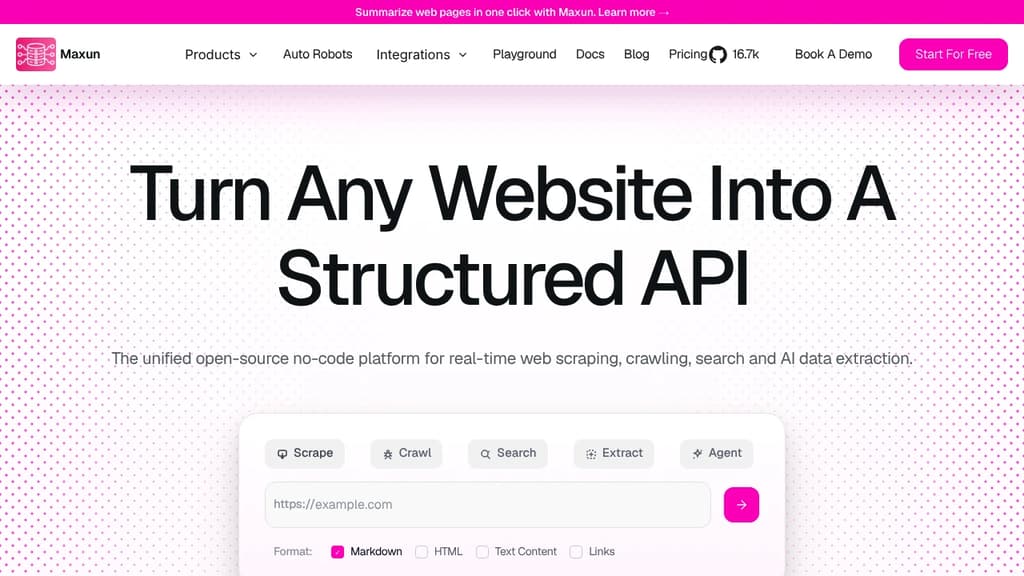
Maxun is a no-code platform for scraping, crawling, and extracting data from websites. It's built for developers and non-technical users alike who need structured data from the web without writing custom scrapers or maintaining brittle pipelines.
The core idea is simple: record your actions in a browser, and Maxun turns that recording into a reusable "robot" that extracts data on demand. No selectors to write, no code to maintain. You can also skip the recorder entirely and describe what you want in plain language. The AI agent navigates the site and pulls the relevant data automatically.
Key capabilities:
- Visual recorder builds production-ready scrapers by watching you browse, capturing clicks and scrolls into a repeatable workflow
- Natural language extraction lets you describe the data you need; the agent figures out how to get it
- Full-site crawling maps and extracts content across entire domains, not just single pages
- Web search finds relevant pages matching a query before extraction
- Scheduled monitoring runs scrapers hourly or daily to track price changes, job listings, or any content that updates
- Stealth mode handles proxy rotation and browser fingerprinting so scrapers don't get blocked
- Multiple output formats including Markdown, HTML, raw text, and links, ready for LLM pipelines or downstream apps
For developers who want more control, Maxun exposes a REST API, Python and JavaScript SDKs, a CLI, and native MCP support for agent orchestration. It fits naturally into workflows where an AI agent needs to call a web scraping tool as a skill. There are also pre-built robots for common targets like GitHub trending repos, IMDb, YouTube, and Airbnb listings.
Compared to tools like Firecrawl or Crawl4AI, Maxun leans harder into the no-code recorder experience and autonomous agents, making it accessible to people who don't want to touch an API at all. It's a self-hostable alternative to proprietary platforms like Apify or Octoparse, with the full codebase available on GitHub.
Over 100 million rows have been extracted through the platform, and it carries more than 14,000 GitHub stars.
Web data API for AI agents that searches, scrapes, crawls, maps, extracts and monitors pages, returning clean markdown or JSON. Runs managed or self-hosted.
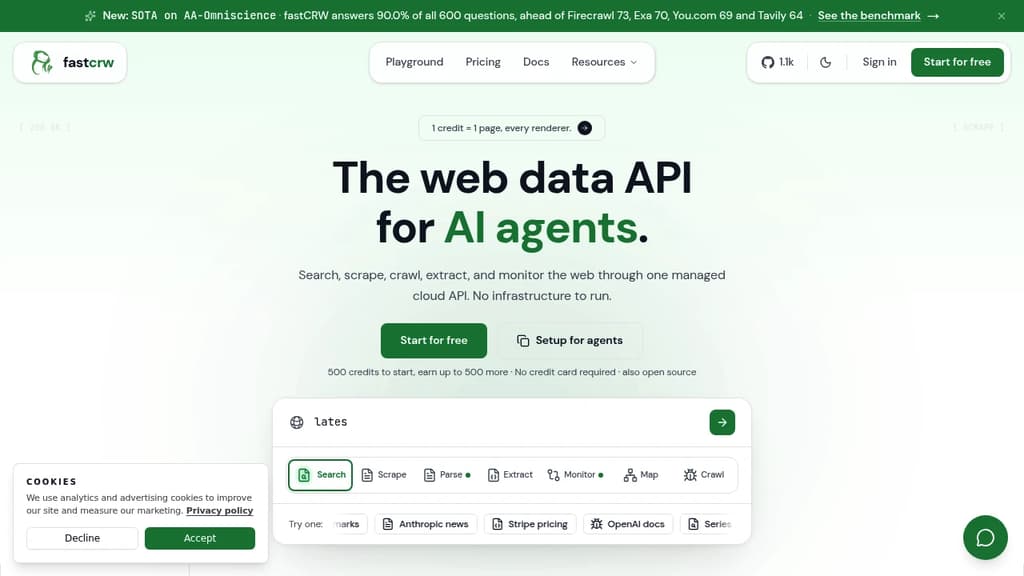
A web data API built for AI agents and the teams shipping them. It turns searches and URLs into clean markdown, JSON, or HTML, so your agent gets usable content instead of raw pages. It's written in Rust and licensed AGPL-3.0, and you can use the managed cloud or run it yourself.
- Search: multi-engine web search that returns full page content.
- Scrape: full JS rendering, with actions like click, scroll and wait before extraction.
- Crawl and map: pull a whole site as structured data, or list every URL on a domain.
- Extract: get structured JSON from a prompt or a JSON schema.
- Monitor: watch a page and get an AI verdict plus a webhook when it changes.
- Parse: turn PDFs into markdown on CPU, with no LLM involved.
The cloud side handles proxies, headless browsers, anti-detection and scaling, so there's nothing to babysit. Every response includes source URLs and metadata, which makes answers easy to verify and debug.
It works with Python, Node, cURL and MCP, and plugs into Claude Code, Cursor, LangChain, n8n and similar tools. It's compatible with Firecrawl on the shared endpoints, though response fields differ slightly, so migration usually needs small adjustments. If you're comparing options, it's also a fit as a Tavily alternative.
Pricing is usage-based. The free tier gives 500 credits, with up to 500 more to earn, and no card. Paid plans start at $13/mo. One credit covers one page, search costs two, and failed requests aren't billed. The public benchmark harness shows higher recall than Firecrawl on the ArXivQA research set.

People are looking for alternatives to...
View all alternatives
Claude

Claude Code

CapCut
Notion

Wispr Flow

Grok Bot
 Highseat – Cookieless analytics with revenue by source.

 Openlane