Open Source Apify Alternatives
A curated collection of the 3 best open source alternatives to Apify.
The best open source alternative to Apify is Firecrawl. If that doesn't suit you, we've compiled a ranked list of other open source Apify alternatives to help you find a suitable replacement. Other interesting open source alternatives to Apify are: Crawl4AI and fastCRW.
Apify alternatives are mainly Scraping Platforms & SDKs but may also be Web Crawlers. Browse these if you want a narrower list of alternatives or looking for a specific functionality of Apify.

Written by Piotr Kulpinski


API for AI agents to search, scrape, crawl, and interact with the live web, returning clean Markdown, structured JSON, or screenshots from any page.
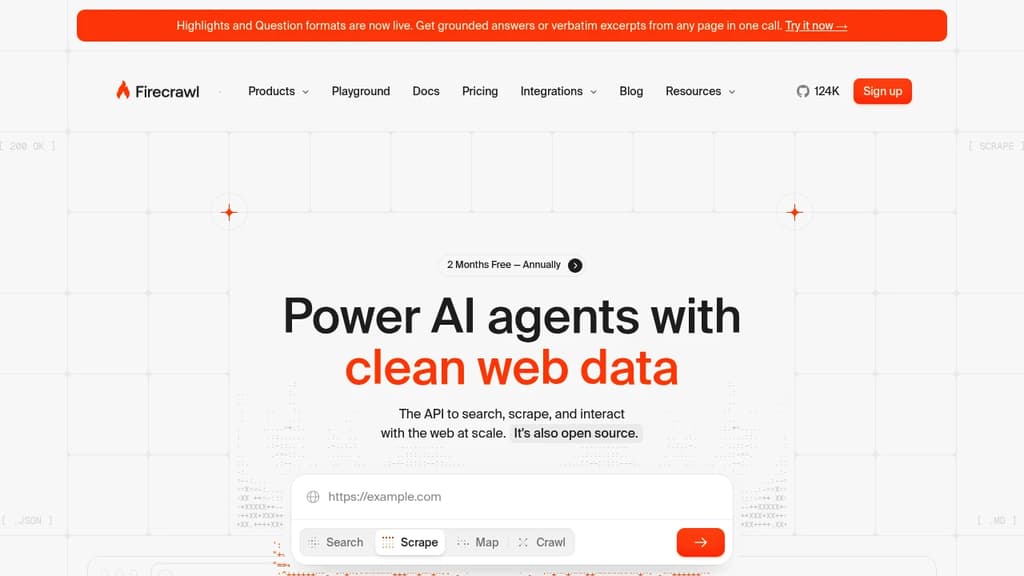
Firecrawl is a web data API built specifically for AI systems. It takes the messy, JavaScript-heavy, human-oriented web and converts it into structured data that agents and LLM pipelines can actually use. Over 80,000 companies rely on it, from indie developers wiring up AI search tools to teams at Apple and Canva running production-scale pipelines.
The three core capabilities work together:
- Search returns full-page Markdown alongside results, so one call goes from a query to usable content without a separate scrape step.
- Scrape handles JavaScript rendering, smart waits, and dynamic content automatically. Pass a URL and get back Markdown, HTML, screenshots, metadata, or structured JSON via a schema you define.
- Interact goes further. It lets agents click, scroll, type, and navigate multi-step flows, reaching data behind logins, pagination, or any sequence of actions a static scrape can't touch.
For browser automation for AI use cases, Firecrawl connects directly to MCP-compatible clients like Cursor, Claude, and Windsurf. There's also a CLI and official SDKs for Python, Node.js, Go, Rust, Java, and Elixir.
Under the hood, it covers 96% of the web with a reported P95 latency of 3.4 seconds across millions of pages. The hosted version adds proprietary infrastructure for proxy management and rendering reliability. The self-hostable version is the largest open source repo in the web crawlers space, with over 100,000 GitHub stars.
Common use cases include deep research agents, RAG pipelines, lead enrichment, competitive intelligence, and price monitoring. The free tier covers 1,000 pages per month, with paid plans scaling to millions of pages for larger workloads.
Unlike scraping tools that stop at raw HTML, Firecrawl parses PDFs and DOCX files, extracts structured data against a JSON schema, and caches results against a growing web index. It's a practical fit for any AI workflow that needs reliable, clean input from the live web.

Open-source web crawler and scraper that produces clean, structured output optimized for LLMs, RAG pipelines, and AI agents. Supports async crawling, CSS/XPath/LLM extraction, and stealth browser control.
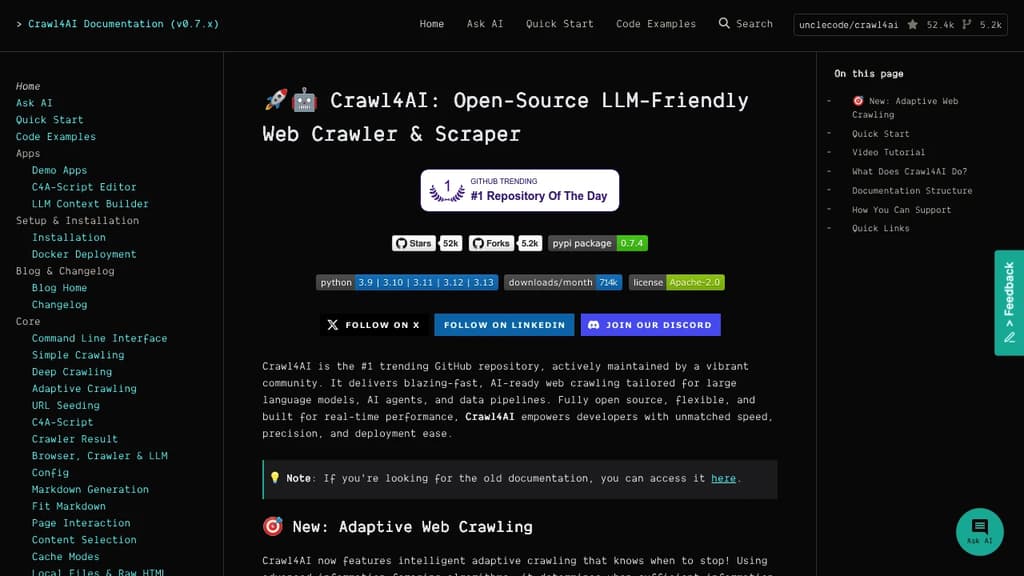
Crawl4AI is a web crawler and scraper built specifically for feeding data into AI pipelines and agents. Where generic scrapers dump raw HTML, Crawl4AI outputs clean Markdown and structured data that LLMs can consume directly, without heavy post-processing.
It's aimed at developers building RAG systems, data pipelines, or AI agents that need reliable, well-formatted web content at scale. The async-first architecture means you can run parallel crawls without blocking, making it practical for real-time use cases.
Key capabilities include:
- Clean Markdown output formatted for direct ingestion into LLMs or AI search tools, with minimal noise
- Structured extraction using CSS selectors, XPath, or LLM-based strategies for pulling repeated patterns from pages
- Adaptive crawling that uses information foraging algorithms to stop once enough data has been gathered to answer a query
- Advanced browser control including hooks, proxies, stealth modes, and session reuse for handling JavaScript-heavy or auth-protected sites
- Chunking and clustering approaches for breaking large pages into digestible pieces before passing to models
- No forced API keys or paywalls – you own the extraction process end to end
Compared to alternatives like Firecrawl or Jina AI, Crawl4AI leans heavily on self-hosting and configurability. You're not routing traffic through a third-party service, and there's no usage metering on the open-source version.
It also ships an AI assistant skill package (compatible with Claude, Cursor, and similar AI coding assistants) that bundles the full SDK reference and ready-to-use extraction scripts, so you can query the docs from inside your editor.
Deployable via pip or Docker, with a Python async API that fits naturally into existing data engineering workflows.
Web data API for AI agents that searches, scrapes, crawls, maps, extracts and monitors pages, returning clean markdown or JSON. Runs managed or self-hosted.
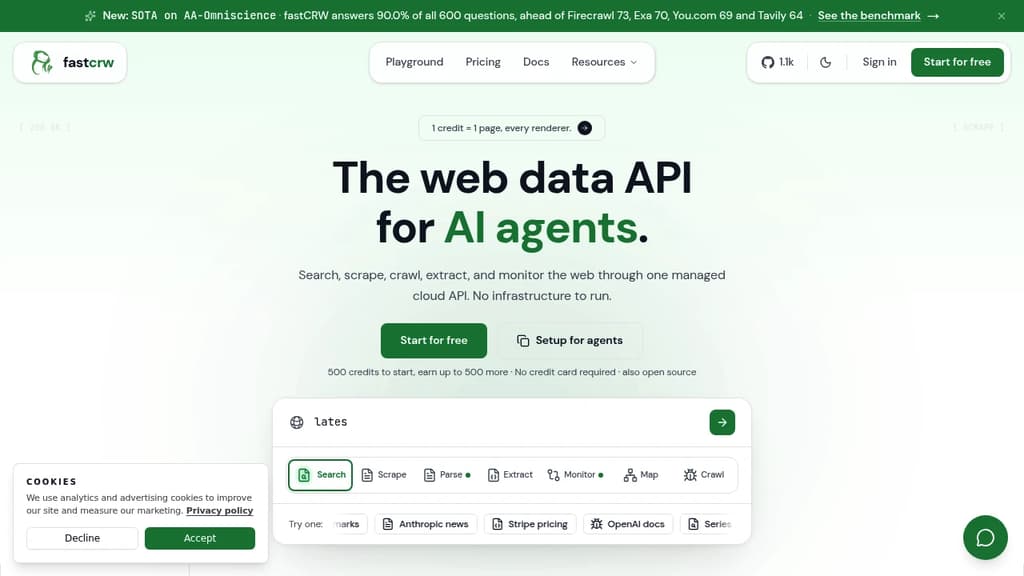
A web data API built for AI agents and the teams shipping them. It turns searches and URLs into clean markdown, JSON, or HTML, so your agent gets usable content instead of raw pages. It's written in Rust and licensed AGPL-3.0, and you can use the managed cloud or run it yourself.
- Search: multi-engine web search that returns full page content.
- Scrape: full JS rendering, with actions like click, scroll and wait before extraction.
- Crawl and map: pull a whole site as structured data, or list every URL on a domain.
- Extract: get structured JSON from a prompt or a JSON schema.
- Monitor: watch a page and get an AI verdict plus a webhook when it changes.
- Parse: turn PDFs into markdown on CPU, with no LLM involved.
The cloud side handles proxies, headless browsers, anti-detection and scaling, so there's nothing to babysit. Every response includes source URLs and metadata, which makes answers easy to verify and debug.
It works with Python, Node, cURL and MCP, and plugs into Claude Code, Cursor, LangChain, n8n and similar tools. It's compatible with Firecrawl on the shared endpoints, though response fields differ slightly, so migration usually needs small adjustments. If you're comparing options, it's also a fit as a Tavily alternative.
Pricing is usage-based. The free tier gives 500 credits, with up to 500 more to earn, and no card. Paid plans start at $13/mo. One credit covers one page, search costs two, and failed requests aren't billed. The public benchmark harness shows higher recall than Firecrawl on the ArXivQA research set.

People are looking for alternatives to...
View all alternatives
Claude

Claude Code

CapCut
Notion

Wispr Flow

Grok Bot
 Docmost – Open-source wiki software with real-time collaboration, diagrams, AI, SSO, RBAC permissions and more.

 Openlane