Open Source Tavily Alternatives
A curated collection of the 4 best open source alternatives to Tavily.
The best open source alternative to Tavily is Firecrawl. If that doesn't suit you, we've compiled a ranked list of other open source Tavily alternatives to help you find a suitable replacement. Other interesting open source alternatives to Tavily are: Crawl4AI, Swirl Search, and OpenSERP.
Tavily alternatives are mainly Scraping Platforms & SDKs but may also be Web Crawlers or Enterprise Knowledge Search. Browse these if you want a narrower list of alternatives or looking for a specific functionality of Tavily.

Written by Piotr Kulpinski


API for AI agents to search, scrape, crawl, and interact with the live web, returning clean Markdown, structured JSON, or screenshots from any page.
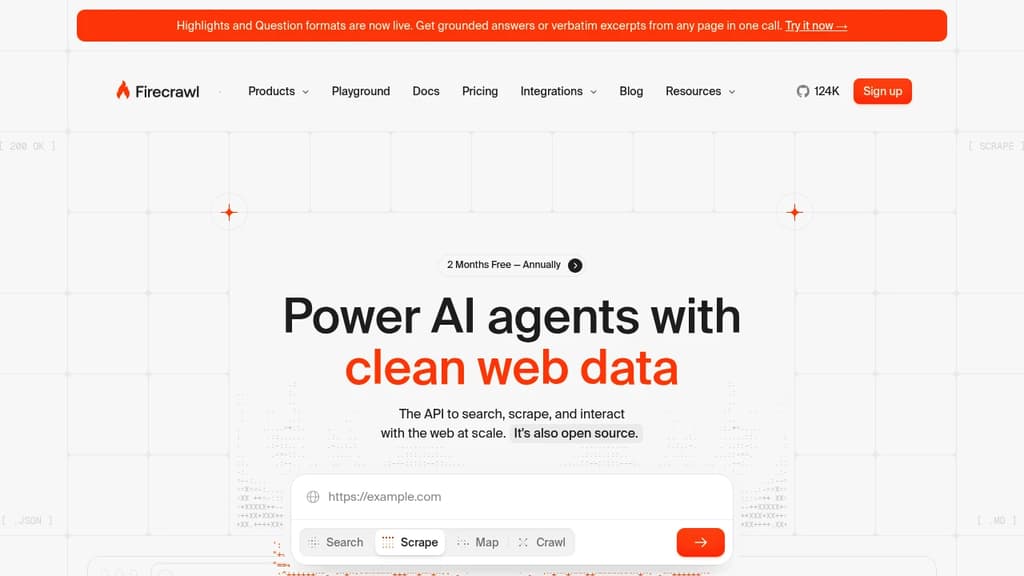
Firecrawl is a web data API built specifically for AI systems. It takes the messy, JavaScript-heavy, human-oriented web and converts it into structured data that agents and LLM pipelines can actually use. Over 80,000 companies rely on it, from indie developers wiring up AI search tools to teams at Apple and Canva running production-scale pipelines.
The three core capabilities work together:
- Search returns full-page Markdown alongside results, so one call goes from a query to usable content without a separate scrape step.
- Scrape handles JavaScript rendering, smart waits, and dynamic content automatically. Pass a URL and get back Markdown, HTML, screenshots, metadata, or structured JSON via a schema you define.
- Interact goes further. It lets agents click, scroll, type, and navigate multi-step flows, reaching data behind logins, pagination, or any sequence of actions a static scrape can't touch.
For browser automation for AI use cases, Firecrawl connects directly to MCP-compatible clients like Cursor, Claude, and Windsurf. There's also a CLI and official SDKs for Python, Node.js, Go, Rust, Java, and Elixir.
Under the hood, it covers 96% of the web with a reported P95 latency of 3.4 seconds across millions of pages. The hosted version adds proprietary infrastructure for proxy management and rendering reliability. The self-hostable version is the largest open source repo in the web crawlers space, with over 100,000 GitHub stars.
Common use cases include deep research agents, RAG pipelines, lead enrichment, competitive intelligence, and price monitoring. The free tier covers 1,000 pages per month, with paid plans scaling to millions of pages for larger workloads.
Unlike scraping tools that stop at raw HTML, Firecrawl parses PDFs and DOCX files, extracts structured data against a JSON schema, and caches results against a growing web index. It's a practical fit for any AI workflow that needs reliable, clean input from the live web.

Open-source web crawler and scraper that produces clean, structured output optimized for LLMs, RAG pipelines, and AI agents. Supports async crawling, CSS/XPath/LLM extraction, and stealth browser control.
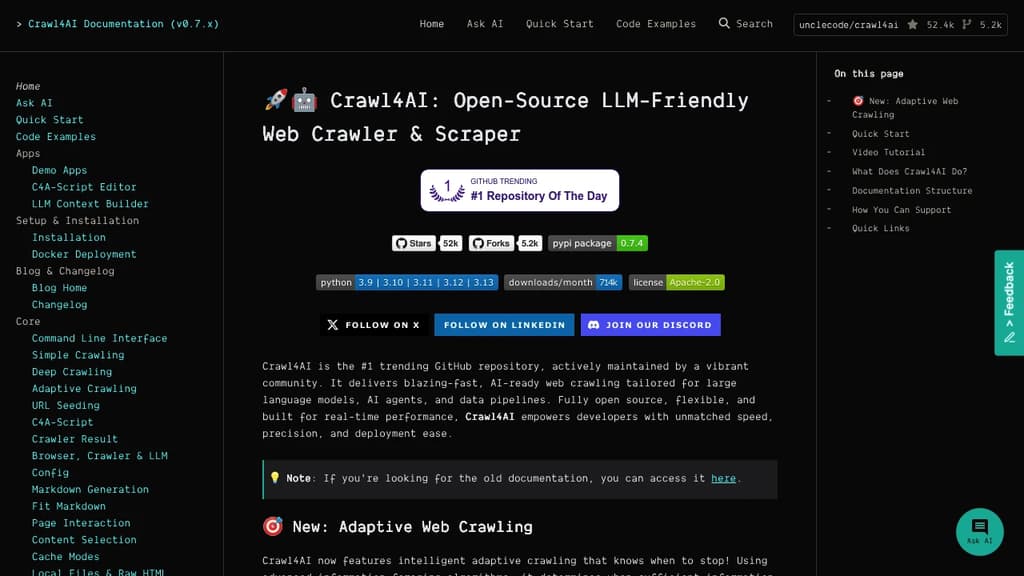
Crawl4AI is a web crawler and scraper built specifically for feeding data into AI pipelines and agents. Where generic scrapers dump raw HTML, Crawl4AI outputs clean Markdown and structured data that LLMs can consume directly, without heavy post-processing.
It's aimed at developers building RAG systems, data pipelines, or AI agents that need reliable, well-formatted web content at scale. The async-first architecture means you can run parallel crawls without blocking, making it practical for real-time use cases.
Key capabilities include:
- Clean Markdown output formatted for direct ingestion into LLMs or AI search tools, with minimal noise
- Structured extraction using CSS selectors, XPath, or LLM-based strategies for pulling repeated patterns from pages
- Adaptive crawling that uses information foraging algorithms to stop once enough data has been gathered to answer a query
- Advanced browser control including hooks, proxies, stealth modes, and session reuse for handling JavaScript-heavy or auth-protected sites
- Chunking and clustering approaches for breaking large pages into digestible pieces before passing to models
- No forced API keys or paywalls – you own the extraction process end to end
Compared to alternatives like Firecrawl or Jina AI, Crawl4AI leans heavily on self-hosting and configurability. You're not routing traffic through a third-party service, and there's no usage metering on the open-source version.
It also ships an AI assistant skill package (compatible with Claude, Cursor, and similar AI coding assistants) that bundles the full SDK reference and ready-to-use extraction scripts, so you can query the docs from inside your editor.
Deployable via pip or Docker, with a Python async API that fits naturally into existing data engineering workflows.

AI-powered search and RAG platform that connects to 100+ enterprise tools without data migration. Deploy securely on-premises with any LLM.
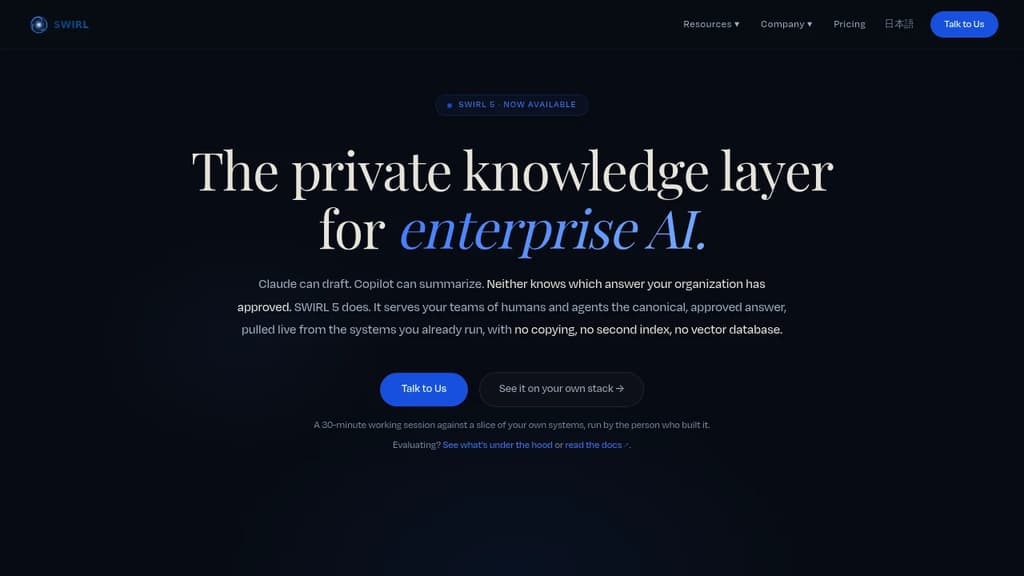
SWIRL transforms how enterprises access their knowledge by connecting AI directly to existing data sources without requiring expensive migrations or exposing sensitive information.
Key advantages:
- Zero data migration required - connects to 100+ enterprise platforms including SharePoint, Salesforce, Snowflake, and more
- Deploy anywhere - on-premises, private cloud, or hybrid environments with complete data isolation
- Use any LLM - works with your preferred language model, including air-gapped deployments
- Launch in minutes - no development time or complex setup required
- Maintain security - leverages existing SSO and permissions for compliance
Real enterprise impact:
- Fortune 500 pharma company saved $3M in migration costs while reducing analyst time by 20%
- Government agencies deployed secure search in classified environments
- Real estate firm reduced contract risk by finding hidden compliance issues across scattered documents
Universal search capabilities include relevancy re-ranking, real-time data access, and AI agent enablement. SWIRL eliminates the data scavenger hunt by providing instant answers from your company's information while keeping your intellectual property secure and maintaining full control over your data governance.

Query Google, Bing, Yandex, Baidu, DuckDuckGo, and Ecosia through one REST API. Self-host free under MIT, or use the managed cloud option.
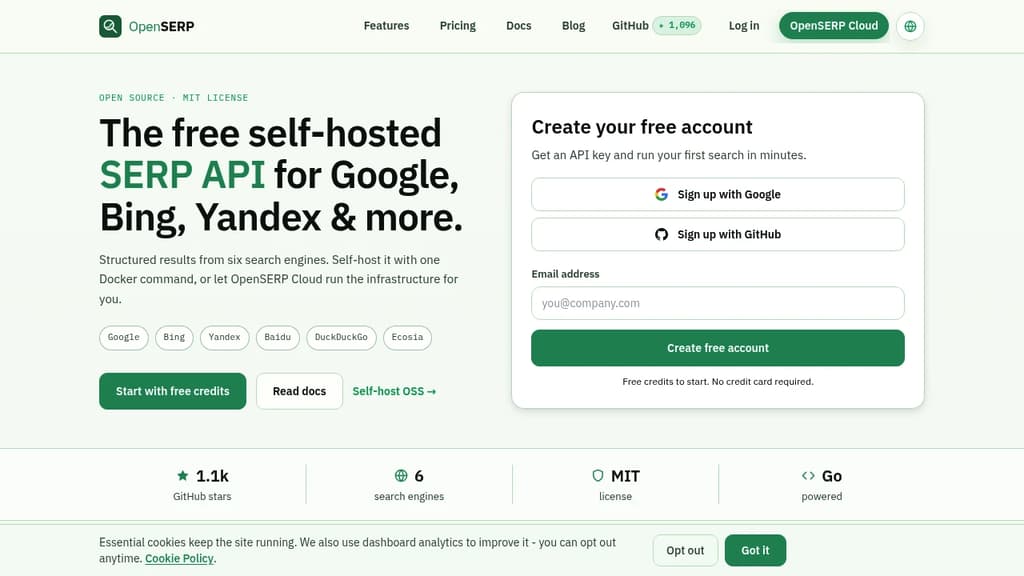
OpenSERP is a self-hosted REST API that pulls structured search results from six major search engines through a single, consistent endpoint. It's built for developers, SEO teams, and AI pipelines that need programmatic access to live SERP data without paying per-query fees or accepting vendor lock-in.
The self-hosted version is completely free. No API keys, no rate limits beyond your own hardware, no subscription. One Docker command starts a local server you can query immediately from any app, script, or pipeline.
What it returns is consistent JSON across every engine: titles, URLs, snippets, rank positions, and SERP features including AI summaries, answer boxes, people-also-ask, and related searches. Output can also be requested as Markdown, plain text, or NDJSON.
Key capabilities:
- Six engines supported: Google, Bing, Yandex, Baidu, DuckDuckGo, and Ecosia for web and image search
- Uniform response shape: the same JSON envelope regardless of which engine you query, so switching or combining engines requires no extra parsing logic
- SERP feature extraction: captures AI summaries, answer boxes, and related searches alongside organic results
- MIT license: full source on GitHub, deploy on any infrastructure you already run
- Multi-engine megasearch: the managed Cloud tier adds endpoints that query several engines in a single call
Common use cases include SEO rank tracking across regional engines like Yandex and Baidu, grounding LLM responses with live search data, feeding Firecrawl-style scraping pipelines, and competitor monitoring. It's a direct open-source alternative to paid providers like DataForSEO.
For teams that don't want to manage infrastructure, OpenSERP Cloud offers the same API as a managed endpoint with free starter credits and pay-as-you-go pricing. The open-source version and the cloud path share the same underlying codebase.

People are looking for alternatives to...
View all alternatives
Claude Code

Spotify

CapCut

Claude

Notion

Lovable
 Postiz – The All-in-One agentic social media scheduling tool
 Sent
Sent