
Omnara
AIProduction-ready agent infrastructure that handles state, machines, permissions, and history so you don't have to build the platform yourself.
Open Source Alternative to:




Last 30 days
Last commit
2 days agoRepository age
1 yearVersion
v0.2.11License
Apache-2.0Self-hosted
YesRepository
omnara-ai/omnara
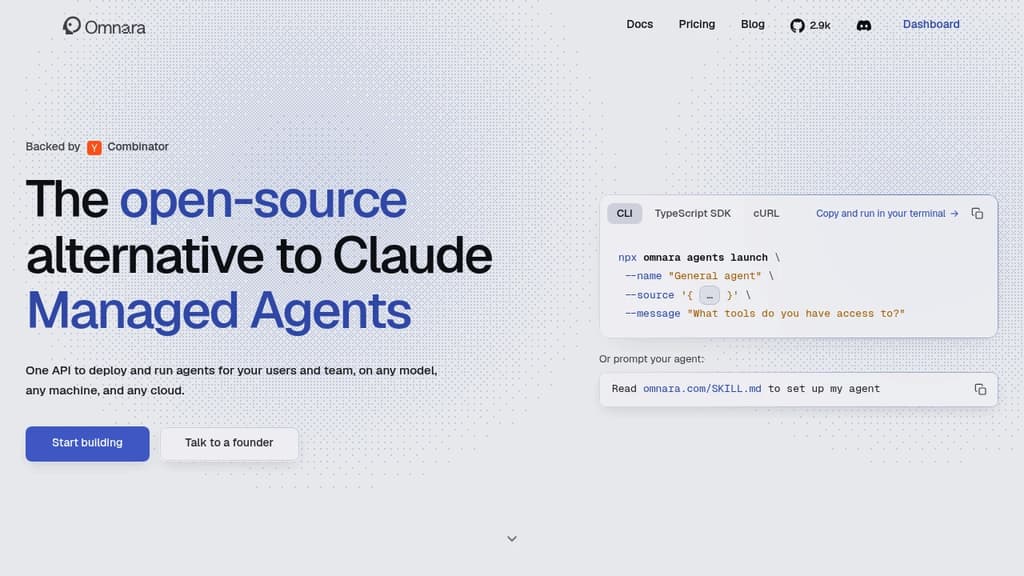
Building a prototype agent takes an afternoon. Getting it to production is where teams burn months. Omnara is an open-source agent platform that handles the hard parts: durable state, machine management, access controls, and audit history. It's aimed at teams that want the speed of a managed agent platform without handing over control of their models, data, or cloud.
Agents in Omnara are durable API objects, not just library calls baked into your app. You launch, steer, and observe them through a REST API, TypeScript SDK, or CLI. That means your application owns the whole experience, and you can run many agents without redeploying code every time something changes.
Key capabilities:
- Durable execution: Agent state survives failures. If a machine dies mid-run, Omnara restores state and continues from where it left off.
- Any machine: Run agents on Omnara-managed sandboxes, your own Blaxel, Daytona, or Unikraft Cloud account, or any laptop, VM, or container running the Omnara daemon. The daemon connects outbound, so no ports need to be opened.
- Any model: OpenAI, Anthropic, OpenRouter, LiteLLM, or any compatible endpoint you host yourself. Switch providers without rebuilding anything.
- Access controls: Require human approval before risky tool calls, store credentials as encrypted scoped secrets, assign role-based access, and keep an append-only audit trail of every action.
- MCP integrations: Connect MCP servers and reusable skills to reach your data, plus a first-party Slack integration so agents meet your team where it already works.
- Agent-ready APIs: Embed agents inside your own product rather than routing users through someone else's interface.
The comparison to building in-house is stark. Several engineering teams have publicly described spending four months and roughly 100,000 lines of code to ship a single internal agent. Omnara provides that substrate on day one: session management, durable event logs, credential proxying, and observability, without a dedicated platform team.
Unlike Amazon Bedrock AgentCore or similar managed platforms, Omnara doesn't lock you to one vendor's models, sandboxes, or pricing. The platform itself is free. You bring your own model keys and machines at no charge, or pay as you go for Omnara-managed resources at provider token rates. Self-hosting under the Apache 2.0 license is fully supported.
Tags:











Last 30 days
Last commit
2 days agoRepository age
1 yearVersion
v0.2.11License
Apache-2.0Self-hosted
YesRepository
omnara-ai/omnara
Every Sunday we deconstruct one proprietary app and pick the best open source alternatives worth switching to.
Similar open source projects

Stars
Last commit
License
Stars
Last commit
License
Stars
Last commit
License
 Sent – A unified API for sending messages across SMS, RCS, and apps like WhatsApp.
 Postiz
 CodeRabbit