Open Source Azure Data Explorer Alternatives
A curated collection of the 6 best open source alternatives to Azure Data Explorer.
The best open source alternative to Azure Data Explorer is InfluxDB. If that doesn't suit you, we've compiled a ranked list of other open source Azure Data Explorer alternatives to help you find a suitable replacement. Other interesting open source alternatives to Azure Data Explorer are: TDengine, QuestDB, Apache Druid, and GreptimeDB.
Azure Data Explorer alternatives are mainly Time Series Databases but may also be Log Management Tools or Cloud Data Warehouses. Browse these if you want a narrower list of alternatives or looking for a specific functionality of Azure Data Explorer.

Written by Piotr Kulpinski


InfluxDB handles high-velocity, high-resolution time series data at scale, built for telemetry, edge devices, IoT, and physical AI workloads.
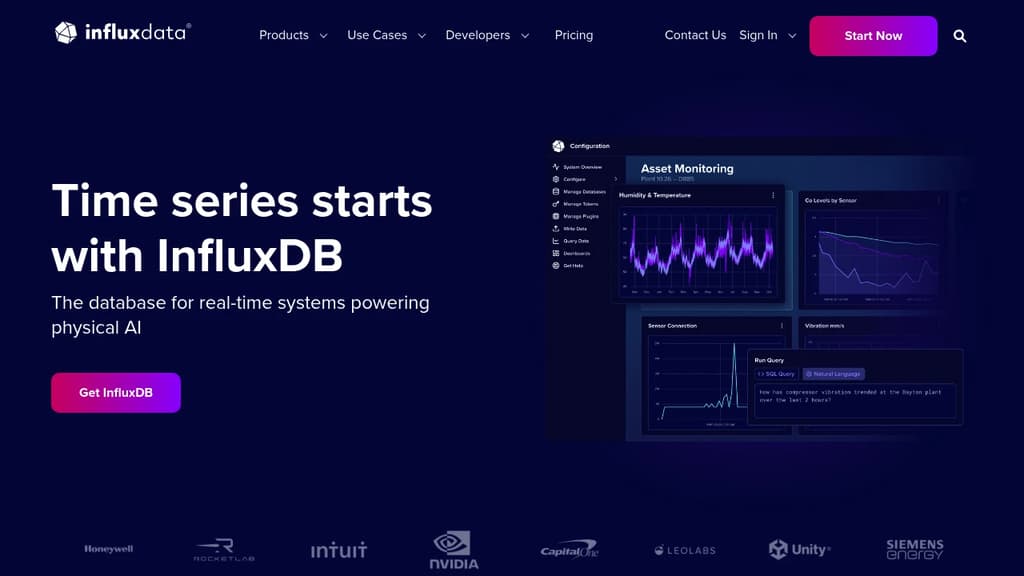
InfluxDB is a time series database built specifically for systems that generate continuous, high-resolution data. Think industrial sensors, satellite telemetry, power grids, and infrastructure monitoring. General-purpose databases weren't designed for this kind of workload, and the performance difference shows at scale.
The core strength is ingest speed. InfluxDB handles millions of data points per second without sacrificing query latency or blowing up storage costs. It uses efficient compression and stores data in Parquet format, which keeps footprint manageable even over long retention windows. Cold data gets automatically evicted and streamed into data lakes, warehouses, or AI/ML pipelines, so you're not paying hot-storage prices for data you rarely touch.
Key capabilities include:
- High-speed ingest – Millions of series ingested continuously without performance degradation
- Real-time analytics – SQL-based querying across unlimited series with low latency
- Edge-to-cloud continuity – Capture data at the source and analyze it anywhere without pipeline redesign
- Lakehouse integration – Automatic eviction of cold data into lakes, warehouses, and AI/ML systems
- 400+ Telegraf plugins – The open source Telegraf agent connects InfluxDB to virtually any data source, with over 5 billion downloads
- Client libraries – Official support for Python, Go, JavaScript, Java, and C#
Deployment is flexible. You can run it self-managed on-prem or at the edge, or use the fully managed cloud offering. Both options share the same engine, so you're not locked into a single environment.
Compared to alternatives like QuestDB, TDengine, or Timescale, InfluxDB has the largest installed base in its category, with over 1 million live open source instances and more than 2,800 contributors. It's ranked the top time series database by DB-Engines.
The tool targets engineers building monitoring systems, physical AI pipelines, aerospace telemetry platforms, and industrial data historians. If your workload involves continuous sensor streams and you need both fast writes and fast reads, InfluxDB is built around exactly that problem.

High-performance time-series database with industrial data management, built-in stream analytics, and AI-driven anomaly detection for operational environments.

TDengine is built for industrial organizations that need to move beyond legacy historians. It combines a high-performance time-series database with an industrial data management layer, giving engineers a single platform to ingest, store, contextualize, and analyze large-scale operational data.
The open-source core (TDengine TSDB) handles the heavy lifting: a specialized storage engine tuned for time-series workloads that claims 10x the performance of general-purpose databases at a fraction of the storage cost. Automated tiered storage and S3 support keep the data footprint manageable as data volumes grow.
On top of the database sits the historian layer, which is where TDengine differentiates itself from tools like InfluxDB or GreptimeDB:
- Industrial connectivity via OPC, MQTT, and Kafka with built-in ETL for cleaning and transforming data at ingestion
- Asset contextualization through a tree hierarchy, reusable templates, and rich metadata, so raw sensor data becomes meaningful operational context
- Stream analytics that continuously monitor data to generate KPIs and trigger alerts without manual rule configuration
- Process analytics including batch comparison, trend analysis, and correlation tools for root cause investigation
- AI-driven anomaly detection and forecasting powered by TDgpt, running directly inside the database without external tooling
- Zero-Query Intelligence that automatically surfaces dashboards, insights, and KPI recommendations based on data and business context
The AI assistant can generate analyses on demand and investigate alerts, making it practical for operations teams rather than just data engineers. This positions TDengine as a direct alternative to GE Proficy Historian and similar industrial historians, but with an open-source foundation that avoids vendor lock-in.
Security features include role-based access controls, IP whitelisting, data encryption, and backup and disaster recovery options, which matter in regulated industrial environments. The platform integrates with third-party BI and AI tools over open interfaces, so it fits into existing workflows rather than replacing them wholesale.

Open-source time-series database offering massive ingestion throughput, millisecond queries, and SQL extensions, designed for optimal performance at any hardware scale.
QuestDB delivers exceptional performance for time-series data management with features that set it apart:
- Massive Ingestion Capability: Handles over 4 million rows per second per node, making it ideal for high-frequency data collection
- SQL Compatibility: Offers powerful time-series extensions while maintaining familiar SQL syntax and PostgreSQL wire protocol
- Hardware Efficiency: Performs effectively on both minimal hardware (like Raspberry Pi) and enterprise-grade servers
- Built-in Features: Includes out-of-box support for deduplication, out-of-order indexing, and real-time aggregations
- Integration Ready: Compatible with popular tools like Grafana, Pandas, Python, and various data streaming platforms
Used by major financial institutions and enterprises for real-time analytics, market data processing, and IoT applications.

Columnar, time-indexed analytics database built for streaming and batch data at scale, handling billions to trillions of rows with millisecond query response times.
Apache Druid is an OLAP database built for teams that need fast, concurrent analytics on massive datasets without pre-caching queries or pre-defining schemas. It targets use cases where query latency must stay low even as data volumes and concurrent users grow into the hundreds of thousands of queries per second.
Druid sits in the same space as tools like ClickHouse and QuestDB, but its architecture is distinctly oriented around streaming-first ingestion and elastic, loosely coupled components.
What makes it fast:
- Scatter/gather query engine preloads data into memory or local storage, avoiding data movement and network latency during query execution
- Automatic columnarization on ingestion, combined with dictionary encoding, bitmap indexing, and type-aware compression, means queries touch only the data they need
- Time-based indexing is a first-class citizen, which benefits time-series and event-driven workloads considerably
Streaming and batch ingestion:
Druid connects natively to Apache Kafka and Amazon Kinesis without additional connectors, supporting query-on-arrival at millions of events per second. Historical batch data and live streaming data are queryable through the same interface. Schema auto-discovery handles column detection and type inference automatically, updating as data evolves.
Operational features include configurable tiering with quality-of-service controls for mixed workloads, automatic continuous backup, multi-node replication, and automated recovery. These make it practical to run as a production system without constant manual intervention.
Analysts and developers use standard SQL across ingestion, transformation, and querying. Join operations work both at ingestion time and at query time, with best performance when tables are pre-joined during ingestion.
For teams evaluating time-series alternatives or looking beyond InfluxDB for higher-concurrency OLAP workloads, Druid's architecture handles cardinality and dimensionality that would slow down general-purpose databases significantly.

Cloud-native observability database unifying metrics, logs, and traces with sub-second queries, 50x cost reduction, and seamless OpenTelemetry integration.
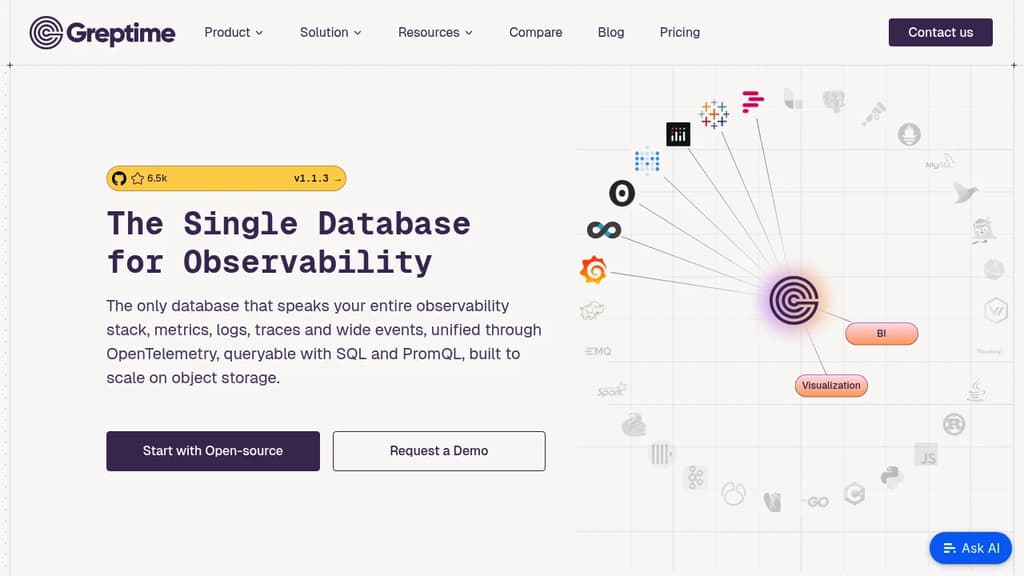
GreptimeDB is a cloud-native, real-time observability database that revolutionizes how organizations handle metrics, logs, and traces. Built for OpenTelemetry and modern cloud environments, it delivers sub-second query performance at petabyte scale while dramatically reducing operational complexity.
Key benefits include:
- All-in-One Solution: Process metrics, logs, and traces through a unified database with full SQL, PromQL, and streaming processing support
- Exceptional Performance: Built with Rust for reliability, featuring rich indexing options (inverted, fulltext, skipping, and vector) that enable sub-second responses on massive datasets
- Massive Cost Savings: Achieve 50x lower operational and storage costs through compute-storage separation and flexible cloud scaling
- Infinite Scalability: Purpose-built for Kubernetes with industry-leading architecture that handles cardinality explosion at massive scale
- Developer-Friendly: Access through standardized interfaces including web dashboard, REST API, and MySQL/PostgreSQL protocols
- Flexible Deployment: Deploy anywhere from ARM-based edge devices to cloud environments with unified APIs
Trusted by companies like Li Auto (reduced traffic costs by 50%, storage costs by 98%), SGCC (2x write performance, 5x query performance), and others who have migrated from InfluxDB, Loki, and Thanos to achieve superior performance and simplified operations.

Sub-second SQL queries on fresh streaming data at petabyte scale, built for high-concurrency user-facing apps and AI agent backends.
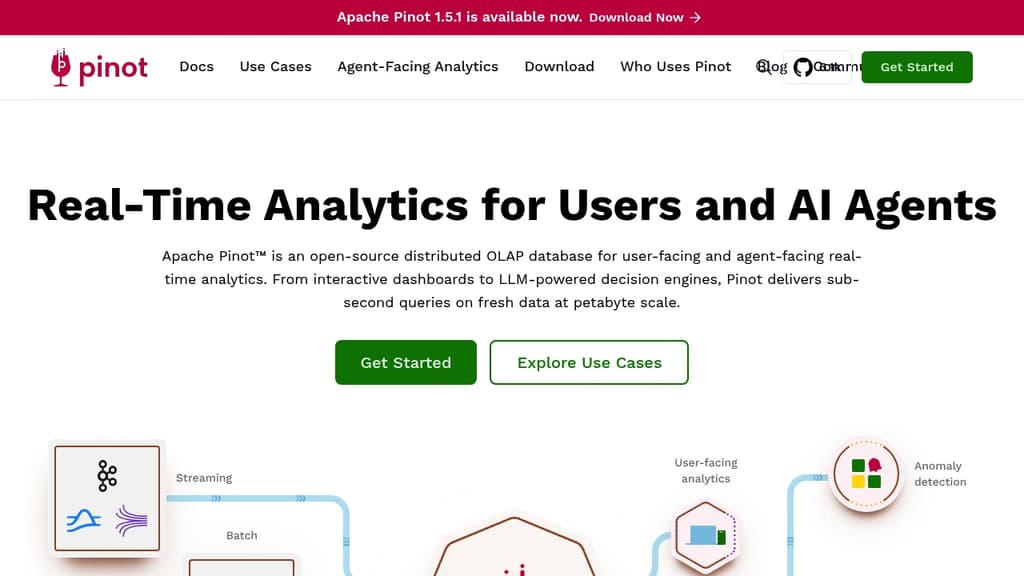
Apache Pinot is a distributed OLAP database built for real-time analytics where latency and concurrency actually matter. Originally developed at LinkedIn, it's now used by Stripe, Uber, Walmart, and others to serve analytical queries at hundreds of thousands of requests per second, often with P99 latencies under 100ms.
The core use case: you have streaming data and you need to query it interactively, at scale, without pre-aggregating everything in advance. Pinot handles that through columnar storage, a rich set of pluggable indexes, and a distributed architecture that scales horizontally.
Key capabilities:
- Real-time ingestion from Kafka, Kinesis, and Pulsar, plus batch sources like S3, Hadoop, and Spark. Both can feed the same table.
- Upserts built in, so repeated records resolve to their latest value at query time without extra application logic.
- High-concurrency query serving, designed for scenarios where end users or AI agents are hitting the database directly, not just internal dashboards.
- Versatile joins across petabyte datasets, not just simple lookups.
- Multitenancy with logical namespace isolation, useful for SaaS products serving per-customer analytics.
- SQL interface with a built-in query editor and REST API.
Pinot fits two broad patterns. First, user-facing analytics: embedded dashboards, customer-facing data exploration, leaderboards, and usage metrics where your product's users are running queries in real time. Second, AI agent backends: LLM-powered systems that need fresh context from streaming data rather than stale snapshots. Think fraud scoring, real-time RAG retrieval, or agentic observability over live logs.
Compared to tools like ClickHouse, Pinot's design leans heavily toward serving many concurrent external users rather than fewer internal analysts running complex ad-hoc queries. The trade-off is intentional. Pinot's indexing options (inverted, range, text, geospatial, and more) let you tune for specific query patterns without restructuring your data model.
At Stripe, it handles 200K queries per second across 3 petabytes with P99 latency of 70ms. At Uber, a single service runs 500 million Pinot queries daily. These aren't edge cases; the architecture is built around this kind of load from the start.

People are looking for alternatives to...
View all alternatives
Claude Code

Spotify

CapCut

Claude

Notion

Lovable
 Stellar Hosted – Managed Open Source software hosting in the EU: secure, compliant, fast.
 Sent
Sent