Hermes Agent
AICross-platform desktop agent from Nous Research that connects to Telegram, Discord, Slack, WhatsApp, and more, with persistent memory, scheduling, and isolated sandboxing.
Open Source Alternative to:




Last 30 days
Last commit
12 minutes agoRepository age
1 yearVersion
v0.21.6License
MITSelf-hosted
YesRepository
nousresearch/hermes-agent
- 1
Start a KVM 2 VPS on Hostinger
Recommended plan for one-click apps.
- 2
Apply code
10% off any 12-month plan at checkout.
- 3
Deploy Hermes Agent
With Hostinger's one-click installer.
 Host with Hostinger
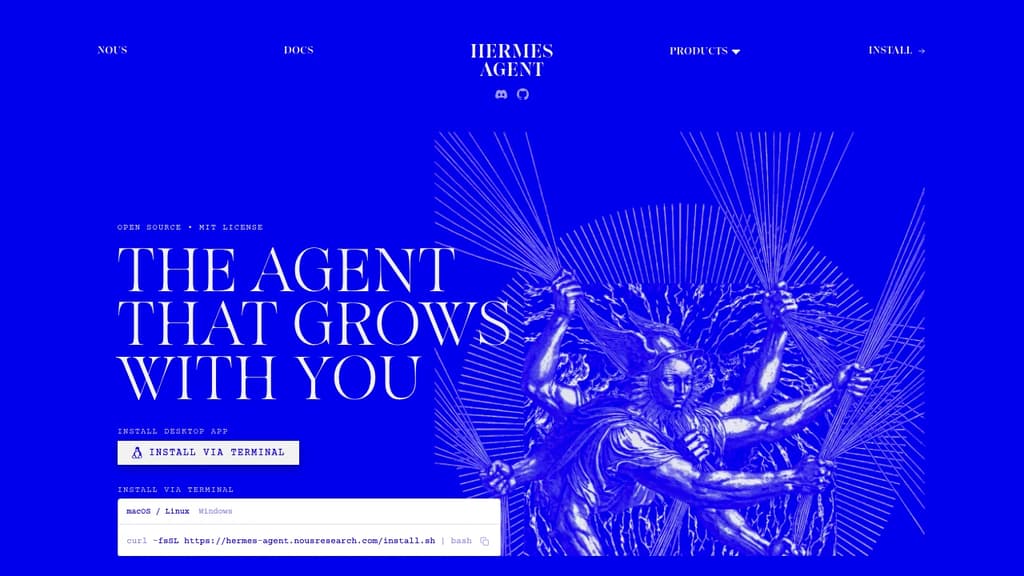
Hermes Agent is a desktop AI agent built by Nous Research that runs natively on macOS, Windows, and Linux. It's designed for people who want a single agent that works across their communication tools, handles recurring tasks, and actually remembers what it's done before.
The core idea is persistence. Most agents start fresh every session. Hermes maintains memory across conversations, auto-generates skills from past interactions, and builds up context about your projects over time. You don't have to re-explain things.
Where it connects:
- Telegram, Discord, Slack, WhatsApp, Signal, and email are all supported natively, so the agent meets you where you already work
- A CLI interface is also available for terminal-first workflows
What it can do:
- Natural-language scheduling for reports, backups, and briefings that run unattended
- Web search and browser automation with vision, image generation, and text-to-speech
- Subagents that run in isolated conversations with their own terminals and Python RPC scripts, useful for parallel pipelines without ballooning context costs
- Multi-model reasoning with access to 300+ models through the Nous Portal
Sandboxing is a genuine differentiator. Five execution backends (local, Docker, SSH, Singularity, and Modal) give you control over where code actually runs, with container hardening and namespace isolation. That matters if you're running automated tasks or untrusted scripts.
For teams or individuals already using LobeChat or similar multi-surface chat interfaces, Hermes takes a different angle: it's less about chat UI and more about an agent that operates autonomously across surfaces. Think of it as closer to an AgentOS approach, where the agent itself is the persistent layer.
It's free to use under the MIT license, with paid tiers through the Nous Portal for higher model access and monthly credits.
Tags:











Last 30 days
Last commit
12 minutes agoRepository age
1 yearVersion
v0.21.6License
MITSelf-hosted
YesRepository
nousresearch/hermes-agent
- 1
Start a KVM 2 VPS on Hostinger
Recommended plan for one-click apps.
- 2
Apply code
10% off any 12-month plan at checkout.
- 3
Deploy Hermes Agent
With Hostinger's one-click installer.
Host with HostingerEvery Sunday we deconstruct one proprietary app and pick the best open source alternatives worth switching to.
Similar open source projects

Stars
Last commit
License
Stars
Last commit
License
Stars
Last commit
License
 CodeRabbit – The leading AI Code Review platform. Ship better quality code in 50% less time, with 90% fewer bugs.
 InfluxDB
 c15t
c15t