
OpenBot
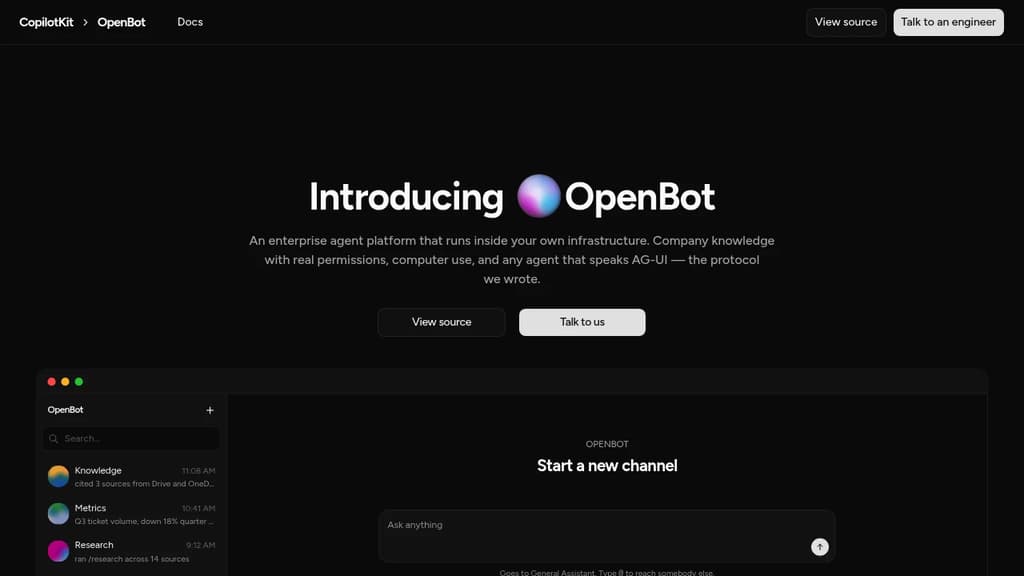
AIDeploy AI agents inside your own infrastructure with document-grounded answers, computer use, and support for any AG-UI-compatible agent framework.
Open Source Alternative to:





Last 30 days
Last commit
8 hours agoRepository age
2 monthsVersion
v0.2.0License
MITSelf-hosted
YesRepository
copilotkit/openbot
OpenBot is a self-hosted enterprise agent platform built for companies that can't afford to hand their data to a third party. It runs on your own infrastructure, keeps documents and conversations in your own Postgres database, and enforces the same file permissions your existing systems already have. Every agent gets its own channel, behaves like a named colleague, and only has access to the tools and sources its role requires.
The platform ships several agent archetypes out of the box:
- Knowledge agent answers questions from connected company documents (Google Drive, OneDrive) and always cites the source files, so answers can be verified rather than trusted.
- Metrics agent queries your analytics warehouse and draws the answer directly instead of describing it in prose.
- Research agent gathers context across documents and drafts from them, keeping contradictory sources rather than quietly picking one.
- Tool operator signs into interfaces that have no useful API and drives them the way a person would. You can watch the screen in real time and take control mid-task.
- Inbox triage, onboarding buddy, and other role-based agents can be published and scoped to exactly the skills they need.
Permissions are fail-closed throughout. An agent only sees files the person asking is already allowed to open. Documents with ambiguous permission mappings aren't returned at all. Sensitive tool calls go through a gateway with an explicit per-tool allowlist, and every call is logged.
OpenBot is built on AG-UI, the Agent-User Interaction Protocol that the team behind OpenBot wrote and maintains. This means any agent that speaks AG-UI, whether built on LangGraph, Mastra, PydanticAI, or a custom framework, can be registered as an endpoint and given a channel. No lock-in to a single agent framework.
On the infrastructure side: no shared tenancy, no seat counting, and no bundled model. Admins supply their own provider credentials, which are encrypted at rest and never logged. Nothing silently falls back to an external LLM if a provider isn't configured. Helm is the supported production deployment path.











Last 30 days
Last commit
8 hours agoRepository age
2 monthsVersion
v0.2.0License
MITSelf-hosted
YesRepository
copilotkit/openbot
Every Sunday we deconstruct one proprietary app and pick the best open source alternatives worth switching to.
Similar open source projects

Stars
Last commit
License
Stars
Last commit
License
Stars
Last commit
License
 InfluxDB – The purpose-built time series platform for high-velocity ingestion and real-time queries at scale.
 Openlane
 Bright Data