
Helium
Chromium-based desktop browser with default ad and tracker blocking, no analytics, native !bangs, split view, and full MV2 extension support.
Open Source Alternative to:




Last 30 days
Last commit
7 hours agoRepository age
2 yearsVersion
0.19.4License
GPL-3.0Repository
imputnet/helium
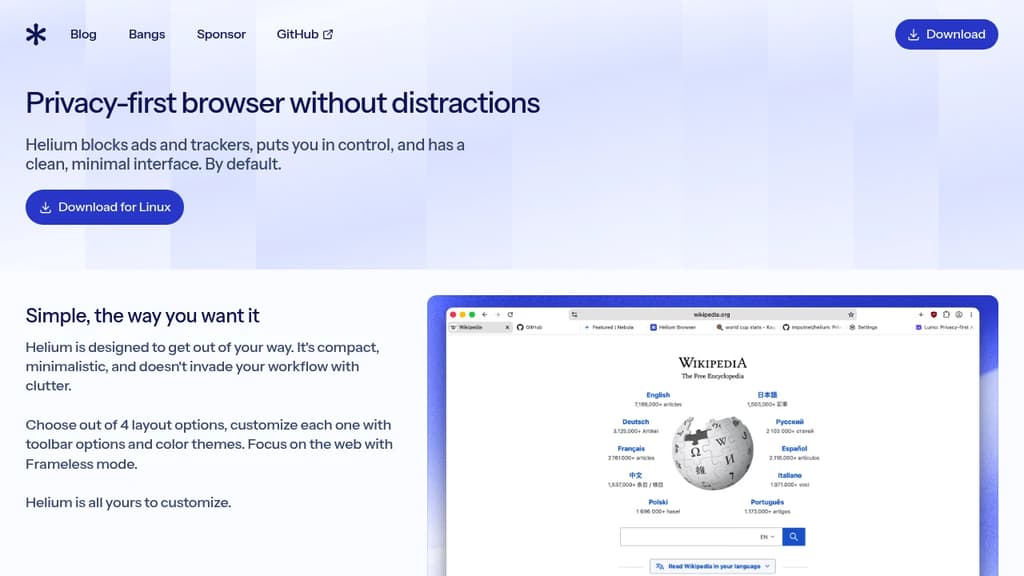
Helium is a desktop web browser built around one premise: your browsing should be private by default, not by configuration. It's aimed at people tired of browsers that ship with adware, nag screens, and hidden telemetry, as well as developers who want a clean Chromium base that doesn't interfere with web standards.
Privacy isn't a toggle buried in settings. Helium blocks ads, trackers, phishing sites, and third-party cookies out of the box using community filters and uBlock Origin. Fingerprinting protection is on by default. The browser itself contains no analytics and makes zero network requests on first launch without your explicit consent. There are no exceptions carved out for paying advertisers, which sets it apart from browsers like Brave that have faced criticism for whitelisting certain ad networks.
Key capabilities include:
- !bangs built directly into the browser, working offline with over 10,000 shortcuts to jump straight to Wikipedia, GitHub, Wolfram Alpha, and more
- Split view for opening two pages side by side without extensions
- Full MV2 extension support, including all Chrome Web Store extensions, with anonymized requests so Google can't track your installs
- No built-in password manager or cloud sync, by design, keeping your credentials and history off third-party servers
- HTTPS enforcement on all sites with visible warnings when a site doesn't support it
The interface is compact and minimal. There's no toolbar clutter, no unprompted update tabs, no popups about features you didn't ask about. It's based on Chromium, so page compatibility is identical to Chrome, and DevTools are intact for developers.
All source code is open, including the online services Helium runs. You can self-host those services and point your browser at your own instance. Compared to privacy-focused alternatives like Zen Browser or Midori, Helium leans hard into being a drop-in Chrome replacement rather than a Firefox fork, which matters if your workflow depends on Chromium-specific behavior or extensions.






Last 30 days
Last commit
7 hours agoRepository age
2 yearsVersion
0.19.4License
GPL-3.0Repository
imputnet/helium
Every Sunday we deconstruct one proprietary app and pick the best open source alternatives worth switching to.
Similar open source projects

Stars
Last commit
License
Stars
Last commit
License
Stars
Last commit
License
 Postiz – The All-in-One agentic social media scheduling tool
 CodeRabbit
 Sent
Sent