Gigapipe vs HyperDX
Learn how Gigapipe and HyperDX differ in their key features, development activity, technology
stack and community adoption, so you can decide which of these log management tools is best for you.
Learn how Gigapipe and HyperDX differ in their key features, development activity, technology stack and community adoption, so you can decide which of these log management tools is best for you.

Gigapipe
Last 30 days
Last commit
5 days agoRepository age
8 yearsVersion
v5.5.3License
AGPL-3.0Repository
metrico/gigapipe


HyperDX
Last 30 days
Last commit
7 hours agoRepository age
3 yearsVersion
v0.7.0License
MITSelf-hosted
YesRepository
hyperdxio/hyperdx
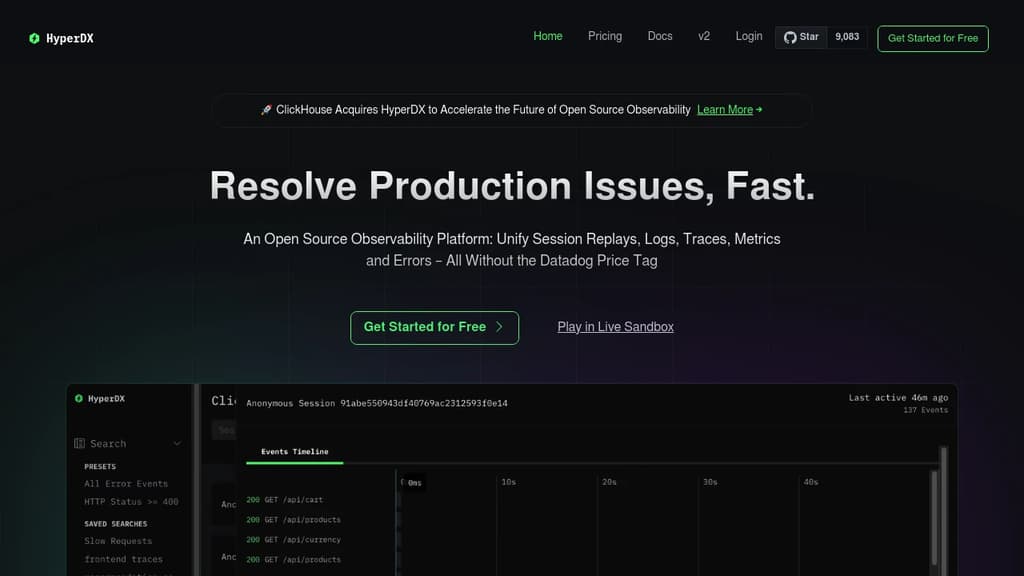
Detailed Comparison
HyperDX appears to have several advantages over Gigapipe, particularly in popularity, licensing and features. Consider your specific needs regarding popularity, growth, activity, technology, maturity, licensing and features when making your decision.
HyperDX appears to have several advantages over Gigapipe, particularly in popularity, licensing and features. Consider your specific needs regarding popularity, growth, activity, technology, maturity, licensing and features when making your decision.
Community & Popularity
HyperDX significantly outpaces Gigapipe in community adoption with 9,957 stars compared to 1,714 stars on GitHub. This 5.8x difference suggests HyperDX has a much larger and more active community. In terms of developer contributions, HyperDX has 495 forks, indicating moderate developer engagement.
Growth Momentum
Gigapipe and HyperDX are moving at much the same rate, adding 8 stars and adding 54 stars respectively over the last 30 days (+0.5% vs +0.5%). Neither is pulling away from the other on momentum alone.
Development Activity
Both projects show recent activity, with Gigapipe last updated 5 days ago and HyperDX 7 hours ago.
Technology Stack
Both tools share common technology foundations, being built with Golang. However, they differ in their additional technology choices: HyperDX leverages JavaScript, CSS, Bash, Typescript, JSX, Next.js, SCSS.
Project Maturity
Gigapipe has been in development longer, starting 8 years ago, compared to HyperDX which began 3 years ago. This 4.8-year head start suggests Gigapipe may have more mature features and established processes.
Licensing
HyperDX uses the MIT license, which is more permissive than Gigapipe's AGPL-3.0 license, potentially offering greater flexibility for commercial use and integration.
Use Cases & Features
Both tools serve similar use cases in Log Management. However, they also have distinct specializations: Gigapipe also focuses on Infrastructure Monitoring while HyperDX extends into Performance Monitoring (APM), Error Tracking.
Hosting & Deployment
HyperDX provides self-hosting options for complete data control and customization, while Gigapipe may be primarily cloud-based or require different deployment approaches.
Other tool comparisons to consider
Gigapipevs
 GrafanaGigapipe
vs
 ProjectDiscoveryGigapipe
vs
 SigNozGigapipe
vs
 Grafana LokiGigapipe
vs
 Apache SkyWalkingGigapipe
vs
 OpenObserveGigapipe
vs
 VectorGigapipe
vs
 LogstashGigapipe
vs
 GreptimeDBGigapipe
vs
 LogfireGigapipe
vs
 UptraceGigapipe
vs
 MapleHyperDX
vs
GrafanaHyperDXvs
 NetDataHyperDX
vs
 SentryHyperDX
vs
SigNozHyperDXvs
Grafana LokiHyperDXvs
Apache SkyWalkingHyperDXvs
OpenObserveHyperDXvs
VectorHyperDXvs
LogstashHyperDXvs
 HighlightHyperDX
vs
 CorootHyperDX
vs
GreptimeDBHyperDXvs
LogfireHyperDXvs
UptraceHyperDXvs
MapleHyperDXvs
 BugsinkHyperDX
vs
 GlitchTip
 Sent – Messaging Infrastructure for Developers. One API for SMS, WhatsApp, and RCS across 190+ countries.