Open Source Voiceflow Alternatives
A curated collection of the 9 best open source alternatives to Voiceflow.
The best open source alternative to Voiceflow is Parlant. If that doesn't suit you, we've compiled a ranked list of other open source Voiceflow alternatives to help you find a suitable replacement. Other interesting open source alternatives to Voiceflow are: Langflow, LiveKit, Botpress, and Typebot.
Voiceflow alternatives are mainly AI Agent Platforms but may also be Chatbot Platforms or Low-Code/No-Code Platforms. Browse these if you want a narrower list of alternatives or looking for a specific functionality of Voiceflow.

Written by Piotr Kulpinski


A conversational AI server that manages agent behavior through context-aware guidelines, keeping responses consistent, auditable, and aligned at scale.
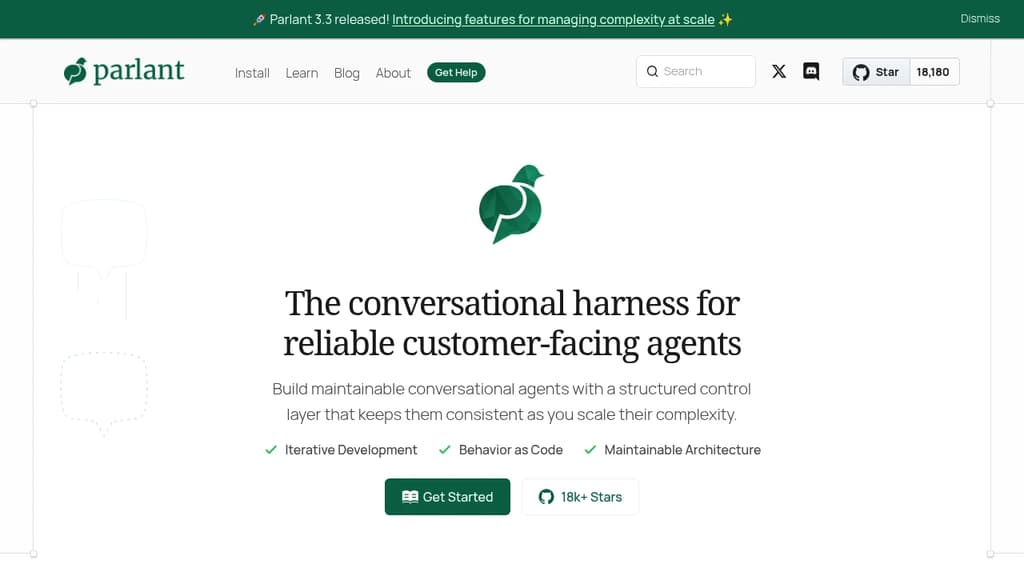
Parlant is a self-hostable conversational AI server designed for teams building customer-facing agents that need to stay on-brand, on-policy, and predictable in production. It sits between your frontend and your LLM provider, managing every interaction through a structured control layer rather than relying on monolithic system prompts or rigid intent graphs.
The core idea is context engineering: instead of stuffing all your rules into one prompt and hoping the model follows them, Parlant dynamically assembles only the rules, data, and tools relevant to each turn. The result is that the 200th behavioral rule is as safe to add as the first, with no degradation in adherence.
Key capabilities:
- Guidelines define conditional behavioral rules that fire based on conversational context. When several apply at once, Parlant merges them intelligently without manual routing.
- Canned responses let you lock down exact wording for high-stakes moments. In strict mode, required fields must be present in context before a response can be selected, making hallucination prevention structural and deterministic.
- Journeys model multi-step interactions while preserving the fluid, non-linear nature of real dialogue. Users can mix topics and circle back without losing context.
- Full traceability on every turn: which guidelines fired, which glossary terms were matched, and why the agent responded the way it did.
This is a meaningful departure from tools like Rasa or flow-based builders. Changing agent behavior is a content change (add or edit a guideline), not a structural one (rewire a graph). That makes it practical for product teams to feed ongoing feedback directly into the agent without requiring engineering intervention for every adjustment.
Parlant is LLM-agnostic and works with OpenAI, Anthropic, Azure, and others. It's built for enterprise AI teams where tone, edge cases, and policy constraints aren't afterthoughts.

Build, deploy, and iterate on AI agents, RAG applications, and MCP servers using a drag-and-drop visual interface backed by Python.
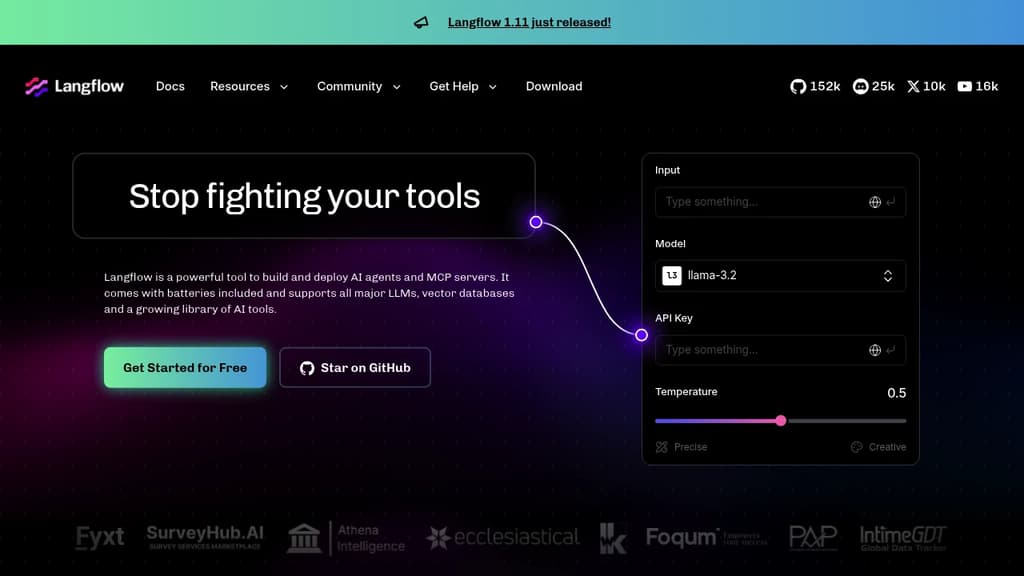
Langflow is a low-code platform for building AI agents and RAG applications visually. It targets developers and AI teams who want to move fast without writing boilerplate, while still having full access to the underlying Python when they need it. The visual canvas lets you wire together models, data sources, and tools by dragging components onto a flow, then deploy that flow as an API with minimal extra work.
The integration library is broad:
- LLMs: OpenAI, Anthropic, Mistral, Meta (Llama), Groq, NVIDIA, Amazon Bedrock, Ollama, HuggingFace, and more
- Vector stores: Pinecone, Milvus, Weaviate, Qdrant, Cassandra, Couchbase, Upstash, Vectara
- Data sources: Google Drive, Confluence, Notion, Gmail, GitHub, Slack, MongoDB, and dozens more
- Agent frameworks: LangChain, CrewAI, Composio
Flows are reusable and shareable. You can pick from a library of pre-built components, swap models mid-flow to compare outputs, and run single agents or coordinated fleets where each agent has access to your components as tools. Every flow exposes itself as an API endpoint, so connecting Langflow to an existing product is straightforward.
Python is always available under the hood. Any component can be customized with code, so the visual layer doesn't box you in. Teams that need observability can pair it with tools like Langfuse for tracing.
Deployment is flexible. Self-host it on your own infrastructure, or use the managed cloud option, which runs the same codebase as the open-source version. That parity matters: there's no feature gap to worry about when moving between environments.
Compared to alternatives like Flowise AI or Dify, Langflow leans into Python extensibility and a wide integration surface, making it a practical fit for teams building production-grade agents rather than quick demos.

Build, test, deploy, and scale voice and video AI agents with an open source framework, inference gateway, telephony integrations, and full observability.
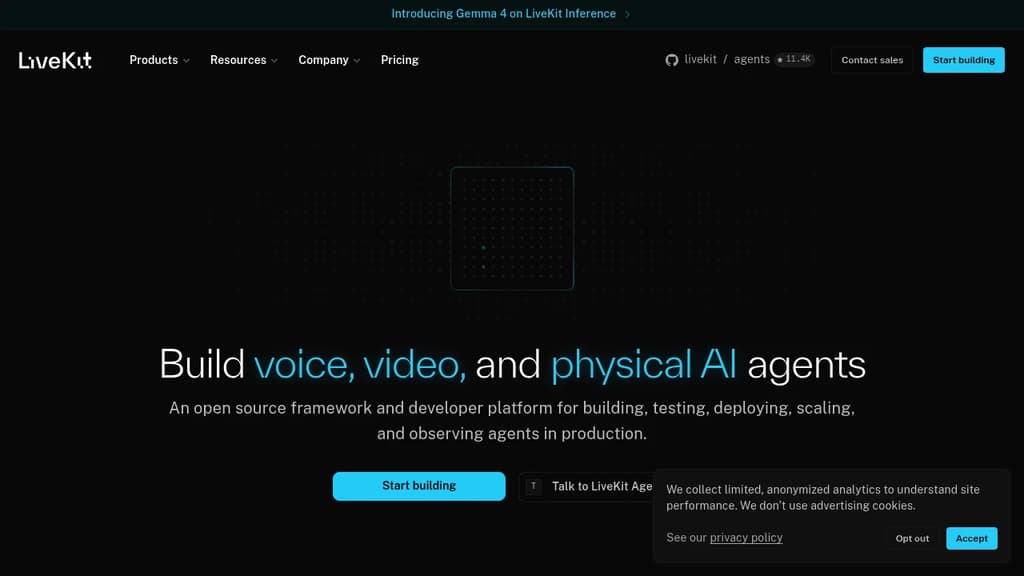
LiveKit is an open source framework and cloud platform for building AI agents that communicate through voice, video, or physical interfaces. It's aimed at developers who need production-grade infrastructure without assembling a custom stack from scratch. OpenAI built ChatGPT's Advanced Voice on it, and the platform handles over 2.5 billion calls annually.
The core idea is to cover the entire agent lifecycle in one place. You write agent logic, connect it to the speech and language models you choose, and deploy it without managing the underlying real-time infrastructure yourself. Automatic turn detection and interruption handling are built in, so agents respond naturally in conversation rather than waiting for rigid cues.
Key capabilities include:
- Open source agent framework for building and testing agents locally before deploying
- Inference gateway that connects to TTS, LLM, and STT providers (Deepgram, Google, Cartesia, and others) through a unified interface
- Telephony and SIP integrations so agents can handle phone calls alongside browser and app sessions
- Full-stack observability across every agent session, not just aggregate metrics
- LiveKit Cloud for deploying and scaling agents across regions globally, with SOC 2 Type 2, HIPAA, and GDPR compliance
LiveKit fits squarely in the AI agent platforms space but goes further than most by covering real-time media transport, not just LLM orchestration. That makes it relevant for robotics and video AI use cases, not just voice chatbots. Teams that have moved off homegrown WebSocket stacks cite the unified export interface across web and phone as a concrete reason to switch.
The self-hosted framework is free and open source. LiveKit Cloud adds managed scaling, telephony, and observability, with 1,000 free agent session minutes per month and no credit card required to start.

A comprehensive platform for creating AI agents with intuitive tools, extensive integrations, and enterprise-grade features powered by the latest language models.
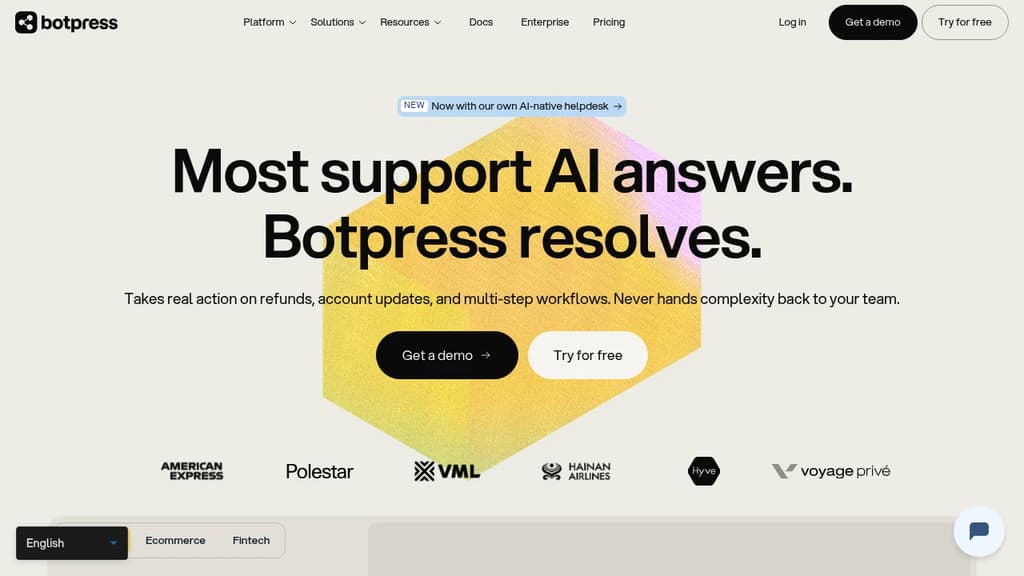
Botpress delivers a complete solution for building sophisticated AI agents. The platform combines powerful LLM capabilities with an intuitive visual builder, making it accessible for both developers and non-technical users. Key features include:
- Extensive Integration Options - Connect with popular services like WhatsApp, Telegram, and Calendly
- Knowledge Management - Import data from multiple sources including websites, PDFs, and documents
- Enterprise-Ready - Built-in security, compliance (GDPR, SOC 2), and scalability features
- Developer-Friendly - Comprehensive API/SDK access and extensive documentation
- Active Community - Large Discord community with daily office hours and expert support
The platform processes over 1 billion messages and is trusted by major companies like Windstream and American Eagle for customer support automation at scale.

Design, build, and deploy interactive chatbots with a visual editor. Integrate easily and collect data effortlessly.
Typebot revolutionizes the way you create and manage chatbots, offering a powerful yet user-friendly platform for businesses and developers alike. With its intuitive visual editor, you can design complex conversational flows without writing a single line of code.
Key benefits of Typebot include:
- Visual Flow Builder: Drag-and-drop interface for easy bot creation
- Customizable Design: Match your brand with fully customizable themes
- Multi-Platform Integration: Embed your chatbots on websites, apps, or popular messaging platforms
- Advanced Logic: Implement conditional branching and variables for sophisticated interactions
- Data Collection: Gather and analyze user inputs securely
- API Connections: Integrate with your existing tools and databases
- Multi-Language Support: Create bots in any language to reach a global audience
- Templates: Jump-start your projects with pre-built templates for various use cases
- Analytics Dashboard: Track performance and optimize your chatbots
Whether you're looking to automate customer support, streamline lead generation, or create interactive surveys, Typebot provides the tools you need to build engaging conversational experiences. Its versatility makes it suitable for businesses of all sizes, from startups to enterprises, across various industries.
Get started with Typebot today and transform the way you interact with your audience!

Open-source voice agent platform that lets you plug in your own STT, LLM, and TTS models, deploy on-prem or in your VPC, and build agents via MCP or a visual workflow builder.
Dograh is a self-hostable voice agent platform built for teams that can't hand call recordings, transcripts, or customer PII to a third-party vendor. It's the open-source alternative to Vapi and Retell, licensed under BSD-2-Clause, and designed to run entirely within your own infrastructure perimeter.
The core idea is a modular pipeline you assemble yourself. Pick an inbound channel, a speech-to-text provider, an LLM, and a text-to-speech engine. Swap any node for a different provider, or skip the cascade entirely and run a speech-to-speech model like Gemini Flash Live or GPT Realtime for single-hop, audio-in/audio-out conversations. Lower latency, real interruption handling, no text round-trip.
Key capabilities:
- Bring your own models across STT (Whisper, Voxtral, Deepgram, AssemblyAI), LLM (OpenAI, Groq, Gemini, OpenRouter, Azure, AWS), and TTS (ElevenLabs, Cartesia, Kokoro, Chatterbox, your own voice clone weights)
- Telephony integrations with Twilio, Telnyx, Plivo, Vonage, Vobiz, Asterisk, and Cloudonix
- MCP server so Claude Code, Cursor, or any MCP-compatible agent runtime can spin up and configure voice agents without leaving the IDE
- Hybrid voice mode that mixes pre-recorded human clips with TTS in the same cloned voice, cutting costs up to 3x and reducing perceived latency
- On-prem or VPC deployment with fully air-gapped model serving, so no data crosses your boundary
- Observability via Langfuse integration
For regulated industries like healthtech, fintech, insurance, and government, the pitch is direct: your existing HIPAA, GDPR, and SOC 2 controls keep covering the data because Dograh never sees it. The code is auditable, so your security team can review every line before a call goes out. No vendor compliance review needed.
Compared to LiveKit or hosted platforms, Dograh's differentiator is the combination of a visual workflow builder, MCP-driven agent creation, and genuine data sovereignty, all in one stack you can fork and run yourself. Three deployment modes cover the range: self-host on your own servers, use their managed cloud, or have them operate the stack inside your VPC.

Build and run AI agents, agentic workflows, and multichannel automation on your own infrastructure, with memory, RAG, MCP tools, and full data control.
Hexabot is a self-hosted platform for building AI agents and business automation workflows that span conversations, actions, memory, and multiple service channels. It's aimed at development teams, agencies, and service operations that need real workflow automation without surrendering control of their data or logic to a third-party cloud.
The core idea is that a workflow can be triggered by chat, a form, a schedule, or an external event, then fan out to LLM calls, APIs, back-office systems, and tools before responding or routing to a human. It sits in the same space as n8n for workflow automation and chatbot platforms like Tiledesk, but combines both into one runtime.
Key capabilities:
- Visual and YAML workflow design – model flows in a graph editor or as portable YAML with schema validation and version control
- Memory and RAG – give workflows managed memory and retrieval-augmented context so agents can recall and reason across sessions
- MCP integration – connect sanctioned external tools through Model Context Protocol integration points
- Multichannel delivery – run assistants across web, messaging, social, and custom channels from one runtime
- Human handoff – conditionals, loops, inbox workflows, and live escalation when automation needs a human call
- Roles and analytics – team access control, usage tracking, and operational history for production deployments
- Multilingual support – serve customers in multiple languages across channels, as Orange demonstrated at scale
Workflows and extensions are built around typed input/output contracts, so actions and LLM bindings stay composable and testable. Developers can build custom channels and actions; support teams manage live interactions and step in centrally.
The codebase is source-available under the Fair Core License with an ALv2 future license. A free Community plan covers one user and ten workflows with no project or integration caps, which is enough to prototype before committing. Paid plans add users, workflow capacity, and license activations without metering on message volume.

Free, open-source macOS voice assistant that transcribes speech, applies AI transformations, and controls apps hands-free. No subscription, no training required.
Jarvis is a free, open-source voice assistant for macOS that lets you dictate text, transform it with AI, and control your computer entirely by voice. It works offline, requires no account, and starts working immediately after install. No training period, no subscription.
The core workflow is simple: speak naturally, and your words appear as text. From there, you can issue a voice command to reshape what you just said. Ask it to make a draft more professional, fix the tone, translate it, or expand on an idea, and the transformation happens instantly in place. It works across any app where you'd normally type.
Beyond dictation, Jarvis handles broader Mac control:
- Universal app control: switch windows, open files, and adjust settings without touching the keyboard
- Chained commands: string multiple actions into a single spoken phrase, like composing and addressing an email in one step
- Smart context: adapts its behavior based on which app is active, so commands stay relevant to what you're doing
- Noise tolerance: functions in loud environments like open offices or coffee shops, not just quiet rooms
- Learns your patterns: picks up your speaking style and preferences over time for better accuracy
Privacy is handled locally. Voice data isn't stored or sent to a server for retention. It's processed and deleted immediately after transcription.
If you've looked at tools like Superwhisper or OpenWispr and wanted something that combines dictation with AI text transformation and full Mac control, Jarvis covers all three without a paywall. It's a practical alternative for writers, developers, or anyone who spends long hours at a keyboard and wants to reduce that friction.

Build AI chatbots, automate customer support workflows, and connect live agents across web, WhatsApp, email, and voice with a no-code visual designer.
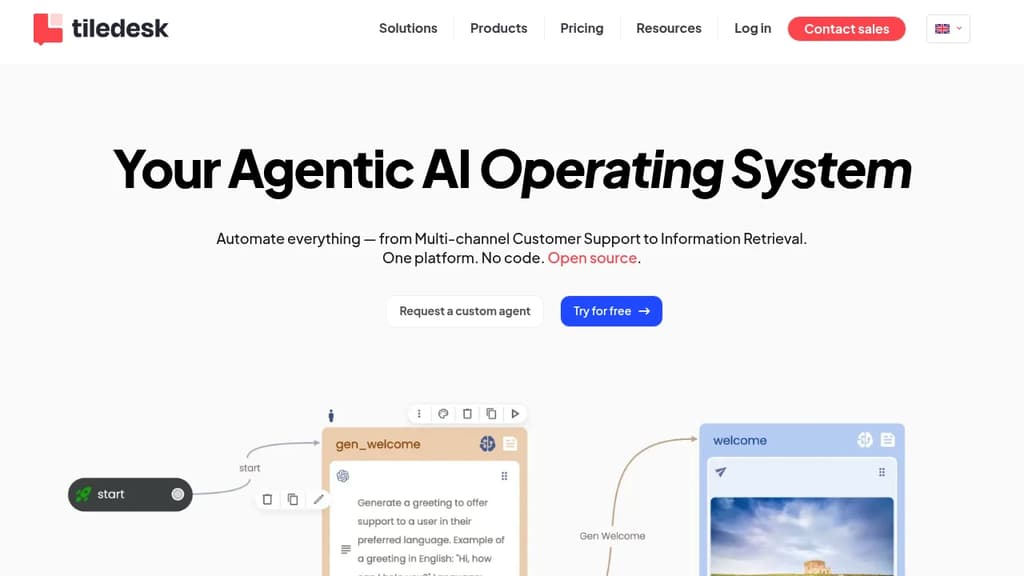
Tiledesk is an open-source platform for building AI agents that handle customer support, appointment booking, email processing, and more, without writing code. It's built for businesses that want to automate conversations at scale while keeping humans in the loop when it matters.
The core of the platform is a visual flow builder where you design conversation logic using prompt chains, LLM calls, and conditional routing. You can create multiple specialized agents (one for sales, another for support, another for onboarding) and chain them together so a conversation moves between them based on intent or topic. It's a practical alternative to other chatbot platforms that force you to choose between simple bots and full custom development.
Key capabilities:
- Multi-channel deployment across web chat, WhatsApp, Facebook Messenger, SMS, voice, and email from one platform
- RAG with multiple knowledge bases so support docs, sales playbooks, and internal content stay separate, with hybrid full-text and semantic search
- Human-in-the-loop handoff that escalates complex cases to live agents with full conversation context intact
- AI Copilot for agents that surfaces relevant articles and summaries during live chats
- Self-learning that extracts knowledge from resolved conversations and updates the knowledge base automatically
- Appointment scheduling connected to Google, Outlook, or custom calendars, handled entirely by the AI
- Email automation that reads incoming messages, extracts intent, and triggers workflows or sends replies
- Shopify integration for e-commerce assistants that display product carousels and build carts conversationally
- MCP and REST API support for connecting agents to external systems
- On-premises deployment with local LLM support (LLaMA, Mistral) and local vector stores like Qdrant
Compared to tools like Botpress or Hexabot, Tiledesk leans heavily into the enterprise self-hosting angle. You can run the entire stack behind your own firewall, control your vector store, and connect open-source models, which matters for regulated industries like healthcare, finance, and public sector.
The platform is GDPR-compliant and Italy-based. It supports SSO, integrates with existing live agent consoles and VoIP systems, and includes an MQTT-based real-time debugger for testing automations. A 14-day free trial is available without a credit card.

People are looking for alternatives to...
View all alternatives
Spotify

Claude Code

Claude

CapCut
Notion

Lovable
 Bright Data – Web data for AI agents and apps. Built-in unblocking, proxies, and ready-made APIs.
 Sent
Sent