Open Source Typebot Alternatives
A curated collection of the 5 best open source alternatives to Typebot.
The best open source alternative to Typebot is Parlant. If that doesn't suit you, we've compiled a ranked list of other open source Typebot alternatives to help you find a suitable replacement. Other interesting open source alternatives to Typebot are: Langflow, Botpress, Hexabot, and ChatbotX.
Typebot alternatives are mainly AI Agent Platforms but may also be Chatbot Platforms or Low-Code/No-Code Platforms. Browse these if you want a narrower list of alternatives or looking for a specific functionality of Typebot.

Written by Piotr Kulpinski


A conversational AI server that manages agent behavior through context-aware guidelines, keeping responses consistent, auditable, and aligned at scale.
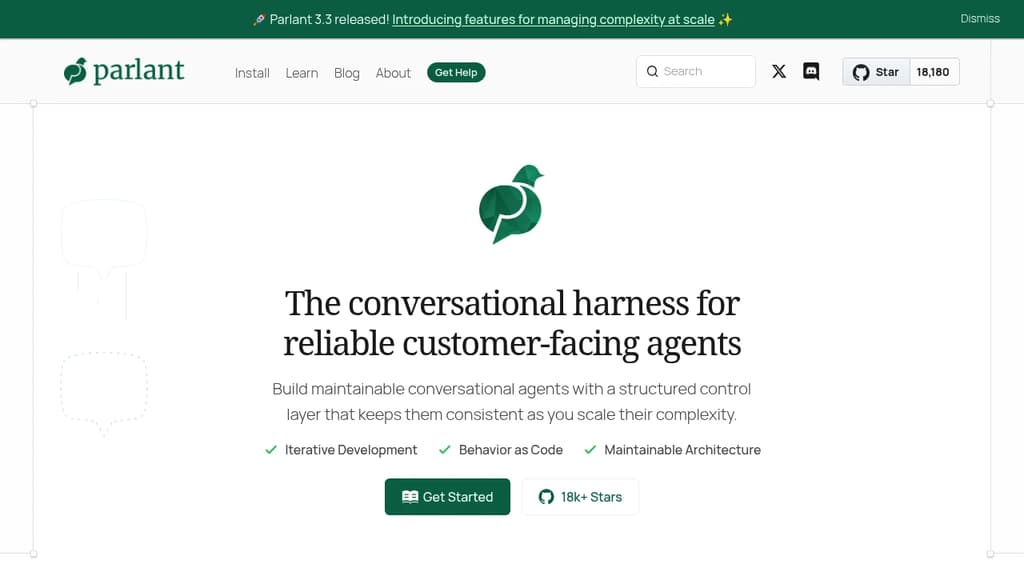
Parlant is a self-hostable conversational AI server designed for teams building customer-facing agents that need to stay on-brand, on-policy, and predictable in production. It sits between your frontend and your LLM provider, managing every interaction through a structured control layer rather than relying on monolithic system prompts or rigid intent graphs.
The core idea is context engineering: instead of stuffing all your rules into one prompt and hoping the model follows them, Parlant dynamically assembles only the rules, data, and tools relevant to each turn. The result is that the 200th behavioral rule is as safe to add as the first, with no degradation in adherence.
Key capabilities:
- Guidelines define conditional behavioral rules that fire based on conversational context. When several apply at once, Parlant merges them intelligently without manual routing.
- Canned responses let you lock down exact wording for high-stakes moments. In strict mode, required fields must be present in context before a response can be selected, making hallucination prevention structural and deterministic.
- Journeys model multi-step interactions while preserving the fluid, non-linear nature of real dialogue. Users can mix topics and circle back without losing context.
- Full traceability on every turn: which guidelines fired, which glossary terms were matched, and why the agent responded the way it did.
This is a meaningful departure from tools like Rasa or flow-based builders. Changing agent behavior is a content change (add or edit a guideline), not a structural one (rewire a graph). That makes it practical for product teams to feed ongoing feedback directly into the agent without requiring engineering intervention for every adjustment.
Parlant is LLM-agnostic and works with OpenAI, Anthropic, Azure, and others. It's built for enterprise AI teams where tone, edge cases, and policy constraints aren't afterthoughts.

Build, deploy, and iterate on AI agents, RAG applications, and MCP servers using a drag-and-drop visual interface backed by Python.
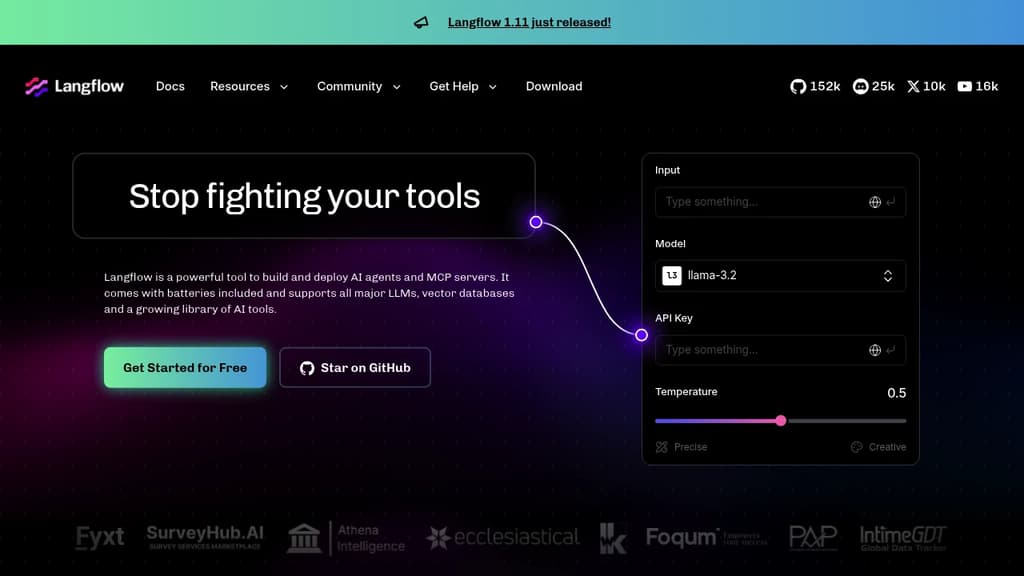
Langflow is a low-code platform for building AI agents and RAG applications visually. It targets developers and AI teams who want to move fast without writing boilerplate, while still having full access to the underlying Python when they need it. The visual canvas lets you wire together models, data sources, and tools by dragging components onto a flow, then deploy that flow as an API with minimal extra work.
The integration library is broad:
- LLMs: OpenAI, Anthropic, Mistral, Meta (Llama), Groq, NVIDIA, Amazon Bedrock, Ollama, HuggingFace, and more
- Vector stores: Pinecone, Milvus, Weaviate, Qdrant, Cassandra, Couchbase, Upstash, Vectara
- Data sources: Google Drive, Confluence, Notion, Gmail, GitHub, Slack, MongoDB, and dozens more
- Agent frameworks: LangChain, CrewAI, Composio
Flows are reusable and shareable. You can pick from a library of pre-built components, swap models mid-flow to compare outputs, and run single agents or coordinated fleets where each agent has access to your components as tools. Every flow exposes itself as an API endpoint, so connecting Langflow to an existing product is straightforward.
Python is always available under the hood. Any component can be customized with code, so the visual layer doesn't box you in. Teams that need observability can pair it with tools like Langfuse for tracing.
Deployment is flexible. Self-host it on your own infrastructure, or use the managed cloud option, which runs the same codebase as the open-source version. That parity matters: there's no feature gap to worry about when moving between environments.
Compared to alternatives like Flowise AI or Dify, Langflow leans into Python extensibility and a wide integration surface, making it a practical fit for teams building production-grade agents rather than quick demos.

A comprehensive platform for creating AI agents with intuitive tools, extensive integrations, and enterprise-grade features powered by the latest language models.
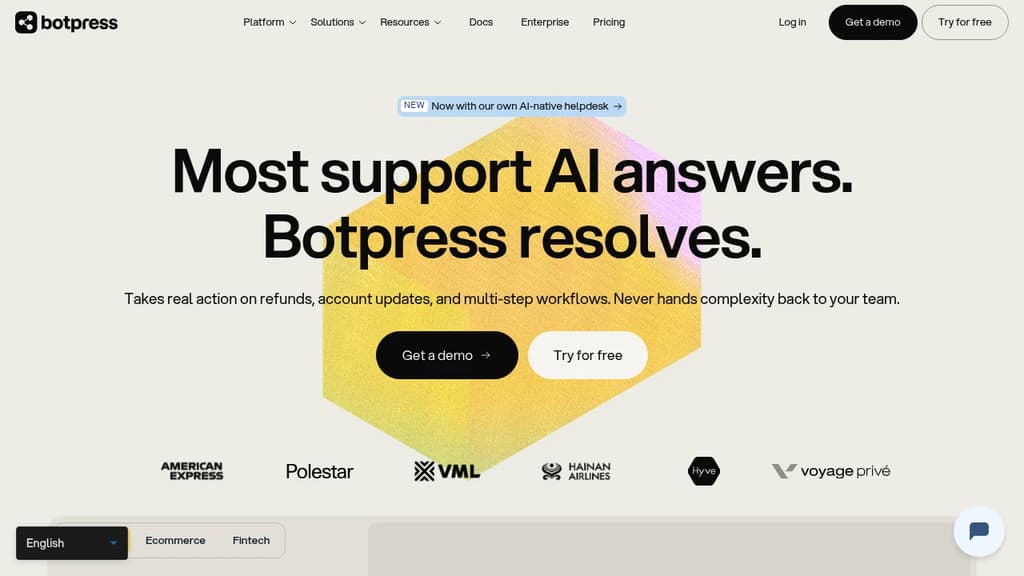
Botpress delivers a complete solution for building sophisticated AI agents. The platform combines powerful LLM capabilities with an intuitive visual builder, making it accessible for both developers and non-technical users. Key features include:
- Extensive Integration Options - Connect with popular services like WhatsApp, Telegram, and Calendly
- Knowledge Management - Import data from multiple sources including websites, PDFs, and documents
- Enterprise-Ready - Built-in security, compliance (GDPR, SOC 2), and scalability features
- Developer-Friendly - Comprehensive API/SDK access and extensive documentation
- Active Community - Large Discord community with daily office hours and expert support
The platform processes over 1 billion messages and is trusted by major companies like Windstream and American Eagle for customer support automation at scale.

Build and run AI agents, agentic workflows, and multichannel automation on your own infrastructure, with memory, RAG, MCP tools, and full data control.
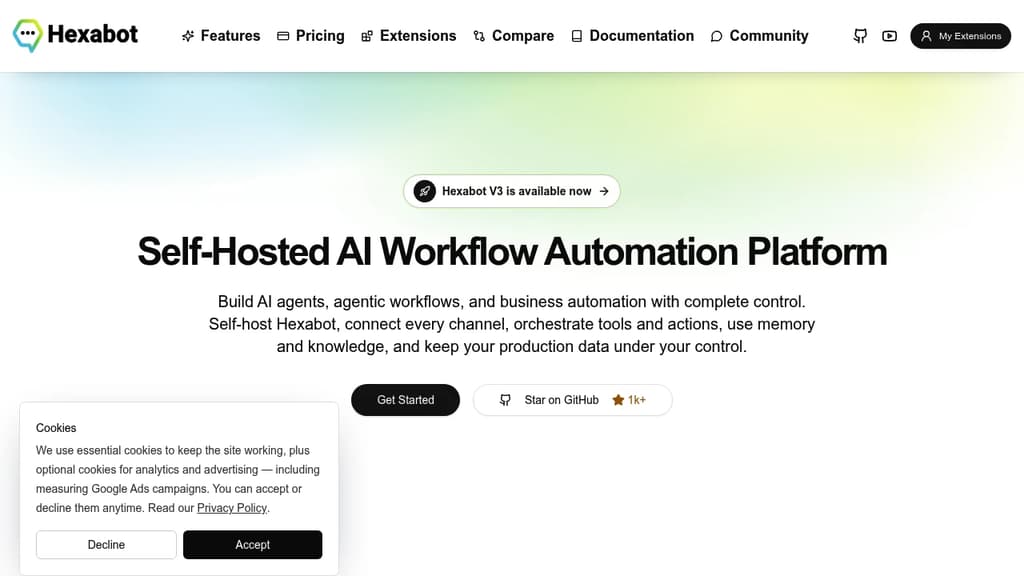
Hexabot is a self-hosted platform for building AI agents and business automation workflows that span conversations, actions, memory, and multiple service channels. It's aimed at development teams, agencies, and service operations that need real workflow automation without surrendering control of their data or logic to a third-party cloud.
The core idea is that a workflow can be triggered by chat, a form, a schedule, or an external event, then fan out to LLM calls, APIs, back-office systems, and tools before responding or routing to a human. It sits in the same space as n8n for workflow automation and chatbot platforms like Tiledesk, but combines both into one runtime.
Key capabilities:
- Visual and YAML workflow design – model flows in a graph editor or as portable YAML with schema validation and version control
- Memory and RAG – give workflows managed memory and retrieval-augmented context so agents can recall and reason across sessions
- MCP integration – connect sanctioned external tools through Model Context Protocol integration points
- Multichannel delivery – run assistants across web, messaging, social, and custom channels from one runtime
- Human handoff – conditionals, loops, inbox workflows, and live escalation when automation needs a human call
- Roles and analytics – team access control, usage tracking, and operational history for production deployments
- Multilingual support – serve customers in multiple languages across channels, as Orange demonstrated at scale
Workflows and extensions are built around typed input/output contracts, so actions and LLM bindings stay composable and testable. Developers can build custom channels and actions; support teams manage live interactions and step in centrally.
The codebase is source-available under the Fair Core License with an ALv2 future license. A free Community plan covers one user and ten workflows with no project or integration caps, which is enough to prototype before committing. Paid plans add users, workflow capacity, and license activations without metering on message volume.

Open source agentic chat marketing platform you can self-host, white-label, and resell. Automate omnichannel conversations across WhatsApp, Messenger, Instagram, Telegram, Zalo, TikTok, Email, and Webchat with a flow builder, shared inbox, AI agents, CRM, and broadcasts.
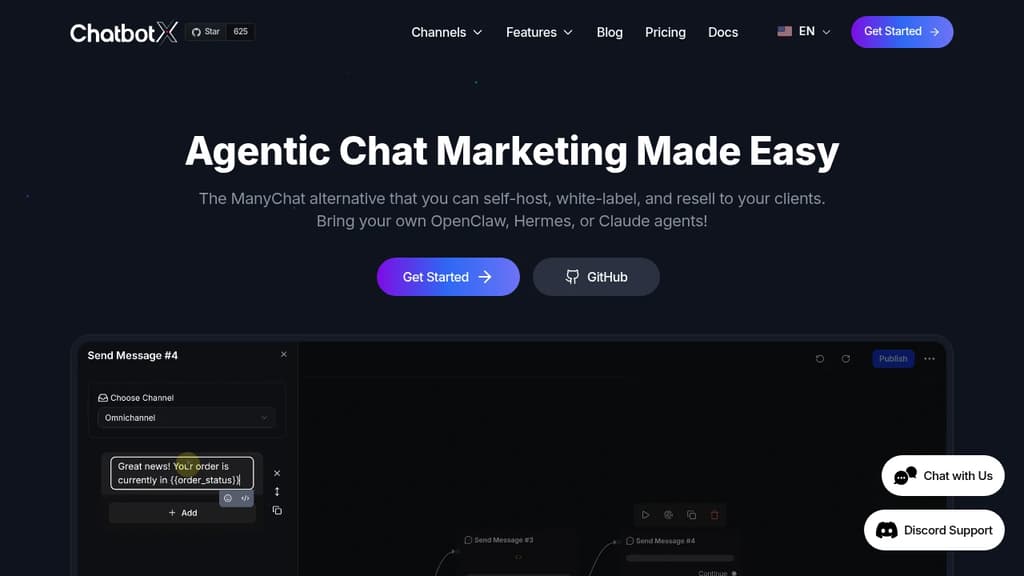
ChatbotX is an open source chatbot platform built for marketing agencies, freelancers, and developers who want full control over their chat automation without being locked into closed platforms like ManyChat. You can self-host it on your own infrastructure, white-label it for clients, and resell it as your own SaaS product.
It connects to a wide range of messaging channels from a single dashboard:
- WhatsApp for broadcast campaigns, lead capture, and abandoned cart recovery
- Facebook Messenger, Instagram, Telegram for inbox management and automation
- Zalo for official account engagement (particularly relevant for Southeast Asian markets)
- WebChat for live chat on your own website
- TikTok and more, all centralized in one inbox
The platform is built around agentic AI. You bring your own AI models (OpenAI-compatible, Hermes, or Claude) and configure how agents detect intent, respond contextually, and hand off to human agents when needed. Flows are visual and reusable across channels, so you build logic once and deploy it everywhere.
For marketing teams, ChatbotX includes smart broadcast campaigns, drip sequences, and auto-segmentation based on behavior and purchase history. Pricing is based on bot messages, not contact count, so you're not penalized for list size.
The live chat and messaging inbox supports team collaboration, automated routing by intent, and real-time sync across all connected channels. Role-based access control is available on enterprise plans.
Developers get a public API, CLI, and Model Context Protocol (MCP) support. The community plan is free for self-hosting with no licensing fees. Paid cloud plans add message volume, workspaces, and priority support, with a white-label tier at $299/month that includes full SaaS reseller capabilities.

People are looking for alternatives to...
View all alternatives
Claude Code

Spotify

CapCut

Claude
Notion

Lovable
 Capture – Capture screenshots, generate PDFs, scrape content, extract metadata, and automate browsers with one API.
 Stellar Hosted