The best open source alternative to Supermemory is Mem0. If that doesn't suit you, we've compiled a ranked list of other open source Supermemory alternatives to help you find a suitable replacement. Other interesting open source alternatives to Supermemory are: Agno, CopilotKit, Langfuse, and Chroma.
Supermemory alternatives are mainly LLM Application Frameworks but may also be Data Platforms for AI or AI Agent Platforms. Browse these if you want a narrower list of alternatives or looking for a specific functionality of Supermemory.
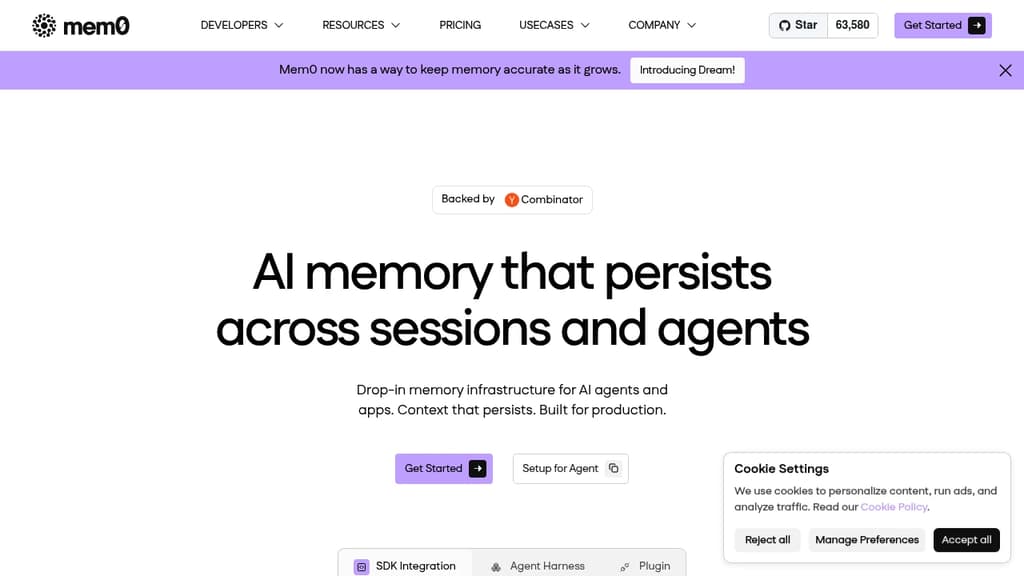
Universal memory layer for LLM applications that learns from user interactions, reduces token costs by 80%, and delivers personalized AI experiences.

Transform your AI applications with persistent memory that learns and adapts. Mem0 is a self-improving memory layer that enables LLM applications to remember user preferences, context, and interactions across sessions, creating truly personalized AI experiences.
Key benefits include:
Perfect for diverse use cases: Healthcare assistants that remember patient history, adaptive learning tutors that track student progress, sales tools that maintain context across long cycles, and customer support that builds on previous interactions.
Proven performance: Benchmarked 26% higher response quality compared to OpenAI memory while using 90% fewer tokens. Trusted by 50,000+ developers and backed by Y Combinator, with customers like Sunflower Sober scaling to 80,000+ users and OpenNote reducing costs by 40%.
Looking for open source alternatives to other popular services? Check out other posts in the alternatives series and openalternative.co, a directory of open source software with filters for tags and alternatives for easy browsing and discovery.
Open-source platform that enables developers to create, deploy and monitor AI agents with built-in memory, knowledge integration, and external tool connectivity.

Agno is a powerful open-source platform for building production-ready AI agents. The platform stands out with its model-agnostic approach, allowing developers to use any LLM from providers like OpenAI, Anthropic, or open-source alternatives.
Key capabilities include:
The platform is designed for high performance and scalability, making it ideal for production environments. With Agno workspaces, teams can go from development to production quickly while maintaining full control over their infrastructure.
Integrate production-ready AI copilots into any product quickly and easily with CopilotKit's open-source platform.

CopilotKit is an open-source platform that enables developers to rapidly integrate AI copilots into their products. With CopilotKit, you can:
Add an AI copilot to your app in minutes using simple React components like <CopilotSidebar /> or <CopilotPopup />.
Ground the copilot in real-time context specific to your application and users.
Enable the copilot to take actions on behalf of users within your application.
Seamlessly integrate LangChain & LangGraph agents into your copilot for advanced AI capabilities.
Generate custom UI components inside the chat interface for a fully tailored experience.
Implement guardrails and suggestions to control AI actions and guide users.
CopilotKit is designed to be flexible and extensible. Its open-source nature allows developers to customize and expand functionality as needed. Whether you're building a simple chatbot or a complex AI assistant, CopilotKit provides the tools to create production-ready copilots quickly and efficiently.
Join the growing community of developers using CopilotKit to shape the future of AI-powered applications. Get started today and bring the power of AI copilots to your users in a fraction of the time it would take to build from scratch.
Langfuse provides tracing, evaluations, prompt management, and analytics to debug and improve LLM applications.

Langfuse is an open source LLM engineering platform designed to help teams build, debug, and improve AI-powered applications. With its comprehensive suite of tools, Langfuse empowers developers to gain deep insights into their LLM applications and optimize performance.
Key features of Langfuse include:
Tracing: Capture detailed production traces to quickly identify and resolve issues in your LLM applications. Visualize the entire request flow and pinpoint bottlenecks.
Evaluations: Collect user feedback, annotate data, and run custom evaluation functions to assess the quality and performance of your AI models.
Prompt Management: Collaboratively version and deploy prompts, with low-latency retrieval for production use. Streamline your prompt engineering workflow.
Analytics: Track key metrics like cost, latency, and quality to optimize your LLM application's performance and efficiency.
Playground: Test different prompts and models directly within the Langfuse UI, enabling rapid experimentation and iteration.
Datasets: Derive high-quality datasets from production data to fine-tune models and thoroughly test your LLM applications.
Langfuse integrates seamlessly with popular LLM frameworks and libraries, including LangChain, LlamaIndex, and OpenAI. It offers SDKs for Python and JavaScript/TypeScript, making it easy to incorporate into your existing workflow.
Built for teams of all sizes, Langfuse can be self-hosted or used as a cloud service. It's designed with enterprise-grade security in mind, offering SOC 2 Type II and ISO 27001 certifications for the cloud version.
By providing a comprehensive toolkit for LLM engineering, Langfuse helps teams build more reliable, efficient, and high-quality AI applications. Whether you're just starting with LLMs or scaling a complex AI system, Langfuse offers the observability and tools needed to succeed in the rapidly evolving field of AI engineering.
Open-source vector database designed for AI applications. Store, search, and retrieve embeddings with semantic similarity matching and metadata filtering.

Chroma is a powerful open-source vector database specifically built for AI applications that need efficient storage and retrieval of embeddings. Perfect for developers building RAG (Retrieval-Augmented Generation) systems, semantic search engines, and AI-powered applications.
Key features include:
Whether you're building a chatbot that needs to search through documents, creating a recommendation system, or developing any AI application requiring semantic search capabilities, Chroma provides the foundation you need with minimal setup and maximum flexibility.
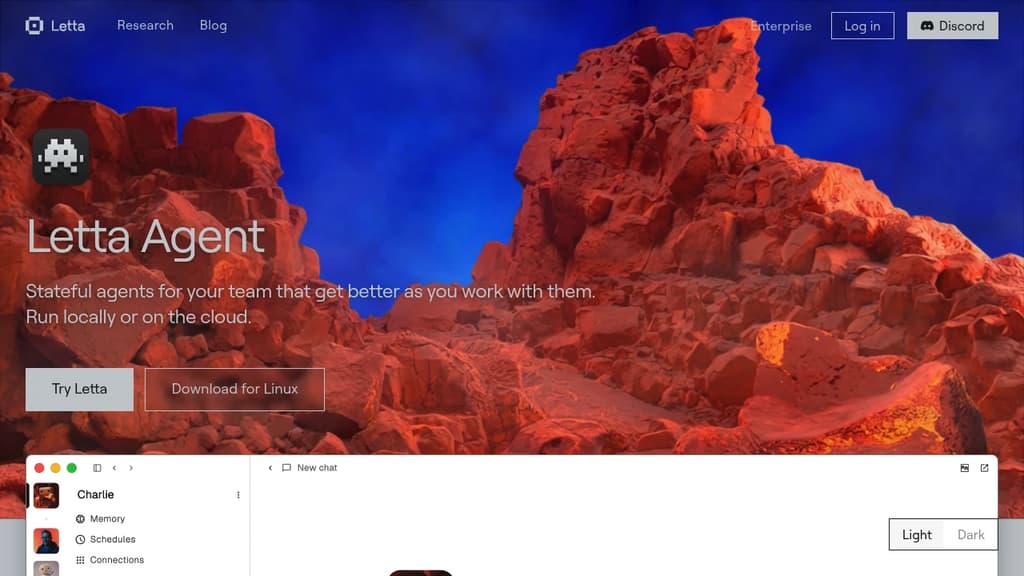
Letta is an open-source platform for creating AI agents with built-in memory, reasoning, and support for thousands of tools.

Letta is an open-source platform that enables developers to build and deploy advanced AI agents.
Some key features include:
With its focus on memory management, extensive capabilities, and developer-friendly features, Letta aims to push the boundaries of what's possible with AI agents. Whether you're building prototypes or production-ready systems, Letta provides the tools and infrastructure to create more capable and context-aware AI assistants.
Looking for open source alternatives to other popular services? Check out other posts in the alternatives series and openalternative.co, a directory of open source software with filters for tags and alternatives for easy browsing and discovery.
Open-source vector database designed for building powerful, production-ready AI applications with hybrid search capabilities and flexible deployment options.

Weaviate is an AI-native vector database that empowers developers to create intuitive applications with less hallucination, data leakage, and vendor lock-in. Key features include:
Hybrid Search: Combines vector and keyword techniques for contextual, precise results across all data modalities.
RAG (Retrieval-Augmented Generation): Enables building trustworthy generative AI applications using your own data, with privacy and security in mind.
Generative Feedback Loops: Enrich datasets with AI-generated answers, improving personalization and reducing manual data cleaning.
Flexible Deployment: Available as an open-source platform, managed service, or within your VPC to adapt to your business needs.
Pluggable ML Models: Built-in modules for popular machine learning models and frameworks, allowing easy integration.
Cost-Efficient Scaling: Advanced multi-tenancy, data compression, and filtering for confident and efficient scaling.
Strong Community Support: Open-source with a vibrant community and resources for developers of all levels.
Integrations: Supports various neural search frameworks and vectorization modules, including OpenAI, Hugging Face, Cohere, and more.
Weaviate is designed to handle lightning-fast pure vector similarity searches over raw vectors or data objects, even with filters. It's more than just a database – it's a flexible platform for building powerful, production-ready AI applications that can adapt to the evolving needs of businesses in the AI landscape.
Open-source platform for LLM tracing, evaluation, and optimization. Features automatic instrumentation, prompt playground, and real-time AI application monitoring.

Open-source LLM tracing and evaluation platform designed for AI teams who need complete visibility into their applications. Built on OpenTelemetry standards, this platform offers vendor-agnostic monitoring without lock-in restrictions.
Key capabilities include:
The platform has gained significant traction with 2.5M+ monthly downloads, 8k+ GitHub stars, and adoption by top AI teams. Users praise its ability to identify root causes of problematic responses, debug LLM workflows, and integrate observability directly into development processes.
Completely self-hostable with no feature restrictions, making it ideal for teams requiring full control over their AI monitoring infrastructure while maintaining transparency in model decision-making.
Deep Lake is an open-source database for storing, querying and managing complex AI data like images, audio, and embeddings.

Deep Lake is an open-source tensor database designed specifically for AI and machine learning workflows. It allows you to efficiently store, query, and manage complex unstructured data like images, audio, video, and embeddings.
Some key features of Deep Lake:
Deep Lake aims to simplify ML data management and accelerate the development of AI applications. It provides a standardized way to work with unstructured data across the ML lifecycle - from data preparation to model training to deployment.
The open-source nature allows for customization and integration into existing ML workflows. Deep Lake can significantly reduce data preparation time and enable faster experimentation and iteration on ML models.
Laminar is an open-source platform that helps collect, understand, and utilize data for building high-quality LLM applications.

Laminar is an innovative, open-source platform designed to revolutionize the development of Large Language Model (LLM) products. It offers a comprehensive suite of tools for engineering best-in-class AI applications from first principles.
Key features and benefits:
Traces: Laminar provides powerful tracing capabilities, allowing developers to gain a clear picture of every step in their LLM application's execution. This feature simultaneously collects invaluable data that can be used for:
Zero-overhead observability: All traces are sent in the background via gRPC, ensuring minimal impact on performance. The platform supports tracing for both text and image models, with audio model support coming soon.
Online evaluations: Laminar enables the setup of LLM-as-a-judge or Python script evaluators to run on each received span. This approach to evaluation is more scalable than human labeling and particularly beneficial for smaller teams.
Dataset creation: Users can build datasets from their traces, which can be utilized in evaluations, fine-tuning, and prompt engineering.
Prompt chain management: Laminar goes beyond single prompts, allowing users to build and host complex chains, including mixtures of agents or self-reflecting LLM pipelines.
Open-source and self-hostable: The platform is fully open-source and easy to self-host, giving users complete control over their data and infrastructure.
Laminar empowers developers to create more robust, efficient, and effective LLM applications by providing a data-centric approach to AI engineering. Whether you're working on improving model performance, optimizing prompts, or scaling your AI solutions, Laminar offers the tools and insights needed to excel in the rapidly evolving field of AI engineering.
Trieve offers an all-in-one solution for search, recommendations, and RAG with automatic continuous improvement based on user feedback.

Trieve is an AI-first infrastructure API designed to revolutionize search, recommendations, and Retrieval-Augmented Generation (RAG) experiences. This powerful platform combines cutting-edge language models with advanced tools for fine-tuning ranking and relevance, offering a comprehensive solution for businesses looking to enhance their discovery and information retrieval processes.
Key features and benefits:
Trieve's platform is designed to be fast, flexible, and scalable, capable of handling billion-scale search and discovery tasks. Whether you're building a new product or enhancing an existing one, Trieve provides the tools to create delightful, efficient, and intelligent search experiences that can give your business a competitive edge.
By choosing Trieve, you're not just implementing a search solution – you're future-proofing your discovery capabilities with an AI-native, end-to-end platform built for today's needs and tomorrow's innovations.
Looking for open source alternatives to other popular services? Check out other posts in the alternatives series and openalternative.co, a directory of open source software with filters for tags and alternatives for easy browsing and discovery.
Integrate graph AI into your products to extract valuable insights and reduce costs from your data.

Pixlie AI is an open-source knowledge graph engine that empowers you to unlock actionable insights from your data. By leveraging fast and cost-effective graph-based AI, you can connect your private data with public information to gain a deeper understanding of your business landscape.
Key features:
Experience the power of graph-based AI and transform your data into valuable insights with Pixlie AI. Get started today and unlock the full potential of your information ecosystem.