Open Source Sprites Alternatives
A curated collection of the 3 best open source alternatives to Sprites.
The best open source alternative to Sprites is E2B. If that doesn't suit you, we've compiled a ranked list of other open source Sprites alternatives to help you find a suitable replacement. Other interesting open source alternatives to Sprites are: Beam and OpenComputer.
Sprites alternatives are mainly AI Sandboxes but may also be GPU & Compute Platforms. Browse these if you want a narrower list of alternatives or looking for a specific functionality of Sprites.

Written by Piotr Kulpinski


Provide AI agents with secure, isolated sandboxes featuring real-world tools, code execution, and enterprise-grade security. Trusted by 88% of Fortune 100 companies.

E2B delivers secure cloud environments specifically designed for enterprise AI agents, providing isolated sandboxes where agents can safely execute code, access real-world tools, and perform complex tasks without compromising security.
Key capabilities include:
- Secure code execution in isolated Firecracker-powered microVMs with full system access
- Multi-language support for Python, JavaScript, Ruby, C++, and any Linux-compatible framework
- Ultra-fast startup with sub-200ms initialization times and no cold starts
- Extended sessions up to 24 hours for long-running agent workflows
- Enterprise security with complete isolation and secure file handling
Perfect for advanced AI use cases:
- Deep research agents conducting analysis on large datasets
- Data visualization with secure chart generation and analysis
- Computer use agents with virtual desktop environments
- Reinforcement learning with thousands of concurrent sandbox instances
- Code generation and testing with real-time error inspection
Trusted by leading organizations including 88% of Fortune 100 companies, E2B integrates seamlessly with OpenAI, Anthropic, Mistral, LangChain, and custom models. The platform offers flexible deployment options including BYOC, on-premises, and self-hosted solutions to meet enterprise compliance requirements.

Run GPU inference, task queues, and sandboxes on serverless infrastructure with sub-second cold starts, autoscaling, and support for your own AWS, GCP, or bare metal.
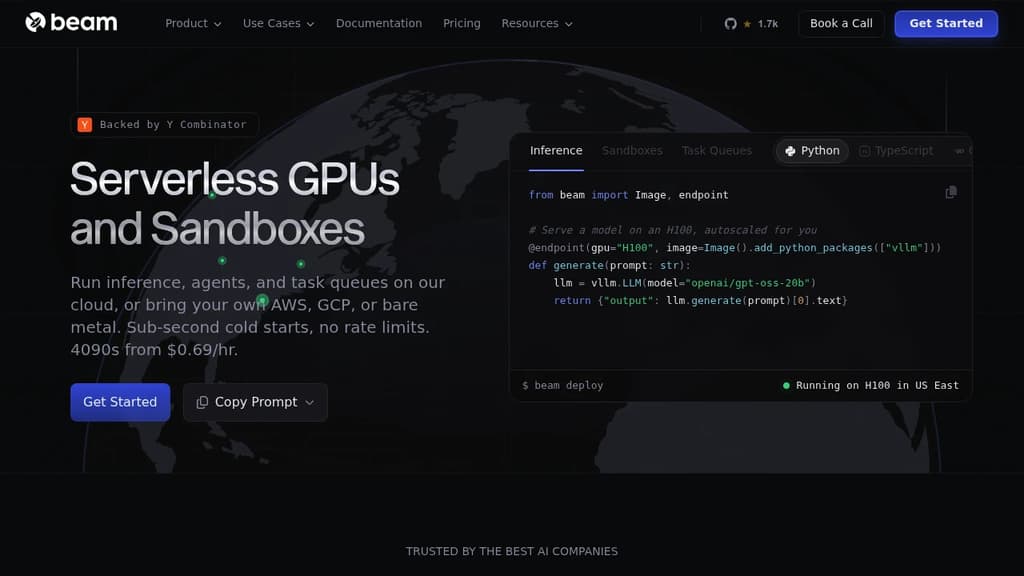
Beam is a GPU compute platform built specifically for AI workloads. It handles serverless inference, durable task queues, and isolated sandboxes, all defined in Python without Dockerfiles or YAML config. You can run on Beam's cloud or connect your own AWS, GCP, or bare metal accounts and let Beam orchestrate across all of them.
The core differentiator is boot time. Beam uses memory snapshots to restore GPU containers in under a second, up to 35× faster than a traditional cold start. That matters when you're running inference at scale or building agent pipelines where latency compounds quickly.
Key capabilities:
- GPU inference endpoints – deploy models on H100s, A10Gs, or 4090s with autoscaling baked in. Scale to zero when idle, burst to hundreds of containers when traffic spikes.
- Task queues – durable, queue-depth-based autoscaling with automated retries, scheduled jobs, and event callbacks. Good for batch workloads like transcription or document processing.
- Sandboxes – stateful, long-running environments for AI agents. Attach persistent storage, run Docker-in-Docker, snapshot the filesystem, and branch into thousands of parallel isolated runs.
- Multi-cloud routing – workloads route across clouds and 30+ regions in real time, keeping execution close to your users.
- CI/CD integration – deploy directly from GitHub Actions without changing your workflow.
Compared to tools like Modal or dstack, Beam leans hard on the sandbox and snapshotting story, which makes it a natural fit for agent frameworks that need stateful, parallelizable execution environments.
Pricing starts at $0.69/hr for a 4090, with $30 in free credits refreshed monthly. SOC 2 Type II certified.

Provides always-on virtual machines for AI agents with full OS access, persistent state, elastic CPU/memory resizing, and instant checkpoints.
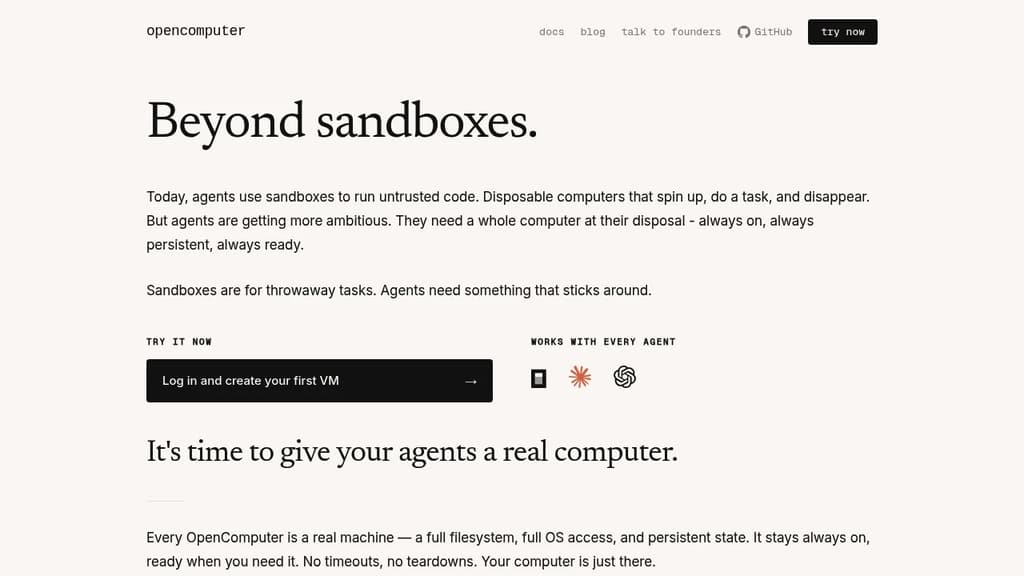
Most AI agents run on disposable sandboxes: spin up, execute a task, disappear. That works for throwaway scripts. It breaks down the moment an agent needs to remember what it installed, keep files between sessions, or pick up mid-task after a pause. OpenComputer is built for that second category.
Each VM is a real machine with a full filesystem and full OS access. It stays running until you explicitly stop or delete it. No timeouts, no teardowns. State persists across sessions without any extra plumbing on your end.
Key capabilities:
- Persistent VMs: always-on instances that survive across agent sessions, so nothing gets re-installed from scratch because a container timed out
- Hibernate and wake: when a VM isn't needed, hibernate it and restore it in seconds, state exactly where you left it
- Elastic compute: resize memory and CPU while the VM is running, no restart required, useful when workload spikes mid-session
- Checkpoints: instant snapshots let you fork or roll back to any previous state, handy when an agent puts the VM in a bad spot
- Agent framework support: purpose-built to run agent harnesses like the Claude Agent SDK
- Scale: runs to thousands of VMs in the cloud, billed only while running
OpenComputer targets teams building agent platforms where end users expect continuity. Think coding assistants like Devin or Lovable, where a user's environment needs to remember yesterday's installs and today's open files. Ephemeral sandboxes give isolation. OpenComputer gives isolation plus persistence, without forcing you to manage state externally.
Pricing starts at $0.004 per minute for a 4 GB / 1 vCPU configuration. Disk beyond the included 20 GB is metered separately, and hibernated VMs don't accrue compute charges.

People are looking for alternatives to...
View all alternatives
Spotify

Claude Code

CapCut

Claude

Notion

Lovable
 Sent – Messaging Infrastructure for Developers. One API for SMS, WhatsApp, and RCS across 190+ countries.
 Sent
Sent