Open Source Parlant Alternatives
A curated collection of the 5 best open source alternatives to Parlant.
The best open source alternative to Parlant is Langflow. If that doesn't suit you, we've compiled a ranked list of other open source Parlant alternatives to help you find a suitable replacement. Other interesting open source alternatives to Parlant are: Botpress, Typebot, Hexabot, and Ethora.
Parlant alternatives are mainly AI Agent Platforms but may also be Low-Code/No-Code Platforms or Chatbot Platforms. Browse these if you want a narrower list of alternatives or looking for a specific functionality of Parlant.

Written by Piotr Kulpinski


Build, deploy, and iterate on AI agents, RAG applications, and MCP servers using a drag-and-drop visual interface backed by Python.
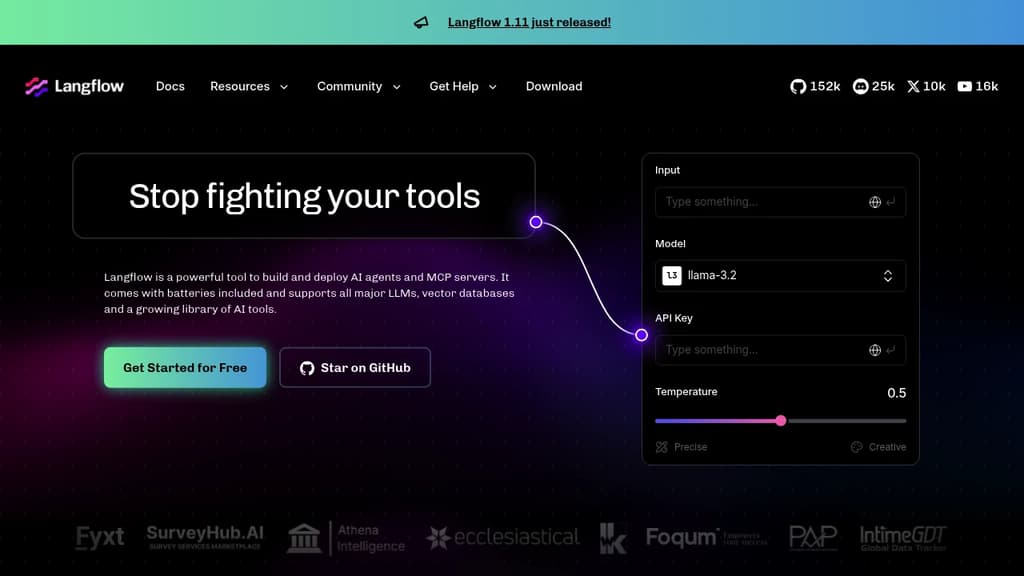
Langflow is a low-code platform for building AI agents and RAG applications visually. It targets developers and AI teams who want to move fast without writing boilerplate, while still having full access to the underlying Python when they need it. The visual canvas lets you wire together models, data sources, and tools by dragging components onto a flow, then deploy that flow as an API with minimal extra work.
The integration library is broad:
- LLMs: OpenAI, Anthropic, Mistral, Meta (Llama), Groq, NVIDIA, Amazon Bedrock, Ollama, HuggingFace, and more
- Vector stores: Pinecone, Milvus, Weaviate, Qdrant, Cassandra, Couchbase, Upstash, Vectara
- Data sources: Google Drive, Confluence, Notion, Gmail, GitHub, Slack, MongoDB, and dozens more
- Agent frameworks: LangChain, CrewAI, Composio
Flows are reusable and shareable. You can pick from a library of pre-built components, swap models mid-flow to compare outputs, and run single agents or coordinated fleets where each agent has access to your components as tools. Every flow exposes itself as an API endpoint, so connecting Langflow to an existing product is straightforward.
Python is always available under the hood. Any component can be customized with code, so the visual layer doesn't box you in. Teams that need observability can pair it with tools like Langfuse for tracing.
Deployment is flexible. Self-host it on your own infrastructure, or use the managed cloud option, which runs the same codebase as the open-source version. That parity matters: there's no feature gap to worry about when moving between environments.
Compared to alternatives like Flowise AI or Dify, Langflow leans into Python extensibility and a wide integration surface, making it a practical fit for teams building production-grade agents rather than quick demos.

A comprehensive platform for creating AI agents with intuitive tools, extensive integrations, and enterprise-grade features powered by the latest language models.
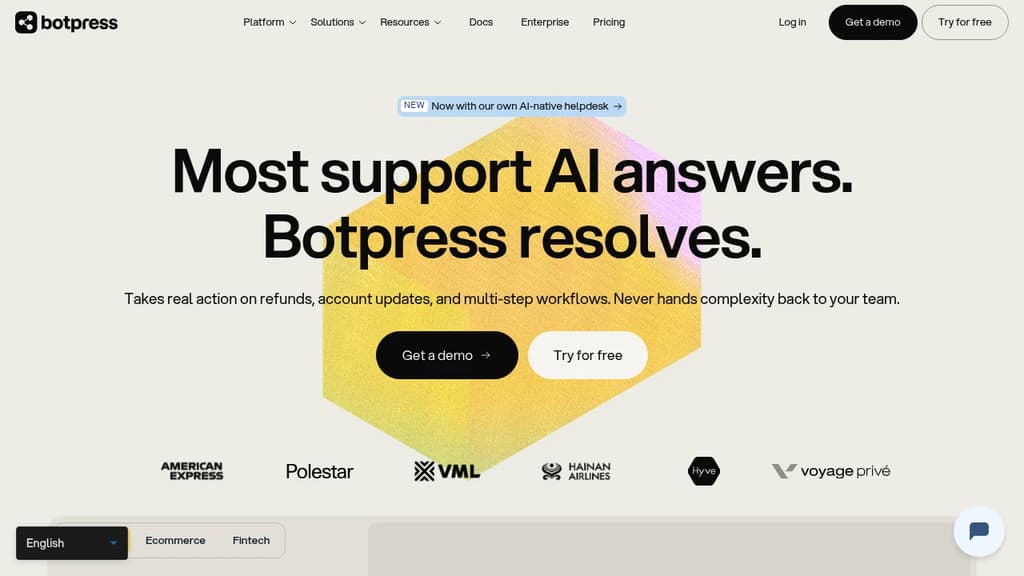
Botpress delivers a complete solution for building sophisticated AI agents. The platform combines powerful LLM capabilities with an intuitive visual builder, making it accessible for both developers and non-technical users. Key features include:
- Extensive Integration Options - Connect with popular services like WhatsApp, Telegram, and Calendly
- Knowledge Management - Import data from multiple sources including websites, PDFs, and documents
- Enterprise-Ready - Built-in security, compliance (GDPR, SOC 2), and scalability features
- Developer-Friendly - Comprehensive API/SDK access and extensive documentation
- Active Community - Large Discord community with daily office hours and expert support
The platform processes over 1 billion messages and is trusted by major companies like Windstream and American Eagle for customer support automation at scale.

Design, build, and deploy interactive chatbots with a visual editor. Integrate easily and collect data effortlessly.
Typebot revolutionizes the way you create and manage chatbots, offering a powerful yet user-friendly platform for businesses and developers alike. With its intuitive visual editor, you can design complex conversational flows without writing a single line of code.
Key benefits of Typebot include:
- Visual Flow Builder: Drag-and-drop interface for easy bot creation
- Customizable Design: Match your brand with fully customizable themes
- Multi-Platform Integration: Embed your chatbots on websites, apps, or popular messaging platforms
- Advanced Logic: Implement conditional branching and variables for sophisticated interactions
- Data Collection: Gather and analyze user inputs securely
- API Connections: Integrate with your existing tools and databases
- Multi-Language Support: Create bots in any language to reach a global audience
- Templates: Jump-start your projects with pre-built templates for various use cases
- Analytics Dashboard: Track performance and optimize your chatbots
Whether you're looking to automate customer support, streamline lead generation, or create interactive surveys, Typebot provides the tools you need to build engaging conversational experiences. Its versatility makes it suitable for businesses of all sizes, from startups to enterprises, across various industries.
Get started with Typebot today and transform the way you interact with your audience!

Build and run AI agents, agentic workflows, and multichannel automation on your own infrastructure, with memory, RAG, MCP tools, and full data control.
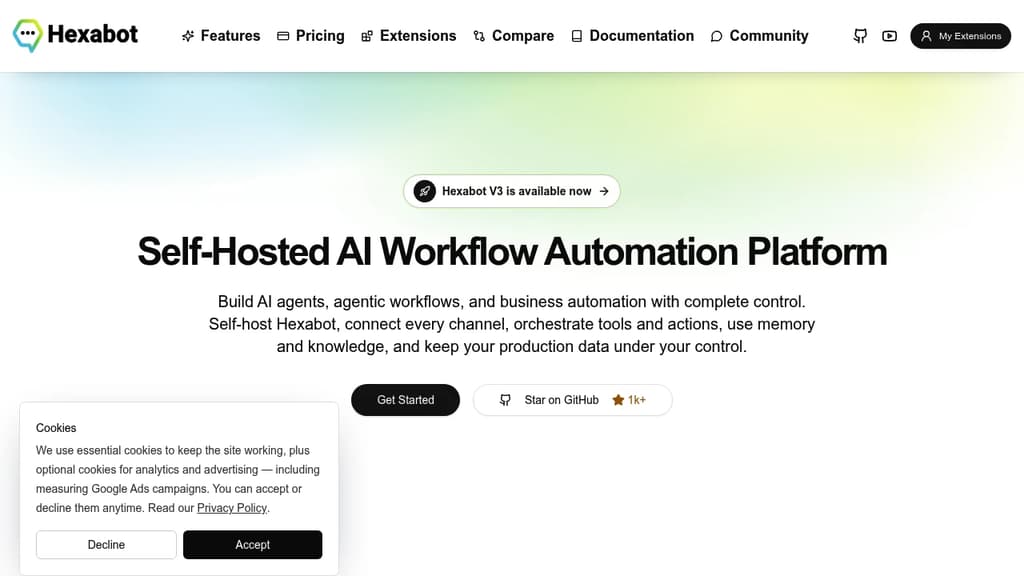
Hexabot is a self-hosted platform for building AI agents and business automation workflows that span conversations, actions, memory, and multiple service channels. It's aimed at development teams, agencies, and service operations that need real workflow automation without surrendering control of their data or logic to a third-party cloud.
The core idea is that a workflow can be triggered by chat, a form, a schedule, or an external event, then fan out to LLM calls, APIs, back-office systems, and tools before responding or routing to a human. It sits in the same space as n8n for workflow automation and chatbot platforms like Tiledesk, but combines both into one runtime.
Key capabilities:
- Visual and YAML workflow design – model flows in a graph editor or as portable YAML with schema validation and version control
- Memory and RAG – give workflows managed memory and retrieval-augmented context so agents can recall and reason across sessions
- MCP integration – connect sanctioned external tools through Model Context Protocol integration points
- Multichannel delivery – run assistants across web, messaging, social, and custom channels from one runtime
- Human handoff – conditionals, loops, inbox workflows, and live escalation when automation needs a human call
- Roles and analytics – team access control, usage tracking, and operational history for production deployments
- Multilingual support – serve customers in multiple languages across channels, as Orange demonstrated at scale
Workflows and extensions are built around typed input/output contracts, so actions and LLM bindings stay composable and testable. Developers can build custom channels and actions; support teams manage live interactions and step in centrally.
The codebase is source-available under the Fair Core License with an ALv2 future license. A free Community plan covers one user and ten workflows with no project or integration caps, which is enough to prototype before committing. Paid plans add users, workflow capacity, and license activations without metering on message volume.

Build branded chat apps with AI agents, group messaging, document exchange, and digital wallets using React and React Native components.
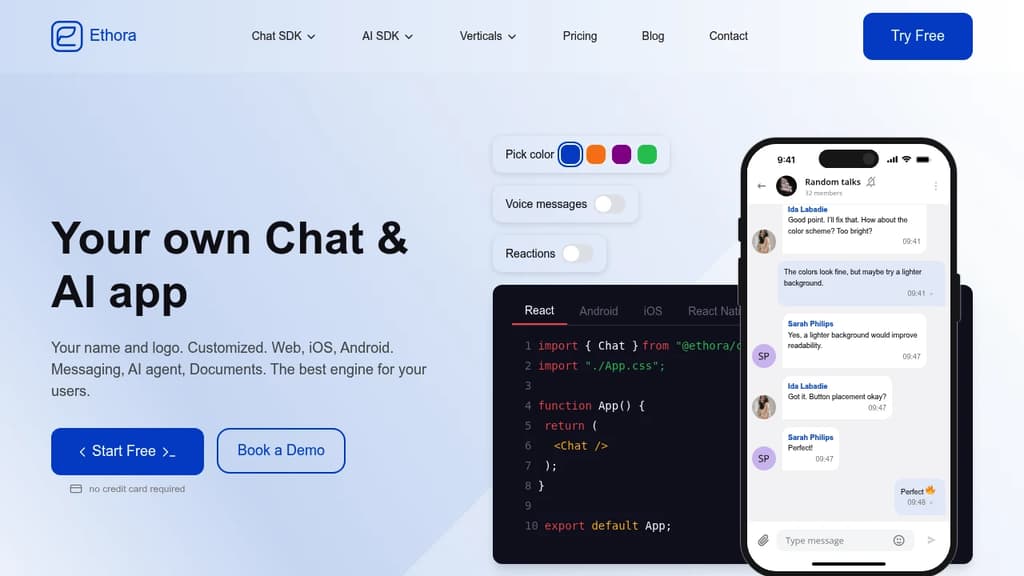
Ethora is a messaging SDK for developers and product teams who need to ship chat features fast, without building everything from scratch. It targets web, iOS, and Android through React and React Native components, and it covers both traditional team chat and AI-powered assistant functionality in one package.
The core use case is embedding a fully functional chat experience into an existing product. Drop in the React component, configure it to match your brand, and you have 1-on-1 messaging, group chats, file and document exchange, voice messages, reactions, and push notifications. The UI is fully customizable, so it can match your product's visual style rather than looking like a third-party widget.
Beyond basic messaging, Ethora includes:
- AI chat agents backed by LLMs, RAG, and vector embeddings, so the bot can answer questions grounded in your own documents or website content
- Digital wallet integration for tokenization and in-app asset management
- Gamification features for user engagement
- Social sign-on and webhook/SQS support for backend integrations
- Custom messages, events, and metadata for building non-standard workflows
The AI agent setup is handled through an admin panel. You configure a prompt, upload documents, or crawl your website, and the agent answers with context drawn from that material. Real-world deployments include a HIPAA-compliant healthcare chatbot indexing thousands of medical conference pages, and a workers' compensation platform connecting injured workers with caseworkers.
Ethora's front-end code (React Native mobile app, React web app, NPM component, WordPress plugin, and JS widget) is open source. The backend is closed source by default, but self-hosted and perpetual license options are available for teams that need full control or deep server-side customization.
Pricing starts at a free tier covering 1,000 monthly active users, with paid plans adding SLA guarantees, custom domains, and dedicated hosting. It's positioned as an alternative to building chat interfaces in-house, or to tools like Chatwoot or Typebot when you need both messaging and AI agents in a single SDK.

People are looking for alternatives to...
View all alternatives
Spotify

Claude Code

CapCut

Claude
Notion

Lovable
 Bright Data – Web data for AI agents and apps. Built-in unblocking, proxies, and ready-made APIs.
 Sent
Sent