Open Source DocsBot Alternatives
A curated collection of the 4 best open source alternatives to DocsBot.
The best open source alternative to DocsBot is AnythingLLM. If that doesn't suit you, we've compiled a ranked list of other open source DocsBot alternatives to help you find a suitable replacement. Other interesting open source alternatives to DocsBot are: FastGPT, Botpress, and Tiledesk.
DocsBot alternatives are mainly Enterprise Knowledge Search but may also be AI Agent Platforms or Chatbot Platforms. Browse these if you want a narrower list of alternatives or looking for a specific functionality of DocsBot.

Written by Piotr Kulpinski


A desktop and self-hostable AI app for chatting with documents, running local LLMs, and using AI agents without writing code or creating an account.
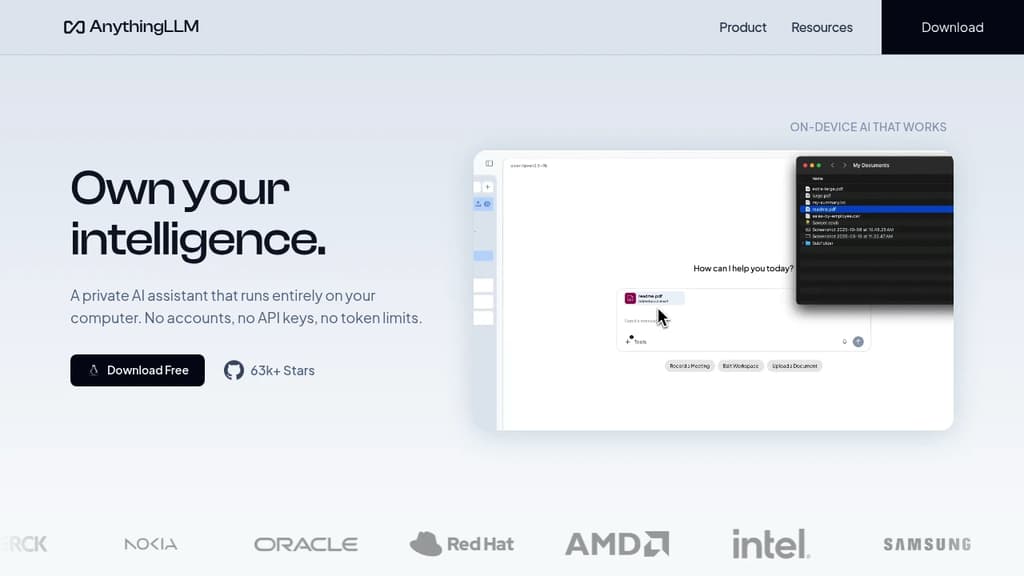
AnythingLLM is a desktop application and self-hostable platform that lets you chat with your documents, run AI agents, and work with large language models entirely on your own machine. No account required. No data leaves your device unless you explicitly connect to a cloud provider. It runs on macOS, Windows, and Linux.
The core use case is document chat. You load in PDFs, Word files, CSVs, codebases, or content pulled from online sources, then ask questions against that material. The underlying LLM can be a local model running on your own hardware or a cloud provider like OpenAI, Azure, or AWS. You pick which one, and you can switch between them. It also supports multi-modal models, so working with images or audio is possible within the same interface.
Privacy is a first-class concern. By default, everything stays local: the model, the vector database, the embedder, your documents, and your chat history. Nothing is shared unless you configure an external provider. That makes it a practical choice for anyone handling sensitive business documents who can't send data to third-party APIs — including use cases that would otherwise call for legal AI platforms.
For teams, there's a self-hosted or cloud-hosted option with multi-user support. Each user gets isolated access, and admins get fine-grained controls over what users can see and do. The platform can also be white-labeled with custom branding, which makes it usable as an internal tool under a company's own identity.
Beyond document chat, it includes a built-in developer API for integrating its capabilities into existing products. If you're building on top of it, the API fits naturally into the broader LLM application framework ecosystem. A community hub provides shared agent skills, system prompts, and slash commands, so you can extend what the assistant can do without building from scratch.
The MIT license means the source is open and free to use or modify. If you want a lighter-weight alternative focused purely on chat, tools like LLMChat or LobeChat cover that narrower scope. AnythingLLM sits closer to a full local AI workspace, with document ingestion, agent support, and multi-user access all in one place.

FastGPT is a free, open-source platform for creating AI-powered knowledge bases with data processing, model invocation, and visual workflows.
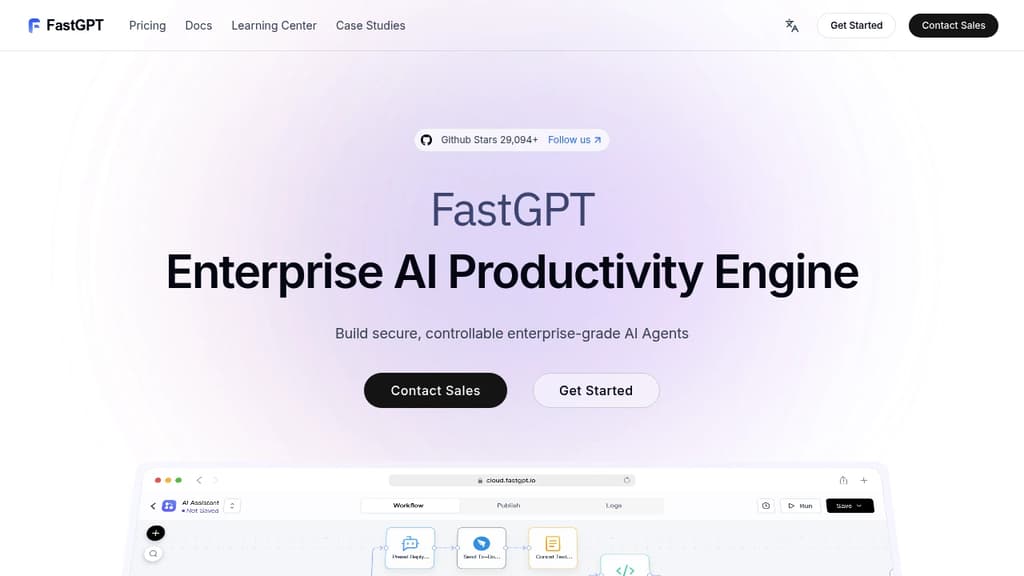
FastGPT is a powerful, open-source AI knowledge base platform that simplifies the creation of complex LLM applications. It offers a comprehensive suite of features designed to streamline the development of AI-powered systems.
Key features include:
-
Domain-Specific AI Assistants: Create specialized chatbots by training models with imported documents or Q&A pairs.
-
Automated Data Preprocessing: Save time with automated text preprocessing, vectorization, and QA segmentation.
-
Visual Workflow Orchestration: Design complex AI workflows using a drag-and-drop interface, integrating tasks like database queries and inventory checks.
-
Seamless API Integration: Connect with existing GPT applications and platforms using OpenAI-aligned APIs.
-
Multi-Model Compatibility: Works with various LLM models, with ongoing expansion of supported models.
-
Debugging Tools: Refine your models with comprehensive debugging features.
FastGPT is ideal for:
- Building custom AI knowledge bases
- Developing complex Q&A systems
- Creating AI-powered customer support solutions
- Integrating AI capabilities into existing applications
The platform is free and open-source, making it suitable for both personal and commercial use. It can be freely deployed in private environments and used as a backend service for other applications.
For those requiring additional features and support, a Commercial Edition is available, offering:
- Customization and development
- Dedicated support
- Custom copyright notice
- Web application synchronization
- Full commercial licensing
FastGPT's flexibility and powerful features make it an excellent choice for businesses and developers looking to harness the power of AI in their projects.

A comprehensive platform for creating AI agents with intuitive tools, extensive integrations, and enterprise-grade features powered by the latest language models.
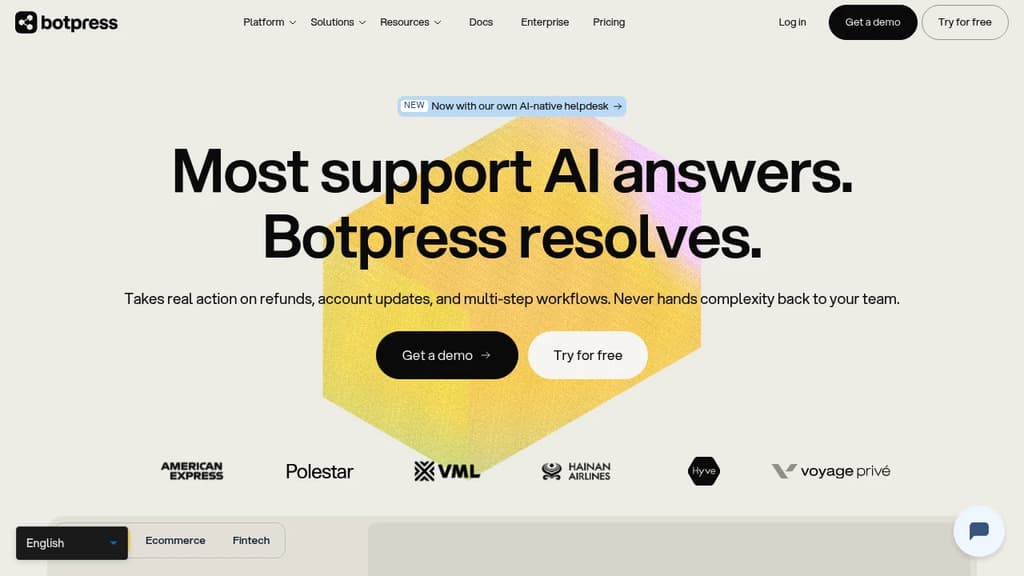
Botpress delivers a complete solution for building sophisticated AI agents. The platform combines powerful LLM capabilities with an intuitive visual builder, making it accessible for both developers and non-technical users. Key features include:
- Extensive Integration Options - Connect with popular services like WhatsApp, Telegram, and Calendly
- Knowledge Management - Import data from multiple sources including websites, PDFs, and documents
- Enterprise-Ready - Built-in security, compliance (GDPR, SOC 2), and scalability features
- Developer-Friendly - Comprehensive API/SDK access and extensive documentation
- Active Community - Large Discord community with daily office hours and expert support
The platform processes over 1 billion messages and is trusted by major companies like Windstream and American Eagle for customer support automation at scale.

Build AI chatbots, automate customer support workflows, and connect live agents across web, WhatsApp, email, and voice with a no-code visual designer.
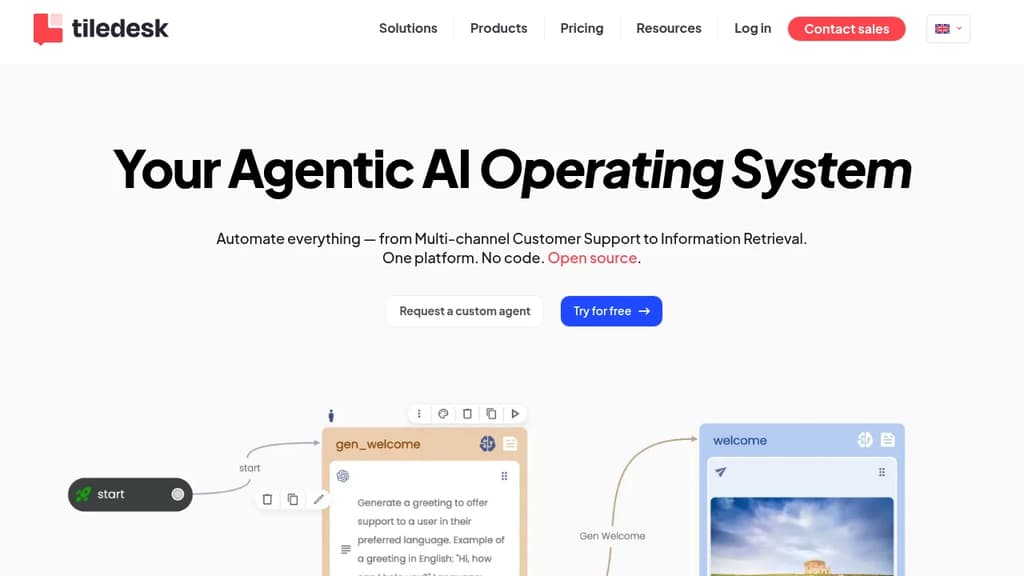
Tiledesk is an open-source platform for building AI agents that handle customer support, appointment booking, email processing, and more, without writing code. It's built for businesses that want to automate conversations at scale while keeping humans in the loop when it matters.
The core of the platform is a visual flow builder where you design conversation logic using prompt chains, LLM calls, and conditional routing. You can create multiple specialized agents (one for sales, another for support, another for onboarding) and chain them together so a conversation moves between them based on intent or topic. It's a practical alternative to other chatbot platforms that force you to choose between simple bots and full custom development.
Key capabilities:
- Multi-channel deployment across web chat, WhatsApp, Facebook Messenger, SMS, voice, and email from one platform
- RAG with multiple knowledge bases so support docs, sales playbooks, and internal content stay separate, with hybrid full-text and semantic search
- Human-in-the-loop handoff that escalates complex cases to live agents with full conversation context intact
- AI Copilot for agents that surfaces relevant articles and summaries during live chats
- Self-learning that extracts knowledge from resolved conversations and updates the knowledge base automatically
- Appointment scheduling connected to Google, Outlook, or custom calendars, handled entirely by the AI
- Email automation that reads incoming messages, extracts intent, and triggers workflows or sends replies
- Shopify integration for e-commerce assistants that display product carousels and build carts conversationally
- MCP and REST API support for connecting agents to external systems
- On-premises deployment with local LLM support (LLaMA, Mistral) and local vector stores like Qdrant
Compared to tools like Botpress or Hexabot, Tiledesk leans heavily into the enterprise self-hosting angle. You can run the entire stack behind your own firewall, control your vector store, and connect open-source models, which matters for regulated industries like healthcare, finance, and public sector.
The platform is GDPR-compliant and Italy-based. It supports SSO, integrates with existing live agent consoles and VoIP systems, and includes an MQTT-based real-time debugger for testing automations. A 14-day free trial is available without a credit card.

People are looking for alternatives to...
View all alternatives
Spotify

Claude Code

CapCut

Claude

Notion

Lovable
 Docmost – Open-source wiki software with real-time collaboration, diagrams, AI, SSO, RBAC permissions and more.

 Stellar Hosted