Open Source Defguard Alternatives
A curated collection of the 2 best open source alternatives to Defguard.
The best open source alternative to Defguard is Pocket ID. If that doesn't suit you, we've compiled a ranked list of other open source Defguard alternatives to help you find a suitable replacement. Other interesting open source alternative to Defguard is WireGuard.
Defguard alternatives are mainly Authentication & SSO Providers but may also be VPN & Secure Access Tools. Browse these if you want a narrower list of alternatives or looking for a specific functionality of Defguard.

Written by Piotr Kulpinski


Self-hostable OpenID Connect and OAuth 2.0 provider that lets users sign in to any OIDC-compatible app using passkeys instead of passwords.
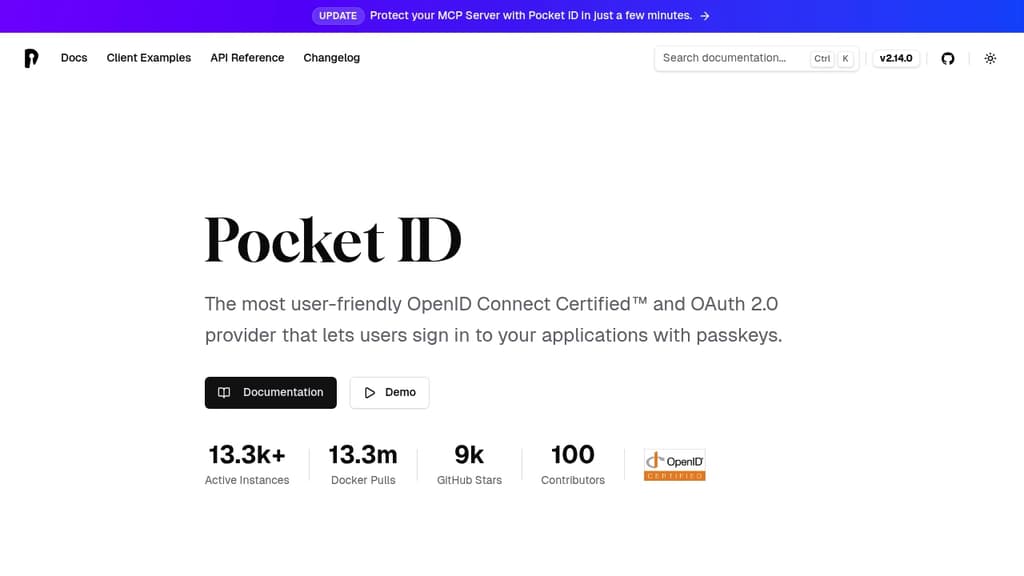
Pocket ID is a self-hostable identity provider built around one idea: passwordless sign-in should be simple to run and simple to use. It's OpenID Connect Certified and OAuth 2.0 compliant, so it works with any app that supports OIDC. Users authenticate with passkeys rather than passwords, which removes the weakest link in most authentication setups.
The self-hosted identity space has heavier options like Keycloak, Authentik, and Zitadel. Pocket ID sits at the opposite end of that spectrum. It does less, but what it does is fast to configure and light on resources. Community reports consistently mention getting from zero to fully connected apps in a couple of hours.
Key capabilities include:
- Passkey-only authentication – no password fallback, no complexity around credential resets
- Group-based access control – restrict which user groups can sign in to each registered application
- LDAP sync – pull users and groups from an existing directory rather than managing them separately
- SCIM provisioning – automatically provision and deprovision users in connected apps
- API resource indicators – issue scoped OAuth tokens tied to a specific API and its allowed actions
- Metadata-based OAuth clients – connect compatible clients via a hosted metadata document without manual registration
- QR code cross-device sign-in – approve a login on a device that holds your passkey by scanning a QR code
- Audit logs – per-user and global logs covering important authentication events
- REST API – manage users, clients, and configuration programmatically
It also works as an OAuth provider for AI applications and remote MCP servers, letting users approve access with a passkey while scoped tokens limit what each client can reach.
Over 25 language translations are available, and the project runs on over 13,000 active instances. It's a practical fit for homelabs, small teams, and anyone who wants one passwordless login across all their self-hosted services without running a full-featured identity platform.

VPN protocol that runs inside the Linux kernel, using public-key cryptography to create encrypted tunnels across UDP with minimal configuration.
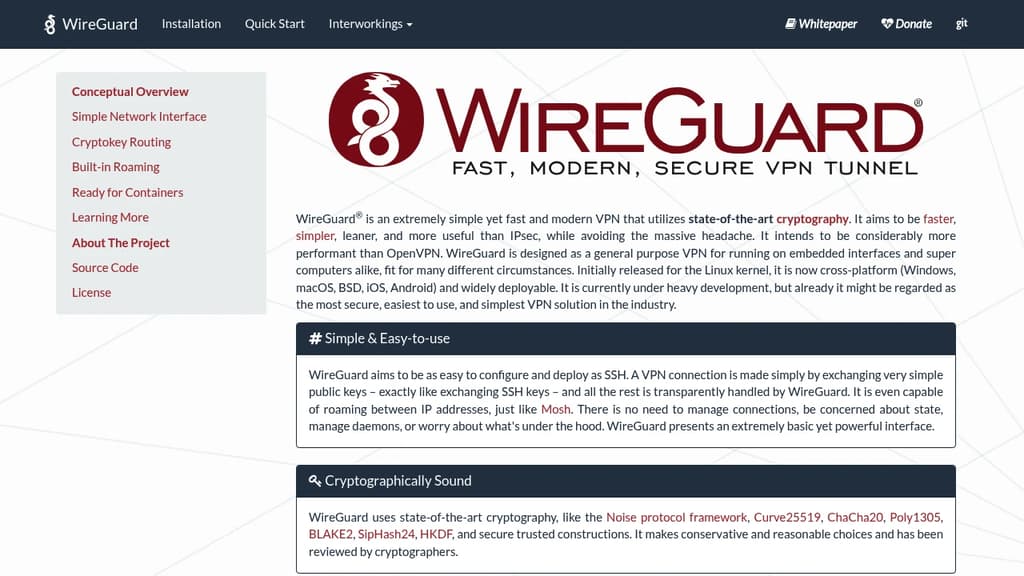
WireGuard is a VPN protocol and implementation designed to be far simpler than OpenVPN or IPsec while outperforming both. It runs inside the Linux kernel and is also available on Windows, macOS, BSD, iOS, and Android. The core idea: set up a network interface, exchange public keys with peers (much like SSH keys), and the tunnel just works.
Configuration is intentionally minimal. There's no connection state to manage, no daemons to babysit, and no complex certificate infrastructure. Each peer has a private key and a list of allowed IP addresses. That pairing of public keys to IPs is what WireGuard calls Cryptokey Routing, and it handles both authentication and access control in one clean mechanism.
Key capabilities:
- Modern cryptography using a curated, conservative set of primitives (Curve25519, ChaCha20, Poly1305, BLAKE2, and others), reviewed by cryptographers
- Tiny codebase with a minimal attack surface, auditable by a single person rather than requiring a large security team
- High throughput from kernel-level packet handling combined with fast cryptographic primitives, suitable for everything from smartphones to backbone routers
- Built-in roaming where both client and server automatically track each other's current IP endpoint, so connections survive network changes
- Container-ready with network namespace support, letting you move a WireGuard interface directly into a Docker container as its sole network path
- IPv4 and IPv6 support, including encapsulating one inside the other
Because identity and IP address are tightly coupled, firewall rules stay simple. You don't need complex extensions to verify packet authenticity. A rule matching an IP on a WireGuard interface is already a cryptographic guarantee.
Several higher-level tools build on WireGuard to add management UIs, access control, and multi-user features. Netbird, Firezone, Defguard, and Pangolin are all examples that use WireGuard as their tunneling layer while adding their own control planes on top.
The protocol is formally documented in an academic paper, and the kernel components are released under GPLv2.

People are looking for alternatives to...
View all alternatives
Claude Code

Spotify

CapCut

Claude

Notion

Lovable
 Sent – Messaging Infrastructure for Developers. One API for SMS, WhatsApp, and RCS across 190+ countries.
 Capture