Open Source CodeRabbit Alternatives
A curated collection of the 3 best open source alternatives to CodeRabbit.
The best open source alternative to CodeRabbit is Continue. If that doesn't suit you, we've compiled a ranked list of other open source CodeRabbit alternatives to help you find a suitable replacement. Other interesting open source alternatives to CodeRabbit are: Kodus and Pullfrog.
CodeRabbit alternatives are mainly AI Code Reviewers but may also be AI Coding Agents. Browse these if you want a narrower list of alternatives or looking for a specific functionality of CodeRabbit.

Written by Piotr Kulpinski


Runs source-controlled AI checks on every pull request, enforcing your engineering standards as native GitHub status checks with suggested fixes.

Continue adds automated quality control to your pull request workflow by running AI checks you define directly in your repo. You write the checks as Markdown files, commit them alongside your code, and Continue enforces them on every PR as native GitHub status checks. When code misses the mark, it surfaces suggested fixes inline.
The core idea is specificity. Unlike generic AI code reviewers that surface unsolicited opinions or broad style feedback, Continue only enforces what you've explicitly told it to catch. That means no surprise flags, no noise, and no drift from your actual standards.
Key capabilities:
- Source-controlled checks written in Markdown, versioned with your codebase so standards evolve alongside the code
- Native GitHub status checks that integrate directly into your existing PR workflow without separate dashboards
- Suggested fixes delivered when a check fails, reducing back-and-forth between author and reviewer
- Consistent enforcement across every PR, regardless of who wrote the code or how fast the team is shipping
It's built for engineering teams that have already defined what good looks like and want that enforced mechanically, not left to whoever has bandwidth for review. The checks cover areas like security, code reuse, and custom standards your team sets.
Tools like CodeRabbit or Qodo take a broader approach to AI review. Continue's value is the opposite: narrow, deliberate, and fully under your control. Your standards, your checks, your call on what gets enforced.

Open source AI code reviewer that analyzes pull requests for quality, security, and performance while respecting your existing rules and model preferences.
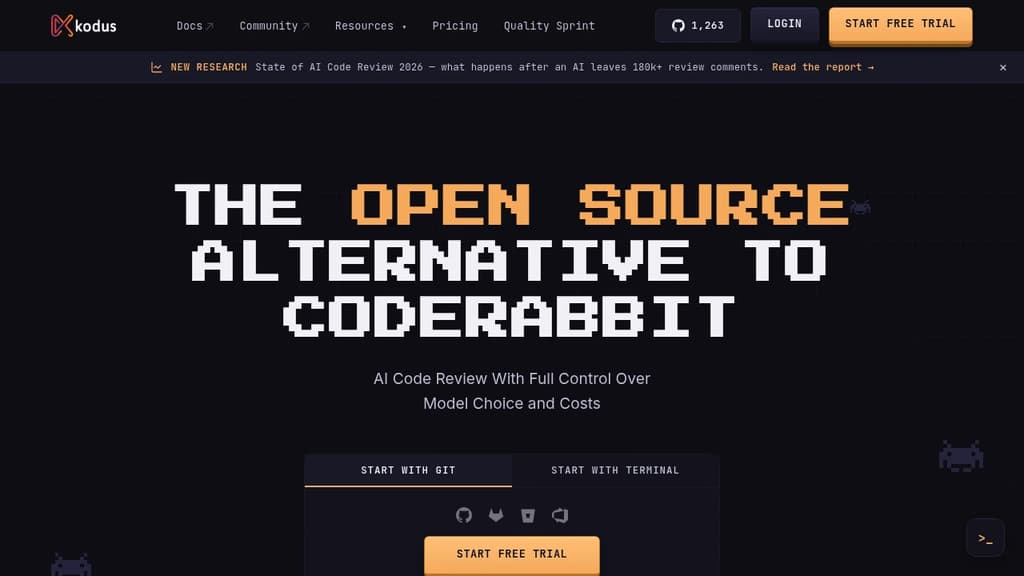
Kodus is an open source AI code reviewer built around a core idea: your team's standards should drive reviews, not a vendor's defaults. It integrates at the pull request level across GitHub, GitLab, Bitbucket, and Azure DevOps, posting inline comments on diffs without storing your source code.
The main differentiator from tools like CodeRabbit is model agnosticism. You connect your own LLM (Claude, GPT-4, Gemini, Llama, or any OpenAI-compatible endpoint) and pay the provider directly. No markup on token costs.
Key capabilities:
- Custom rules – define review standards in plain language or pull from a built-in library. Reviews follow your guidelines consistently.
- Rule sync – Kody detects existing rule files from tools like Cursor, Copilot, and Windsurf automatically, so you don't rewrite what you already have.
- MCP integrations – connect Jira, Notion, or Linear so reviews account for specs and task context, not just the diff.
- Technical debt tracking – unimplemented suggestions become tracked issues, giving teams a running view of accumulated debt.
- Engineering dashboard – monitor deploy frequency, cycle time, bug ratio, and PR sizes in one place.
- Self-hosted runners – code never leaves your infrastructure if you need it that way.
Security is handled seriously. Source code isn't stored, isn't used for model training, and all data is encrypted in transit and at rest. SOC 2 compliance is supported.
Teams using Kodus report review times dropping from hours to minutes, with one team citing a 30% reduction in time spent on reviews. The platform subscription funds the product; token costs stay between you and your model provider.

An open-source GitHub bot that runs AI agents to review PRs, triage issues, fix CI failures, and ship code using any LLM provider.
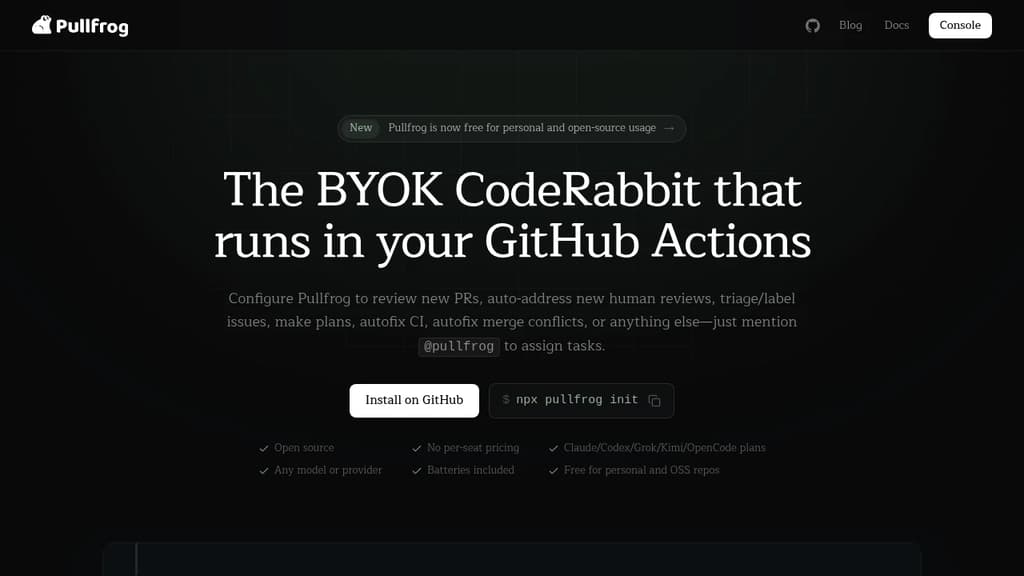
Pullfrog is an AI-powered GitHub bot that automates the repetitive parts of software development directly inside your existing workflow. It listens for GitHub events and triggers agent runs in response: a PR opens, a review is submitted, CI fails, a merge conflict appears. No separate dashboard to babysit. Just tag @pullfrog anywhere, or configure automations to fire on their own.
It runs on GitHub Actions, which means it lives in your repo and uses infrastructure you already have. There's nothing new to learn about where your code runs.
What it can do out of the box:
- PR review – automatically reviews incoming pull requests and leaves structured comments
- Issue triage – labels and categorizes new issues based on your instructions
- CI autofix – detects failures on its own PRs and attempts fixes; can be configured for human PRs too
- Merge conflict resolution – identifies and resolves conflicts automatically
- Plan and PRD generation – drafts technical plans from issue descriptions
- Review iteration – when you leave comments on a Pullfrog-created PR, it addresses them and updates you
- Headless browser – runs end-to-end tests, takes screenshots, and iterates on UI without extra setup
Unlike tools such as CodeRabbit or OpenHands, Pullfrog is model-agnostic. It works with Anthropic, OpenAI, Google, Mistral, DeepSeek, OpenRouter, and more. API keys are stored as GitHub secrets and passed with least-privilege access. Short-lived installation tokens are auto-revoked after each run, so credentials don't linger.
Security is handled at the architecture level. Shell commands run in an isolated subprocess with no access to sensitive environment variables. A purpose-built MCP server handles all git and GitHub operations, with permission checks that prevent the agent from pushing to protected branches or touching repos it shouldn't see.
Pricing is pay-as-you-go at $0.07 per run (plus model costs), with 30 free runs per month and no card required to start. Open source projects can apply for free full access.

People are looking for alternatives to...
View all alternatives
Claude Code

Spotify

CapCut

Claude

Notion

Lovable
 InfluxDB – The purpose-built time series platform for high-velocity ingestion and real-time queries at scale.
 Docmost