Open Source Coda Alternatives
A curated collection of the 11 best open source alternatives to Coda.
The best open source alternative to Coda is Macro Docs. If that doesn't suit you, we've compiled a ranked list of other open source Coda alternatives to help you find a suitable replacement. Other interesting open source alternatives to Coda are: AppFlowy, SiYuan, Logseq, and Outline.
Coda alternatives are mainly Personal Knowledge Management (PKM) Tools but may also be Note-Taking Tools or Collaborative Notes & Wikis. Browse these if you want a narrower list of alternatives or looking for a specific functionality of Coda.

Written by Piotr Kulpinski


Collaborative markdown documents with real-time CRDT editing, AI agent cursors, mention linking, and built-in properties tied to your tasks, channels, and email.
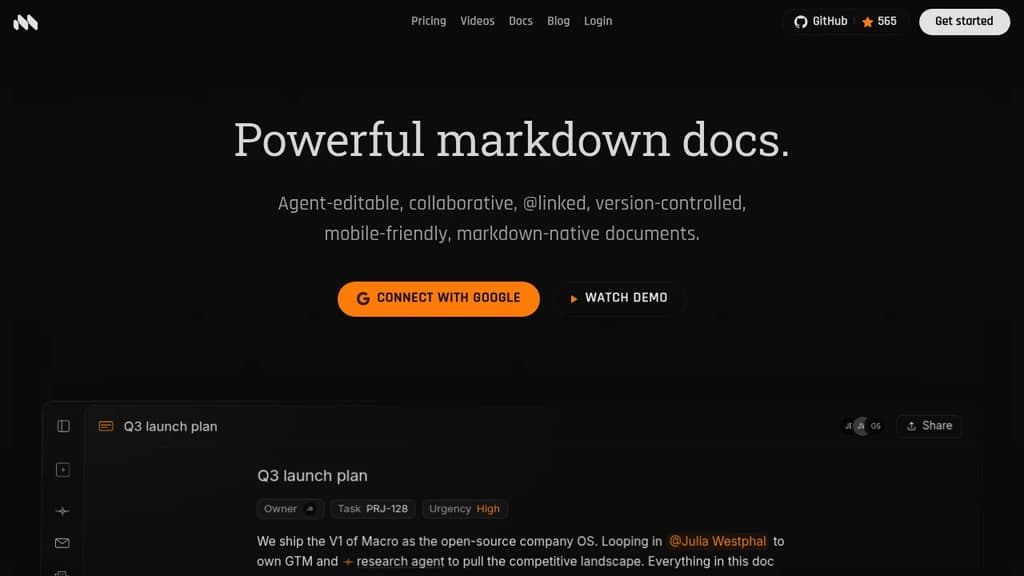
Macro is a markdown-native document editor built to live inside a broader workspace, not alongside one. Every doc connects directly to tasks, email, channels, and AI agents through @mentions that render as live inline pills. What sets Macro apart from tools like Notion or Google Docs is the agent layer. AI agents can edit documents alongside you with a live cursor, not just suggest a diff.
Key capabilities include:
- @mention anything: people, docs, tasks, channels, and calls all render as live inline pills inside any page.
- Markdown-native: type standard markdown and it formats in real time; export back to clean plain markdown anytime.
- Document properties: attach status, assignee, tags, dates, and custom fields directly to a doc without leaving the editor.
- Slash commands: insert headings, tables, code blocks, math equations, and task items with a single keystroke.
- Inline comments and version history: comment on any selection, resolve threads, and restore or fork any past version.
- Unified search: one search index across docs, tasks, email, and channels.
The editing foundation is built on CRDTs (Conflict-free Replicated Data Types), which means multiple people can type on the same line simultaneously without conflicts. Edits apply locally first and reconcile in the background, so the experience stays fast even offline. The backend is written in Rust with a SolidJS frontend, and each document runs as its own Durable Object in the cloud, keeping latency low. Macro is licensed under AGPLv3.
Macro is aimed at teams who want the writing experience of something like Outline or Logseq but need their docs to stay in sync with everything else happening at work. Things can be @mentioned directly in a doc and given context from tasks, channels, or email threads in the same workspace.

Open source collaborative workspace combining notes, databases, and AI with full data ownership, offline support, and self-hosting options.
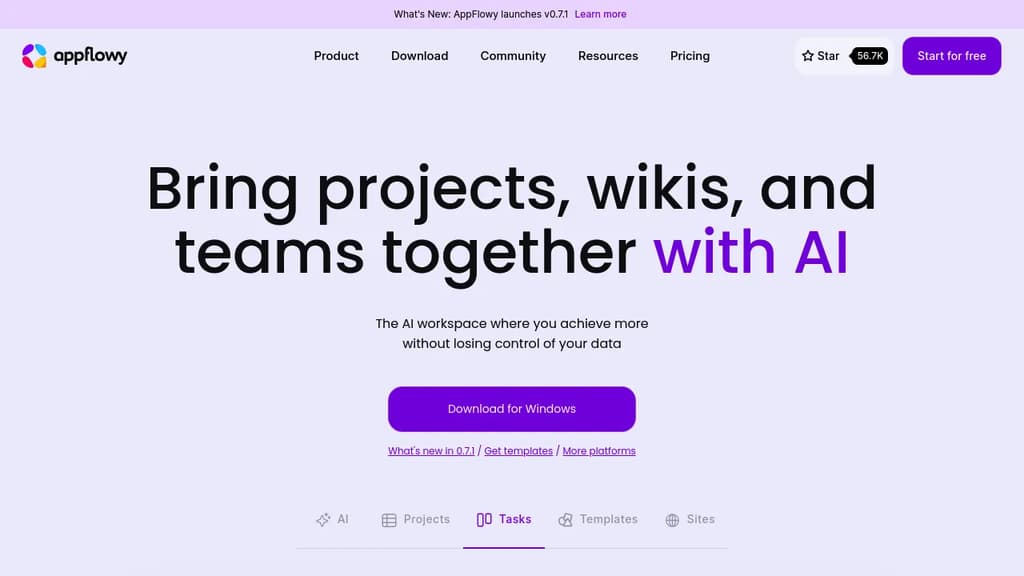
AppFlowy is an open source workspace that brings together documents, wikis, project tracking, and team collaboration in one place. It's built as a self-hostable alternative to tools like Notion, designed for people who want a modern workspace without handing their data to a third-party cloud.
The core of the product is a block-based editor paired with flexible databases. You can build pages with rich content types, attach properties and labels to records, and switch between different views of the same data. Grids, boards, and calendars are all available. Custom themes and fonts let you adjust the look to your preference.
AI is built directly into the workspace, not bolted on as a separate add-on. You can ask questions across your pages, generate and improve writing, and autofill database fields from existing content. AppFlowy supports multiple AI backends including GPT-5, Gemini 2.5, and Claude 3.7, and it also supports running local models like Mistral 7B and Llama 3 on your own machine. That local option matters for teams or individuals who need AI assistance without sending data to external servers — something tools like Flowise AI or Langflow approach from a different angle.
Offline mode is fully supported. The app works without an internet connection and syncs when connectivity returns, across desktop and mobile. iOS and Android apps are available alongside the desktop clients.
Self-hosting is a first-class option, not a workaround. You can run AppFlowy on your own infrastructure with no vendor lock-in. For teams that can't store sensitive information in someone else's cloud, this is a practical path. If you're also evaluating Baserow for database-heavy workflows or OpenWork for team collaboration, AppFlowy sits at the intersection of both.
The project has over 400 contributors and a community spanning more than 215 countries. A plugin and template ecosystem is actively growing, which extends the toolbox beyond what ships by default.

Personal knowledge management system with WYSIWYG block editing, bidirectional links, spaced repetition flashcards, a relational database, and end-to-end encrypted sync.
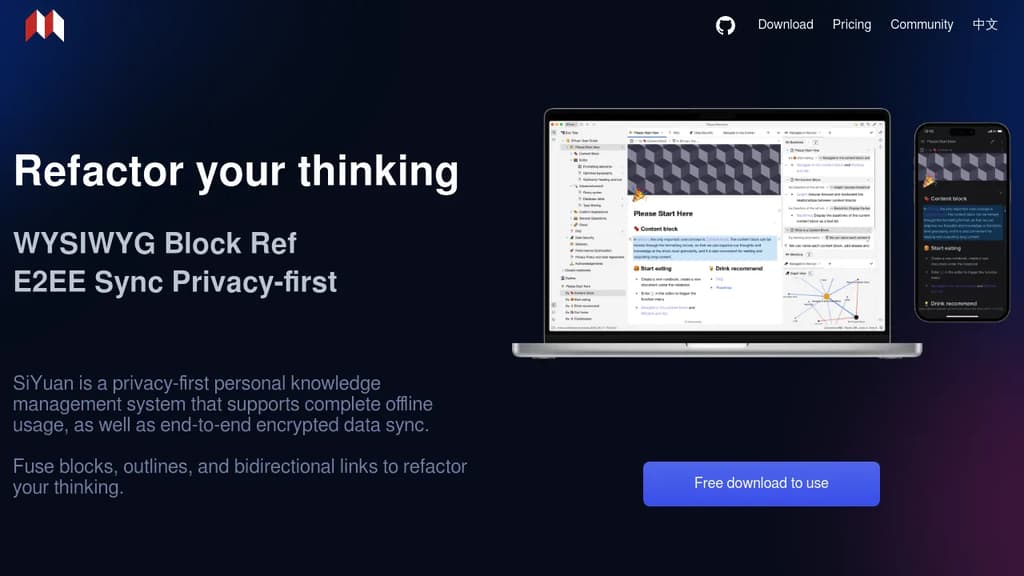
SiYuan is a personal knowledge management tool built around a single core idea: everything is a block. Documents, headings, paragraphs, lists, even pages themselves are all blocks you can reference, link, move, and reorganize without breaking existing connections. It's aimed at people who want a Logseq- or Obsidian-style networked knowledge system but with stronger privacy guarantees and a fully offline-capable architecture.
The editing experience is WYSIWYG with Markdown support. SiYuan ships with 20+ block-level element types and 10+ inline elements, covering most typesetting needs out of the box. Widget blocks handle more specialized cases. Large documents with millions of words load smoothly through dynamic rendering, so file size doesn't become a bottleneck.
Key capabilities:
- Bidirectional links at the block level, not just the page level. Backlinks show unlinked mentions, and a global relationship graph gives a visual map of how your knowledge connects.
- Database blocks with relation and rollup support, letting you link two databases and surface aggregated data across them.
- Spaced repetition flashcards built in, using an algorithm to schedule reviews based on memory decay.
- AI writing assistance for drafting, translation, summarization, grammar correction, and Q&A, accessed directly inside the editor.
- List outlines with folding, rich typography per item, and full integration with document structure.
- Zoom-in focus mode on any block, with breadcrumb navigation to keep context.
On the privacy side, all data lives on your device by default. Sync uses end-to-end encryption with incremental transfers to minimize bandwidth. No network connection is required to use it. SiYuan can also run as a local server accessible from a phone over a LAN, or be self-hosted via Docker for small-team collaboration with access controlled by an authorization code. For people comparing AppFlowy or AnyType, SiYuan's block-reference model and built-in spaced repetition are distinctive features that the others don't combine in one package.

Local-first, open-source knowledge management tool with bidirectional linking, outlines, flashcards, PDF annotations, and whiteboards for building a connected second brain.
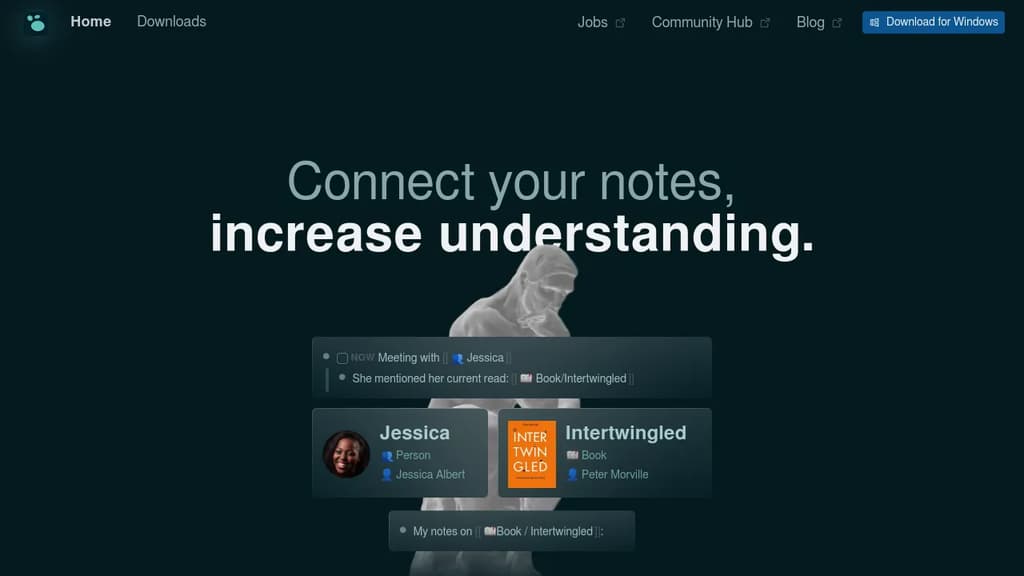
Logseq is a local-first knowledge base for people who work with a lot of information and can't afford to lose the thread. Your notes live as plain Markdown files on your own device, so you own them completely. No subscription required for personal use, no vendor lock-in, and no cloud dependency unless you want one.
It's built around an outliner model where every bullet is a block you can reference, embed, or query from anywhere in your notes. That structure makes it easy to build connections between ideas over time rather than hunting through disconnected documents. If you've tried tools like Obsidian or Roam Research and wanted something fully open source with strong privacy defaults, Logseq is the closest match.
Key capabilities:
- Bidirectional linking connects pages and blocks so related ideas surface automatically
- Outliner-based editing lets you nest, collapse, and reorganize thoughts at any depth
- Flashcards turn any block into a spaced-repetition card for memorizing facts
- PDF annotations keep highlights and notes alongside the source document
- Whiteboards give you an infinite canvas to arrange and connect blocks visually
- Queries let you pull structured tables of information from across your notes
- 150+ plugins extend the core with community-built functionality
- Encrypted sync keeps notes consistent across devices without exposing your data
The daily journal is the default entry point. Capture everything there and let Logseq's linking and query system turn that raw input into something navigable. It suits students reviewing class notes, writers outlining drafts, developers keeping project context, and anyone who needs meeting notes that don't disappear into a folder.
Compared to a tool like Notion, Logseq keeps everything local and doesn't require a browser. Unlike SiYuan or AnyType, its plain-text Markdown storage means your notes are readable in any editor, long after the app itself might change.

Team knowledge base with real-time collaboration, AI-powered search, Slack integration, and self-hosting support for internal docs and wikis.
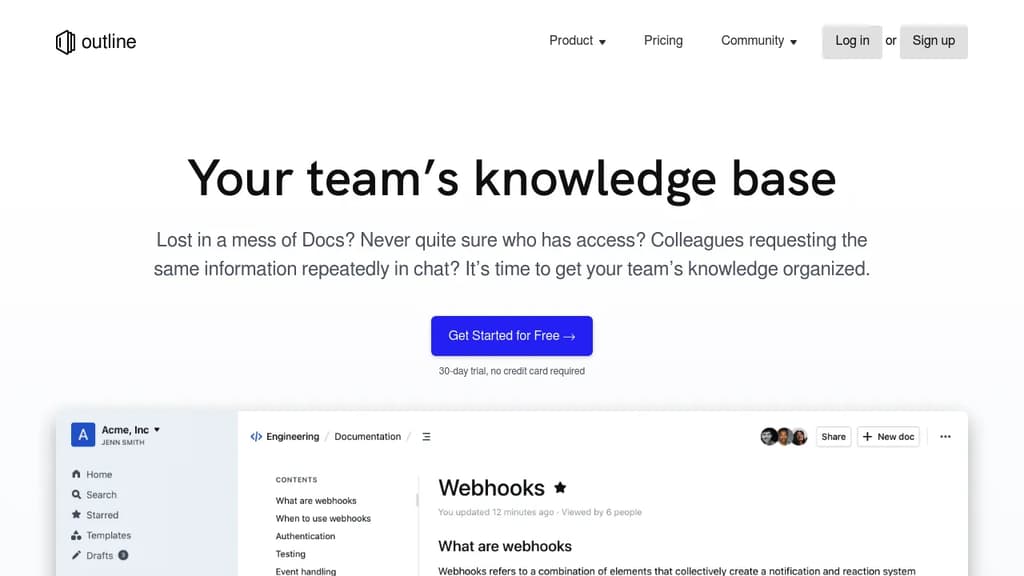
Outline is a team knowledge base built for companies that have outgrown scattered docs, messy shared drives, and repeated Slack questions. It gives teams a single place to write, organize, and find internal documentation, from product specs and onboarding guides to meeting notes and support answers. It's available as a cloud-hosted service or self-hosted on your own infrastructure.
The editor is fast. Documents load instantly, search returns results in milliseconds, and the UI stays snappy even in large workspaces. Writing feels close to plain text, with markdown support and slash commands, but you also get interactive embeds, real-time multiplayer editing, and threaded comments for keeping conversations tied to specific content.
Key capabilities include:
- AI-powered search that lets you ask questions about your documents and get direct answers, not just a list of links
- Slack integration for searching, sharing, and asking questions without leaving chat, plus channel notifications when docs change
- Granular permissions with read/write controls, user groups, guest access, and public sharing via link
- Custom branding with your own domain, colors, and logo
- 20+ integrations including Figma and Loom
- Localization with RTL support and translations in 20 languages
Outline sits in the same space as tools like Docmost or AppFlowy for collaborative wikis, but it's particularly focused on speed and team-wide usability rather than personal note-taking. Unlike personal tools such as Logseq, Outline is designed around shared workspaces with access controls from the start.
The codebase is open source, and self-hosting is a first-class option for teams that need to keep data on their own servers. A cloud-hosted plan with a 30-day free trial is also available for teams that want to get started without managing infrastructure.

Transform document collaboration with real-time editing, version control, and secure sharing features that enhance team productivity and communication.

A powerful document collaboration platform that brings teams together for seamless content creation and editing. Real-time collaboration allows multiple users to work simultaneously on documents, with changes reflected instantly across all users.
The platform offers robust version control to track changes and maintain document history, making it easy to review edits and revert to previous versions when needed. Smart commenting and annotation features enable contextual discussions right within documents.
Key features include:
- Intuitive rich text editing with formatting tools
- Secure document sharing with customizable permissions
- Automatic saving and backup
- Cross-platform compatibility for access anywhere
- Integration with popular productivity tools
- Offline mode for uninterrupted work
Whether you're writing business proposals, technical documentation, or creative content, Docs provides the tools needed for efficient document management and team collaboration.

AITable.ai offers a visual database platform that simplifies workflow automation and connects to over 6,000 apps through integrations like Zapier and Make.

AITable.ai is a powerful visual database platform designed to streamline workflow automation and enhance productivity. With its intuitive interface, users can easily organize and manage data while leveraging powerful automation capabilities.
Key features include:
- Visual database: Combines the simplicity of spreadsheets with the power of databases for flexible data management.
- Extensive integrations: Connect to over 6,000 apps via popular platforms like Zapier, Make, Pabbly, and Activepieces.
- Automated workflows: Create custom automations to streamline repetitive tasks and processes.
- One-click form creation: Instantly generate and integrate forms into websites for efficient data collection.
- AI-powered assistance: Leverage AI capabilities for data analysis, content generation, and workflow optimization.
- Customizable views: Visualize data in various formats including lists, boards, calendars, and Gantt charts.
AITable.ai is ideal for teams looking to improve their project management, CRM, and productivity workflows. Its no-code approach makes it accessible to users of all technical levels, while its powerful features cater to complex business needs.
By centralizing data and automating processes, AITable.ai helps organizations save time, reduce errors, and make more informed decisions. Whether you're managing customer relationships, tracking projects, or analyzing business data, AITable.ai provides a flexible and scalable solution to meet your needs.

The next generation of open-source AI-powered card notes designed to help you quickly capture and organize inspiration so that ideas never run out.

Blinko is a powerful self-hosted note-taking solution that puts you in control of your personal knowledge management. With its intuitive interface, you can:
- Create and organize notes with rich text formatting and markdown support
- Build connections between related notes to create a personal knowledge graph
- Keep your data private and secure by self-hosting on your own infrastructure
- Access your notes from anywhere through web and mobile interfaces
- Import and export notes in standard formats for data portability
- Customize the experience with themes and plugins
Perfect for students, researchers, writers, and anyone who wants to build a structured personal knowledge base while maintaining complete control over their data.

A local-first, encrypted workspace for notes, tasks, databases, and chats. Your data stays on your device, syncs peer-to-peer, and never passes through a central server.
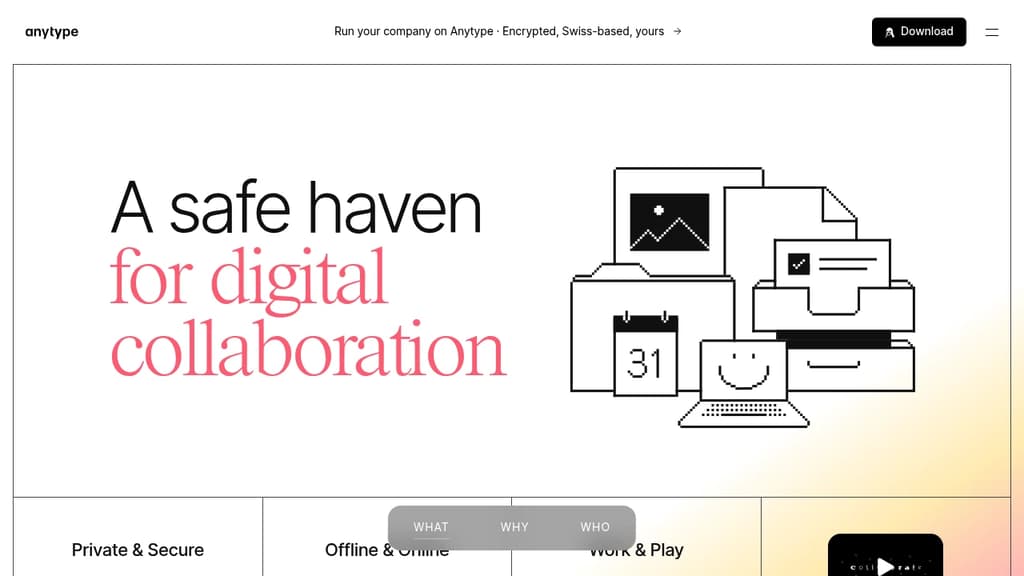
Anytype is a local-first workspace where your data lives on your device, encrypted with keys only you hold. It's built for people who want the flexibility of a tool like Notion or Nuclino without handing their data to a company's servers. Notes, tasks, databases, wikis, and chats all live in one place, and none of it is readable by anyone but you.
The privacy model is the core differentiator. Anytype uses on-device encryption by default. No server sits between your devices; sync happens peer-to-peer over local networks. You can also self-host your own backup node. There's no account recovery through a third party because no third party ever has your keys.
Beyond privacy, it's a capable creation tool:
- Block-based editor for composing pages, notes, and documents with rich formatting
- Databases with multiple views including table, kanban, and gallery layouts
- Templates to standardize recurring structures across your workspace
- Graph view to visualize relationships between objects
- Widgets for surfacing frequently used content on your home screen
- Offline-first operation, so the app works fully without an internet connection
- Native mobile apps for iOS and Android with touch-optimized navigation
The object model is flexible. Everything in Anytype is an "object" with its own type and relations, which means a task, a contact, a note, and a project can all link to each other in structured ways. It's closer to a personal knowledge graph than a simple note-taking app.
For teams, Anytype supports shared spaces with collaborative editing, making it a self-sovereign alternative to tools like Affine for groups that need both privacy and real-time collaboration. A business tier adds features for larger organizations.
The underlying protocols are open, built by Any, a Swiss non-profit association, so third-party developers can build on top of them without permission.

Local-first collaboration platform combining real-time chat, rich text pages, databases, and file management in a single self-hostable workspace.
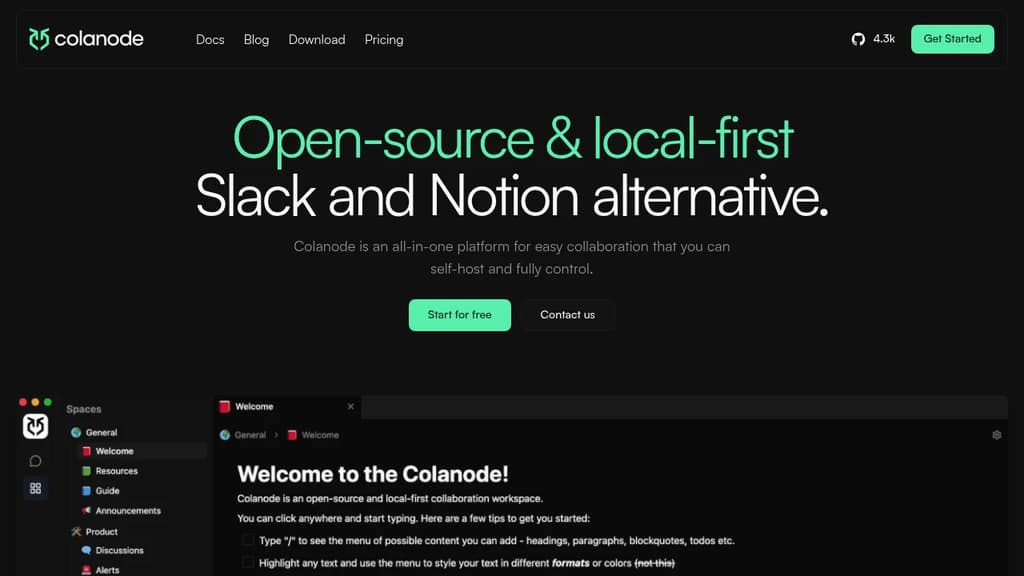
Colanode brings together the tools teams usually juggle across multiple apps: messaging, documents, wikis, databases, and file storage. It's a single workspace you can self-host and fully control, making it a practical Notion alternative and Slack alternative for teams that don't want their data living on someone else's servers.
The local-first architecture is what sets it apart. Changes save to your device first and sync in the background, so the app stays fast and responsive even on a spotty connection. Conflict-free collaboration is handled through CRDTs (Conflict-free Replicated Data Types), the same technology that powers tools like AnyType and AppFlowy, meaning multiple people can edit simultaneously without stepping on each other's work.
Key capabilities include:
- Real-time chat with direct messages and channels, covering the ground that tools like Rocket.Chat specialize in
- Rich text pages with an intuitive block-based editor for documents, wikis, and notes
- Databases with custom fields and multiple views including table, kanban, and calendar
- File management for storing and sharing files within workspaces
You can self-host the whole thing or use a cloud option. The workspace model means you only enable the features your team actually needs, rather than paying for a bundle of tools you'll ignore. Teams that want data sovereignty without stitching together separate tools for chat, docs, and project tracking will find it covers most of that ground in one place.

A privacy-focused, offline-first note-taking app that stores everything on your device, with Markdown, note linking, file attachments, LaTeX math, and bring-your-own sync.
Beaver Notes is a local-first note-taking app that keeps your data on your device by default. There are no accounts to create, no servers to trust, and no telemetry phoning home. It's MIT-licensed and built for people who want full ownership of their notes without trading away convenience.
The core idea is simple: everything works offline, and you decide whether and how to sync. Instead of locking you into a proprietary cloud, Beaver lets you bring your own cloud provider to move notes across devices on your terms.
The feature set covers more ground than a basic editor:
- Note linking connects ideas across your notes, building a personal web of information similar to what you'd find in tools like Logseq
- Tags and labels keep notes organized without complex folder hierarchies
- File attachments let you embed PDFs, images, and audio directly in a note
- LaTeX math renders equations inline as you type, useful for science and engineering notes
- Drawing lets you insert sketches or handwritten sections from any device, and those drawings travel with the note when you share it
- Command prompt gives keyboard-first access to search, settings, and actions without touching the mouse
- Markdown support throughout, with shortcuts that keep your hands on the keyboard
Sharing is built in too. You can send notes to other apps or people directly, and shared notes carry their embedded drawings and files along with them.
Beaver sits in a different lane from cloud-dependent tools like Notesnook or Memos. It's not trying to be a team collaboration platform or an AI-assisted workspace. The focus is on a fast, distraction-free writing environment that respects your privacy by design, not as a setting you have to hunt down.

People are looking for alternatives to...
View all alternatives
Spotify

Claude Code

CapCut

Claude

Notion

Lovable
 Openlane – Open-source, developer-first platform for automated compliance, risk management, and built-in Trust Center.

 Sent
Sent