LangWatch vs OpenLIT
Learn how LangWatch and **OpenLIT ** differ in their key features, development activity, technology
stack and community adoption, so you can decide which of these llm observability & evaluation is best for you.
Learn how LangWatch and **OpenLIT ** differ in their key features, development activity, technology stack and community adoption, so you can decide which of these llm observability & evaluation is best for you.

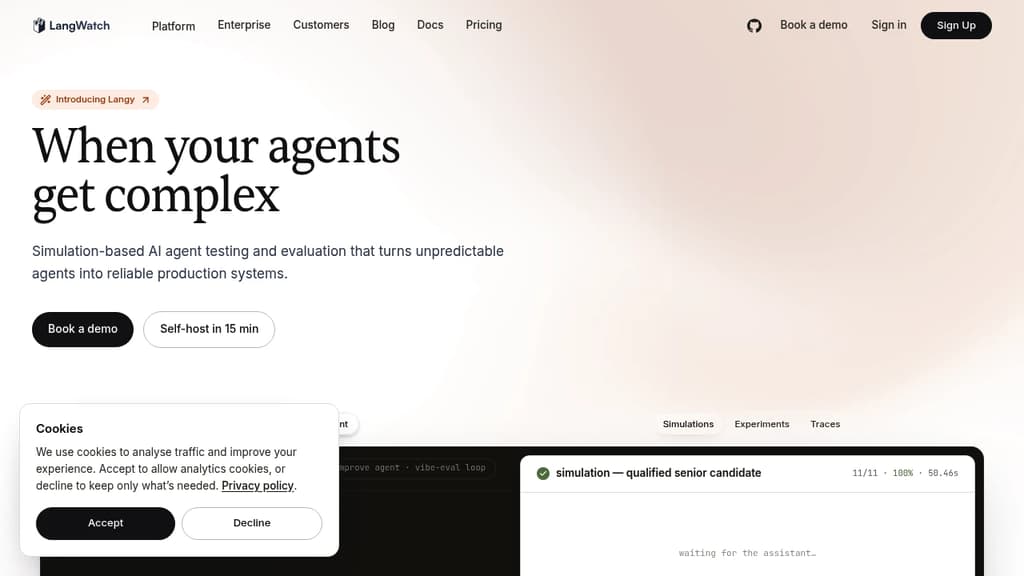
LangWatch
Last 30 days
Last commit
2 hours agoRepository age
3 yearsVersion
3.21.0License
Apache-2.0Repository
langwatch/langwatch

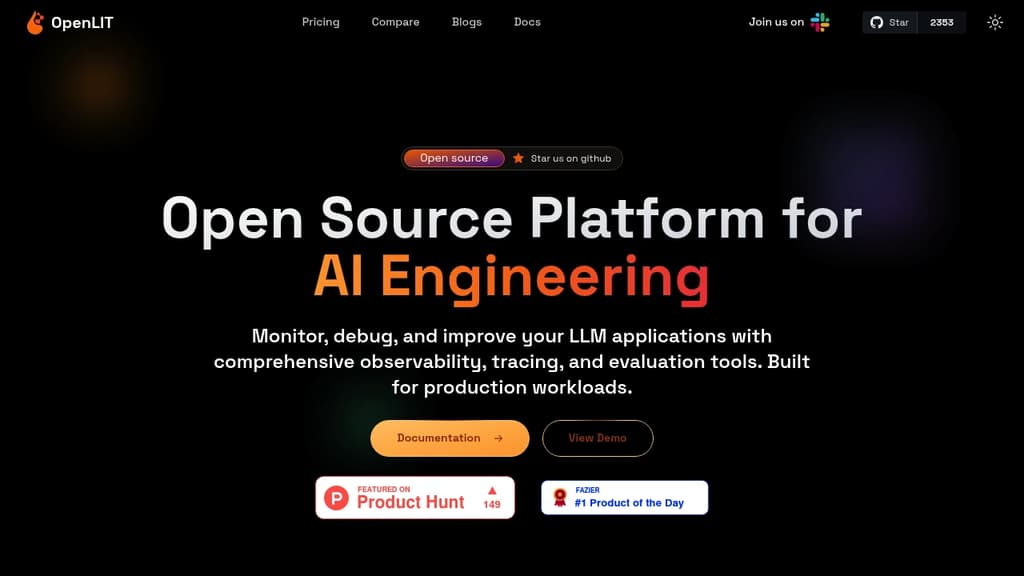
OpenLIT
Last 30 days
Last commit
2 days agoRepository age
3 yearsVersion
1.0.0License
Apache-2.0Self-hosted
YesRepository
openlit/openlit
Detailed Comparison
Both LangWatch and **OpenLIT ** have their unique strengths and serve similar purposes effectively. Consider your specific needs regarding popularity, growth, activity, technology, maturity, licensing and features when making your decision.
Both LangWatch and **OpenLIT ** have their unique strengths and serve similar purposes effectively. Consider your specific needs regarding popularity, growth, activity, technology, maturity, licensing and features when making your decision.
Community & Popularity
LangWatch leads in popularity with 4,991 stars vs 2,880 stars for **OpenLIT **. The 73% higher star count indicates stronger community adoption. In terms of developer contributions, **OpenLIT ** has 443 forks, indicating moderate developer engagement.
Growth Momentum
OpenLIT ** is growing faster, adding 88 stars in the last 30 days (+3.2%) against adding 119 stars for LangWatch (+2.4%**). OpenLIT is the smaller project of the two, so it is closing the gap rather than extending a lead.
Development Activity
Both projects show recent activity, with LangWatch last updated 2 hours ago and **OpenLIT ** 2 days ago.
Technology Stack
Both tools share common technology foundations, being built with JavaScript, CSS, Bash, Typescript, JSX, Python, Golang. However, they differ in their additional technology choices: LangWatch uses SCSS, Ruby while **OpenLIT ** leverages Next.js, C, Objective-C.
Project Maturity
Both projects started around the same time, with LangWatch beginning 3 years ago and **OpenLIT ** 3 years ago.
Licensing
Both projects use the Apache-2.0 license, providing identical terms for usage and distribution.
Use Cases & Features
Both tools serve similar use cases in LLM Observability & Evaluation.
Hosting & Deployment
**OpenLIT ** provides self-hosting options for complete data control and customization, while LangWatch may be primarily cloud-based or require different deployment approaches.








 Docmost – Open-source wiki software with real-time collaboration, diagrams, AI, SSO, RBAC permissions and more.