ego lite vs Zen Browser
Learn how ego lite and Zen Browser differ in their key features, development activity, technology
stack and community adoption, so you can decide which of these web browsers is best for you.
Learn how ego lite and Zen Browser differ in their key features, development activity, technology stack and community adoption, so you can decide which of these web browsers is best for you.

ego lite
Last 30 days
Last commit
13 hours agoRepository age
6 monthsVersion
v2.1.0License
MITRepository
citrolabs/ego-lite

Zen Browser
Last 30 days
Last commit
9 hours agoRepository age
3 yearsVersion
1.23.4License
MPL-2.0Repository
zen-browser/desktop
Detailed Comparison
Both ego lite and Zen Browser have their unique strengths and serve similar purposes effectively. Consider your specific needs regarding popularity, growth, activity, technology, maturity, licensing and features when making your decision.
Both ego lite and Zen Browser have their unique strengths and serve similar purposes effectively. Consider your specific needs regarding popularity, growth, activity, technology, maturity, licensing and features when making your decision.
Community & Popularity
Zen Browser leads in popularity with 45,360 stars vs 20,122 stars for ego lite. The 125% higher star count indicates stronger community adoption. In terms of developer contributions, Zen Browser has 1,917 forks, indicating strong developer engagement.
Growth Momentum
ego lite is growing faster, adding 3,568 stars in the last 30 days (+22%) against adding 741 stars for Zen Browser (+1.7%). ego lite is the smaller project of the two, so it is closing the gap rather than extending a lead.
Development Activity
Both projects show recent activity, with ego lite last updated 13 hours ago and Zen Browser 9 hours ago.
Technology Stack
Both tools share common technology foundations, being built with JavaScript, Bash, Typescript. However, they differ in their additional technology choices: Zen Browser leverages CSS, Python, Rust, C, Objective-C, C++.
Project Maturity
Zen Browser has been in development longer, starting 3 years ago, compared to ego lite which began 6 months ago. This 2.1-year head start suggests Zen Browser may have more mature features and established processes.
Licensing
ego lite uses the MIT license, which is more permissive than Zen Browser's MPL-2.0 license, potentially offering greater flexibility for commercial use and integration.
Use Cases & Features
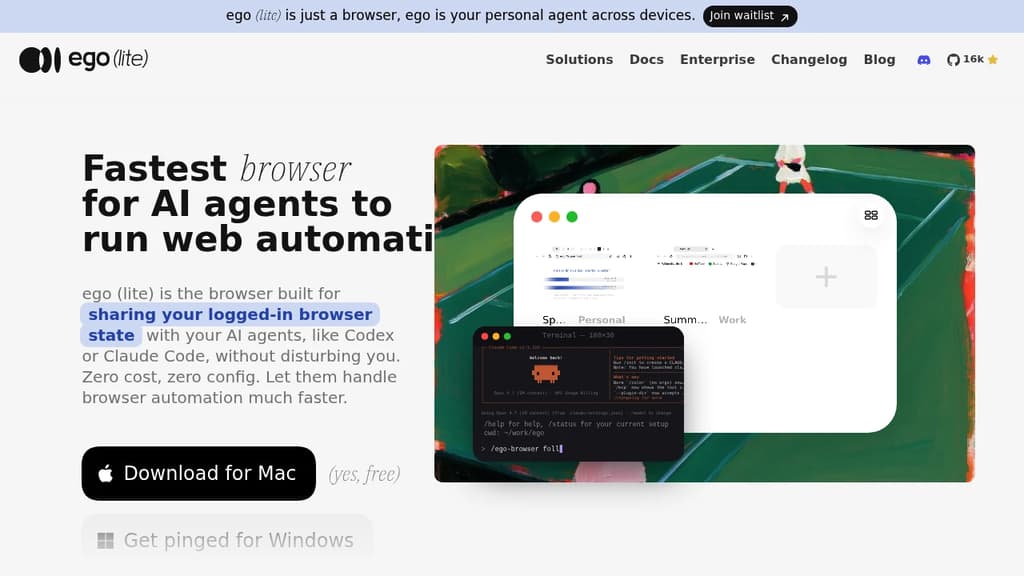
Both tools serve similar use cases in Web Browsers. However, they also have distinct specializations: ego lite also focuses on Browser Automation for AI.
Other tool comparisons to consider
ego litevs
 Browser Useego lite
vs
 Ladybirdego lite
vs
 Lightpandaego lite
vs
 Skyvernego lite
vs
 Heliumego lite
vs
 Steelego lite
vs
 Waterfoxego lite
vs
 LibreWolfego lite
vs
 Flowego lite
vs
 Browser Operatorego lite
vs
 Midori BrowserZen Browser
vs
LadybirdZen Browservs
HeliumZen Browservs
 BraveZen Browser
vs
WaterfoxZen Browservs
LibreWolfZen Browservs
FlowZen Browservs
Browser OperatorZen Browservs
Midori Browser Openlane – Open-source, developer-first platform for automated compliance, risk management, and built-in Trust Center.