Dray vs Orchestrator.inc
Learn how Dray and Orchestrator.inc differ in their key features, development activity, technology
stack and community adoption, so you can decide which of these ai coding agent orchestrators is best for you.
Learn how Dray and Orchestrator.inc differ in their key features, development activity, technology stack and community adoption, so you can decide which of these ai coding agent orchestrators is best for you.

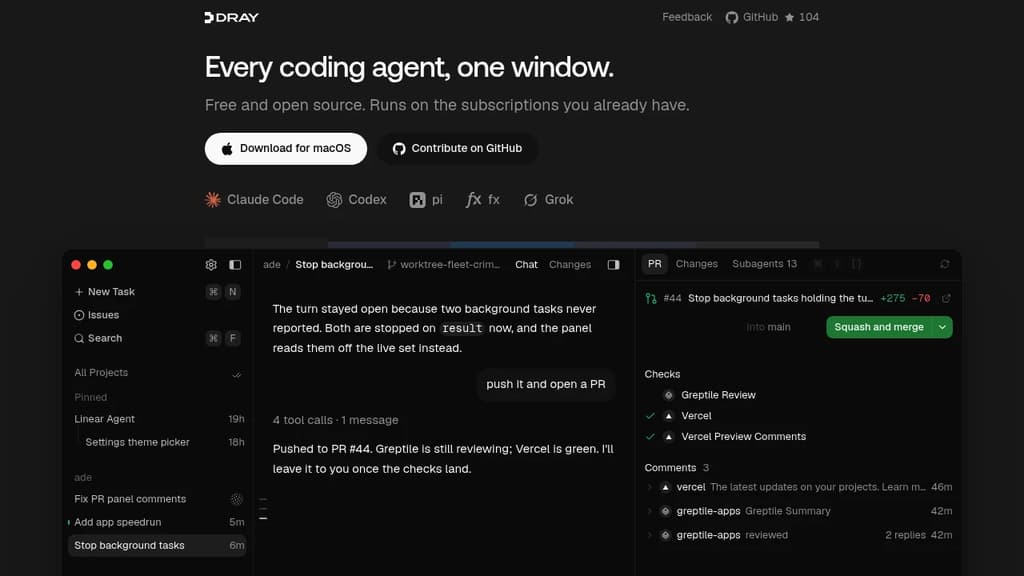
Dray
Last 30 days
Last commit
7 hours agoRepository age
4 monthsVersion
v0.20.4License
Apache-2.0Repository
monorepo-labs/dray

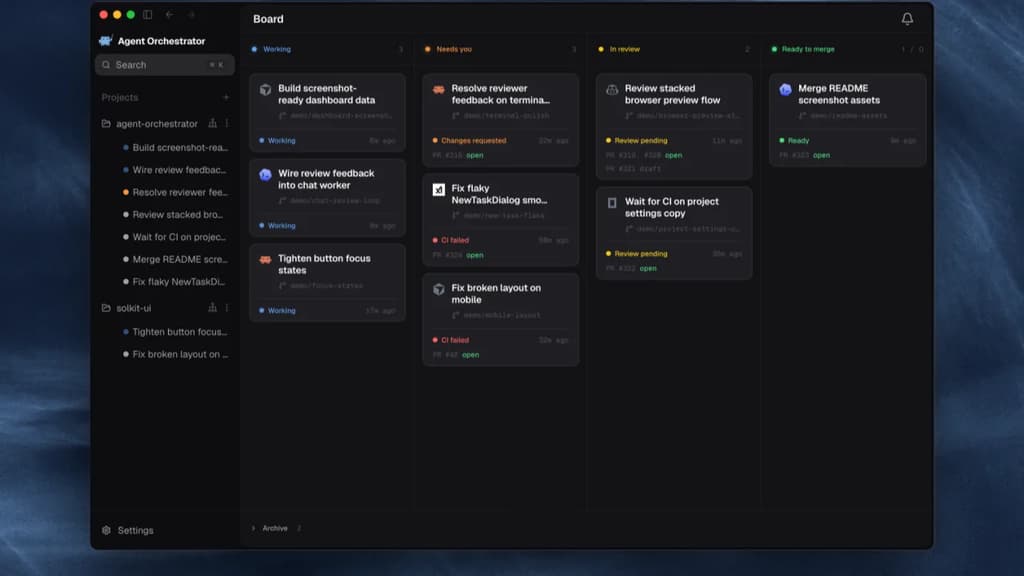
Orchestrator.inc
Last 30 days
Last commit
4 hours agoRepository age
10 monthsVersion
v0.15.6License
Apache-2.0Self-hosted
YesRepository
agent-orchestrator
Detailed Comparison
Both Dray and Orchestrator.inc have their unique strengths and serve similar purposes effectively. Consider your specific needs regarding popularity, growth, activity, technology, maturity, licensing and features when making your decision.
Both Dray and Orchestrator.inc have their unique strengths and serve similar purposes effectively. Consider your specific needs regarding popularity, growth, activity, technology, maturity, licensing and features when making your decision.
Community & Popularity
Orchestrator.inc significantly outpaces Dray in community adoption with 15,229 stars compared to 158 stars on GitHub. This 96.4x difference suggests Orchestrator.inc has a much larger and more active community. In terms of developer contributions, Orchestrator.inc has 2,088 forks, indicating strong developer engagement.
Growth Momentum
Dray is growing faster, adding 36 stars in the last 30 days (+30%) against adding 1,054 stars for Orchestrator.inc (+7.4%). Dray is the smaller project of the two, so it is closing the gap rather than extending a lead.
Development Activity
Both projects show recent activity, with Dray last updated 7 hours ago and Orchestrator.inc 4 hours ago.
Technology Stack
Both tools share common technology foundations, being built with JavaScript, CSS, Bash, Typescript, JSX, Next.js. However, they differ in their additional technology choices: Dray uses Rust, Tauri while Orchestrator.inc leverages Python, Golang, Objective-C, Java, Swift, MATLAB.
Project Maturity
Both projects started around the same time, with Dray beginning 4 months ago and Orchestrator.inc 10 months ago.
Licensing
Both projects use the Apache-2.0 license, providing identical terms for usage and distribution.
Use Cases & Features
Both tools serve similar use cases in AI Coding Agent Orchestrators.
Hosting & Deployment
Orchestrator.inc provides self-hosting options for complete data control and customization, while Dray may be primarily cloud-based or require different deployment approaches.
Other tool comparisons to consider
Drayvs
 OrcaDray
vs
 T3 CodeDray
vs
 PaseoDray
vs
 HappyDray
vs
 ParadevDray
vs
 bbDray
vs
 EmdashDray
vs
 SynaraDray
vs
 JeanOrchestrator.inc
vs
OrcaOrchestrator.incvs
T3 CodeOrchestrator.incvs
PaseoOrchestrator.incvs
HappyOrchestrator.incvs
ParadevOrchestrator.incvs
bbOrchestrator.incvs
EmdashOrchestrator.incvs
SynaraOrchestrator.incvs
Jean Postiz – The All-in-One agentic social media scheduling tool