Open Source Wachd Alternatives
A curated collection of the 5 best open source alternatives to Wachd.
The best open source alternative to Wachd is Uptime Kuma. If that doesn't suit you, we've compiled a ranked list of other open source Wachd alternatives to help you find a suitable replacement. Other interesting open source alternatives to Wachd are: Gatus, Nagios, Peekaping, and StatusScout.
Wachd alternatives are mainly Infrastructure Monitoring Tools but may also be Status Pages or Uptime Monitoring Tools. Browse these if you want a narrower list of alternatives or looking for a specific functionality of Wachd.

Written by Piotr Kulpinski


Monitors websites, APIs, and services with real-time alerts, a status page, and support for dozens of notification channels. Self-hosted and Docker-friendly.

Uptime Kuma is a self-hosted uptime monitoring tool built for teams and individuals who want full control over their monitoring data without relying on a third-party SaaS. It's a popular UptimeRobot alternative you can run on your own infrastructure.
The interface is clean and reactive, showing live status for all your monitors without needing a page refresh. You can track HTTP(S) endpoints, TCP ports, DNS records, Docker containers, databases, and more. Each monitor gets its own response time graph and uptime history.
Key capabilities include:
- 90+ notification integrations covering Slack, Telegram, Discord, PagerDuty, email, webhooks, and many others
- Status pages you can publish publicly or keep private, with custom domains and branding
- Multiple monitor types including keyword matching, JSON query checks, gRPC, and certificate expiry monitoring
- Maintenance windows to pause alerts during planned downtime
- Two-factor authentication and multi-user support for team access
- Ping and heartbeat monitors for cron jobs and background tasks
Compared to tools like Checkmate or OpenStatus, Uptime Kuma is deliberately lightweight. It runs as a single Docker container with no external database required, storing everything in SQLite. That makes it easy to self-host on a small VPS or home server without much overhead.
It doesn't offer distributed probing from multiple global locations out of the box, which tools like Peekaping do. But for a single-node monitor covering your own services, it covers the essentials well and has a large, active community behind it.

Openlane
Open-source, developer-first platform for automated compliance, risk management, and built-in Trust Center.
Get started for free
A highly customizable monitoring solution that provides automated status pages, extensive alerting options, and detailed testing capabilities for your services and infrastructure

Gatus is a powerful monitoring solution that helps you keep track of your infrastructure's health in real-time. The platform offers comprehensive monitoring capabilities for HTTP, GraphQL, DNS, ICMP/PING, TCP, and certificate expiration checks.
Key features include:
- Highly customizable monitoring with conditions for response time, body content, and IP addresses
- Extensive alerting system supporting Email, Slack, PagerDuty, Teams, Twilio, Discord, and more
- Developer-focused approach with detailed insights and automated user acceptance testing
- Real-time status updates that automatically reflect your services' current state
- Customer-centric design providing clear, accurate information about ongoing issues
The platform stands out by being completely open source, allowing for community contributions and custom feature development. Unlike traditional status pages that only show historical uptime, Gatus focuses on providing immediate, actionable information about current service status.

Free open source IT monitoring solution for servers, networks, and applications. Trusted by 1M+ users worldwide with powerful alerting and enterprise-grade features.
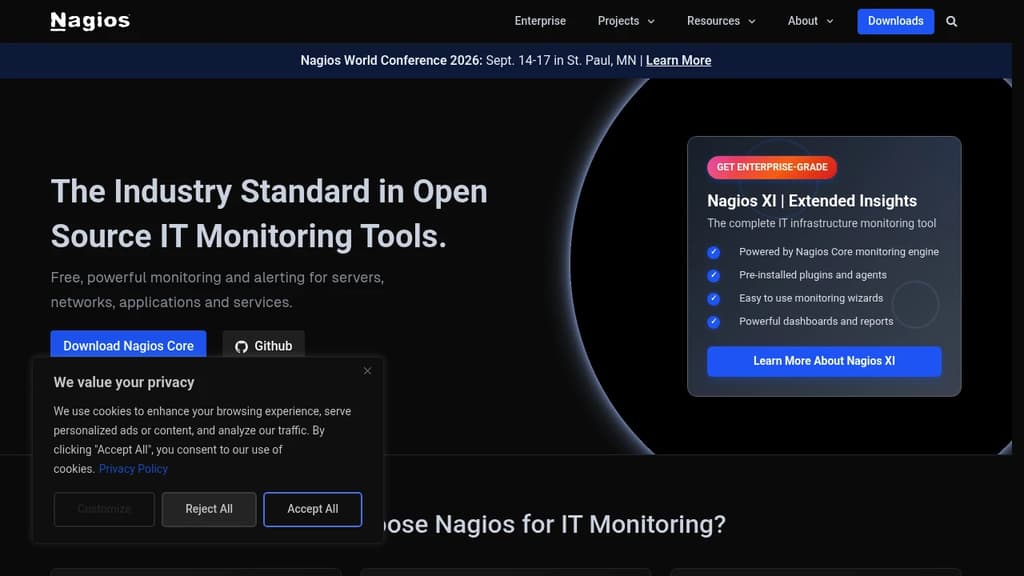
Nagios is the industry-standard open source monitoring solution that has been protecting critical IT infrastructure for over 25 years. Trusted by more than 1 million users worldwide, this powerful platform provides comprehensive monitoring and alerting for servers, networks, applications, and services.
The platform offers complete infrastructure monitoring capabilities, supporting Windows, Linux systems, and network devices to prevent downtime before it impacts business operations. With its powerful plugin architecture, users can extend functionality through thousands of community-developed plugins, including NRPE, NSCA, and custom monitoring solutions.
Key benefits include:
- Free, enterprise-grade monitoring with intuitive wizards and dashboards
- 573+ community add-ons available through Nagios Exchange
- Pre-configured solutions including Nagios XI for extended insights
- Global community support with active development and contributions
- Proven reliability with 4+ years in production environments
The Nagios Core Services Platform provides everything needed in one comprehensive package, including the monitoring engine, 50+ official plugins, cross-platform agents, and configuration tools. Whether you're monitoring simple setups or complex enterprise infrastructure, Nagios delivers the flexibility and reliability needed to maintain optimal system performance.

Open-source uptime monitoring solution with real-time alerts, status pages, and comprehensive checks for websites, APIs, databases, and services.
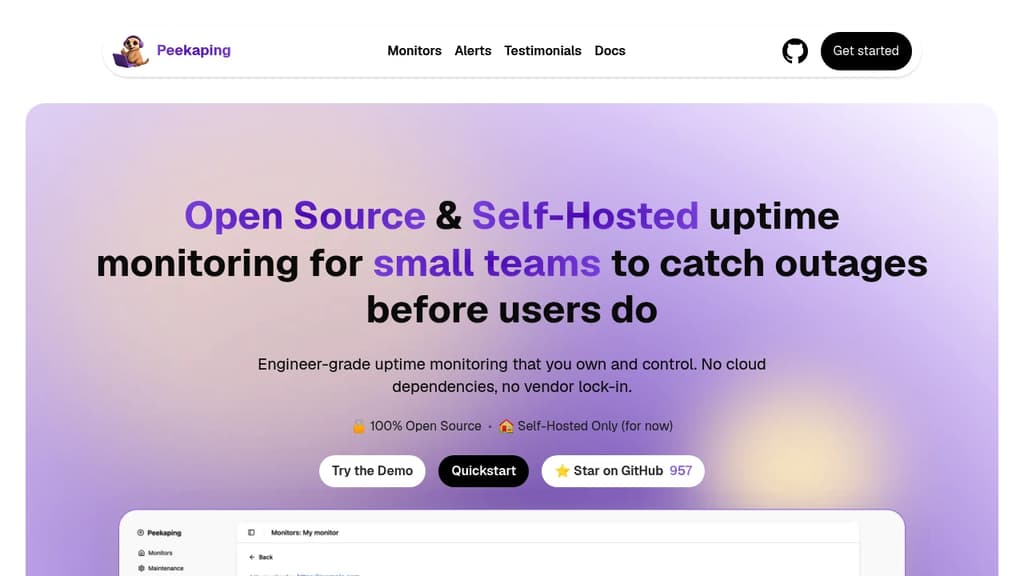
Complete infrastructure monitoring that runs entirely on your servers with zero vendor lock-in. Built with Go and React for high performance and reliability.
Comprehensive monitoring capabilities include HTTP/HTTPS websites, TCP ports, DNS queries, databases (PostgreSQL, MongoDB, Redis), Docker containers, gRPC services, and message brokers like RabbitMQ and Kafka. Push-based monitoring via webhooks lets services report their own health status.
Instant notifications through 15+ channels including Telegram, Slack, Discord, Email, PagerDuty, and Opsgenie. Configure alerts by severity and team workflows to reduce noise and ensure rapid response times.
Beautiful status pages can be public for customers or private for internal teams. Display real-time service status, uptime metrics, and incident history in a clean, professional interface that builds trust and reduces support tickets.
Flexible deployment options with official Docker images, docker-compose setup, or bare metal installation. Choose your database backend: SQLite for simple setups, PostgreSQL or MongoDB for production workloads.
API-first architecture with complete Swagger/OpenAPI documentation enables automation and custom integrations. Two-factor authentication, brute-force protection, and SSL certificate monitoring ensure security.
MIT-licensed and completely free for personal and commercial use. No usage limits, no feature restrictions, no data leaving your infrastructure.

Monitor website uptime, detect security vulnerabilities, find broken links, and simulate user flows. Get instant alerts when issues arise. Free tier available.
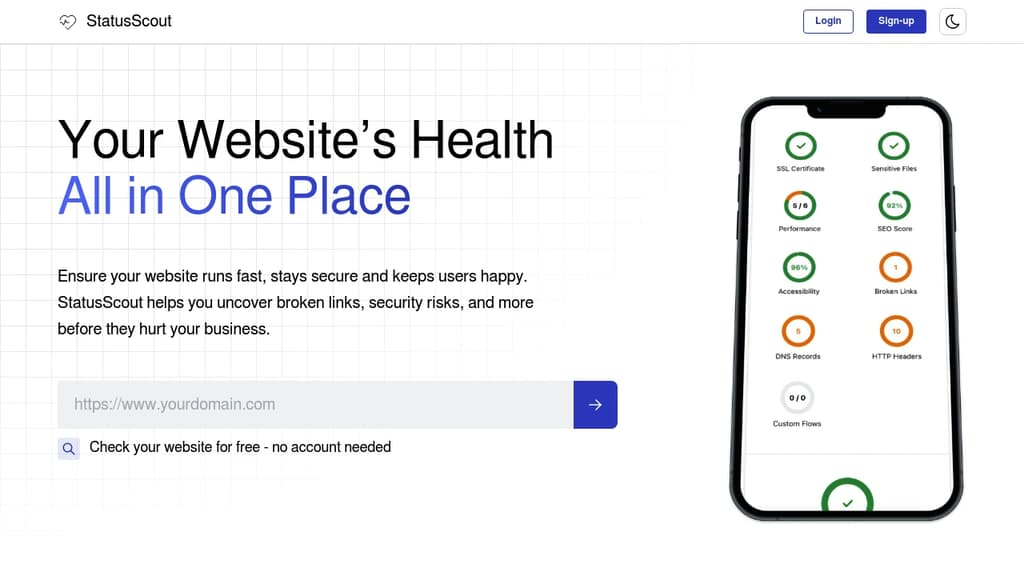
StatusScout provides comprehensive website health monitoring that goes beyond basic uptime checks. This all-in-one platform helps you maintain a secure, fast, and user-friendly website by proactively identifying issues before they impact your visitors.
Key features include:
- Security protection - Detects exposed sensitive files, DNS vulnerabilities, and missing security headers
- Broken link detection - Automatically crawls your site to find and report dead links or bad redirects
- User flow simulation - Tests critical user journeys like signups and checkouts to ensure smooth experiences
- Real-time monitoring - Instant alerts when something breaks, allowing you to resolve issues quickly
- SEO and accessibility insights - Actionable recommendations to improve search rankings and user experience
- Integration verification - Confirms that tracking codes, analytics scripts, and marketing pixels are working properly
Flexible deployment options cater to different needs: a free self-hosted version for complete control, a managed cloud service starting at $12/month for up to 5 websites, and custom enterprise solutions for larger organizations.
The platform is hosted in Europe, runs on renewable energy, and has already delivered insights for over 600 websites. With no credit card required for the cloud tier and a robust roadmap including API access and advanced security scans, StatusScout offers a reliable solution for maintaining website health and performance.
 Capture
People are looking for alternatives to...

 Capture – Capture screenshots, generate PDFs, scrape content, extract metadata, and automate browsers with one API.