Open Source Vertex AI Alternatives
A curated collection of the 3 best open source alternatives to Vertex AI.
The best open source alternative to Vertex AI is Dify. If that doesn't suit you, we've compiled a ranked list of other open source Vertex AI alternatives to help you find a suitable replacement. Other interesting open source alternatives to Vertex AI are: Mem0 and Beam.
Vertex AI alternatives are mainly AI Agent Platforms but may also be AI Memory & Context or AI Sandboxes. Browse these if you want a narrower list of alternatives or looking for a specific functionality of Vertex AI.

Written by Piotr Kulpinski


Visual platform for building agentic workflows, RAG pipelines, and LLM-powered apps. Supports hundreds of models, MCP integration, and self-hosted deployment.
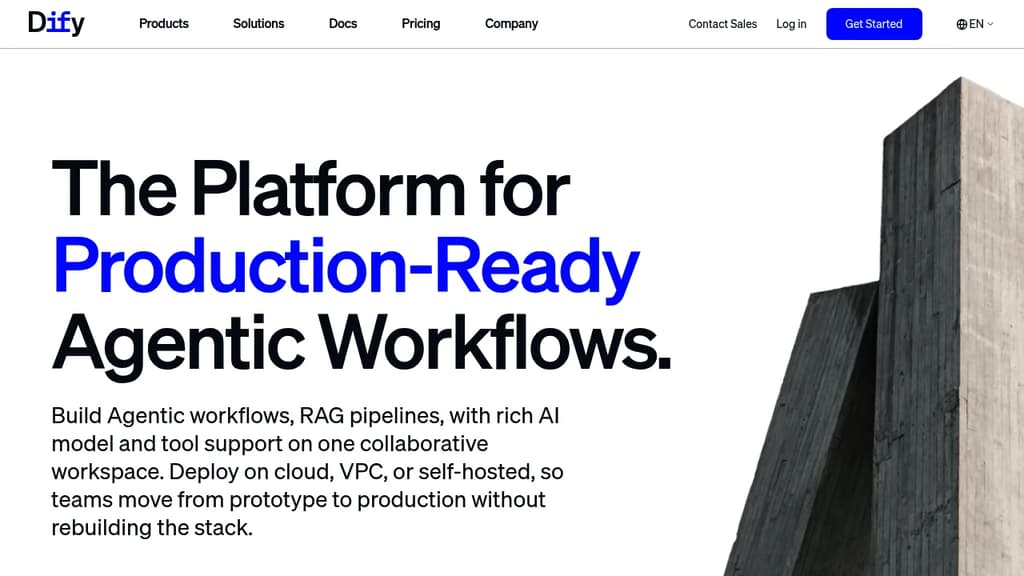
Dify is an open source platform for building production-ready AI applications without writing boilerplate infrastructure. It targets developers and teams who want to move from idea to deployed app quickly, using a visual workflow builder rather than assembling everything from scratch.
The core of Dify is its agentic workflow builder: a drag-and-drop canvas where you connect LLM calls, tools, conditional logic, and data sources into multi-step pipelines. These aren't toy demos. The platform is designed to handle real production traffic, with enterprise-grade security and scalability built in from the start.
Key capabilities include:
- RAG pipelines: ingest documents, connect knowledge bases, and make your data queryable by any LLM with minimal setup
- Multi-model support: connect to hundreds of global LLMs, including OpenAI, Anthropic, and locally-hosted models via Ollama or OpenAI-compatible APIs
- MCP integration: native support for the Model Context Protocol, both consuming external MCP servers and publishing your own app as an MCP server
- Plugin marketplace: extend functionality with community plugins without touching source code
- Observability: built-in monitoring so you can iterate based on real usage data
Teams can self-host the entire platform, which matters for organizations with strict data residency or compliance requirements. The no-code interface makes it accessible to non-engineers, while the underlying API and plugin system give developers room to build complex, custom logic.
Dify is used across industries from biomedicine to automotive. Ricoh built internal tooling on it; Volvo Cars uses it for rapid AI validation. Over a million applications run on Dify deployments worldwide.

Adds persistent, searchable memory to AI agents and apps, so they remember user preferences and past interactions across sessions without pipeline changes.
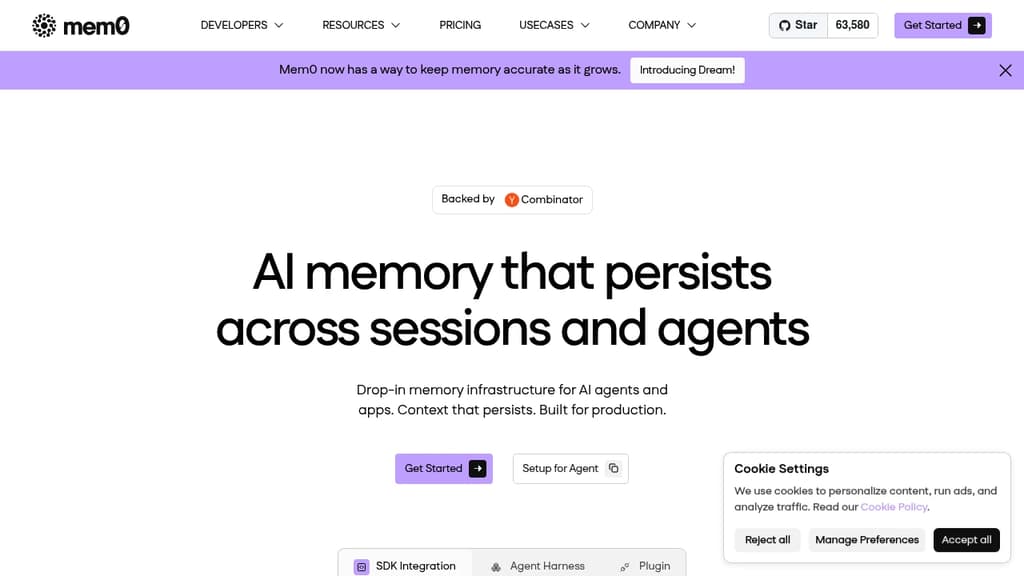
Mem0 is a memory infrastructure layer built for AI agents and applications that need to retain context across sessions. Without something like this, every conversation starts from scratch, forcing developers to stuff redundant history into prompts or lose personalization entirely. Mem0 solves that by extracting, storing, and retrieving memories automatically as users interact.
The core idea is simple: you send messages to Mem0, it learns from them, and later retrieves the relevant context when needed. No boilerplate configuration required. It fits into existing agent architectures without restructuring your pipeline.
Key capabilities include:
- Memory Compression Engine that condenses chat history into compact, token-efficient memories, cutting latency and API costs
- Multi-signal retrieval that surfaces the right memories at the right time, benchmarked on LoCoMo, LongMemEval, and BEAM datasets
- User-scoped memory so each user's preferences, history, and context stay separate and addressable by ID
- Full audit logging with visibility into every read and write, including who accessed what and when
- Flexible deployment across Kubernetes, private cloud, or air-gapped environments with a consistent API
- Compliance at the enterprise level: SOC 2 (Type 1), HIPAA, BYOK, and zero-trust architecture
Mem0 is particularly well-suited for products where personalization compounds over time: healthcare assistants that track patient history, customer support bots that remember past issues, or AI chat interfaces that need to feel consistent across sessions. It also works well as the memory backend for more complex agent frameworks that handle multi-step reasoning but lack native persistence.
Over 90,000 developers use it in production. The SDK supports Python and Node.js, and the managed API makes it easy to get started without self-hosting. For teams that need full control, self-hosted deployment is available with the same API surface.

Run GPU inference, task queues, and sandboxes on serverless infrastructure with sub-second cold starts, autoscaling, and support for your own AWS, GCP, or bare metal.
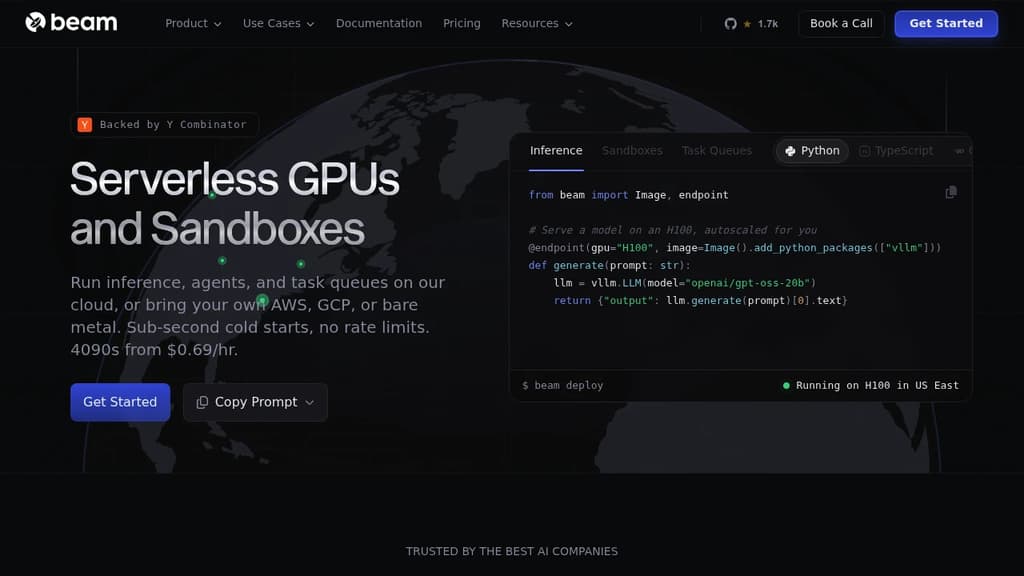
Beam is a GPU compute platform built specifically for AI workloads. It handles serverless inference, durable task queues, and isolated sandboxes, all defined in Python without Dockerfiles or YAML config. You can run on Beam's cloud or connect your own AWS, GCP, or bare metal accounts and let Beam orchestrate across all of them.
The core differentiator is boot time. Beam uses memory snapshots to restore GPU containers in under a second, up to 35× faster than a traditional cold start. That matters when you're running inference at scale or building agent pipelines where latency compounds quickly.
Key capabilities:
- GPU inference endpoints – deploy models on H100s, A10Gs, or 4090s with autoscaling baked in. Scale to zero when idle, burst to hundreds of containers when traffic spikes.
- Task queues – durable, queue-depth-based autoscaling with automated retries, scheduled jobs, and event callbacks. Good for batch workloads like transcription or document processing.
- Sandboxes – stateful, long-running environments for AI agents. Attach persistent storage, run Docker-in-Docker, snapshot the filesystem, and branch into thousands of parallel isolated runs.
- Multi-cloud routing – workloads route across clouds and 30+ regions in real time, keeping execution close to your users.
- CI/CD integration – deploy directly from GitHub Actions without changing your workflow.
Compared to tools like Modal or dstack, Beam leans hard on the sandbox and snapshotting story, which makes it a natural fit for agent frameworks that need stateful, parallelizable execution environments.
Pricing starts at $0.69/hr for a 4090, with $30 in free credits refreshed monthly. SOC 2 Type II certified.

People are looking for alternatives to...
View all alternatives
Claude Code

Spotify

CapCut

Claude

Notion

Lovable
 InfluxDB – The purpose-built time series platform for high-velocity ingestion and real-time queries at scale.
 Bright Data