Open Source TDengine Alternatives
A curated collection of the 4 best open source alternatives to TDengine.
The best open source alternative to TDengine is InfluxDB. If that doesn't suit you, we've compiled a ranked list of other open source TDengine alternatives to help you find a suitable replacement. Other interesting open source alternatives to TDengine are: TimescaleDb, QuestDB, and Apache IoTDB.
TDengine alternatives are mainly Time Series Databases but may also be Relational Databases (SQL). Browse these if you want a narrower list of alternatives or looking for a specific functionality of TDengine.

Written by Piotr Kulpinski


InfluxDB handles high-velocity, high-resolution time series data at scale, built for telemetry, edge devices, IoT, and physical AI workloads.
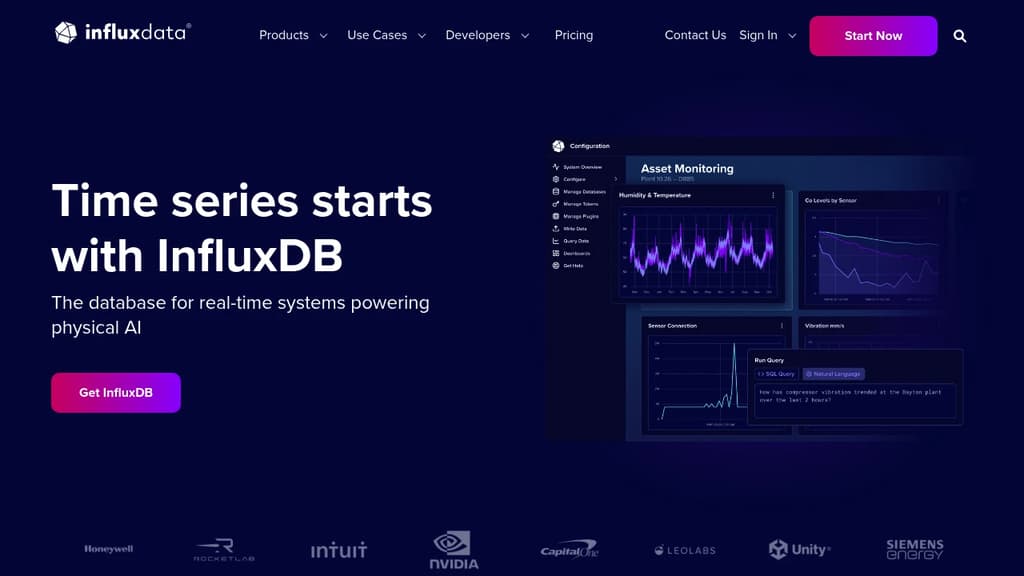
InfluxDB is a time series database built specifically for systems that generate continuous, high-resolution data. Think industrial sensors, satellite telemetry, power grids, and infrastructure monitoring. General-purpose databases weren't designed for this kind of workload, and the performance difference shows at scale.
The core strength is ingest speed. InfluxDB handles millions of data points per second without sacrificing query latency or blowing up storage costs. It uses efficient compression and stores data in Parquet format, which keeps footprint manageable even over long retention windows. Cold data gets automatically evicted and streamed into data lakes, warehouses, or AI/ML pipelines, so you're not paying hot-storage prices for data you rarely touch.
Key capabilities include:
- High-speed ingest – Millions of series ingested continuously without performance degradation
- Real-time analytics – SQL-based querying across unlimited series with low latency
- Edge-to-cloud continuity – Capture data at the source and analyze it anywhere without pipeline redesign
- Lakehouse integration – Automatic eviction of cold data into lakes, warehouses, and AI/ML systems
- 400+ Telegraf plugins – The open source Telegraf agent connects InfluxDB to virtually any data source, with over 5 billion downloads
- Client libraries – Official support for Python, Go, JavaScript, Java, and C#
Deployment is flexible. You can run it self-managed on-prem or at the edge, or use the fully managed cloud offering. Both options share the same engine, so you're not locked into a single environment.
Compared to alternatives like QuestDB, TDengine, or Timescale, InfluxDB has the largest installed base in its category, with over 1 million live open source instances and more than 2,800 contributors. It's ranked the top time series database by DB-Engines.
The tool targets engineers building monitoring systems, physical AI pipelines, aerospace telemetry platforms, and industrial data historians. If your workload involves continuous sensor streams and you need both fast writes and fast reads, InfluxDB is built around exactly that problem.

PostgreSQL extension for time-series data with automatic partitioning, up to 95% columnar compression, continuous aggregates, and ~200 native SQL functions.
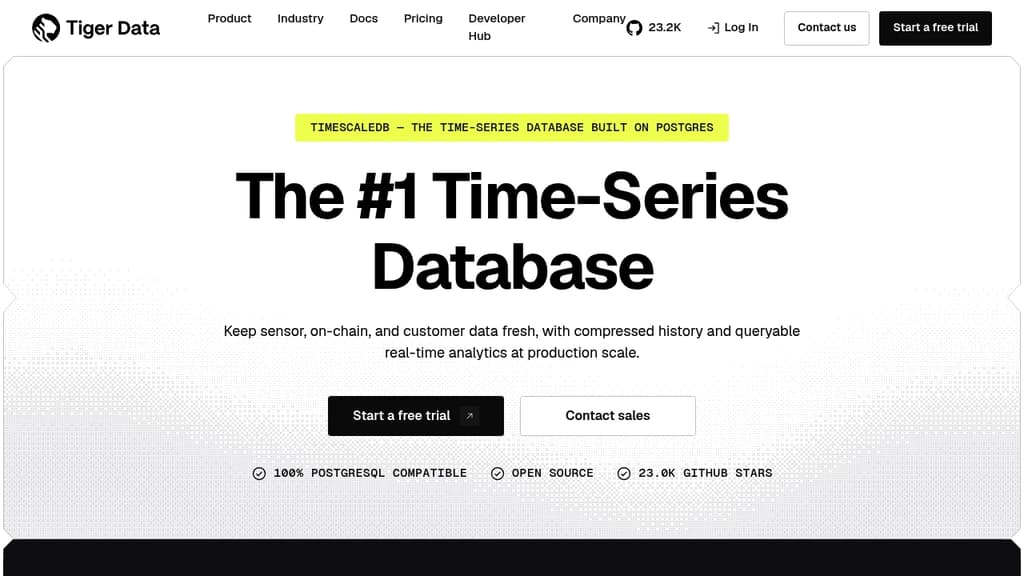
TimescaleDB is a PostgreSQL extension that turns Postgres into a purpose-built time-series database. It's designed for teams that want specialized time-series performance without abandoning the SQL ecosystem they already know. Sensor data, on-chain events, application metrics, customer behavior – if it's timestamped and high-volume, this is what it's built for.
The core abstraction is the hypertable: a regular Postgres table that's automatically partitioned by time (or ID) under the hood. Partition skipping at query planning means the database eliminates irrelevant chunks before scanning begins, so queries stay fast even as data grows into billions of rows.
Key capabilities:
- Hybrid row/columnar storage – recent data stays in the rowstore for fast ingest and point lookups; older data auto-converts to columnar format for analytical scans, with SIMD-accelerated vectorized execution
- Compression up to 95% – delta, dictionary, and RLE encodings compress historical data aggressively, and queries can filter directly on compressed data without decompressing first
- Continuous aggregates – incrementally refreshed materialized views that update in parallel batches; real-time mode includes the latest uncommitted data so dashboards never go stale
- ~200 time-series SQL functions – hyperfunctions cover time-weighted averages, interpolation, gap-filling, and partial aggregations that avoid reprocessing historical data
- Automated data management – built-in job scheduler handles retention policies, columnstore conversion, and aggregate refresh with configurable retries and full auditability
Because it's 100% PostgreSQL-compatible, existing Postgres tooling, drivers, ORMs, and extensions all work without modification. That's a meaningful difference from purpose-built alternatives like InfluxDB, QuestDB, or TDengine, which require learning new query languages or migration overhead.
Cloudflare uses it to balance analytical performance with operational simplicity, keeping analytical and configuration data under one roof. The project has 22,000+ GitHub stars and an active Slack community of 12,000+ members.

Open-source time-series database offering massive ingestion throughput, millisecond queries, and SQL extensions, designed for optimal performance at any hardware scale.
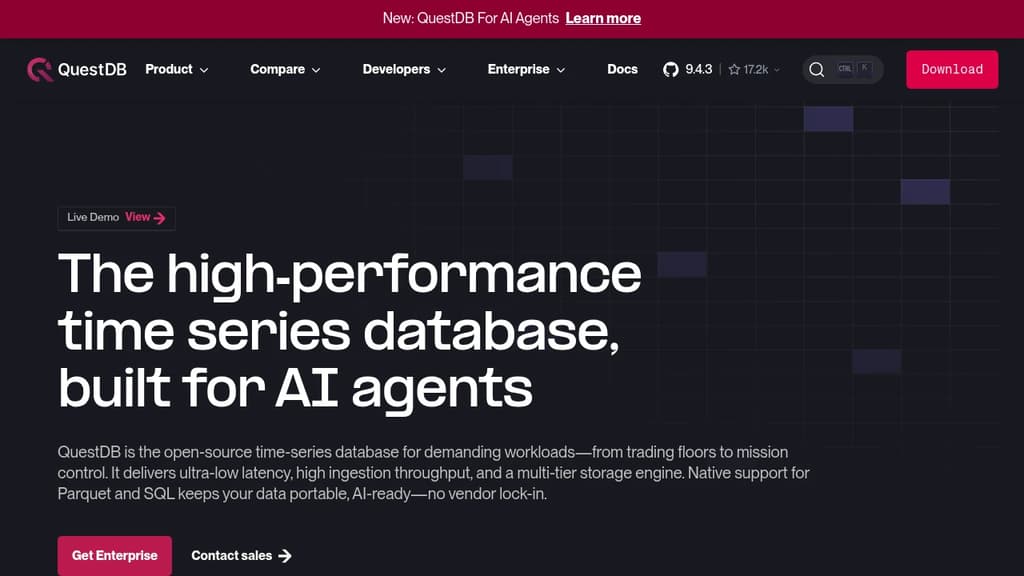
QuestDB delivers exceptional performance for time-series data management with features that set it apart:
- Massive Ingestion Capability: Handles over 4 million rows per second per node, making it ideal for high-frequency data collection
- SQL Compatibility: Offers powerful time-series extensions while maintaining familiar SQL syntax and PostgreSQL wire protocol
- Hardware Efficiency: Performs effectively on both minimal hardware (like Raspberry Pi) and enterprise-grade servers
- Built-in Features: Includes out-of-box support for deduplication, out-of-order indexing, and real-time aggregations
- Integration Ready: Compatible with popular tools like Grafana, Pandas, Python, and various data streaming platforms
Used by major financial institutions and enterprises for real-time analytics, market data processing, and IoT applications.

Apache IoTDB manages industrial IoT time-series data with high-throughput read/write, edge-cloud sync, ultra-high compression, and integrations with Hadoop, Spark, Flink, and Grafana.
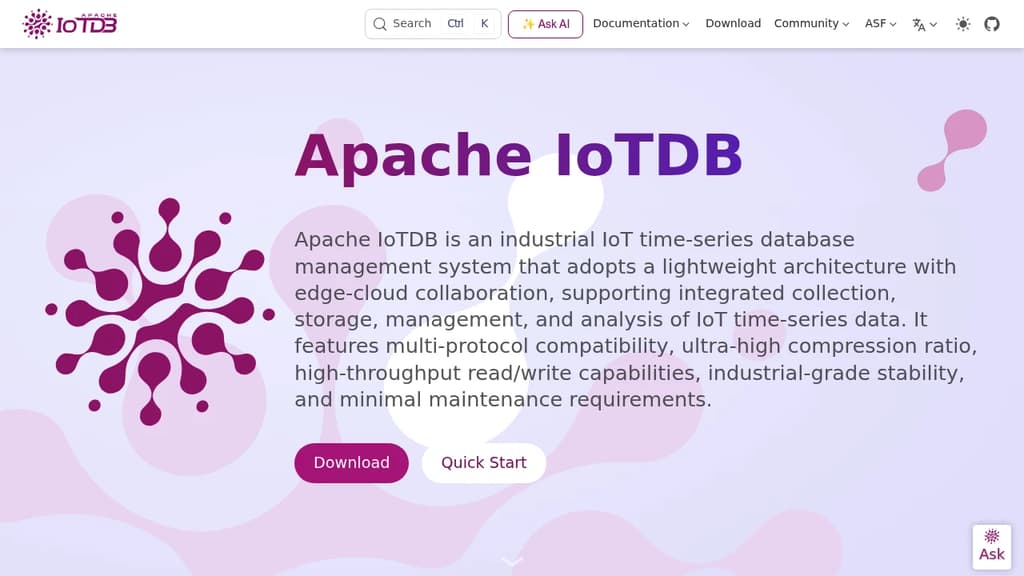
Apache IoTDB is a time-series database management system built specifically for industrial IoT environments. Where general-purpose databases struggle with millions of concurrent device connections and the relentless write pressure of sensor data, IoTDB is designed from the ground up for exactly that. It fits into IoT database deployments ranging from edge nodes to full cloud infrastructure, with a lightweight architecture that keeps hardware costs low.
The core appeal is scale without complexity. IoTDB can ingest data from millions of low-power devices simultaneously, while keeping disk storage costs remarkably low through a high compression ratio (under $0.23 per GB on hard disk). That's a meaningful difference for deployments measuring storage in terabytes.
Key capabilities include:
- High-throughput writes that handle mass device connectivity without batching workarounds
- Fuzzy directory search for navigating complex, deeply nested time-series hierarchies from heterogeneous device fleets
- Rich query semantics including time alignment across devices and sensors, time-dimension aggregation, and field-level computation
- Edge-cloud sync via a built-in Data Synchronization Tool, so data flows reliably between on-premise machines and cloud platforms
- Flexible deployment from one-click cloud install to desktop terminal tools
- Open ecosystem integrations with Hadoop, Spark, Flink, and Grafana out of the box
Compared to alternatives like InfluxDB or QuestDB, IoTDB leans heavily into industrial use cases: energy grids, railways, aerospace telemetry, steel manufacturing, and smart factories. It supports multi-protocol compatibility and targets environments where uptime and data integrity matter more than developer ergonomics.
If your data comes from physical infrastructure rather than application logs or financial ticks, IoTDB is worth evaluating seriously.

People are looking for alternatives to...
View all alternatives
Spotify

Claude Code

CapCut

Claude

Notion

Lovable
 Sent – A unified API for sending messages across SMS, RCS, and apps like WhatsApp.
 CodeRabbit