Open Source Smartsheet Alternatives
A curated collection of the 8 best open source alternatives to Smartsheet.
The best open source alternative to Smartsheet is Baserow. If that doesn't suit you, we've compiled a ranked list of other open source Smartsheet alternatives to help you find a suitable replacement. Other interesting open source alternatives to Smartsheet are: Plane, OpenProject, Leantime, and Redmine.
Smartsheet alternatives are mainly Project Management Suites but may also be Collaborative Workspaces or Agile Project Management Tools. Browse these if you want a narrower list of alternatives or looking for a specific functionality of Smartsheet.

Written by Piotr Kulpinski


Open-source platform for building databases, internal apps, and automated workflows without writing code. Available on cloud or self-hosted.
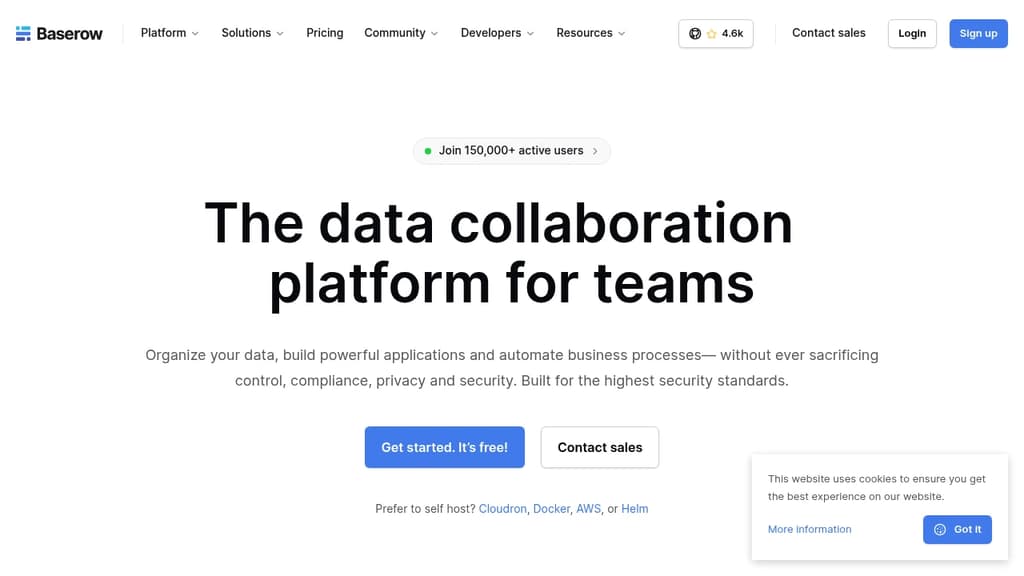
Baserow lets teams organize data, build internal applications, and automate workflows without writing code. It works as a structured database with multiple view types (grid, kanban, calendar, timeline, form, and survey), so different teams can work with the same data in whatever way suits them.
On top of the database layer, you can build full applications using a visual page and dashboard composer. These apps sit directly on your data, so there's no need to export or sync between tools.
Automation is built in. You can create workflows with triggers, branches, conditions, and loops, and connect them to HTTP requests, email, webhooks, or third-party services. An audit log keeps a record of actions for compliance purposes.
Baserow is a popular Airtable alternative. It covers similar ground but adds self-hosting, an MIT open-source license, frontend and backend plugin support, and compliance certifications for GDPR, HIPAA, and SOC 2 Type II. Row limits and API restrictions that frustrate Airtable users at scale are not a factor when self-hosting.
An AI assistant called Kuma can generate database structures from a plain-language description, which speeds up initial setup. AI fields and agent support are also available for adding AI steps inside workflows.
Teams that want NocoDB- or Teable-style open-source flexibility but need a more complete app-building layer will find Baserow covers more ground. It's a practical fit when you need to keep data on your own infrastructure, avoid per-user pricing at scale, or meet stricter data governance requirements.

Open source project management platform combining issues, wikis, and AI agents in one workspace. Available on cloud, self-hosted, and air-gapped deployments.
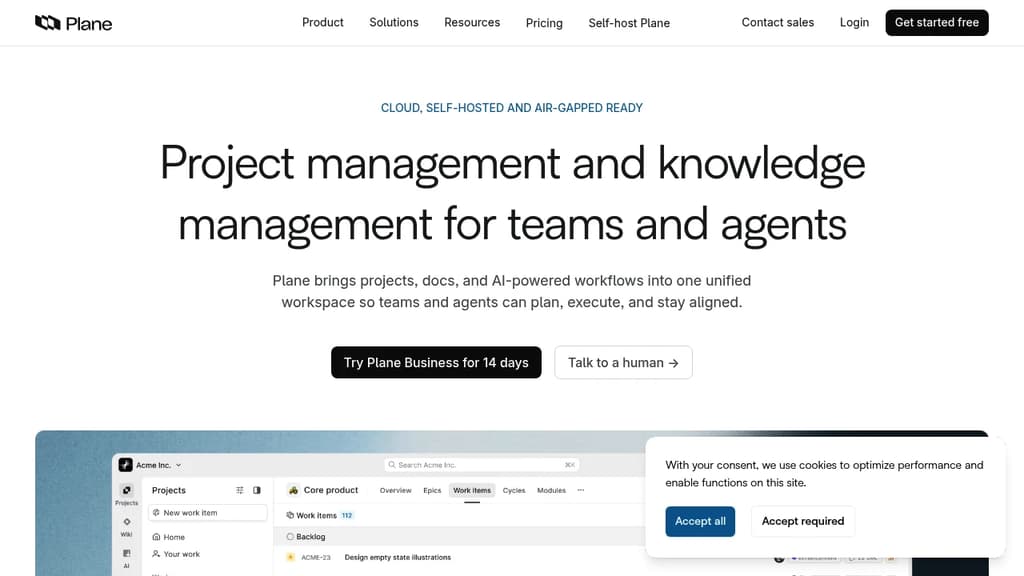
Plane is an open source project management platform that combines issue tracking, documentation, and AI-powered workflows into a single workspace. It's built for software teams that want the flexibility of self-hosting without giving up the polish of tools like Jira or Linear. Projects, wikis, cycles, and dashboards all live in one place, and the AI layer is woven throughout rather than bolted on afterward.
The AI side is genuinely central to how Plane works. Plane AI reads across your entire workspace, including projects, cycles, docs, and threads, so you can ask it about blockers, cycle status, or recent doc changes and get answers grounded in your actual data. Built-in agents can triage incoming requests, assign owners, and post updates automatically. There's also a Slack integration that lets you describe work in a channel and have Plane create, assign, and track it without switching tools.
For teams managing work across different roles, Plane offers board, spreadsheet, list, and Gantt views. Cycles handle time-boxed sprints with burndown charts and velocity tracking built in. Initiatives and epics let you roll team-level work up to org-level goals. Dashboards populate automatically from live data, so there's no manual reporting.
Self-hosting is a first-class option. Plane supports Docker and Kubernetes deployments and includes a God Mode admin panel for configuring SSO, SAML, LDAP, SMTP, and workspace security. Air-gapped environments are explicitly supported, which is rare among modern project management tools. If you're comparing open source alternatives, that air-gap support is a meaningful differentiator.
For teams migrating from Jira, ClickUp, Asana, or Monday, Plane offers full data migration including issues, attachments, comments, and automations. The open API, webhooks, OAuth apps, and a native MCP server make it extensible for teams that want to build custom integrations or AI agents on top of the platform. Projects-as-Code via YAML definitions lets engineering-oriented teams version and deploy project configuration from Git.

Full-featured project management platform with Gantt charts, agile boards, time tracking, and team collaboration. Self-host or use managed cloud hosting.
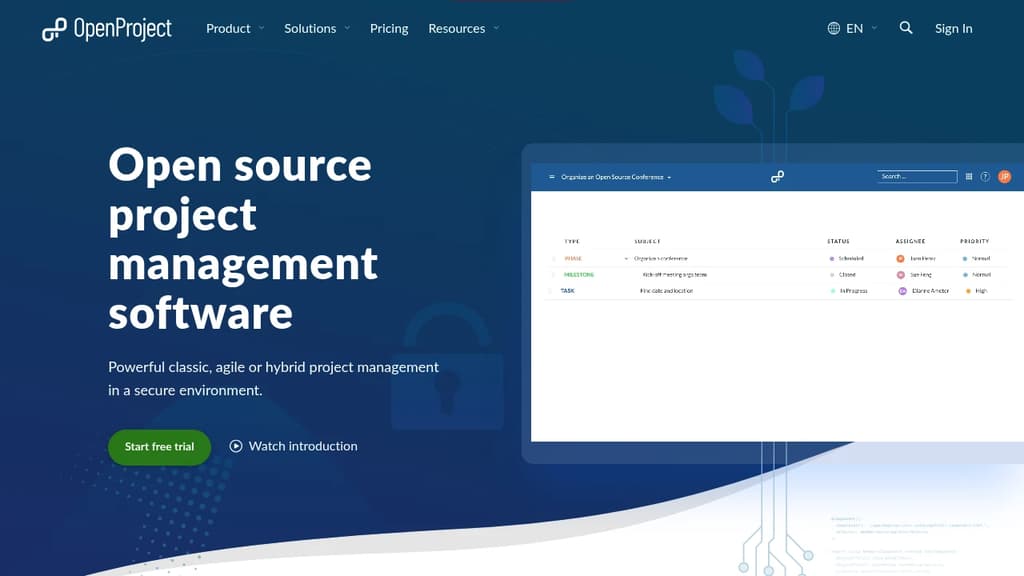
OpenProject is a project management suite built for teams that want full control over their data. It supports classic, agile, and hybrid approaches in a single platform, so you're not forced into one methodology. Organizations with strict data requirements, including government agencies, universities, and NGOs, make up a large share of its user base.
The core feature set covers a lot of ground:
- Gantt charts for visual project planning and scheduling, with dependencies and milestones
- Agile boards supporting Scrum and Kanban workflows, with backlog management and sprint planning
- Team Planner for assigning tasks across a weekly or bi-weekly calendar view
- Time and cost tracking with reporting built in
- Work packages as the central unit for tasks, bugs, features, and more, each with custom fields, watchers, and history
- Meeting management and wiki-style documentation inside each project
Data sovereignty is a genuine differentiator here. You can install it on your own infrastructure and keep everything behind your firewall. The Enterprise on-premises edition adds security features like two-factor authentication, LDAP group sync, and custom branding. For teams that don't want to manage servers, an EU-hosted cloud option is available.
OpenProject is licensed under GNU GPL v3, and development happens publicly. The free Community edition is fully functional and has no time limit. It's a credible Jira alternative for teams leaving Atlassian's self-hosted products, with a migration tool specifically for that transition.
Compared to lighter tools like Kaneo or Operately, OpenProject is heavier and more structured. That's the point. It's built for organizations running multiple concurrent projects that need audit trails, role-based permissions, and reporting across portfolios.

Open-source software designed to streamline tasks, boost productivity, and enhance collaboration for teams of all types, including those with ADHD and neurodiversity.
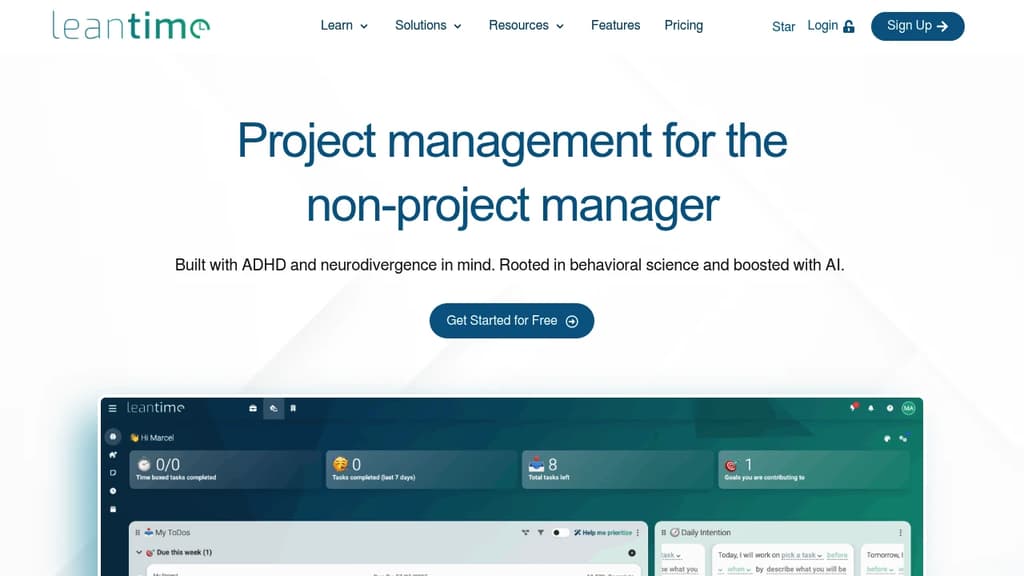
Leantime is an innovative, open-source project management tool that caters to diverse thinking styles, including those with ADHD, ADD, and other neurodivergent conditions. Its goal-driven approach transforms traditional task management into a more engaging and productive experience.
Key features include:
- Strategy-focused workflow: Start with defining goals and objectives before diving into tasks
- Flexible visualization: Multiple views (Kanban, list, timeline) to suit different cognitive styles
- AI-powered assistance: Helps break down large tasks and generates personalized project descriptions
- Time management tools: Built-in Pomodoro timer and time tracking capabilities
- Personal organization: My Work dashboard, time blocking, and note-taking features
Leantime stands out by:
- Prioritizing user experience for neurodivergent individuals
- Offering a comprehensive suite of tools from strategic planning to task execution
- Providing both team collaboration features and personal productivity tools
- Being open-source, allowing for customization and community-driven improvements
Whether you're managing complex projects or organizing personal tasks, Leantime offers a uniquely adaptable platform that turns project management into a more accessible and motivating experience for all types of thinkers.

Self-hosted project management web app built on Ruby on Rails with issue tracking, time logging, SCM integration, and multi-project support across any database.
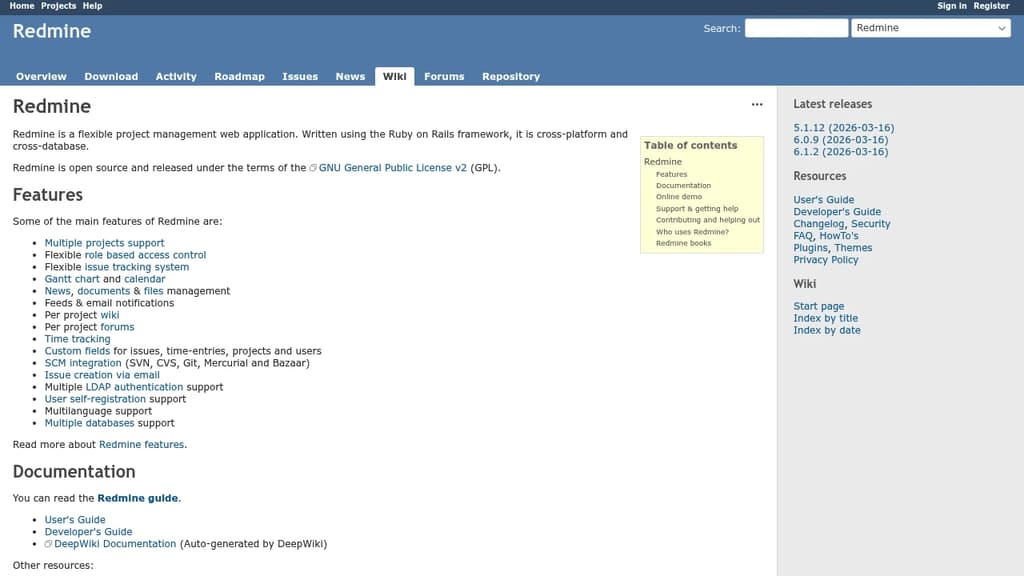
Redmine is a self-hosted project management web application built on Ruby on Rails. It's designed for teams that need full control over their data and want a system flexible enough to fit different workflows, not just one opinionated way of working. It runs on multiple databases and operating systems, so it fits into most existing infrastructure.
At its core, Redmine handles everything a software or operations team needs to track work:
- Issue tracking with flexible role-based access control per project
- Time tracking so teams can log effort against specific tasks
- SCM integration supporting Subversion, Git, Mercurial, Bazaar, and CVS
- Gantt charts and calendars for visualizing schedules
- Wiki and document management built into each project
- Email notifications and feeds to keep everyone updated without manual check-ins
- Custom fields for issues, time entries, projects, and users
- Multiple language support, making it usable across international teams
Each project gets its own wiki, issue categories, and member roles, so large organizations can run many independent teams from a single Redmine instance without them stepping on each other.
Redmine has been around long enough to have a substantial plugin ecosystem, which lets teams extend it well beyond the defaults. If you're comparing it to something like OpenProject, Redmine trades a polished modern UI for a highly configurable, community-driven foundation that's been battle-tested across thousands of deployments.
It's a practical fit for development teams, IT operations, and project managers who want a proven, self-hosted alternative to hosted project management tools without paying per seat or giving up control of their data.

Worklenz is a comprehensive project management platform that helps agencies organize tasks, track resources, and boost productivity.
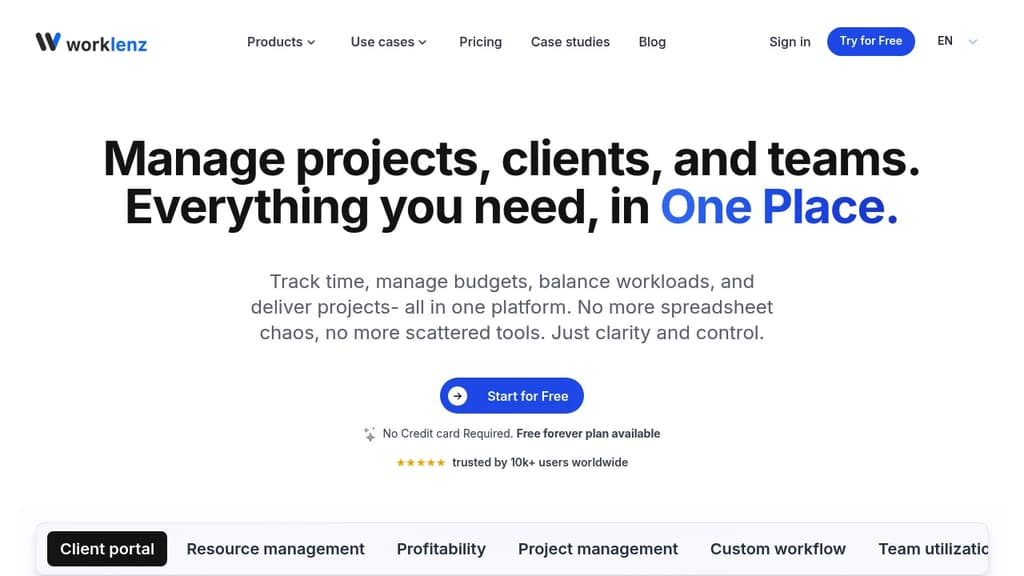
Worklenz is an open-source agency management tool designed to streamline your workflow and boost productivity. With its user-friendly interface and powerful features, Worklenz offers a comprehensive solution for project management, resource allocation, and team collaboration.
Key benefits include:
- All-in-one solution: Manage projects, tasks, time tracking, and team resources in a single platform.
- Resource overview: Gain insights into team member workloads, task progress, and project health at a glance.
- Project visualization: Utilize Kanban boards and project overviews to track progress and milestones effectively.
- Time tracking: Monitor time spent on tasks and projects to improve efficiency and billing accuracy.
- Collaboration tools: Foster teamwork with file sharing, comments, and real-time updates.
- Customizable workflows: Adapt the platform to fit your agency's unique processes and requirements.
Worklenz empowers agencies to deliver projects on time and within budget while maintaining clear communication with clients and team members. Its open-source nature allows for community-driven improvements and customizations, making it a flexible and evolving tool for agencies of all sizes.

Self-hostable agile project management tool with Kanban and Scrum boards, sprint planning, issue tracking, and reporting for teams of any size.
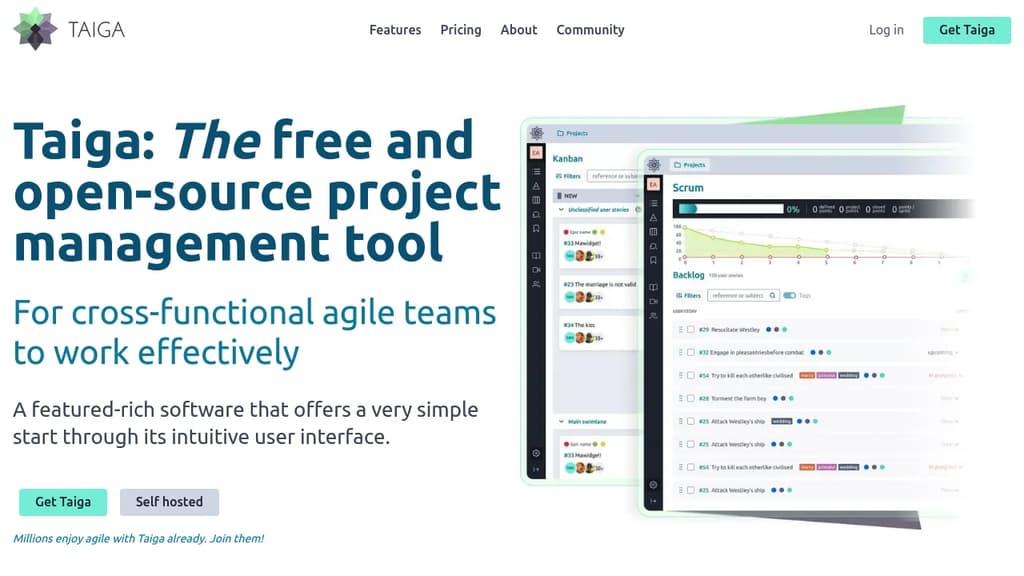
Taiga is an open-source agile project management platform built for cross-functional teams that want structure without complexity. It supports both Kanban and Scrum workflows, and you can switch between them on the same project without losing your work. Teams that don't need training to get started will feel at home immediately.
The Kanban board covers the basics well: WIP limits, swim lanes, custom workflows, EPICS, sub-tasks, and archive functions. Scrum support goes deeper, with full backlog and sprint planning, per-role estimation, a built-in estimation tool called Taiga Seed, burn-down charts at both the project and sprint level, and a sprint task board with swim lanes per user story.
Beyond boards, Taiga includes:
- Issue tracking with customizable types, priorities, and severities, plus the ability to promote an issue directly to a user story
- Dashboards and reporting including a team health function, full project timeline for auditability, and custom real-time CSV reports
- Wiki built into the project for shared documentation
- Custom roles and permissions so you can control what each team member sees and does
- Integrations via Zapier and a project import/export function for migration
For teams comparing it to Jira or Trello, Taiga sits in a middle ground: more capable than a simple board tool, but far less configuration-heavy than enterprise alternatives like OpenProject.
Self-hosting gives full control over your data, and the codebase is translated into more than 20 languages. The cloud-hosted version is available for teams that prefer not to manage infrastructure. Both paths use the same feature set.

Busabase gives AI agents a shared database, knowledge base, and skills registry where every proposed change goes through human review before becoming canonical data.
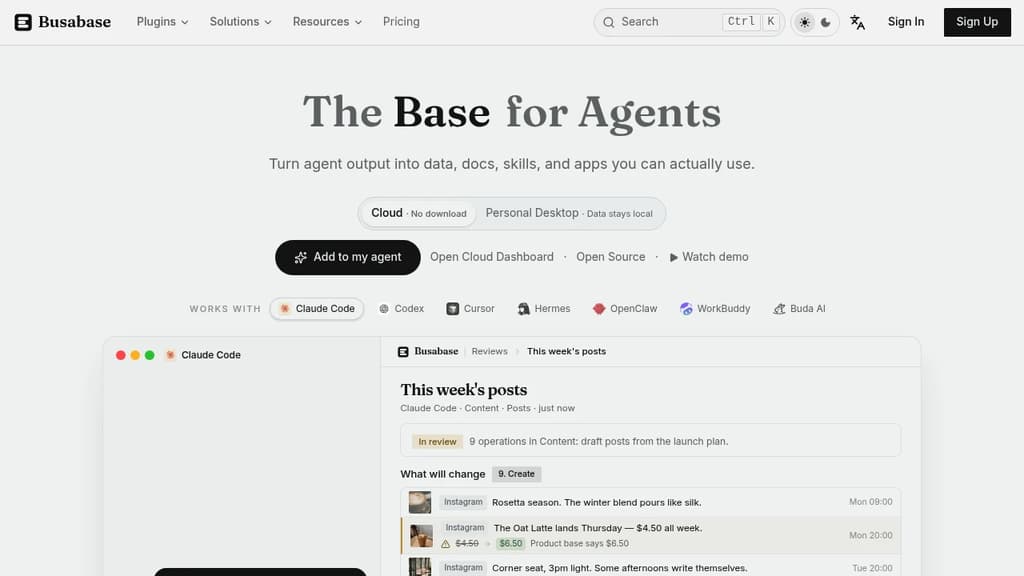
Busabase is a workspace built specifically for AI agents to write into. Instead of agent output disappearing into chat logs or scratch files, it lands in typed databases, documents, and skills that persist across sessions. The core idea: agents propose changes, humans verify them, and only approved records become canonical data that other agents and apps can trust.
The review loop is the product's backbone. Every agent submission arrives as a structured change request with a field-level diff, a source context, and a full message history. Reviewers can approve, request revisions, or reject, and every decision stays attached to the record. Nothing enters your database until a human signs off.
Key capabilities:
- Change request review: inspect field-by-field diffs before any agent write touches your data
- Fact verification: check source context and downstream impact to catch hallucinations before they become business facts
- Audit trail: every submit, approval, and merge is logged with who, when, and why
- Canonical records: approved work becomes the source of truth with full commit history and relationship context
- Graph view: see how customers, content, assets, and business objects connect
- AirApps and dashboards: the same verified data renders directly into usable views without a separate build step
- Agent-first API: any agent that can call a REST API, including Claude Code, n8n, Zapier, or LangChain, can submit structured changes through OpenAPI, MCP, or Agent Skills
Busabase runs locally on PGlite, so your data never leaves your machine on the desktop version. Cloud adds collaboration, hosted APIs, and permission governance across teams. The open-source core is free to self-host; paid tiers add seats, storage, and API access.
It fits teams managing CRM enrichment, content pipelines, training datasets, finance records, or any workflow where AI proposes and humans need to verify before the output becomes institutional truth. The problem it solves is concrete: agent work that used to evaporate into sessions now accumulates into a database every subsequent agent can read and build on.

People are looking for alternatives to...
View all alternatives
Spotify

Claude Code

Claude

CapCut

Notion

Lovable
 Bright Data – Web data for AI agents and apps. Built-in unblocking, proxies, and ready-made APIs.

 Sent
Sent