Open Source Signal Alternatives
A curated collection of the 2 best open source alternatives to Signal.
The best open source alternative to Signal is Cinny. If that doesn't suit you, we've compiled a ranked list of other open source Signal alternatives to help you find a suitable replacement. Other interesting open source alternative to Signal is Stoat.
Signal alternatives are mainly Team Chat & Messaging Tools but may also be Encrypted Communication Tools or Decentralized Social Networks. Browse these if you want a narrower list of alternatives or looking for a specific functionality of Signal.

Written by Piotr Kulpinski


Cinny offers a simple, elegant, and secure interface for Matrix-based conversations, protected by end-to-end encryption.
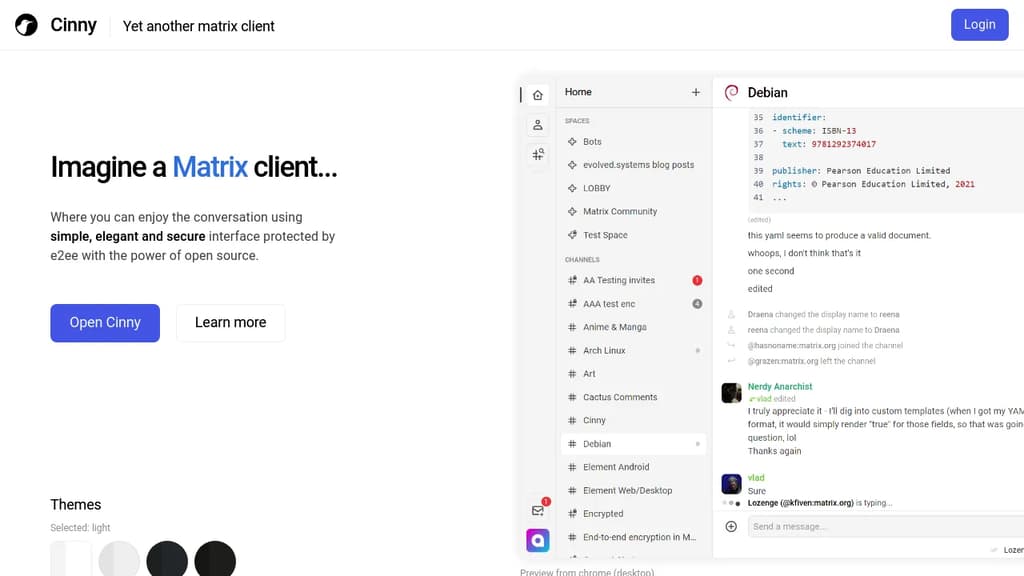
Cinny is an open-source Matrix client that provides a secure and elegant interface for seamless conversations. Built on the Matrix protocol, it offers:
- End-to-end encryption for enhanced privacy and security
- A clean and intuitive user interface for effortless navigation
- Organized conversations, separating DMs from channels
- Adaptive input that adjusts to your actions without disrupting your workflow
- Calm visual design with proper alignment and formatting
Cinny is constantly evolving to create a better communication experience. As an open-source project, it benefits from community contributions and transparency.
Key features:
- Simple and elegant interface
- End-to-end encryption
- Organized conversation management
- Adaptive input system
- Calm visual design
- Open-source development
Whether you're looking for a secure messaging solution for personal use or team collaboration, Cinny offers a refreshing alternative to traditional chat applications. Experience the power of open-source, decentralized communication with Cinny's user-friendly approach to Matrix.

Self-hostable group chat with servers, channels, voice, and moderation tools. No ads, no data mining, built under EU privacy law.
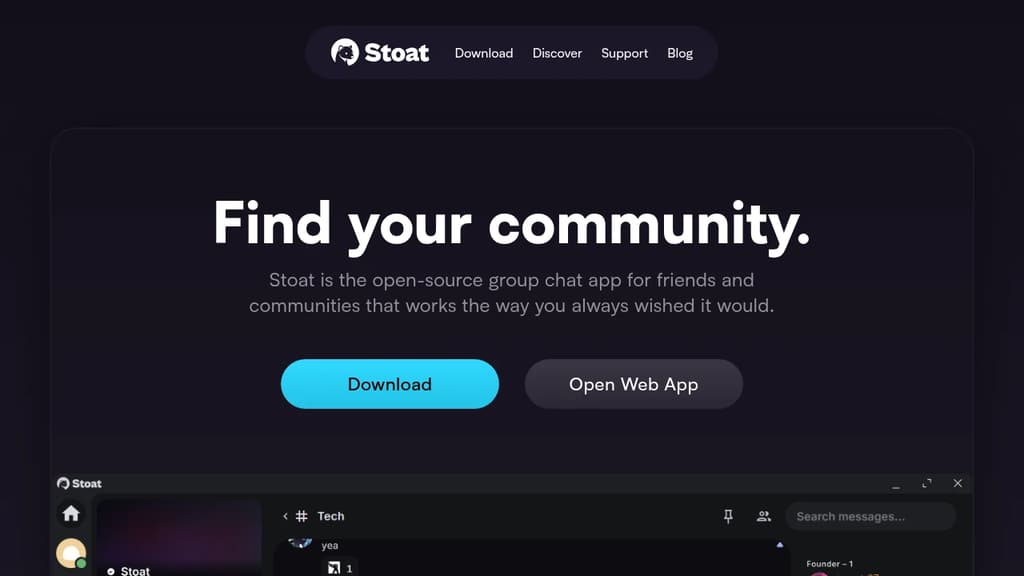
Stoat (formerly Revolt) is a group chat app built for friends and communities who want the features of mainstream platforms without the surveillance business model behind them. It's a direct Discord alternative that covers the basics well: servers, channels, voice chat, file sharing, and markdown support, all without ads or data collection.
Built in Europe under EU data protection law, the codebase is public and the privacy policy is short enough to actually read. There's no investor pressure shaping product decisions, which means features exist because users want them, not because they serve an ad-targeting pipeline.
A few things stand out from the typical chat app:
- Custom emojis and animated avatars are free, with no subscription tier required
- Group DMs support up to 50 members and work with bots, making them useful for project collaboration or ad-hoc voice groups
- Role-based permissions and moderation tools handle communities of any size, from a handful of friends to thousands of members
- Theming ships with built-in options, community themes via a Discover section, and custom CSS for those who want full control
- Cross-platform sync covers Windows, macOS, Linux, Android, iOS, and the web
- Self-hosting is supported if you want full control over your own instance
- A public API powers the official apps themselves, so third-party bots and custom clients are first-class citizens
Compared to tools like Rocket.Chat or Twake Chat, Stoat leans toward the consumer end: it's designed to feel familiar to anyone coming from mainstream chat apps, with a lighter footprint and fewer enterprise-focused features. The 20MB file upload limit and server-specific profile pictures are available without paying, which removes friction that similar platforms put behind paywalls.
The issue tracker is public and the team runs a community server, so feedback has a direct path to the people building it.

People are looking for alternatives to...
View all alternatives
Claude Code

Spotify

CapCut

Claude

Notion

Lovable
 Docmost – Open-source wiki software with real-time collaboration, diagrams, AI, SSO, RBAC permissions and more.
 Sent
Sent