Open Source ProjectDiscovery Alternatives
A curated collection of the 10 best open source alternatives to ProjectDiscovery.
The best open source alternative to ProjectDiscovery is Grafana. If that doesn't suit you, we've compiled a ranked list of other open source ProjectDiscovery alternatives to help you find a suitable replacement. Other interesting open source alternatives to ProjectDiscovery are: NetData, Prometheus, SigNoz, and Coroot.
ProjectDiscovery alternatives are mainly Infrastructure Monitoring Tools but may also be Performance Monitoring (APM) Tools or Log Management Tools. Browse these if you want a narrower list of alternatives or looking for a specific functionality of ProjectDiscovery.

Written by Piotr Kulpinski


Grafana unifies metrics, logs, traces, profiles, and business data into one OpenTelemetry-native platform with AI-assisted root cause analysis and adaptive cost controls.
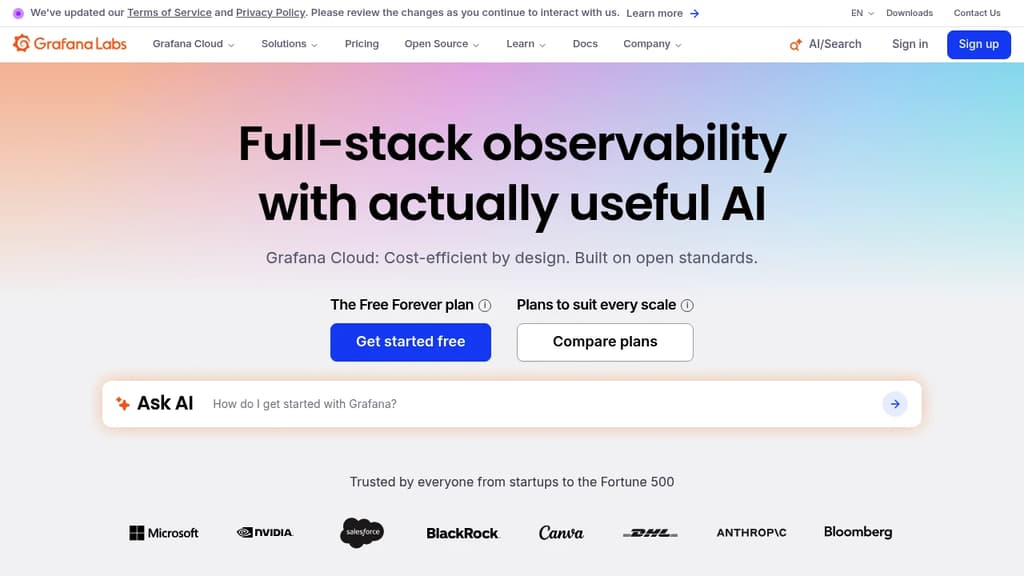
Grafana is a self-hosted observability platform built on open standards like OpenTelemetry and Prometheus. It brings together metrics, logs, traces, profiles, and business data into a single view, so engineering and SRE teams can troubleshoot across their entire stack without jumping between tools.
It's built for teams that want the flexibility of open source without the overhead of managing infrastructure themselves. Hundreds of plugins and integrations let you connect existing data sources rather than replacing them.
Key capabilities include:
- Adaptive Telemetry automatically identifies high-value data and aggregates the rest, cutting telemetry costs by up to 80% without manual filtering rules
- AI-assisted analysis helps interpret production telemetry and accelerate root cause analysis, plus tooling to evaluate and monitor production AI agents
- Unified signal map correlates metrics, logs, and traces so teams can move from alert to fix without context-switching
- Incident response and synthetic monitoring built in, covering the full reliability workflow rather than just data collection
- Compliance certifications including FedRAMP, PCI DSS, SOC Type II, and GDPR, making it viable for regulated industries
Compared to alternatives like Dynatrace or Coralogix, Grafana's differentiator is its open-source foundation. The core Grafana stack is community-driven, and the cloud product extends it with managed infrastructure, enterprise features, and cost controls. You're not locked into proprietary agents or data formats.
For teams already using OpenObserve or Uptrace and considering a managed path, Grafana Cloud offers a broader feature surface with the same commitment to open standards. A free tier is available with no time limit, and paid plans scale with usage.

Powerful, efficient, and user-friendly monitoring solution for servers, containers, and applications with instant insights and alerts.
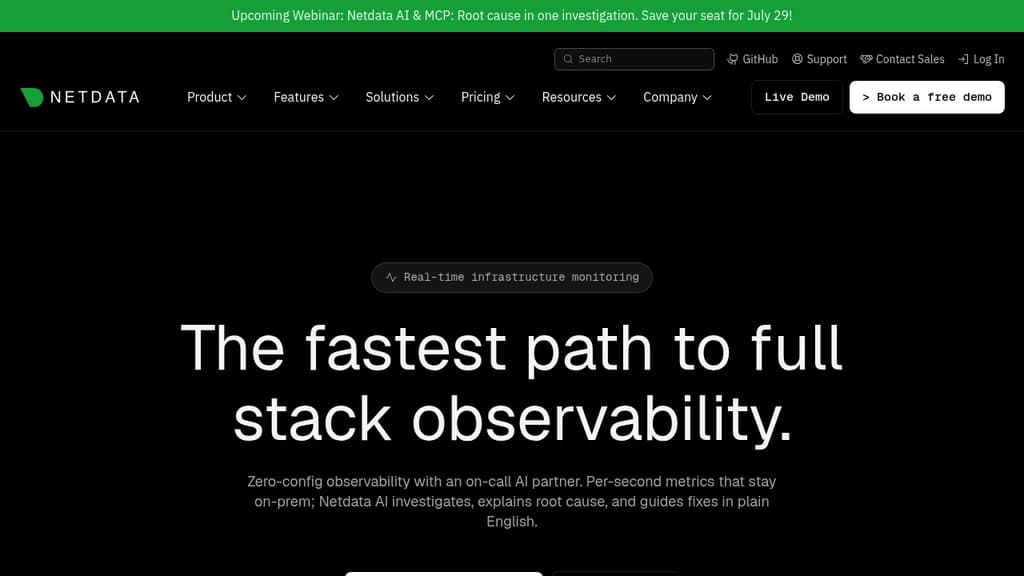
NetData is a cutting-edge, open-source monitoring and troubleshooting tool designed for modern infrastructure and applications. It offers real-time, high-resolution metrics collection and visualization, enabling users to gain instant insights into their systems' performance.
Key benefits of NetData include:
- Lightning-fast performance: Collects thousands of metrics per second with minimal resource usage.
- Zero configuration: Auto-detects and monitors services out of the box, reducing setup time.
- Stunning visualizations: Provides interactive, customizable dashboards for easy data interpretation.
- Scalability: Efficiently monitors everything from single servers to large-scale distributed systems.
- Alerting: Offers intelligent, customizable alerts to detect and respond to issues promptly.
- Extensibility: Supports plugins and integrations with popular monitoring stacks.
NetData empowers DevOps teams, system administrators, and developers to identify and resolve performance bottlenecks quickly. Its user-friendly interface and powerful analytics capabilities make it an essential tool for maintaining optimal system health and performance in today's fast-paced, data-driven environments.

Pull-based monitoring system with a multi-dimensional data model, PromQL query language, built-in alerting, and a time series database built for cloud native environments.
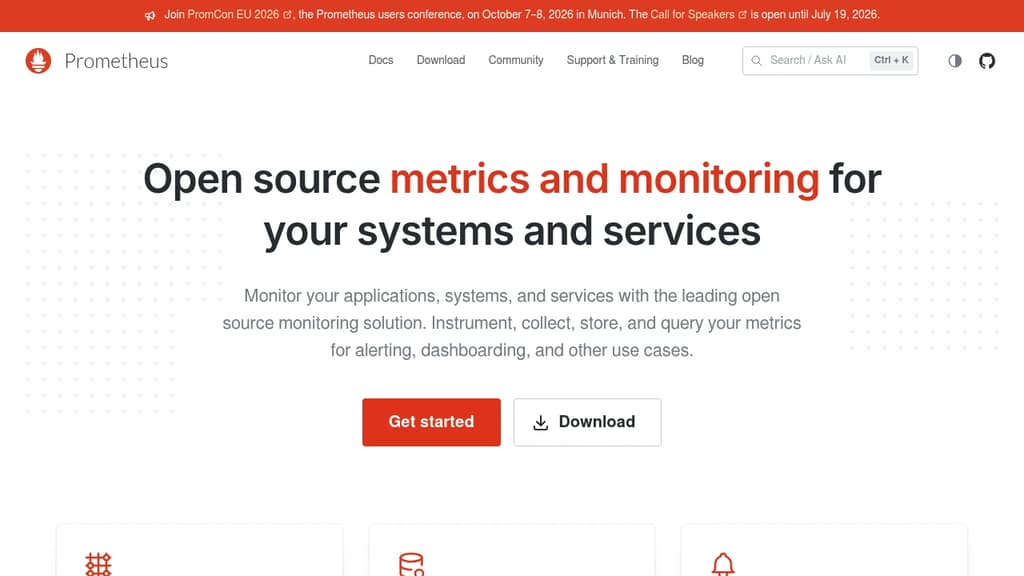
Prometheus is the de facto standard for open source infrastructure monitoring. It collects metrics from your applications, systems, and services, stores them as time series data, and lets you query, visualize, and alert on that data. Originally inspired by Google's internal Borgmon system, it's now a graduated CNCF project (the second after Kubernetes) with a large community behind it.
The core model is pull-based: Prometheus scrapes metrics from instrumented targets at configurable intervals. This makes it straightforward to see exactly what's being collected and when. Targets can be defined statically or discovered automatically, which is where its Kubernetes integration shines. It continuously discovers pods, services, and nodes as they come and go, so you don't have to manually update your monitoring config every time your infrastructure changes.
Key capabilities:
- PromQL: a flexible query language for slicing and aggregating time series data across any combination of labels
- Multi-dimensional data model: every metric carries key-value label pairs, letting you filter and group by environment, region, service, or any dimension you define
- Built-in alerting: Alertmanager handles deduplication, grouping, silencing, and routing alerts to your notification channels
- Service discovery: native integrations with Kubernetes, Consul, EC2, and other platforms
- Local storage: an efficient on-disk time series database, purpose-built for high-ingestion workloads
For dashboards, Prometheus pairs naturally with Grafana, which can query it directly. Tools like Uptrace and OpenObserve also support Prometheus as a data source, extending what you can do with the metrics you're already collecting.
Prometheus is self-hosted, which means your metrics stay on your infrastructure. The entire project is Apache-licensed and community-governed under the CNCF.

Comprehensive monitoring and troubleshooting solution for microservices architectures, offering metrics, traces, and logs in a single pane.
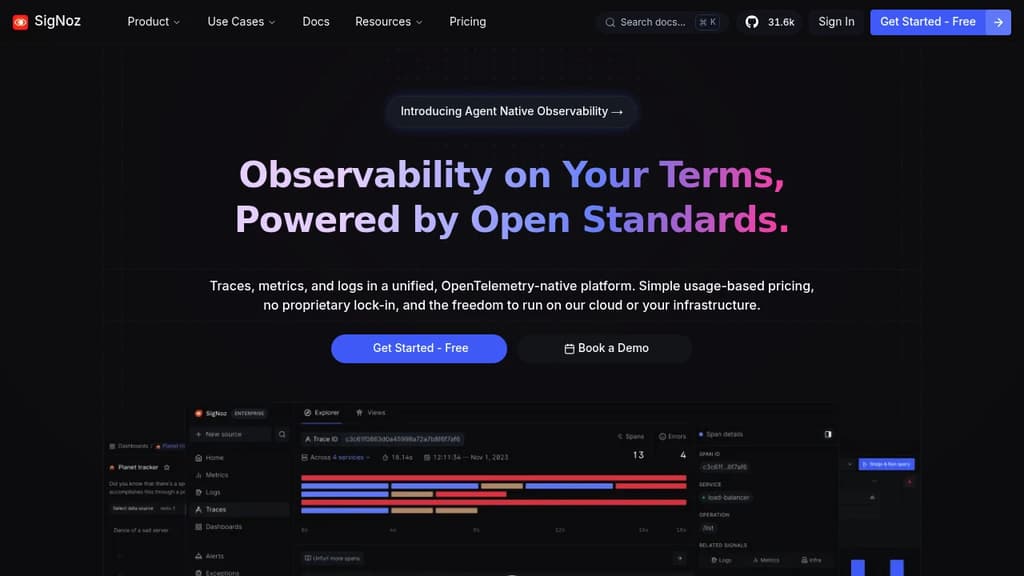
SigNoz is a powerful, open-source observability platform designed for modern, cloud-native applications. It provides a unified solution for monitoring, troubleshooting, and optimizing your microservices architecture.
Key benefits of SigNoz include:
-
All-in-One Observability: Combine metrics, traces, and logs in a single platform, eliminating the need for multiple tools and reducing context-switching.
-
Cost-Effective: As an open-source solution, SigNoz offers significant cost savings compared to proprietary alternatives, especially for high-volume data ingestion.
-
Easy Setup: Get started quickly with a simple installation process and intuitive UI, making it accessible for teams of all sizes.
-
Customizable Dashboards: Create tailored views of your system's performance with flexible, drag-and-drop dashboard builders.
-
Distributed Tracing: Gain deep insights into request flows across your microservices, helping you identify bottlenecks and optimize performance.
-
Anomaly Detection: Leverage built-in anomaly detection capabilities to proactively identify issues before they impact your users.
-
Scalability: Designed to handle high-volume data ingestion, SigNoz scales effortlessly with your growing infrastructure.
-
Open Standards: Built on OpenTelemetry, ensuring compatibility with a wide range of technologies and future-proofing your observability stack.
By choosing SigNoz, you're not just adopting a monitoring tool; you're embracing a comprehensive observability solution that grows with your needs and empowers your team to maintain high-performing, reliable applications.
Coroot simplifies system monitoring by providing metrics, logs, traces, and profiling with zero instrumentation, leveraging eBPF technology.
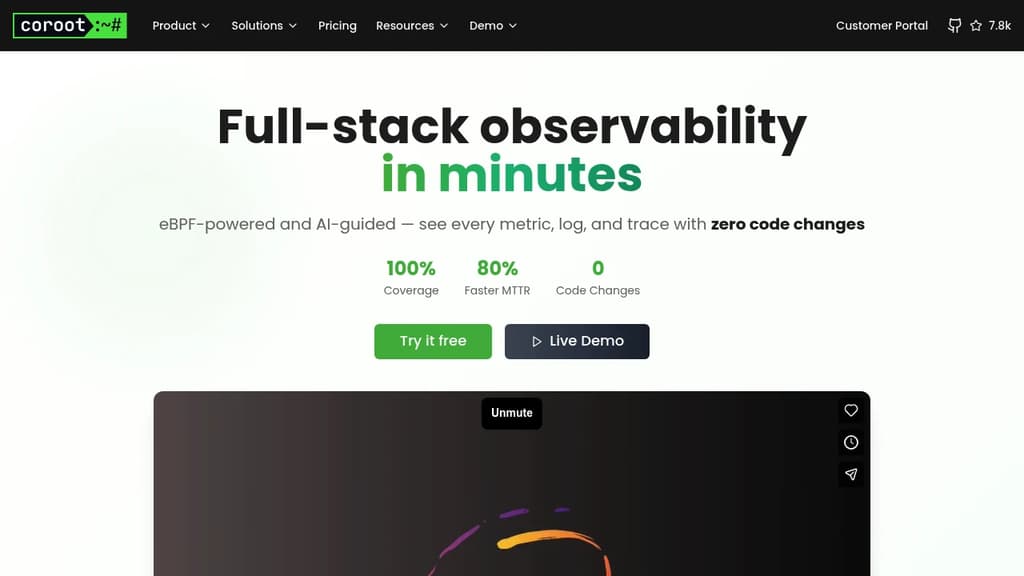
Coroot is an innovative open-source observability platform that revolutionizes how developers and operations teams monitor and troubleshoot their systems. Here's what makes Coroot stand out:
-
Zero-instrumentation observability:
- Utilizes eBPF technology to automatically gather metrics, logs, traces, and profiles without any code changes
- Provides a comprehensive Service Map covering 100% of your system with no blind spots
- Offers predefined inspections to audit each application without configuration
-
Comprehensive monitoring features:
- Application Health Summary for easy status overview of multiple services
- Distributed tracing to explore outlier requests with a single click
- Log pattern analysis with out-of-the-box event clustering
- Continuous profiling to analyze CPU and memory usage down to specific code lines
- AI-powered root cause analysis for quick anomaly explanations
-
User-friendly interface:
- Intuitive dashboards for visualizing system performance
- One-click investigation of anomalies
- Easy comparison of system behavior against baselines
-
Built-in expertise:
- Automatically identifies over 80% of issues
- Sends concise alerts with relevant inspection results when SLOs are not met
- Customizable inspections for specific applications or entire projects
-
Deployment and cost monitoring:
- Tracks every application rollout in Kubernetes clusters
- Compares each release with the previous one to detect performance degradations
- Provides cloud cost insights down to individual applications
-
Open-source and cloud options:
- Available as a free, open-source Community Edition
- Coroot Cloud offering for those who prefer a managed solution
Coroot simplifies the complex task of system observability, making it accessible to teams of all sizes. By leveraging cutting-edge technologies and providing a user-friendly interface, Coroot enables faster debugging, better development practices, and improved system reliability.

Tracecat is a scalable, self-hostable platform for automating security workflows and playbooks without limits.
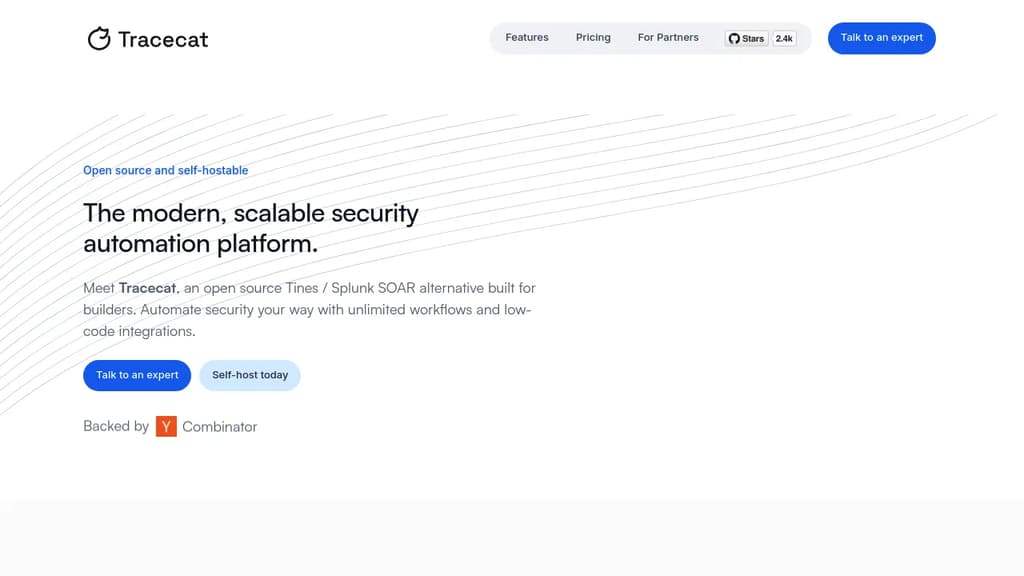
Tracecat is an open source alternative to proprietary security orchestration, automation and response (SOAR) platforms like Tines and Splunk SOAR. It empowers security engineers to automate their workflows and playbooks without restrictions.
Key features:
- Unlimited workflows: Build, reuse and scale security playbooks without limits using the visual drag-and-drop builder or YAML configuration.
- Low-code integrations: Use pre-built integrations or easily create custom ones to connect your security tools.
- Self-hostable: Deploy Tracecat in your own environment using Docker, Kubernetes or AWS Fargate for maximum control and data privacy.
- Open source: Fully open source and built on Temporal, the same durable execution engine used by major tech companies.
- Enterprise-ready: Offers mission-critical alerting and 99.99% uptime SLAs for organizations that need guaranteed reliability.
Tracecat allows security teams to automate alert triage, threat enrichment, incident response and more. The platform scales to handle high volumes of workflows in parallel across isolated tenants. With both no-code and code-based options, it provides flexibility for teams of all technical levels.
By offering an open source alternative to proprietary SOAR tools, Tracecat aims to make powerful security automation accessible to more organizations. The self-hosted deployment model ensures sensitive security data and workflows remain under your control.

Uptrace is an OpenTelemetry-based platform that integrates traces, metrics, and logs to help monitor and optimize complex distributed systems.
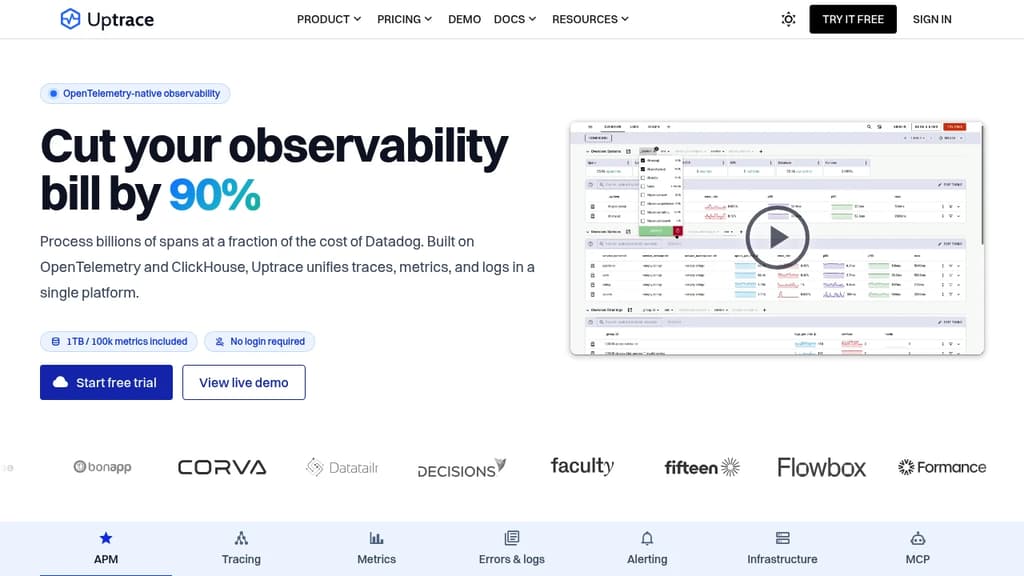
Uptrace is an open-source observability platform built on OpenTelemetry, designed to help developers and operations teams monitor, understand, and optimize complex distributed systems. It offers a comprehensive solution for application performance monitoring (APM) with integrated tracing, metrics, and logging capabilities.
Key features and benefits:
-
All-in-one solution:
- Integrates traces, metrics, and logs in a single platform
- Eliminates the need for multiple monitoring tools
- Supports data from OpenTelemetry, Prometheus, Vector, FluentBit, and CloudWatch
-
Flexible deployment options:
- Self-hosted: Free to use without limitations
- Managed cloud service: For those who prefer a hands-off approach
- On-premise installation available upon request
-
Cost-effective and predictable pricing:
- Pay only for ingested gigabytes and active timeseries
- Set a budget to avoid unexpected costs
- First month free with 1TB storage and 50,000 timeseries (no credit card required)
-
OpenTelemetry integration:
- Quick setup with minimal code changes
- Supports multiple programming languages (Go, Python, Ruby, Node.js, .NET, Java, Erlang, Elixir, Rust, PHP)
- Vendor-agnostic instrumentation for easy switching between providers
-
Comprehensive monitoring dashboard:
- Service graph showing relationships between components
- RED metrics (Rate, Errors, Duration)
- Latency percentiles (p50/p90/p99/max)
- Most frequent logs and errors
- Slowest requests identification
-
Scalability:
- Designed to work at any scale, from small applications to large distributed systems
-
Incident response:
- Helps teams identify and resolve issues quickly, often before customers notice
By offering a unified platform for observability, Uptrace simplifies the monitoring process and provides valuable insights into application performance, helping teams optimize their systems and respond to incidents more effectively.
Monitor your entire IT infrastructure with 2,000+ plugins, automated discovery, and scalable architecture. Open source and enterprise solutions available.
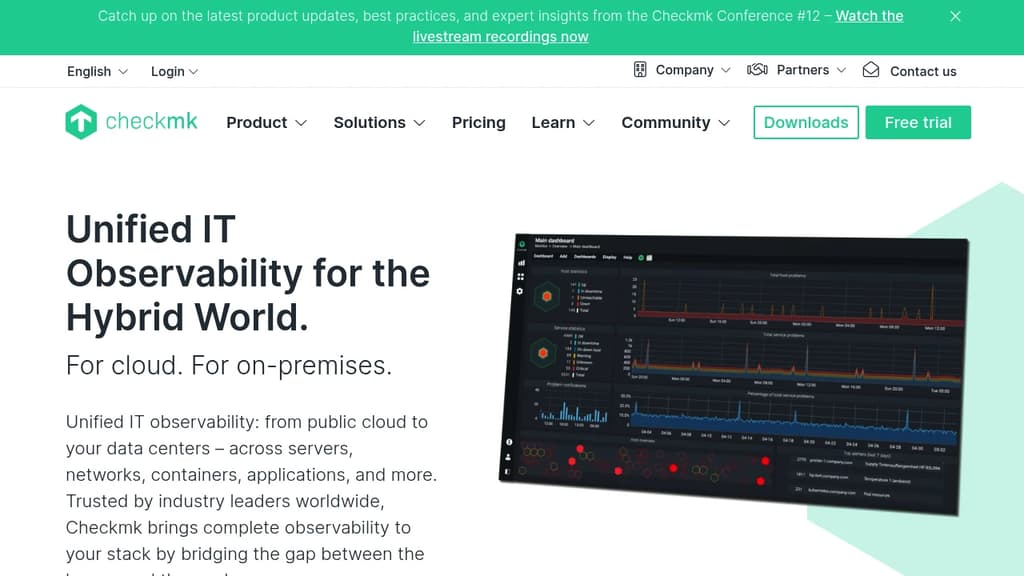
Comprehensive IT monitoring that scales from small teams to enterprise environments with millions of services. Checkmk automatically discovers and monitors your entire infrastructure - from cloud providers to data centers, servers, networks, containers, and applications.
Key advantages include:
- 2,000+ vendor-maintained plugins for out-of-the-box monitoring of virtually any system
- Automated discovery and configuration via REST API reduces manual setup time
- High-performance core designed to handle massive scale while maintaining a small footprint
- Granular alerting system that notifies only relevant teams and integrates with ServiceNow, Jira, Slack, and more
Multiple deployment options cater to different needs:
- Raw Edition: Free open-source version for mid-sized infrastructures
- Enterprise Edition: Advanced automation and visualization features
- Cloud Edition: SaaS solution optimized for hybrid cloud environments
- MSP Edition: Multi-tenant capabilities for service providers
Advanced features include dynamic dashboards, business intelligence mapping, custom self-healing actions, and comprehensive SLA reporting. The platform combines infrastructure monitoring with log analysis, synthetic testing capabilities, and historical performance forecasting to provide complete visibility into your IT operations.

Monitor networks, servers, and cloud environments with flexible open-source solution. Custom checks, fast alerts, and complete infrastructure control.
Complete visibility across your entire IT landscape with this comprehensive open-source monitoring platform. Whether managing on-premises servers, cloud environments, or hybrid infrastructures, you get the flexibility and control needed for complex enterprise monitoring.
Key capabilities include:
- Real-time monitoring of servers, networks, applications, and services
- Custom check configurations tailored to your specific requirements
- Fast alerting system to detect and respond to issues before they escalate
- Scalable architecture that grows with your infrastructure needs
- Multi-tenancy support for enterprise environments
- High availability configurations for mission-critical monitoring
Comprehensive monitoring solutions cover Kubernetes clusters, database performance, Windows and VMware environments, plus business-critical applications. The platform bridges monitoring with IT service workflows and security operations for unified visibility.
Enterprise-ready features include automation capabilities, API-driven processes, extensive integrations with existing DevOps tools, and professional support options. Built on open-source principles while delivering enterprise-grade stability, security, and customization options that adapt to your operational needs.

Unified platform for logs, metrics, traces and profiles with native compatibility for popular tools like OpenTelemetry, Prometheus, and Loki. No data silos, no usage limits.
A powerful observability platform that brings together logs, metrics, traces and profiles in one unified solution. Built on high-performance OLAP engines ClickHouse and DuckDB with NVMe storage, Gigapipe delivers exceptional speed and reliability.
Key advantages:
- Drop-in compatibility with OpenTelemetry, Loki, Prometheus, Tempo, Pyroscope and other popular tools
- Flat-cost pricing model with no usage limits or surprise bills
- True open source solution under AGPLv3 license
- Single platform approach eliminates data silos and reduces complexity
- Native support for thousands of compatible agents
- Query API that emulates familiar tools like Loki and Prometheus
Perfect for engineering teams and DevOps professionals who need comprehensive observability without the complexity of managing multiple tools or worrying about data volume costs. Gigapipe's polyglot approach ensures you can work with your data your way, while the unified platform enables quick correlation between different data types for faster troubleshooting and deeper insights.

People are looking for alternatives to...
View all alternatives
Spotify

Claude Code

CapCut

Claude
Notion

Lovable
 Sent – Messaging Infrastructure for Developers. One API for SMS, WhatsApp, and RCS across 190+ countries.

 Stellar Hosted