Open Source Pipedream Alternatives
A curated collection of the 11 best open source alternatives to Pipedream.
The best open source alternative to Pipedream is n8n. If that doesn't suit you, we've compiled a ranked list of other open source Pipedream alternatives to help you find a suitable replacement. Other interesting open source alternatives to Pipedream are: ActivePieces, Windmill, Trigger, and CocoIndex.
Pipedream alternatives are mainly API Integration Tools but may also be Workflow Automation Tools or Low-Code/No-Code Platforms. Browse these if you want a narrower list of alternatives or looking for a specific functionality of Pipedream.

Written by Piotr Kulpinski


Build automated workflows connecting 500+ apps, write custom code, and deploy AI agents with full visibility into every decision. Self-hostable or cloud.
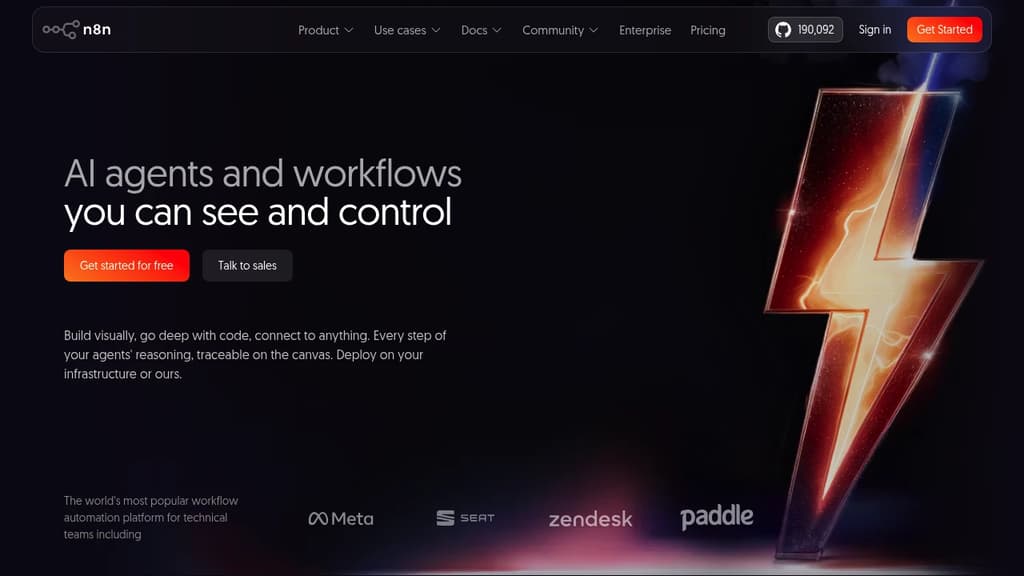
n8n is a workflow automation platform built for technical teams who find no-code tools too limiting but want something faster than building integrations from scratch. It sits in the middle: a visual canvas for building workflows, with the option to drop into JavaScript or Python at any step. That combination is what separates it from tools that force you to pick one or the other.
The platform connects to over 500 apps through pre-built nodes, with custom API support for anything not covered. Common use cases include onboarding automation, security incident enrichment, converting natural language into API calls, and generating customer insights from reviews. IT ops, SecOps, DevOps, and sales teams all show up in the documented use cases.
The AI agent capabilities are a significant part of what n8n has become. You can connect any AI model, including cloud or offline options, and build multi-agent setups and RAG systems. Every reasoning step is visible on the canvas, which matters when you need to audit what an agent actually did. Human-in-the-loop approvals can be inserted at any point, and structured inputs and outputs let you control exactly what data flows to and from AI steps.
Debugging is handled more practically than most tools. You can re-run a single step without replaying the entire workflow, mock external data to avoid waiting on third-party systems, and view logs without excessive clicking. AI workflows can be tested against real data before going to production.
Self-hosting is a first-class option. Full source code is available on GitHub, Docker deployment is supported, and the on-prem path includes SSO with SAML and LDAP, encrypted secret stores, RBAC permissions, audit logs, and Git-based version control. Teams that prefer not to manage infrastructure can use the hosted cloud version instead. If you're evaluating alternatives to n8n, options like ByteChef and Nango cover different parts of the integration and automation space.

Open-source integration platform for seamless workflow automation. Connect apps, automate tasks, and boost productivity effortlessly.
ActivePieces is a powerful, open-source integration platform that empowers users to automate their workflows without writing a single line of code. This versatile tool bridges the gap between various applications and services, enabling seamless connectivity and task automation.
Key benefits of ActivePieces include:
- No-Code Simplicity: Build complex workflows using an intuitive drag-and-drop interface, making automation accessible to users of all technical levels.
- Extensive App Integrations: Connect with popular services like Slack, Google Workspace, Trello, and many more to streamline your daily operations.
- Customizable Triggers: Set up automated actions based on specific events or schedules, ensuring your workflows respond dynamically to your needs.
- Open-Source Flexibility: Benefit from community-driven development, transparency, and the ability to self-host for complete control over your data.
- Time and Resource Savings: Eliminate repetitive tasks and reduce human error, allowing your team to focus on high-value activities.
- Scalable Solutions: Whether you're a small business or a large enterprise, ActivePieces adapts to your growing automation needs.
With ActivePieces, you can create powerful automations that sync data between apps, send notifications, update records, and much more. Its user-friendly interface and robust capabilities make it an ideal choice for businesses looking to optimize their processes and boost overall productivity.

Powerful, self-hosted platform for building and running workflows, scripts, and apps with code-first approach and collaborative features.
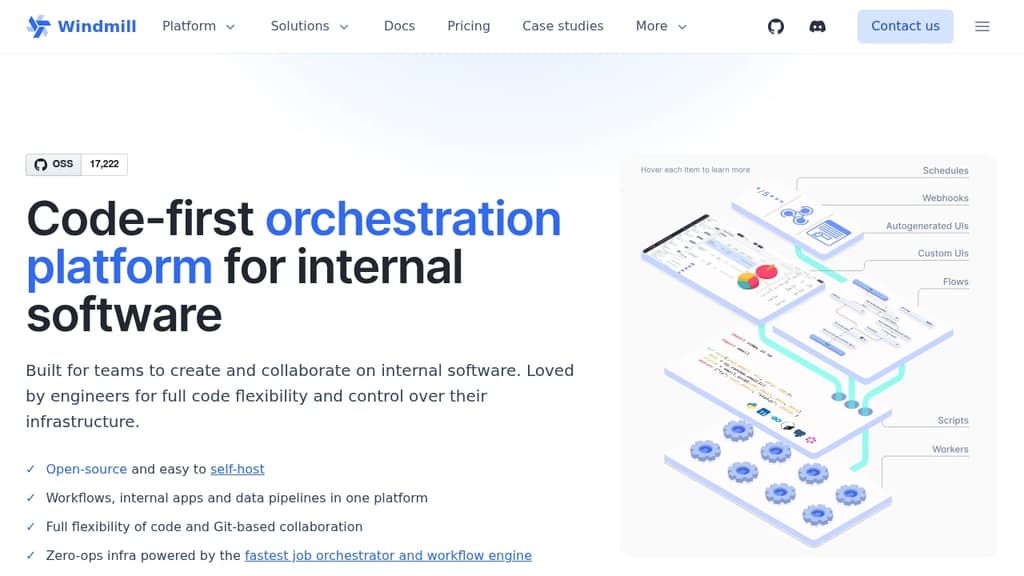
Windmill is a versatile, open-source workflow automation platform designed for developers who value flexibility and control. It offers a unique code-first approach, allowing you to create powerful workflows, scripts, and apps using your preferred programming languages.
Key benefits of Windmill include:
- Language Agnostic: Write in Python, Typescript, Go, Bash, or Deno, giving you the freedom to use the best tool for each task.
- Self-Hosted: Deploy Windmill on your own infrastructure, ensuring data privacy and compliance with your organization's security requirements.
- Collaborative Features: Work seamlessly with your team using built-in version control, approvals, and sharing capabilities.
- Resource Management: Easily manage credentials, environment variables, and resources across your workflows.
- Flexible Triggers: Schedule jobs, respond to webhooks, or integrate with external services to automate your processes.
- Visual Flow Editor: Combine scripts visually to create complex workflows, making it easy to understand and modify your automation.
- Extensible: Build custom apps and internal tools on top of your workflows, leveraging Windmill's powerful API and SDK.
Whether you're automating DevOps tasks, creating data pipelines, or building internal tools, Windmill provides the flexibility and power you need to streamline your development processes and boost productivity.

Open source TypeScript platform for building and deploying AI agents and background workflows with retries, queues, observability, and elastic scaling.
Trigger.dev is a managed platform for running long-running TypeScript tasks in production. It handles the infrastructure so you can write straightforward async code without worrying about timeouts, server provisioning, or queue management.
The core use case is AI workflows and agents. You define tasks that can call LLMs, use tools, process files, or chain multiple steps together. Tasks run with automatic retries, configurable backoff, and full execution logs. If something fails, you can replay individual runs from the dashboard.
Beyond AI, it covers scheduled jobs, media processing, browser automation, email sequences, and ETL pipelines. You can run Python scripts alongside your TypeScript code, add system packages, use FFmpeg for video tasks, or automate browsers with Puppeteer.
Realtime lets you stream task status and LLM responses directly to your frontend as tasks progress, without polling. If you want tracing and observability across LLM calls specifically, tools like OpenLIT or OpenLLMetry cover that layer.
Every run is logged with its inputs, outputs, attempt history, and timing. You can filter runs, apply bulk actions, and set up alerts via email, Slack, or webhooks when tasks fail. Each deploy is versioned atomically, so in-flight tasks aren't disrupted by new code.
Pricing is usage-based. You only pay for actual execution time. It's also Apache 2.0 licensed and self-hostable if you prefer to run it on your own infrastructure. For teams comparing workflow orchestration options, Temporal is a common alternative with a different approach to durability and state.

Open-source ETL framework built in Rust for AI workloads. Features incremental processing, data lineage, and observability tools for semantic search and RAG applications.
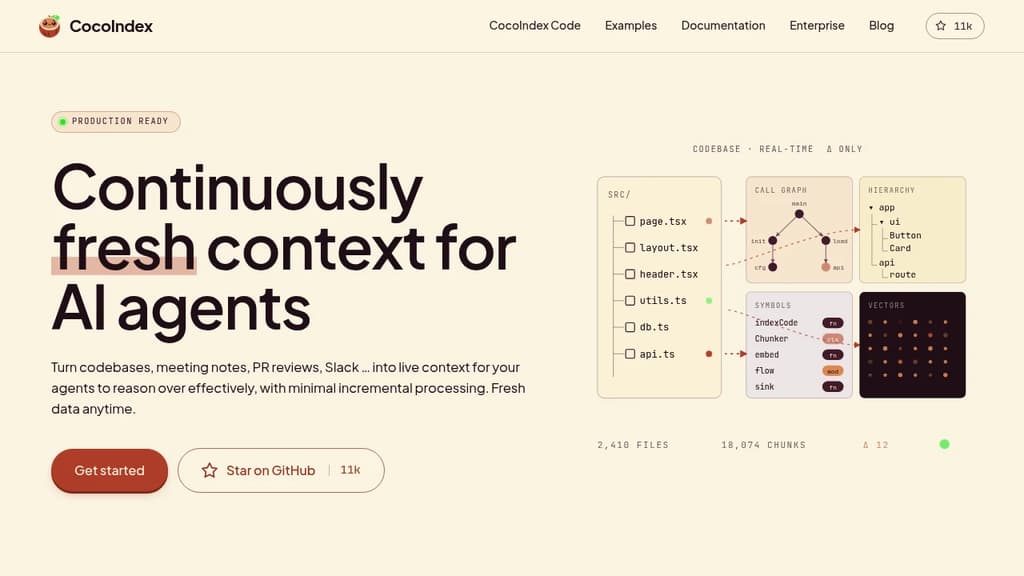
Transform your data for AI workloads with exceptional performance and developer velocity. CocoIndex is an open-source ETL framework with a Rust-powered core engine, designed specifically for modern AI applications including semantic search, RAG, and knowledge graphs.
Key advantages:
- Minimal code required - Get started with just ~100 lines of Python using declarative dataflow syntax
- Incremental processing - Automatic recomputation optimization that only processes necessary portions while reusing cached results
- Native building blocks - Standardized interfaces for sources, targets, and transformations with 1-line component switching
- Single source of truth - Define once, run in multiple modes: batch, live updates, or fast preview runs
CocoInsight companion tool provides best-in-class data lineage and observability, helping you understand your pipeline step-by-step without requiring deep data expertise. This significantly boosts developer velocity and lowers barriers to data engineering.
Production-ready from day zero with automatic schema management, cloud-native architecture, and enterprise features including VPC deployments, guaranteed SLA, and data governance. Available as open-source (Apache 2.0) for self-hosting, with free personal use options and enterprise support tiers.

Complete integrations platform with 500+ pre-built APIs, code-first approach, unified data models, and enterprise-grade security. Free tier available.
Build product integrations faster with a comprehensive platform that connects your application to 500+ popular APIs. Nango provides a code-first approach that gives you full control while abstracting away API complexities.
Key features include:
- Pre-built integrations for hundreds of popular use cases
- Unified API interface with your own data models
- Authorization handling for all auth types and API quirks
- Two-way data sync to keep apps and APIs synchronized
- Real-time webhooks processing at scale
- UI components for seamless integration experiences
Developer-friendly tools like API-specific pagination, rate limiting, customer-specific configurations, and an AI co-pilot trained on hundreds of integrations. The platform offers enterprise-grade security with SOC 2 Type II compliance, GDPR compliance, data encryption, and granular permissions control.
Scalable infrastructure includes real-time observability, durable execution with automatic retries, invalid credential detection, and comprehensive testing frameworks. Available as open-source with self-hosting options, plus managed cloud service with free tier.

Self-hosted automation tool that connects your apps and services, enabling powerful integrations and efficient data flow across your ecosystem.
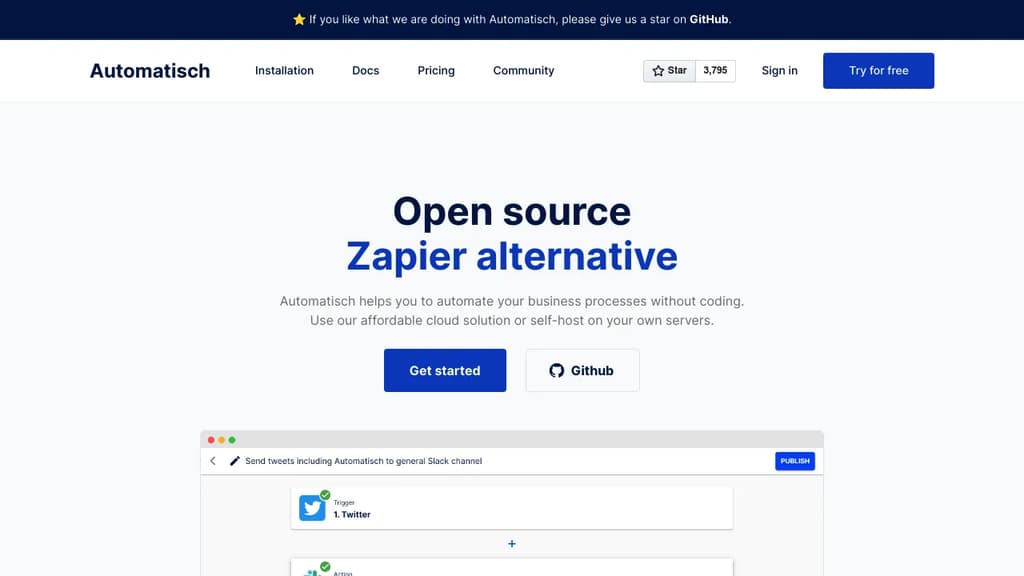
Automatisch is a robust, open-source integration platform that revolutionizes the way you connect and automate your digital tools. By providing a self-hosted solution, it puts you in control of your data and workflows, ensuring maximum privacy and customization.
Key benefits of Automatisch include:
- Seamless Integration: Connect hundreds of apps and services effortlessly, creating powerful automations that streamline your processes.
- Data Sovereignty: Host Automatisch on your own infrastructure, maintaining full control over your sensitive information and complying with data regulations.
- Extensibility: Leverage the open-source nature to add custom integrations and tailor the platform to your specific needs.
- User-Friendly Interface: Design complex workflows with an intuitive, drag-and-drop interface, making automation accessible to both technical and non-technical users.
- Cost-Effective: Eliminate subscription fees for multiple integration tools by using a single, self-hosted solution.
- Community-Driven: Benefit from continuous improvements and updates driven by a passionate community of developers and users.
Whether you're a small business owner, a developer, or an enterprise IT manager, Automatisch provides the flexibility and power to create efficient, automated workflows that save time and reduce errors across your organization.

Durable orchestration platform for managing AI agents, scheduling background tasks, and running mission-critical workflows.
Hatchet is a durable orchestration platform that helps engineering teams build and deploy mission-critical AI agents, durable workflows, and background tasks. It supports applications written in Python, Typescript, Go and Ruby, and can be used as a service through Hatchet Cloud or self-hosting (it's open-source and 100% MIT-licensed). Hatchet provides a full platform for queuing, automatic retries, real-time monitoring, alerting, and logging.
While Hatchet is particularly well-suited for:
- AI agents - Hatchet’s durability features allow agents to automatically checkpoint their current state and pick up where they left off when faced with unexpected errors. Hatchet’s observability features and distributed-first approach are built for debugging long-running agents at scale.
- Massive parallelization - Hatchet is built to handle millions of parallel task executions without overloading your workers. Worker-level slot control allows your workers to only accept the amount of work they can handle, while features like fairness and priorities are built to help scale massively parallel ingestion.
- Mission-critical workloads - everything in Hatchet is durable by default. This means that every task, DAG, event or agent invocation is stored in a durable event log and ready to be replayed at some point in the future.
Whether you're a small startup or a large enterprise, Hatchet provides the tools and flexibility needed to accelerate your development cycles, improve code quality, and maintain robust, scalable cloud infrastructure.

Platform for connecting AI agents to 500+ tools with built-in multi-tenant auth management and granular permissions using either function calling or a unified MCP server

ACI.dev is a powerful platform that enables developers to build production-ready AI agents with seamless tool integrations. The platform provides 500+ pre-built integrations with essential tools like Gmail, Hubspot, Notion, and Slack through either function calling or a unified MCP server connection.
Key capabilities include:
- Multi-tenant authentication and OAuth management
- Natural language-based granular permissions
- Secure agent secrets management
- Dynamic workflow discovery
- Built-in authorization flows for end-users
The platform handles all the complexity of token management, OAuth setup, and permissions, allowing developers to focus on building reliable AI agents that can interact with various tools and services securely.

Add customer-facing webhooks to your product without building the infrastructure. Handles retries, signatures, multi-tenancy, filtering, and monitoring at scale.
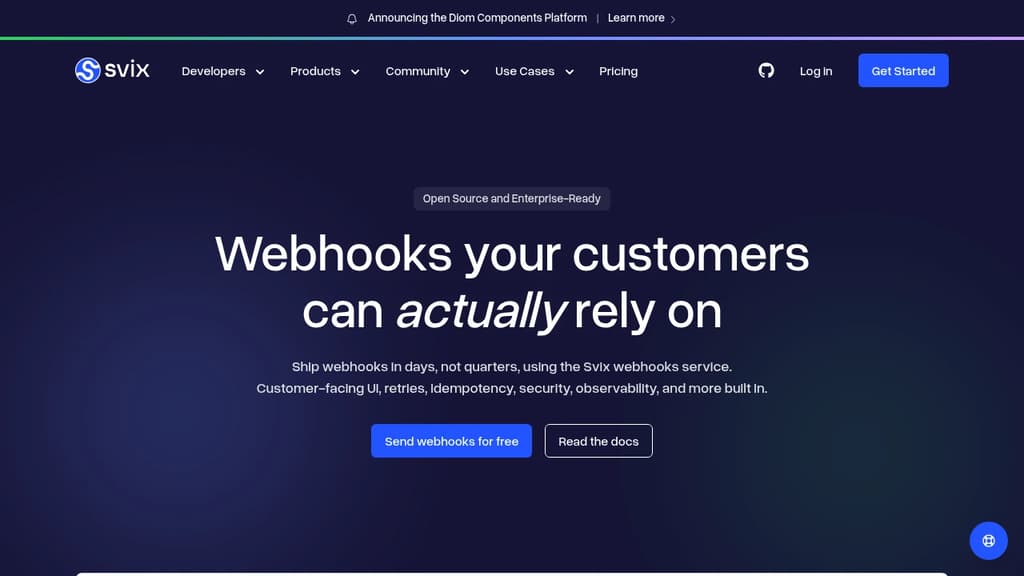
Svix is a webhook platform built for teams that need to offer webhooks to their own customers. Instead of spending months building retry logic, signature verification, and a management UI, you integrate Svix and get all of that out of the box. It's self-hostable via the open source server, or available as a managed cloud service.
The core problem it solves: customer endpoints fail. A lot. Svix handles automatic retries with backoff, logs every attempt, and lets you or your customers replay failed deliveries manually. You can monitor deliverability per endpoint, disable consistently failing ones, and alert customers before they notice something's wrong.
Key capabilities:
- Multi-tenancy isolates endpoints, logs, and configuration per customer from a single deployment, so you're not building tenant separation yourself
- Signed payloads with secret rotation protect against SSRF, replay attacks, and forged events
- Event filtering lets each endpoint subscribe only to the event types it cares about
- Embeddable portal gives your users a white-labeled UI to manage their own endpoints, inspect logs, and replay events without contacting support
- Payload transformations reshape or enrich messages in-flight before delivery
- Advanced delivery modes include polling, FIFO-ordered delivery, and streaming directly into S3, Azure Blob, GCS, and EventBridge
- Multi-region delivery routes from the region closest to each customer for data residency compliance
- Throttling rate-limits delivery per endpoint to protect slow consumers
Svix is SOC 2 Type II, HIPAA, GDPR, and CCPA compliant, which matters when selling to enterprise customers who'll ask about it.
It's a good fit for API platforms, SaaS products adding event notifications, or any team that's found webhook infrastructure eating engineering time. Tools like Inngest handle event-driven workflows internally; Svix is specifically about delivering webhooks to external customer endpoints reliably and at scale. Hook0 is a closer open source alternative if you want something fully self-managed.

Self-hosted webhook solution for effortless event-driven communication between applications, enhancing system interoperability and automation.
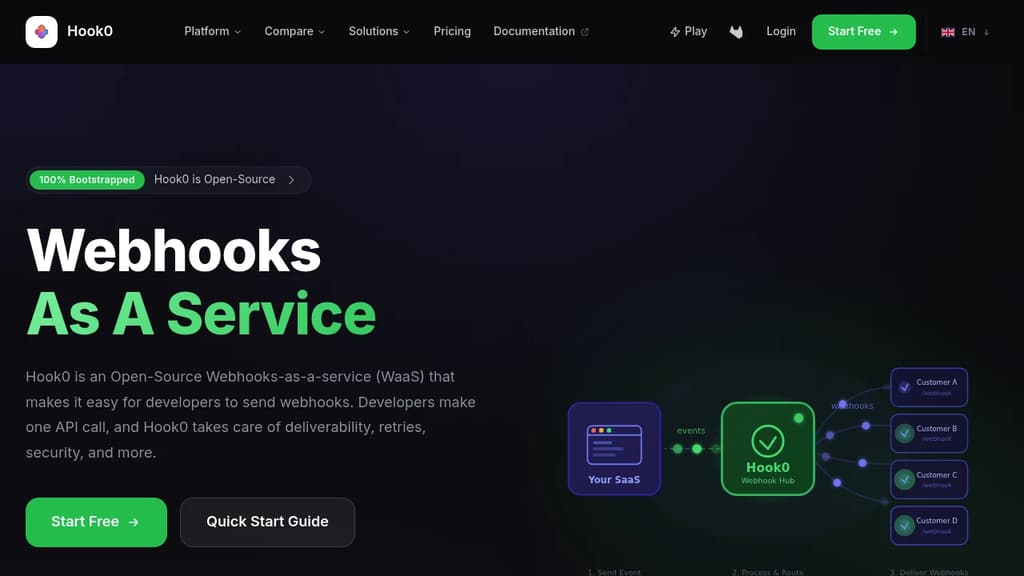
Hook0 is a powerful, open-source webhook management system designed to simplify and enhance communication between applications. By providing a robust infrastructure for event-driven integrations, Hook0 enables developers to create more responsive and interconnected software ecosystems.
Key benefits of Hook0 include:
-
Self-hosted control: Maintain full ownership of your data and infrastructure by hosting Hook0 on your own servers, ensuring privacy and compliance with data regulations.
-
Flexible integration: Easily connect various applications and services, allowing for real-time data exchange and automated workflows across your entire tech stack.
-
Scalable architecture: Built to handle high volumes of webhook events, Hook0 grows with your needs, from small projects to enterprise-level deployments.
-
Reliable delivery: Implement retry mechanisms and queue management to ensure that all webhook events are processed, even in case of temporary failures or downtime.
-
Comprehensive monitoring: Gain insights into your webhook traffic with detailed logs and analytics, helping you optimize performance and troubleshoot issues quickly.
-
Developer-friendly: With clear documentation and intuitive APIs, Hook0 makes it easy for developers to implement and manage webhooks in their applications.
-
Customizable security: Implement robust authentication and encryption measures to protect your webhook endpoints and ensure the integrity of your data.
By leveraging Hook0, development teams can focus on building core features while relying on a dependable webhook infrastructure to handle inter-application communication efficiently.

People are looking for alternatives to...
View all alternatives
Spotify

Claude Code

Claude

CapCut

Notion

Lovable
 c15t – Open-source cookie banner, built for control and lightening fast modern web apps.

 Capture